A phone call comes after the crash. The police want identification. The hospital has questions about medical records. An insurance adjuster may already be asking whether the family has considered a settlement. Meanwhile, you're trying to arrange a funeral, explain the loss to children, and understand how the household will survive without the person who earned income, provided care, or held everyone together.
A wrongful death lawsuit after a car accident can't undo that loss. It can, however, create a legal path toward accountability and financial support. The process depends on state law, evidence, deadlines, and the specific conduct that caused the collision. The most important early step is protecting the facts before vehicles are repaired, electronic data disappears, or witnesses' memories fade.
What Is a Wrongful Death Lawsuit After a Car Accident
Maya's husband died after another driver crossed the center line. The police investigated the crash, and prosecutors considered whether the surviving driver should face criminal charges. Maya's family then faced a separate question: could they bring a civil claim for the financial and emotional harm caused by the death?
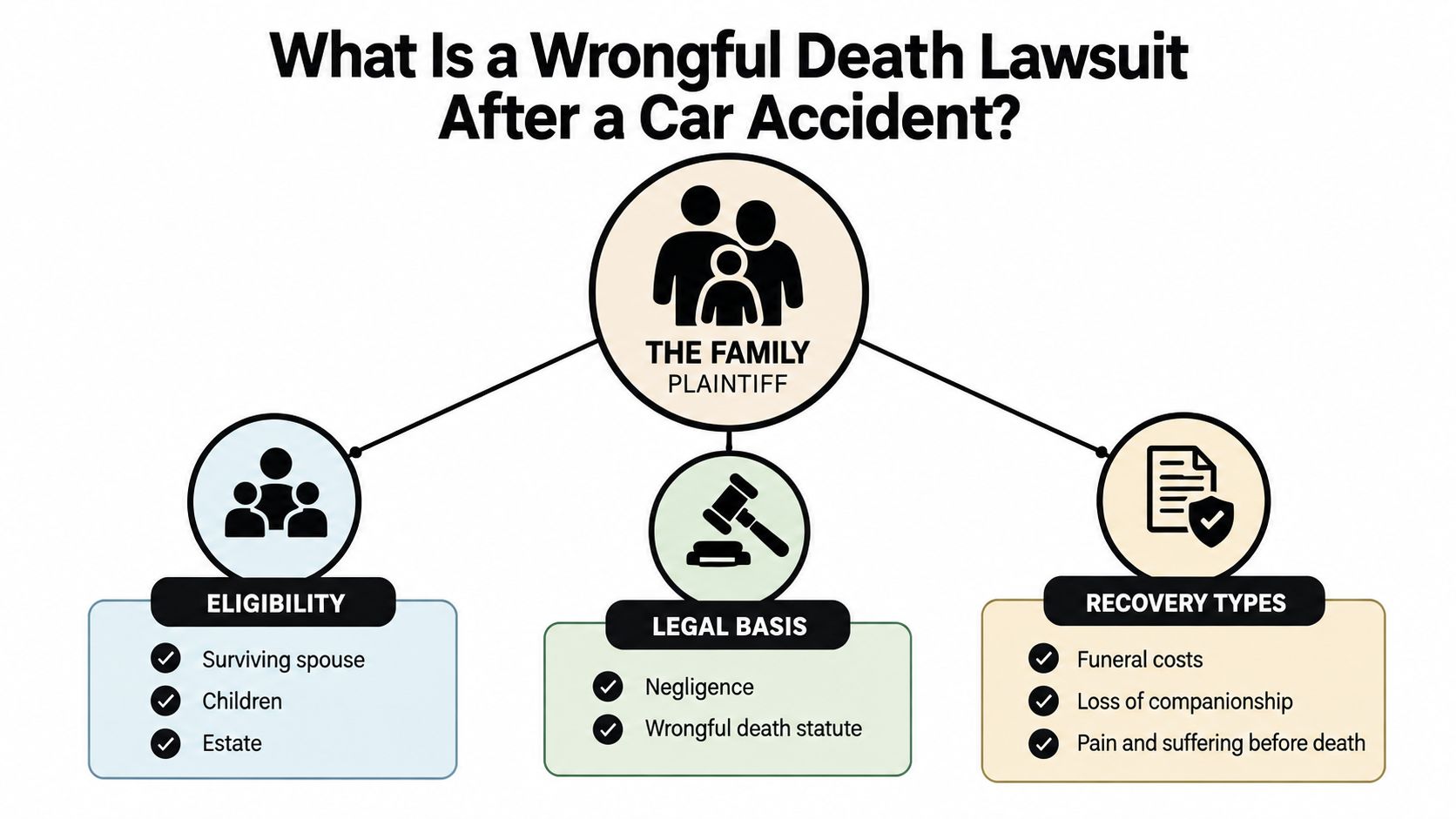
A wrongful death lawsuit is a civil action brought by legally authorized survivors, or sometimes an estate representative, when another person's wrongful conduct causes a death. In a car accident, the legal theory may involve negligent driving, impairment, speeding, distraction, unsafe vehicle maintenance, an unsafe roadway, or the conduct of an employer or vehicle manufacturer. The family generally must connect the defendant's conduct to the death and prove the losses recognized by the applicable wrongful-death statute.
That civil claim is separate from a criminal prosecution or traffic citation. The World Health Organization reports that approximately 1.19 million people die in road traffic crashes every year worldwide, and that the annual total had fallen by about 5% since 2010, although progress remains insufficient to meet the international goal for reducing road deaths by 2030. Those figures show the scale of the public-safety problem, but they don't establish who was legally responsible for an individual collision. (World Health Organization road-safety report)
Who may bring the claim
The answer depends on the state where the claim is filed. Commonly eligible people include:
- Surviving spouses, who may claim losses involving financial support, companionship, and household contributions.
- Children, who may have claims for lost parental care, guidance, support, and companionship.
- Parents, particularly when the deceased was an unmarried child or when state law provides parents with a statutory right.
- An estate representative, who may bring the lawsuit for the benefit of designated survivors or the estate, depending on the statute.
Some states permit only one wrongful-death lawsuit for all eligible survivors. Others establish an order of priority or require the claim to be brought by a personal representative. Don't assume that the person who handles funeral arrangements is automatically the person authorized to file.
A wrongful-death claim also differs from a survival claim. A wrongful-death action seeks losses suffered by survivors because of the death. A survival action, where permitted, may address claims the deceased person could have brought before death, such as conscious pain and suffering or medical expenses incurred before the person died. The two claims can arise from the same crash but follow different rules.
For a plain-language overview of the legal basis and potential claimants, families can review this explanation of a wrongful death claim. The practical point is simple: a ticket, arrest, or criminal conviction may provide useful evidence, but it doesn't automatically create a civil recovery. The civil case still requires proof suited to the statute and the family's losses.
Understanding Recoverable Damages in Fatal Crash Claims
Funeral expenses are only the most visible part of the financial harm after a fatal crash. A careful claim examines what the deceased contributed to the household, what survivors lost emotionally, and what the law permits them to recover.
Colorado law recognizes economic losses such as funeral, burial, interment, or cremation expenses and the net financial loss survivors reasonably would have expected from the deceased. It also recognizes noneconomic harm, including grief, loss of companionship, pain and suffering, and emotional stress. (Colorado wrongful-death case discussion)
Economic and noneconomic losses
An economist may analyze employment records, tax returns, benefits, work-life expectancy, expected wage growth, personal-consumption deductions, and the value of household services. The analysis isn't a projection of every paycheck the person might have received. It attempts to estimate the financial contribution that would reasonably have reached the surviving family after considering personal expenses and other relevant assumptions.
For example, a parent may have contributed income, childcare, transportation, cooking, home maintenance, and assistance with school responsibilities. A spouse may have provided unpaid services that the family would now need to replace. Payroll records help establish earnings, while family testimony, calendars, business records, and household routines can help show the value of non-wage contributions.
Noneconomic damages are different. Grief and loss of companionship don't come with invoices. Evidence may include the relationship between the deceased and each survivor, shared activities, caregiving, guidance, emotional support, and the circumstances of the death. The claim should describe the actual relationship rather than rely on a generic statement that the family is sad.
| Damage Category | What It Covers | Typical Evidence Needed |
|---|---|---|
| Economic losses | Funeral and final-disposition expenses, lost financial support, and the deceased's expected net financial contribution | Invoices, tax returns, payroll records, benefit statements, employment history, economist analysis |
| Household services | Unpaid care, transportation, home maintenance, childcare, and other practical contributions | Family testimony, schedules, school records, household records, service-cost evidence |
| Noneconomic harm | Grief, loss of companionship, emotional stress, and related relational losses | Family testimony, photographs, correspondence, personal records, witness testimony |
| Pre-death losses | Medical expenses and pain and suffering before death, when recognized through a survival claim or applicable statute | Medical records, bills, emergency-care records, autopsy materials |
Colorado's solatium election
Colorado provides an alternative solatium election for eligible claimants. A claimant may elect in writing to recover a statutory amount instead of individually proving noneconomic damages, while retaining economic losses and reasonable final-disposition expenses. The cited Colorado materials list $50,000, with judicial materials indicating periodic inflation adjustment. (Colorado Supreme Court materials on wrongful-death damages)
That election can offer certainty and reduce the need for detailed proof of grief and relational harm. It may also limit the opportunity to present individualized evidence showing the depth of a particular loss. Families should compare the election with the projected financial-loss evidence before choosing it. A written election is a legal decision, not a routine administrative form.
A useful next step is reviewing how damages are evaluated in a wrongful-death claim. Preserve tax filings, payroll information, benefit records, retirement documents, business records, funeral invoices, and evidence of household services early. Those documents can become difficult to locate when relatives are grieving and employers or institutions change their record-retention practices.
The Claims Process From Investigation Through Resolution
A fatal-crash claim usually develops through several decision points rather than one dramatic filing. The family may first need to identify the legally authorized claimant, preserve evidence, and understand insurance coverage before anyone can value the case responsibly.
The United States recorded 40,901 traffic fatalities in 2023, compared with 42,721 deaths in 2022, according to the National Highway Traffic Safety Administration. The agency also estimated 6,138,359 police-reported crashes and 2,442,581 nonfatal injuries in 2023. (NHTSA 2023 traffic-fatality data) These national figures provide context, not proof of liability in a particular case.
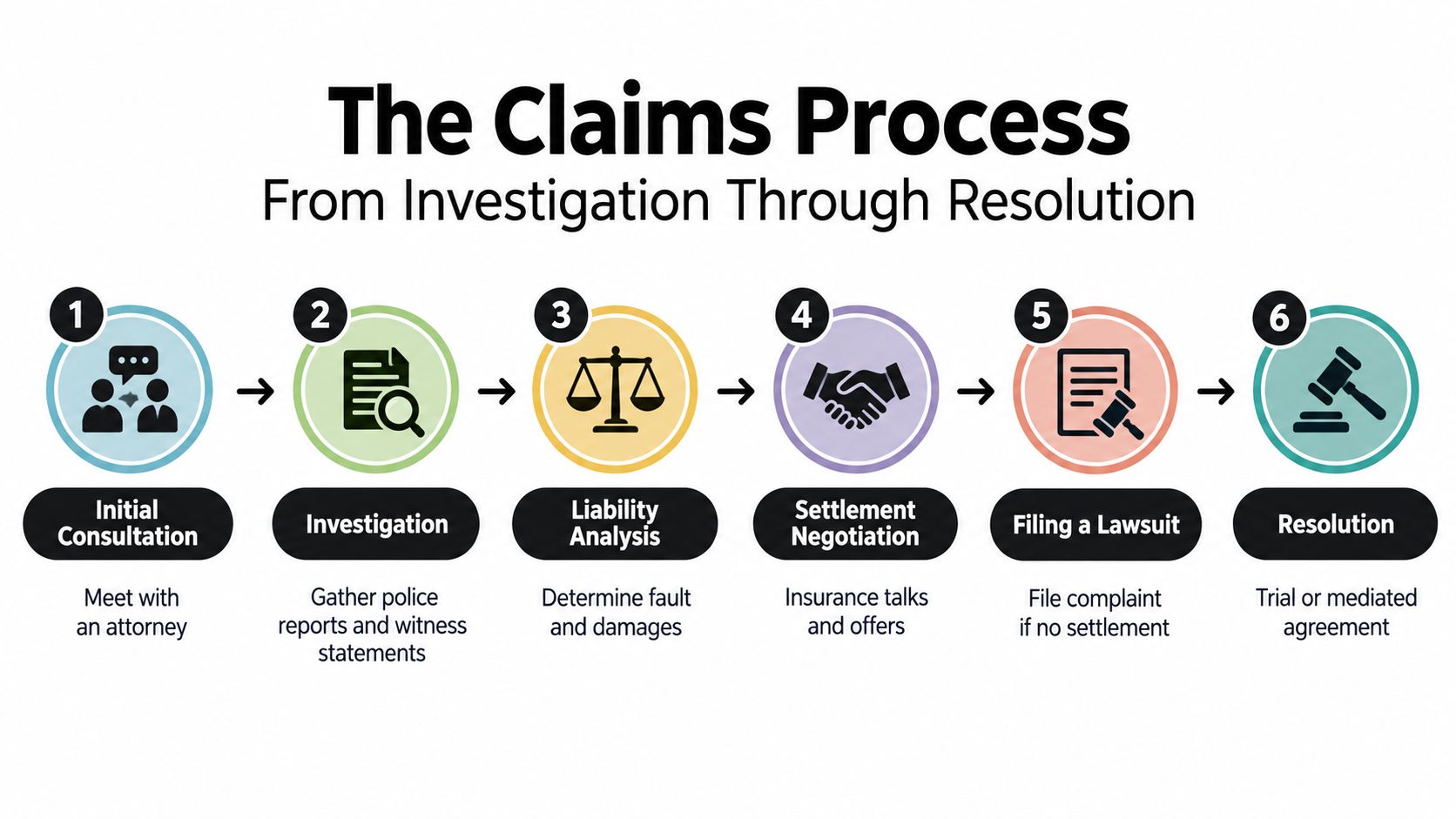
Six stages families commonly encounter
Initial consultation. The family gives counsel the crash location, date, identities of the vehicles and drivers, insurance information, police details, medical records, and any photographs or video. Counsel identifies conflicts, possible defendants, deadlines, and immediate preservation needs.
Investigation. Investigators seek the police report, scene measurements, photographs, witness accounts, vehicle information, surveillance footage, medical records, and insurance coverage. They may inspect the vehicles before repairs or salvage work changes the physical evidence.
Liability and damages analysis. The legal team tests competing explanations. Was the driver impaired, distracted, or speeding? Did a mechanical failure contribute? Did a commercial employer, manufacturer, or governmental entity play a role? At the same time, the team builds the financial and relational damages model.
Settlement discussions. An insurer may request a recorded statement or propose an early settlement. Families shouldn't evaluate an offer only by comparing it with funeral bills. A release may affect claims against other defendants and may prevent later recovery if evidence or damages become clearer.
Lawsuit filing. If negotiations don't resolve the matter, the authorized plaintiff files a complaint before the applicable deadline. The defendants respond, exchange documents, question witnesses, and may retain their own experts.
Resolution. The case may end through negotiation, mediation, or trial. The family generally retains decision-making authority about settlement, while counsel explains the legal risks, evidence, likely defenses, and distribution issues.
Deadlines control the strategy
Every state has filing deadlines, and special rules may apply when a government entity, public roadway, employer, or estate is involved. A deadline can expire while the family is still waiting for a police investigation or medical documentation. Counsel should identify the governing deadlines at the first consultation instead of treating them as a final-stage concern.
This embedded video offers another general explanation of the process:
The process isn't fast, but it should have a reasoned sequence. A family should know what evidence is being pursued, which legal theories are being tested, how damages are calculated, and what decision requires the family's approval.
How Evidence Is Gathered and Preserved in Fatal Crash Cases
A police report may say that one vehicle crossed a lane line. That statement can be important, but it rarely answers every question in a wrongful-death case. The stronger analysis connects the roadway, vehicles, people, technology, and medical evidence into one time-sequenced explanation.
A reconstructionist may examine perception, distraction, visibility, reaction opportunity, braking, steering, impact energy, occupant movement, and fatal injury. The expert should also test alternative explanations, including a medical event, preexisting disease, vehicle defects, roadway design, poor visibility, or a post-impact medical complication. Precision unsupported by measurements can damage credibility, so a careful reconstruction identifies uncertainty in friction estimates, camera frame rates, crush-energy assumptions, and event-data limitations.
The evidence families often overlook
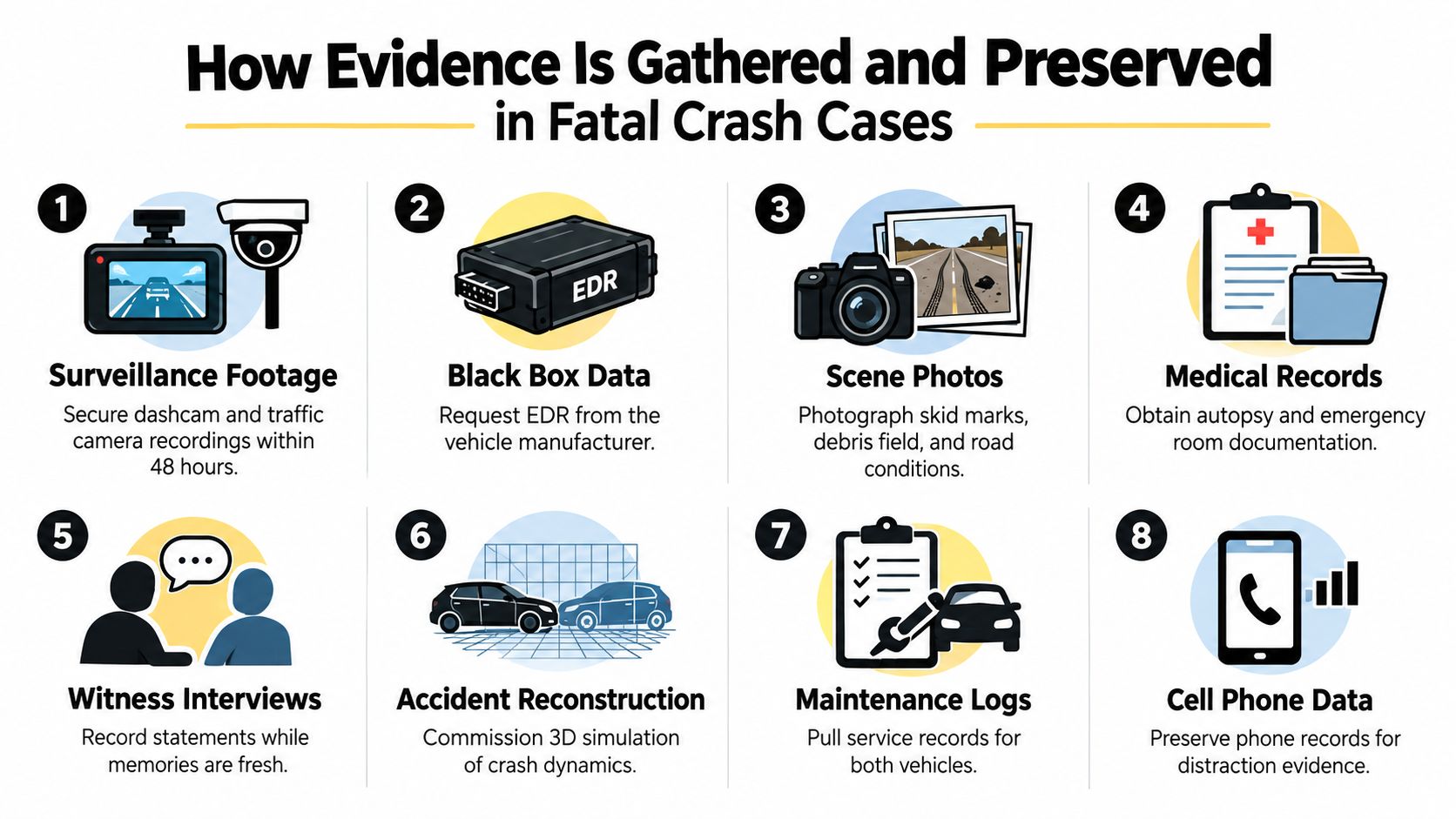
Event-data recorder information. A vehicle's EDR may contain information about speed, braking, seat-belt use, or impact conditions, when the system recorded and retained the relevant data. It isn't automatically a complete record of everything the driver did.
Telematics and driver-assistance records. Connected vehicles may generate data involving lane guidance, braking interventions, warnings, system engagement, or vehicle location. Interpretation depends on the system's design and the available records.
Phone and communications evidence. Call records, messages, application activity, and carrier information may help investigate distraction, subject to privacy rules and legal process.
Video. Dash cameras, traffic cameras, business surveillance, residential security systems, and nearby vehicles may capture only a short window. A recording can be overwritten or discarded before the family knows it exists.
Commercial-driver records. A commercial vehicle may generate dispatch records, electronic logging data, maintenance records, inspection records, and employer communications. These records can matter when fatigue, scheduling, maintenance, or training is disputed.
Medical and injury evidence. Emergency records, autopsy materials, photographs, and biomechanics may help connect collision forces to the death and distinguish the crash mechanism from other possible causes.
Practical rule: Identify every vehicle owner, insurer, employer, manufacturer, fleet operator, camera custodian, and electronic-data custodian as early as possible.
Preservation is an immediate legal task
Vehicles are repaired, totaled, downloaded, sold, or altered. Data may be overwritten, deleted, or produced only in a limited format. A preservation letter can instruct a company, insurer, employer, or manufacturer to retain relevant vehicles, EDR data, telematics, phone-related records, maintenance materials, warning information, software records, and internal communications.
Families should photograph vehicles before repair or salvage when it is safe and lawful to do so. They should keep the original photographs and videos, avoid editing files, record who supplied each item, and provide counsel with the names of witnesses while memories remain fresh.
A recent autonomous-driving dispute reportedly involved testimony about deleted crash data and disagreement over system warnings and roadway suitability. That development illustrates why “black box” evidence isn't automatically decisive. Its meaning depends on chain of custody, system limitations, collection methods, and competing expert interpretations. Families seeking a practical explanation of legal consequences can review spoliation of evidence, especially when a vehicle or electronic record may no longer be available.
When the Deceased Was Partially At Fault What It Means for Your Claim
A family may hear that the deceased was speeding, failed to see a hazard, or trusted a driver-assistance system. The immediate reaction is often, “Then there is no case.” That conclusion is frequently too simple.
Comparative-fault rules generally ask how responsibility should be allocated among the people and entities whose conduct contributed to the crash. Depending on the jurisdiction, a deceased person's share of fault may reduce the recoverable damages, or a statutory threshold may restrict recovery when the assigned share reaches a specified level. The governing rule varies, so the family shouldn't rely on a general internet explanation to predict the outcome.
For example, if evidence shows that another driver caused the collision but the deceased also made a contributing driving error, the defense may argue for a percentage allocation. The family's lawyer must test whether that alleged error contributed to the impact, whether the other driver had a later opportunity to avoid it, and whether a vehicle defect, roadway condition, employer practice, or technology failure also played a role.
Human and technology responsibility can overlap
Driver-assistance cases add another layer. Investigators may need to determine what the driver did, what the system was designed to do, what warnings appeared, whether the driver could understand the limitations, and whether the manufacturer or fleet operator knew about a recurring risk. A defense focused on driver error doesn't eliminate the need to examine product design, warnings, marketing, maintenance, or system performance.
A 2025 Florida federal Tesla case illustrates this issue, but it shouldn't be treated as settled law or as a prediction for Colorado, Texas, New York, or any other jurisdiction. The jury assigned 67% fault to the driver and 33% to Tesla, and awarded $329 million, including $200 million in punitive damages. Tesla later challenged the result. (CNBC report on the Tesla appeal)
The case is useful as an example of apportionment, not as an automatic rule. Settling with one defendant may also affect claims against other defendants, depending on the jurisdiction and settlement documents. Before signing a release, the family should understand whether it preserves claims involving another driver, an employer, a manufacturer, or a roadway entity.
Partial responsibility is a defense to investigate and quantify. It isn't automatically a reason to abandon the claim.
Why Experienced Legal Counsel Matters in Wrongful Death Cases
A straightforward crash with clear liability and limited factual dispute may require less litigation support than a collision involving several vehicles, a commercial fleet, disputed medical causation, or electronic vehicle systems. Fatal cases often become difficult because the legal claim, technical reconstruction, damages calculation, and family structure must all fit together.
Experienced counsel can coordinate the work without asking grieving relatives to become investigators. That may include:
- Preserving physical evidence: Arranging vehicle inspections and preservation demands before repairs, salvage, or data loss.
- Testing causation: Working with reconstructionists, biomechanics professionals, medical specialists, and vehicle experts.
- Calculating losses: Using employment records, tax information, benefits, household-service evidence, and economist analysis.
- Managing insurers: Handling recorded statements, coverage questions, releases, and settlement proposals.
- Preparing for court: Identifying legally authorized claimants, filing within the applicable deadline, conducting discovery, and presenting evidence if negotiation fails.
Self-representation may seem reasonable when the facts appear obvious. The risks increase when an insurer disputes fault, the deceased may be assigned comparative fault, multiple policies apply, or a settlement offer arrives before the full damages picture is developed. An early consultation doesn't require a family to file a lawsuit. It gives the family a chance to understand deadlines, evidence risks, and available options.
Families should ask who will handle the case, whether the lawyer has access to reconstruction and economic experts, how communication works, what potential defendants will be investigated, and how expenses are handled. They should also ask whether the firm has experience with the state's wrongful-death statute and with the specific type of crash involved.
Legal teams may need to organize large collections of medical records, photographs, witness materials, and case documents. Families and lawyers looking for document-management support can also review PDFWix tools for legal docs, while remembering that software doesn't replace legal judgment, evidence authentication, or advice about filing deadlines.
Moving Forward With Purpose and Clarity
A wrongful-death lawsuit begins with a devastating fact, but it doesn't have to remain an undefined legal mystery. The right claimant must be identified, the applicable statute and deadline must be confirmed, damages must be documented, and the evidence must be preserved before it disappears.
Families also deserve an honest assessment of difficult issues. The deceased may have shared responsibility. A criminal case may not produce civil compensation. A vehicle's electronic data may help one side and hurt the other. None of those facts can be evaluated responsibly without examining the complete record.
Pursuing a claim can support financial stability, demand accountability, and sometimes expose conduct that could endanger others. It won't erase grief or guarantee a particular result. It can give a family a structured way to protect its rights while honoring the person who died.
Nares Law Group LLC handles wrongful-death claims arising from fatal motor-vehicle crashes, including investigation, evidence preservation, damages analysis, negotiation, and trial preparation. If your family is considering a claim, visit Nares Law Group LLC to request a consultation and discuss the crash, the available evidence, and the deadlines that may affect your rights.