You're staring at an insurance offer that feels disconnected from what happened to you. Your medical bills are still arriving, your paycheck has taken a hit, and the adjuster wants a quick signature before you know whether your recovery is complete. The number may look substantial at first glance, but a settlement is only fair if it accounts for the full scope of your losses and the practical limits on recovery.
There's no universal calculator that can turn an injury label into a reliable dollar amount. To understand how to calculate a personal injury settlement, you need to separate financial losses from human consequences, then test the result against fault, insurance coverage, medical proof, and the quality of your negotiation.
Why Settlement Numbers Vary So Much
Two drivers are involved in similar rear-end collisions. Both report neck and back pain. Both attend physical therapy. One accepts an offer of $8,000 after a short treatment period and a treatment gap. The other negotiates a $120,000 settlement after diagnostic imaging, consistent medical care, documented wage loss, and evidence showing that the other driver clearly caused the crash.
The injury label didn't decide the result. The surrounding proof did.
The first driver's records may leave the insurer with arguments about whether the symptoms came from the crash, whether treatment was necessary, and whether the injury had resolved. The second driver's file may show a clear accident report, prompt treatment, objective findings, physician restrictions, employer documentation, and a credible explanation of how daily life changed. Those details give an adjuster less room to discount the claim.
The numbers are benchmarks, not promises
A dataset summarized in consumer-facing personal injury settlement reporting included 2,834 cases with awards or settlements from 2003 to 2022. The report stated that about 70% of plaintiffs received $25,000 or more, roughly 24% received between $3,000 and $25,000, and about 6% received less than $3,000. It also reported an overall average payout of $52,900 and stated that 58% of readers who obtained compensation received between $3,000 and $25,000.
Those figures describe a broad collection of outcomes, not the value of your particular claim. An average can be pulled upward by severe injuries, large wage losses, or cases with unusually strong coverage. A headline verdict can be even less useful because a verdict may be reduced, appealed, limited by law, or never collected in full.
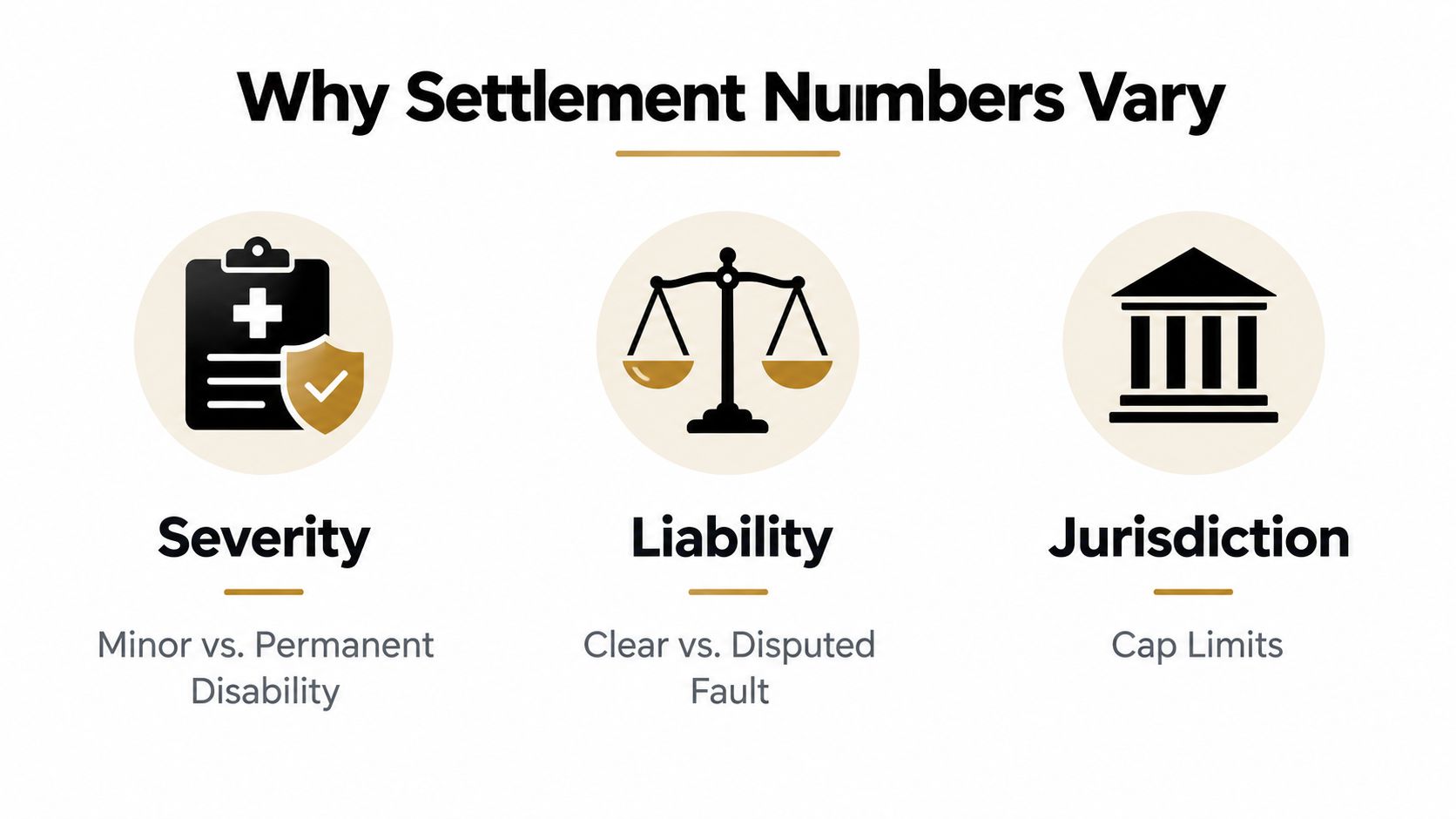
Four questions shape practical value
When reviewing a claim, focus on questions that an insurer, defense lawyer, and jury will ask:
- What happened medically? A short-lived strain is valued differently from chronic pain, permanent impairment, or a need for future care.
- Who caused the accident? Clear liability strengthens negotiations. Disputed fault creates a discount even when the injury is serious.
- What can the records prove? Bills, imaging, wage records, photographs, witness accounts, and consistent treatment make the demand easier to defend.
- What insurance is available? A claim can be worth more on paper than the coverage available to pay it.
A realistic calculation therefore has two parts. First, estimate the damages supported by the evidence. Second, determine how fault, coverage, and proof affect the amount you can recover. Skipping the second part is how people confuse theoretical case value with a realistic settlement target.
Identifying Every Compensable Damage
Start with an inventory, not a multiplier. The first task is to identify every loss caused by the injury and connect each loss to a document, witness, medical opinion, or other reliable proof.
Economic damages are the measurable financial losses. They can include past medical bills, expected future treatment, lost wages, and diminished earning capacity. Property damage may also belong in the claim when the accident damaged a vehicle or other property, although the handling of that loss can differ from the bodily injury portion.
Build the economic side carefully
Collect records in chronological order and separate amounts that have already been incurred from amounts you may incur later.
- Medical treatment: Gather bills, treatment notes, prescriptions, therapy records, diagnostic reports, and information about recommended follow-up care.
- Lost wages: Preserve pay records, employer statements, timekeeping information, and documentation showing the dates and nature of missed work.
- Future earning loss: If the injury affects the work you can perform, identify restrictions, career changes, reduced hours, or the need for retraining.
- Future care: Ask the treating provider to explain anticipated treatment rather than relying on a general statement that care “may” be needed.
- Property damage: Keep repair estimates, invoices, photographs, and records showing whether the property was usable during repairs.
The economic damages calculation resource can help organize the financial component of a claim. The point isn't to collect every receipt indiscriminately. It's to show that each amount flows from the accident and that the calculation doesn't omit a material consequence.
Describe the losses without receipts
Non-economic damages address pain and suffering, emotional distress, and the loss of normal activities. They don't come with invoices, so the evidence must show the injury's effect on your life.
A useful account is specific. Explain what you could do before the accident, what changed afterward, how symptoms affected sleep and concentration, which activities you stopped, and whether family members observed those changes. A daily symptom log can help preserve details, but it should remain accurate and consistent with the medical records.
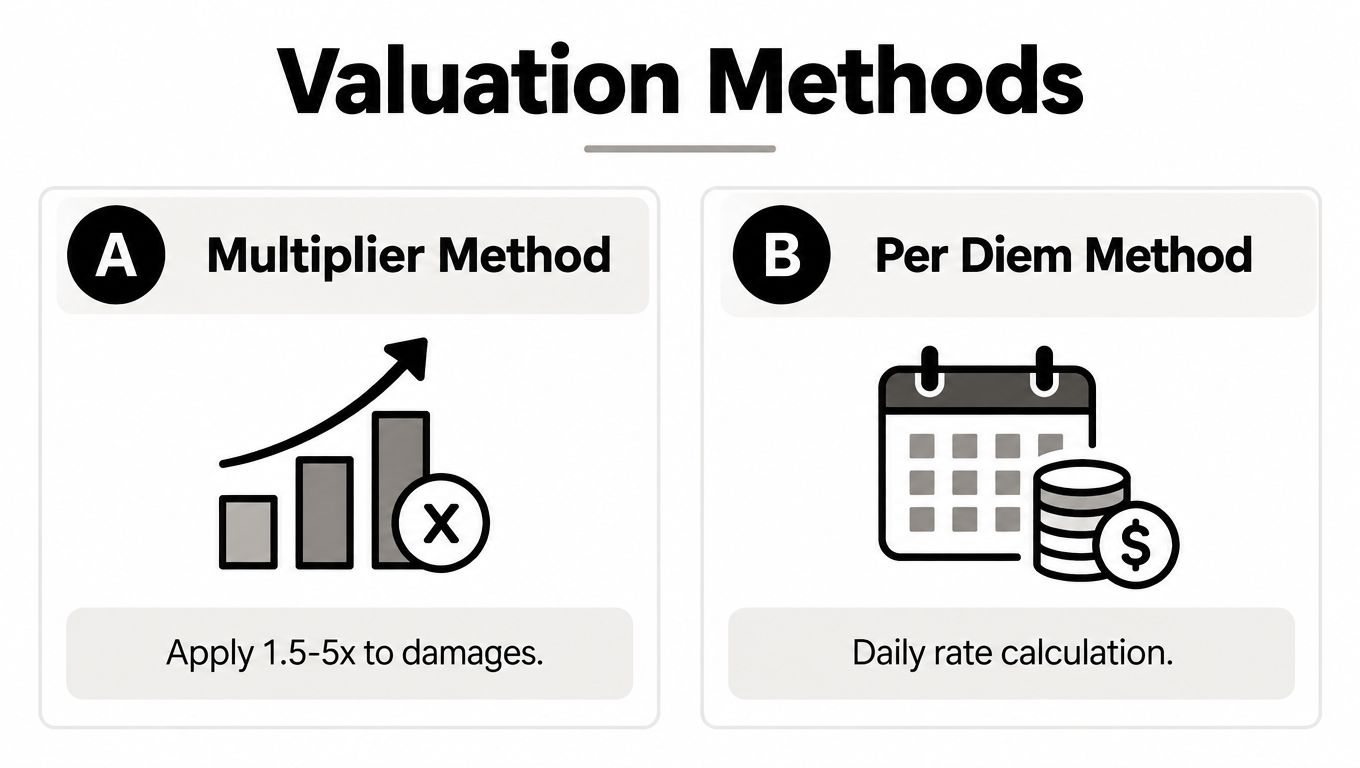
Many legal guides use a multiplier applied to special or economic damages when estimating general damages, commonly ranging from 1.5 to 5, depending on severity, recovery time, and life impact, as described in this personal injury settlement calculation guide. That range is only a starting framework. It doesn't replace medical opinions, proof of permanency, or a careful analysis of liability.
Practical rule: Don't inflate a claim with unsupported future losses. A defensible estimate with complete records usually carries more negotiating weight than an aggressive figure that the insurer can easily challenge.
Applying the Multiplier and Per Diem Methods
The multiplier method begins with economic damages and applies a factor to estimate pain and suffering. The result is then considered alongside liability, coverage, evidence quality, and other case-specific adjustments. It's a negotiation framework, not a statutory formula that guarantees payment.
A practical workflow uses the severity benchmarks described in settlement calculation guidance from US Legal Journal:
- Mild soft-tissue injury: approximately 1.5 to 2.0 times economic damages.
- Chronic pain: approximately 3.0 to 4.0 times economic damages.
- Severe daily impairment or permanent disability: approximately 4.5 to 5.0 times economic damages.
These benchmarks reflect more than the diagnostic name. The factor generally becomes more persuasive when the injury is severe, permanent, medically well documented, treatment lasts longer, and liability is clear. A low factor may be reasonable for a prompt recovery with limited treatment. It becomes harder to justify when the records show lasting restrictions, substantial care, or a permanent change in function.
A worked multiplier example
Suppose your documented medical bills and lost income total $20,000. Applying a multiplier range of 1.5 to 5 produces a preliminary pain-and-suffering estimate of $30,000 to $100,000, before adjustments for comparative fault, policy limits, evidence strength, or other case conditions. The resulting preliminary settlement range would therefore combine the $20,000 in economic damages with that non-economic estimate, subject to those adjustments.
That example shows why the same $20,000 in specials can support very different demands. The question is not only whether the bills exist. You must explain why the injury belongs near the lower, middle, or upper part of the range. A short, uncomplicated recovery may support the lower end. Chronic symptoms or permanent impairment may support a higher factor when the medical and functional evidence is consistent.
When the per diem approach helps
The per diem method for injury claims assigns a daily value to pain and suffering and applies it to the documented recovery period. It can make a short-term injury easier to explain because the demand connects an amount to each day of discomfort, treatment, limited mobility, or missed activities.
A daily-rate presentation can become less persuasive when recovery has no clear endpoint. Permanent disability, recurring symptoms, and future care don't fit neatly into a finite count of recovery days. For that reason, the per diem method for injury claims can be useful as a negotiation tool, but it shouldn't be treated as automatically superior to the multiplier approach.
You can also review this discussion of how to calculate pain and suffering damages for additional guidance on translating non-economic harm into a supported demand. In either method, the evidence determines whether the calculation sounds reasonable or arbitrary.
Adjusting for Fault, Limits, and Evidence Quality
A strong injury claim can still produce a disappointing recovery if the available insurance is limited or the injured person shares responsibility for the accident. These issues can matter more than the injury label because they directly reduce the amount the defendant or insurer can pay.
Comparative fault reduces the result
If an insurer or court assigns part of the blame to you, your recovery may be reduced according to the applicable fault rules. The precise effect depends on the law governing the claim, so don't assume that a preliminary adjuster's fault percentage is the final answer.
For example, an insurer may argue that you were speeding, failed to avoid the collision, or ignored a safety instruction. Your response should be evidence-based. Use photographs, vehicle damage, traffic footage, witness accounts, accident reconstruction, and medical timing to show what really happened and why the proposed allocation is unsupported.
Fault is negotiable when the evidence is disputed, but it isn't negotiable merely because the proposed reduction feels unfair. A demand should address the opposing version of events directly and explain why the available proof supports your position.
Policy limits create a practical ceiling
Before accepting a settlement, determine what insurance coverage may apply. The defendant's primary policy may not be the only source. Depending on the facts, potential coverage can include additional defendants, underinsured motorist benefits, commercial policies, or excess coverage. The availability of any additional source must be investigated rather than assumed.
Settling before learning the policy limits can lead to a serious strategic mistake. If your damages exceed the available coverage, the case may require a different approach, such as identifying other responsible parties or evaluating your own coverage. If the coverage is modest, the demand still needs to establish the claim's full value, but the negotiation strategy must account for collectability.
Evidence changes the insurer's risk assessment
Objective imaging and testing, including X-rays, MRI scans, and CT scans, tend to support higher settlements than claims based mainly on subjective credibility, according to settlement strategy guidance for injury claims. That doesn't mean a claim without abnormal imaging has no value. Soft-tissue injuries and pain conditions can be genuine and disabling. It means the claimant must prove them through consistent treatment, credible reporting, physician opinions, functional limitations, and a coherent timeline.
The number on the medical bill is only the beginning. The insurer is also pricing uncertainty, and strong evidence reduces that uncertainty.
An unexplained gap in treatment, inconsistent statements, or a failure to follow reasonable medical advice can give the insurer a basis to argue that the injury was minor or unrelated. Explain any interruption plainly, preserve the medical chronology, and avoid settling before you understand the long-term picture.
When to Handle Negotiation Yourself and When to Hire Counsel
Self-representation can be reasonable when the injury is minor, treatment is complete, liability is undisputed, the insurer has disclosed applicable coverage, and the damages are straightforward. In that setting, you can organize the records, prepare a concise demand, and negotiate without turning every communication into a legal dispute.
The risk increases when the claim involves significant treatment, permanent symptoms, disputed fault, multiple insurers, or substantial lost income. A release signed too early can prevent you from pursuing later consequences, and an early offer may not reflect the full extent of an injury that hasn't stabilized.
Compare the practical trade-offs
| Self-negotiation | Attorney representation |
|---|---|
| You control every communication and avoid paying a legal fee from the recovery. | Counsel handles insurer communications, evidence collection, valuation, and negotiation. |
| You must identify coverage, liability defenses, medical gaps, liens, and future losses yourself. | Counsel can investigate disputed facts and coordinate medical and financial proof. |
| A simple claim may resolve efficiently when the facts are clear. | A complex claim receives a strategy designed around fault, policy limits, and trial risk. |
| You carry the risk of accepting an offer before understanding the full injury. | Counsel can advise whether the record is developed enough to evaluate a release. |
Settlement strategy sources summarized in the assigned guidance associate attorney representation with settlements about 3.5 times higher than going it alone, though that comparison doesn't predict the outcome of any individual case. It may reflect the types of claims lawyers accept, the severity of represented injuries, stronger case preparation, or more effective negotiation. Treat it as a reason to evaluate representation, not as a promise.
If you're weighing the financial side of hiring counsel, the Smart Receipts tax deduction resource provides general information about legal-fee treatment. Tax consequences depend on the facts and settlement structure, so a tax professional should address your situation.
Building a Demand Package That Moves the Number
An adjuster should be able to open your demand package and understand the accident, the medical course, the financial losses, and the reason your requested amount is justified. A disorganized file forces the insurer to search for proof and makes uncertainty easier to convert into a lower offer.
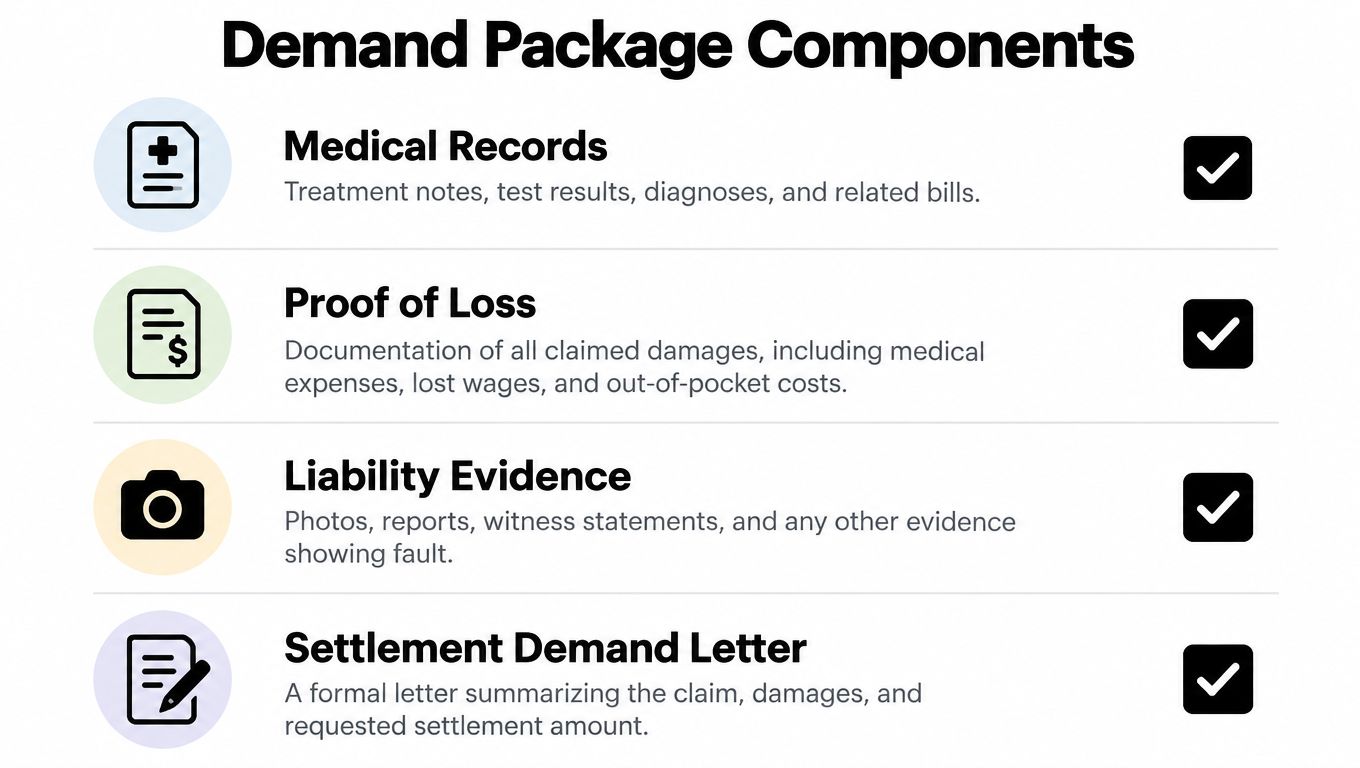
Assemble the proof in a usable order
A practical package should include:
- Medical records and bills: Put treatment in chronological order and connect diagnoses, testing, procedures, therapy, restrictions, and future recommendations.
- Proof of loss: Add wage records, employer verification, disability documentation, repair records, and evidence of future earning or care consequences.
- Liability evidence: Include photographs, reports, witness information, video, vehicle damage, and any material that answers the insurer's fault arguments.
- A settlement demand letter: State the facts, explain the injury, summarize the losses, identify the supporting exhibits, and make a demand that matches the documented valuation.
The settlement demand letter guidance can help frame the letter as an argument rather than a pile of attachments. Avoid dramatic language that the records don't support. A clear description of what you could do before the accident, what you can do now, and what doctors expect in the future is more persuasive.
Close the gaps before making the demand
A treatment gap doesn't automatically defeat a claim, but silence about it creates an opening for the insurer. Explain whether insurance problems, transportation, work obligations, symptom fluctuation, or another documented reason caused the interruption. Include the records that show the overall course rather than submitting only the most favorable pages.
Timing matters too. If physicians are still evaluating whether you'll need additional care, a final demand may be premature. You can discuss the claim while treatment continues, but don't let pressure to settle prevent you from learning whether the injury has stabilized and whether future losses need to be included.
A demand package should answer the adjuster's likely objections before the adjuster writes them into the evaluation.
Knowing When to Accept, Counter, or Consult
Evaluate an offer against your documented economic damages, the supported non-economic range, the likely fault allocation, and the available coverage. An offer deserves careful scrutiny when it ignores future treatment, omits wage loss, applies a low multiplier without explaining why, or requires a release before your medical condition is clear.
Counter with evidence, not frustration. Identify the missing category, correct the factual error, attach the supporting record, and explain why your requested amount fits the injury's severity and life impact.
Consult counsel when liability is disputed, the injury may be permanent, the insurer won't disclose coverage, multiple policies may apply, or the proposed release could eliminate claims you haven't evaluated. Representation is also worth considering when the negotiation has become adversarial or you can't assess the offer independently.
Nares Law Group LLC helps injured people evaluate medical expenses, lost income, long-term effects, policy issues, and settlement strategy in motor vehicle, trucking, brain injury, and wrongful death matters. Visit Nares Law Group LLC to learn about the firm's case resources and request a consultation about the facts affecting your potential recovery.