You're hurt, your car may still be in the shop, the bills keep arriving, and the insurance company has already asked for paperwork you haven't had time to organize. In that position, it's often assumed the next step is a lawsuit. In reality, the claim usually turns on a document most non-lawyers have never had to write before: the settlement demand letter.
A strong demand letter does more than ask for money. It frames liability, organizes medical proof, explains how the injury changed your daily life, and gives the insurer a clear path to resolve the claim. A weak one does the opposite. It invites delay, skepticism, and low offers.
For Colorado injury victims, that difference matters. Insurance adjusters don't pay because someone is upset. They pay when the file makes it expensive to deny, difficult to minimize, and easy to justify a meaningful settlement.
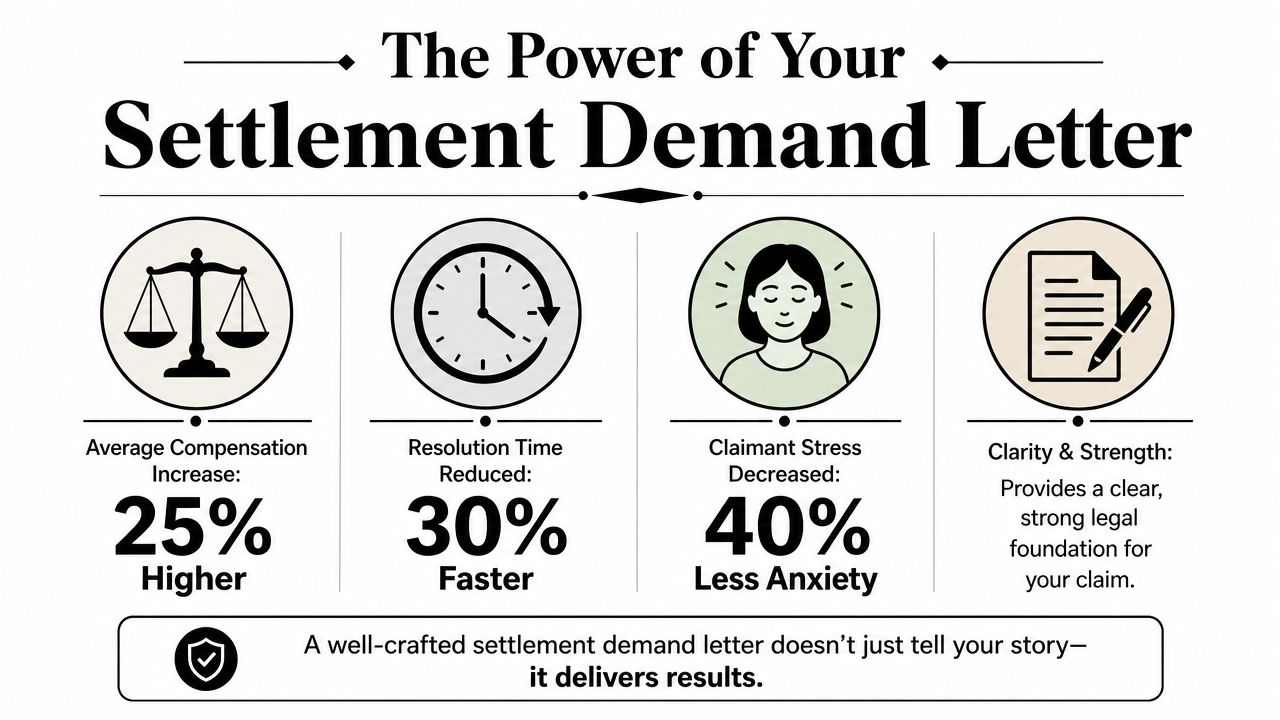
The Power of Your Settlement Demand Letter
After a crash, people often focus on the visible emergencies first. Getting treatment. Missing work. Finding transportation. Talking to the body shop. The demand letter usually comes later, but it often becomes the document that defines the rest of the claim.
According to Trial Guides' discussion of Bureau of Justice Statistics data, 98.2% of all civil tort cases settle prior to the filing of a lawsuit. That reality changes how I think about case preparation. The demand letter isn't a formality. It's the first serious settlement presentation, and in many claims it's the most important one.
What the letter actually does
A proper settlement demand letter tells the insurer four things at once:
- Who caused the harm and why the evidence supports that conclusion
- What treatment was necessary and how the records connect the injury to the incident
- What the claim has cost you financially and personally
- What amount will resolve it without forcing the case into litigation
That combination matters because adjusters evaluate claims through documentation, not sympathy. If your letter is vague, missing records, or written before your damages are fully understood, the insurer gets room to argue that the case is worth less than it is.
Why generic templates fail
Online templates usually produce flat, forgettable letters. They include the date of loss, list a few bills, and end with a round number. That's not enough. A persuasive demand package has structure, chronology, and proof. It shows how the collision happened, what treatment followed, what limitations remained, and why the requested amount is supported instead of inflated.
Practical rule: The best demand letters don't sound dramatic. They sound documented.
That's especially true in motor vehicle claims. The insurance company already has its internal valuation process. Your job is to make the file stronger than the assumptions built into that process. If the carrier sees complete records, a clean liability theory, and a credible damages narrative, settlement becomes easier to justify internally.
Control the story early
The demand letter is also your chance to stop the insurer from writing your story for you. If you stay passive, the file can become a stack of disconnected records: an ER note, a few physical therapy visits, a billing ledger, and an adjuster summary that reduces your injury to a few coded entries.
A good letter restores the human sequence. You explain what happened, what hurt, what treatment followed, what work you missed, what activities changed, and what still hasn't returned to normal. That narrative is not fluff. It's the bridge between the records and the value of the claim.
Gathering Your Ammunition Before You Write
The biggest mistake people make is sending the demand too early. They want movement, closure, and money for bills that are already due. That instinct is understandable, but early demands often undervalue the claim because the medical picture is still incomplete.
A discussion of demand timing and outcomes notes that a demand letter's success rate improves significantly when sent after the injured person reaches maximum medical improvement, with 60 to 90 days post-treatment completion giving adjusters enough documentation to justify higher settlement authority. In plain terms, waiting can make the file easier for the insurer to pay at a better level.
Why timing changes value
If you send the letter while treatment is still developing, several problems show up at once. You may not know whether you'll need imaging, specialist care, injections, or future treatment. You also may not know whether symptoms that seem temporary are going to persist.
An adjuster notices those gaps immediately. They'll argue that the treatment was brief, the condition resolved, or the future is too uncertain to include. Once you've made a low demand before the record is complete, raising it later becomes harder.
What to collect before drafting
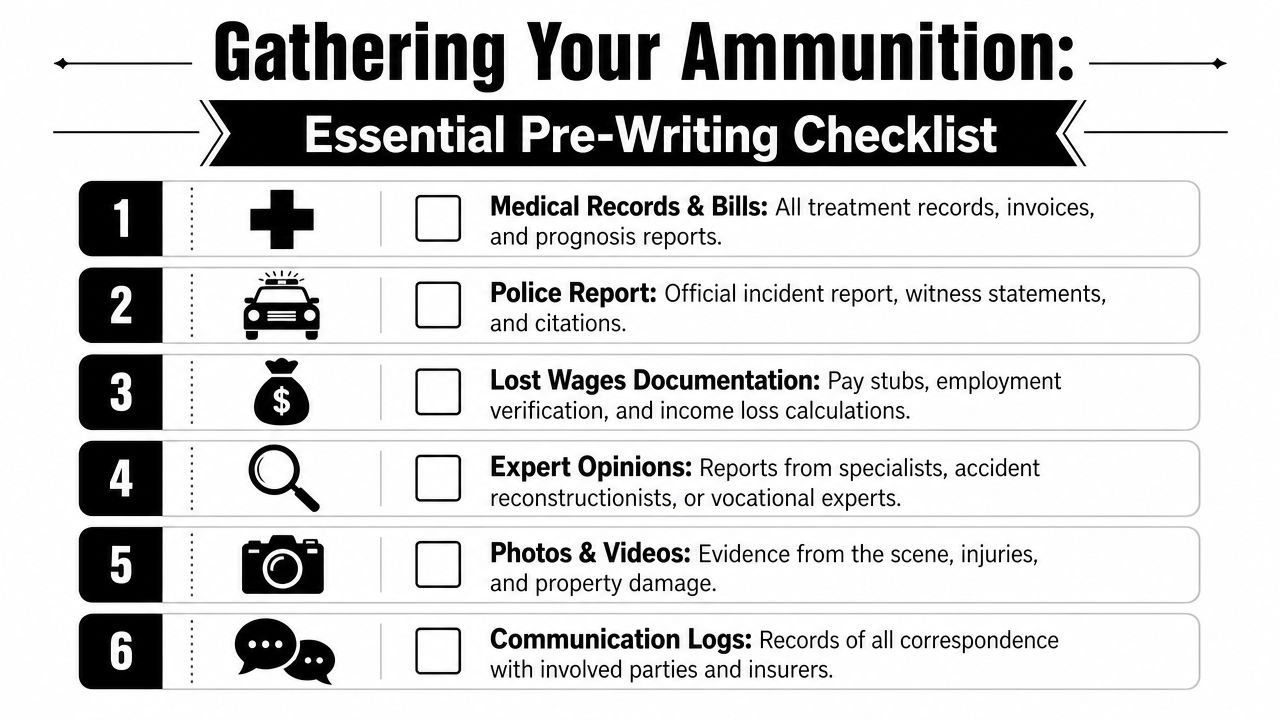
Build your file like you're preparing for scrutiny, because you are. At minimum, gather:
- Full medical records and itemized bills. Not just discharge summaries. Get provider notes, therapy records, imaging reports, invoices, and any prognosis or work restriction documentation.
- The police report and related incident materials. If there were witness statements, citations, or diagrams, include them.
- Photographs and videos. Use scene photos, vehicle damage photos, and images showing how bruising, swelling, scarring, or mobility issues changed over time.
- Proof of lost income. Pay stubs, employer letters, missed shift confirmations, and documentation of reduced hours all help.
- Communication records. Save emails, claim letters, voicemails summarized in writing, and notes of any adjuster conversations.
- Specialist opinions when needed. If liability, causation, or long-term limitations are disputed, expert support can change the strength of the file.
Organize the file before you write a sentence
A demand package reads better when the evidence is already sorted. I recommend grouping documents into folders or PDFs by subject: liability, treatment chronology, bills, wage loss, photos, and future care.
Then create a treatment timeline. Start with the date of the crash, list each provider in order, and note the reason for each visit. That simple timeline often reveals missing records, inconsistent dates, or billing issues that should be fixed before anything goes to the insurer.
Waiting doesn't mean staying inactive. It means using the time to build a record the adjuster can't easily dismiss.
If you're still in the immediate aftermath of a collision, Nares Law Group has a practical guide on steps to take after a car accident that can help you protect the claim before the demand stage arrives.
How to Calculate Your Settlement Demand
The hardest question is usually the simplest one: what should you ask for? Too low, and you leave value on the table. Too high without support, and the adjuster may stop taking the letter seriously.
Start by separating economic damages from non-economic damages. That distinction brings discipline to the process and forces you to support each part of the claim differently.
Economic vs Non-Economic Damages
| Damage Type | What It Covers | Examples |
|---|---|---|
| Economic damages | Financial losses that can be documented | Medical bills, future treatment, lost wages, reduced earning capacity, property damage, out-of-pocket costs |
| Non-economic damages | Human losses that don't come with a fixed invoice | Pain, emotional distress, inconvenience, sleep disruption, loss of enjoyment of life, scarring, embarrassment, trauma |
Economic damages first
Economic damages are the foundation. Add the medical expenses you've already incurred. Include projected future care if the records support it. Add wage loss, missed opportunities for overtime or contract work, and other documented out-of-pocket losses tied to the injury.
Be precise. Round numbers with no support invite reductions. A careful damages worksheet is often more persuasive than a dramatic paragraph.
If you need help thinking through categories that are often missed, this overview of economic damages calculation is a useful starting point.
For vehicle-related losses, property damage can affect negotiation posture too. If diminished value is part of the broader discussion, reviewing insights into insurer's 17c formula can help you understand how carriers often evaluate post-repair vehicle value issues.
Non-economic damages require detail, not slogans
The phrase “pain and suffering” is widely recognized, but insurers don't value that phrase by itself. They respond to specifics. How did the injury affect sleep? Driving? Childcare? Intimacy? Exercise? Household tasks? Concentration? Confidence in traffic? Social plans? Embarrassment from visible injury? Fear when riding as a passenger?
According to 2025 consumer-rights guidance on writing a winning demand letter, people who explicitly describe “extra or unusual discomforts” and “inconveniences” in their demand letters achieve significantly better outcomes because adjusters often focus too narrowly on medical bills.
That point is especially important in claims where medical expenses look modest on paper. A person may have relatively limited treatment but still experience persistent headaches, disrupted sleep, anxiety while driving, or the inability to return to ordinary activities. If those consequences aren't described clearly, they may never get valued.
The strongest non-economic damages section reads like daily life interrupted, not like a legal cliché.
A practical way to set the number
The opening demand should leave room for negotiation, but it still has to be defendable. I prefer this approach:
- Build the economic damages from records, bills, wage proof, and projected care.
- Write a separate non-economic damages summary based on actual life impact.
- Pressure-test the demand by asking whether every major statement can be backed by a document, photo, diary entry, or witness account.
- Remove anything exaggerated. Keep what is human and provable.
That last step matters. Inflated demands can hurt credibility. Well-supported demands create advantage.
A Section-by-Section Guide to Drafting Your Letter
Once the records are complete and the valuation is grounded in evidence, the writing itself becomes much easier. A good settlement demand letter is direct, organized, and readable. It should help an adjuster move through the file quickly without missing the facts that increase value.
Open with the claim facts
Start with the basics. Identify the claimant, the date and location of the incident, the insured party, the claim number, and the purpose of the letter.
A plain opening works well:
“Please accept this correspondence as my formal settlement demand arising from the motor vehicle collision that occurred on [date] in [location], caused by your insured.”
That sentence does three things. It identifies the event, ties it to the insured, and signals that this is a formal negotiation document rather than casual correspondence.
Present liability clearly
The liability section should be short, factual, and confident. Don't over-argue obvious fault. Don't speculate where the evidence is mixed. State what happened, point to the supporting materials, and explain why the insured's conduct caused the crash.
Examples of useful support include:
- Official findings from the police report
- Witness observations that confirm how the collision occurred
- Photographs showing vehicle position or damage pattern
- Your treatment chronology when causation is straightforward
If Colorado comparative fault may become an issue, the wording here matters. Avoid volunteering fault percentages or making concessions that aren't necessary.
Describe injuries in sequence
The damages section should move chronologically. Start with the immediate symptoms, then the first treatment, then follow-up care, then lingering limitations. Without this chronological flow, many self-written letters become disorganized. They jump from diagnosis to billing totals to a broad statement about pain.
A better structure is:
- What symptoms appeared immediately after the crash
- Where you sought treatment first
- What providers found
- What treatment you completed
- What symptoms remain
- How those symptoms affect work and daily life
That structure helps the adjuster connect treatment to function. It also makes the file easier to escalate internally.
A short educational video can help if you want to hear these concepts explained conversationally before you draft:
State the amount and the deadline
The demand itself should be unmistakable. State the amount you're demanding to settle the claim in exchange for an appropriate release. Then give the insurer a firm deadline to respond.
Industry guidance on settlement demand letters recommends a 30-day response deadline as the typical standard for getting the opposing party or insurer to reply and keeping the process moving. That deadline matters because open-ended demands often sit.
A straightforward version looks like this:
“In light of the liability evidence, medical documentation, wage loss records, and the documented impact on my daily life, I hereby demand the sum of [amount] to fully resolve this claim. Please provide a written response within 30 days of receipt.”
Attachments make the letter credible
At the end, list the enclosures. Don't assume the adjuster will infer what's included.
Use a simple attachment list such as:
- Medical records
- Itemized medical bills
- Wage loss verification
- Police report
- Photographs
- Expert opinions, if any
- Receipts for out-of-pocket expenses
This is also the stage where some people choose outside help. For example, Nares Law Group offers a demand preparation service that compiles evidence, calculates damages, and prepares a formal package for the insurer. That kind of support is often useful when the injuries are more serious or the records don't tell the full story on their own.
After You Click Send Navigating the Negotiation
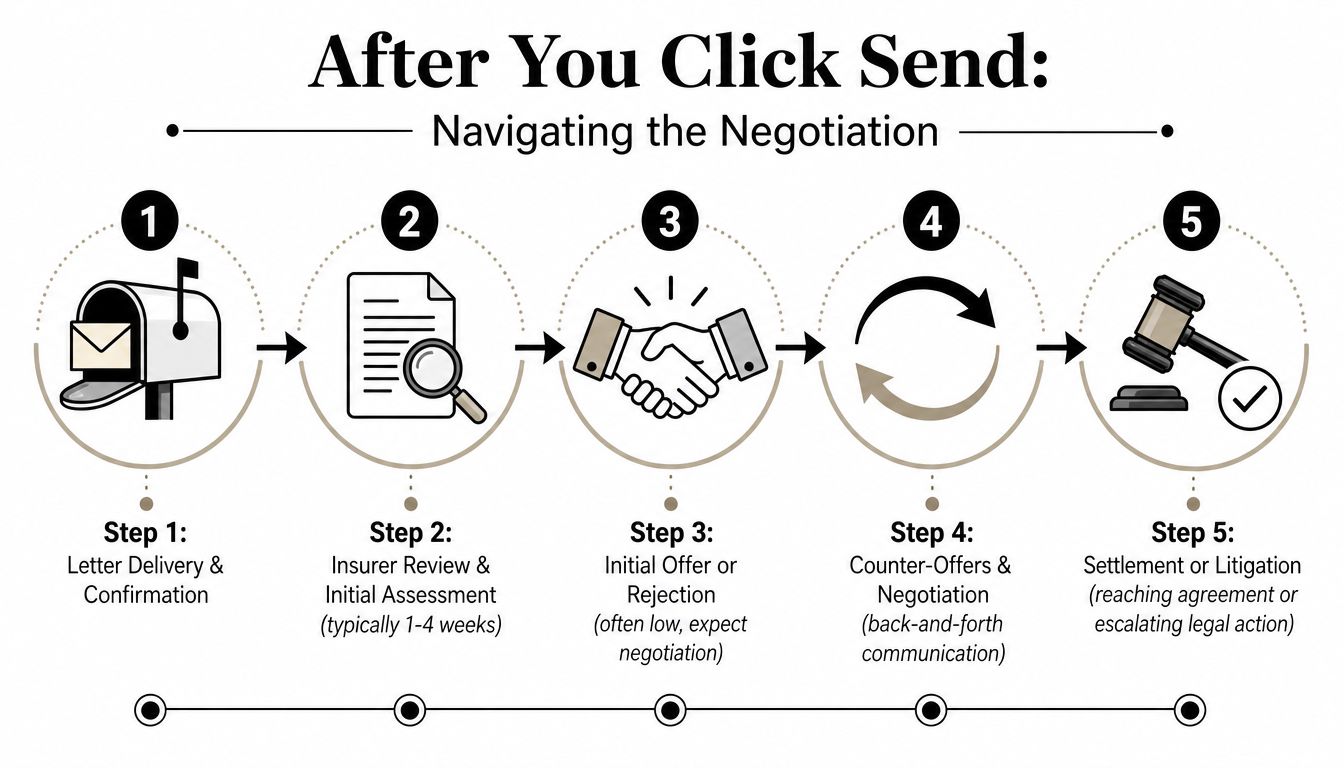
Sending the letter doesn't end the work. It starts the negotiation. This is where patience matters, because insurers often test whether the claimant is prepared, organized, and willing to keep pressing.
Expect three common responses
Most adjuster responses fall into one of these categories:
- A low initial offer that treats your demand as an anchor to be pushed downward
- A request for more information such as missing records or wage proof
- Silence or delay while the file sits without meaningful evaluation
None of those responses should cause panic. A low opening offer is common. A request for more records may be legitimate or strategic. Silence usually means you need documented follow-up.
Keep the negotiation disciplined
The best response strategy is controlled and written. If the insurer counters, don't answer emotionally and don't rush to reveal your minimum acceptable number. Address the reasons given, point back to the evidence, and narrow the dispute.
A few practical habits help:
- Confirm receipt of your demand and every follow-up in writing
- Respond to requests selectively. Give relevant documents, not your entire life history
- Challenge unsupported reductions. Ask what facts justify the insurer's position
- Track deadlines yourself rather than assuming the adjuster will
For claimants who email their demand package, tools that confirm whether a message was opened can be helpful. This guide on how to track emails in Gmail shows one way people document delivery and review activity.
A calm written response usually carries more weight than an angry phone call.
Know when negotiation is real
Meaningful negotiation has movement. The adjuster asks targeted questions, acknowledges parts of the claim, and explains the basis for a counteroffer. Bad-faith style delay feels different. You get vague statements, repeated requests for items already provided, or offers that ignore the core medical proof.
If a settlement is reached, read the release carefully before signing anything. This overview of what a settlement agreement is can help you understand what rights you may be giving up when you accept payment.
Common Pitfalls and When to Call a Colorado Attorney
A lot of people can write a competent demand letter for a straightforward claim. Fewer people can spot the traps that subtly diminish value or undermine bargaining power. That's the difference between handling a claim and handling it well.
Mistakes that cost people money
Some errors show up again and again:
- Admitting partial fault too early. In Colorado, fault allocation matters. Casual statements can come back later in negotiations.
- Giving a recorded statement without strategy. People often minimize symptoms, guess about speed or timing, or speak before the medical picture is clear.
- Ignoring future care. If treatment may continue, a quick settlement can close the door before the full cost is known.
- Writing a demand with weak medical support. Billing alone rarely tells the whole story.
Recent industry analysis on medically supported demand letters indicates that demand letters co-authored or validated by medical professionals secure settlements 20 to 30% faster and with higher final valuations than standard attorney-only drafts. The reason is practical. A medical narrative can connect injury mechanics, symptoms, treatment, and prognosis in a way adjusters have a harder time minimizing.
Colorado issues that make legal help urgent
Colorado law adds pressure points that shouldn't be handled casually. The statute of limitations can cut off a claim if suit isn't filed on time. Colorado also uses a modified comparative fault system, which means liability disputes can sharply affect recoverable compensation.
That's when legal counsel stops being optional and starts being necessary. I strongly recommend talking to an attorney if any of these apply:
- Liability is denied
- You suffered a permanent injury or brain injury
- A trucking company is involved
- A government vehicle or roadway issue may be involved
- The insurer says your treatment was unrelated
- You're being asked to settle before your condition stabilizes
If you follow legal developments outside Colorado as a way to understand how tort rules can shift, this article on understanding Florida's new tort bill is a useful example of how legislative changes can affect injury claims and insurance strategy in another state.
A settlement demand letter can be powerful. It can also lock in mistakes. If the case is complex, if the injuries are serious, or if the insurer is pushing back hard, that's the point to get counsel involved before the claim gets harder to repair.
If you're dealing with a Colorado injury claim and need help valuing it, organizing the records, or preparing a settlement demand letter that reflects what the case is worth, Nares Law Group LLC offers free consultations. We can review where your claim stands, identify gaps in proof, and help you decide whether it makes sense to negotiate further or move toward formal legal action.