The moments after impact feel unreal. You hear the noise, your body floods with adrenaline, and for a few seconds your brain wants to do everything at once and nothing at all. That's normal. It's also why the first steps to take after car accident matter so much. They give you a script when your mind is scrambling.
In the United States, motor vehicle crashes are still a major public-safety problem. The CDC reports that in 2023, more than 44,000 people died in motor vehicle crashes, or more than 120 deaths every day, which helps explain why basic post-crash guidance is so consistent: check for injuries, get to safety if possible, call 911 or the police, and document the scene before details disappear (CDC motor vehicle safety overview). For injured people, those aren't just formalities. They shape emergency response, insurance handling, and the proof you may need later.
If you're dealing with the aftermath right now, think of this as a road map, not a lecture. These are the steps that protect your health first, then your claim, then your long-term stability. If you want a second practical reference on handling car crash claims, use it alongside this guide.
1. Ensure Safety and Call Emergency Services
Your first job is simple. Stop, breathe, and figure out whether anyone is hurt.
If the vehicles can be moved safely and you're not risking further injury, get out of active traffic. On I-25, that may mean moving to the shoulder. On a Denver side street, it may mean pulling out of an intersection so a second collision doesn't happen. Turn on hazard lights and keep yourself visible.
Call 911 before you start solving everything else
Calling emergency services does two things at once. It gets medical help moving toward you, and it starts an official record. In Colorado, that matters in a practical way. The police report often becomes the first neutral document insurers, lawyers, and medical providers look at when they're trying to understand what happened.
When you call, be concrete. Give the nearest cross street, highway exit, mile marker, or landmark. If you're in Boulder County, saying “near the off-ramp” is less useful than saying the exact roadway and direction of travel. If anyone is unconscious, bleeding, confused, or trapped, say that immediately.
Practical rule: If you're deciding between “I should wait and see” and “I should call 911,” call 911.
A common mistake is treating a crash like a private inconvenience. That works poorly. Drivers sometimes wave off police because the damage “doesn't look that bad,” then hours later one person's neck tightens up, another person changes their story, and there's no clear early record.
What works at the scene
A few habits make the next steps easier:
- Move only if it's safe: If moving the car could worsen injuries or create more danger, stay put and wait for responders.
- Speak in facts: Tell dispatch how many vehicles are involved, whether there are injuries, and whether traffic is blocked.
- Ask for identifying details: When officers respond, get the report number if available and the responding officer's name.
- Stay calm with the other driver: This isn't the time to argue, accuse, or negotiate cash on the shoulder.
In Colorado weather, conditions can shift fast. A crash in snow near North I-25 or on an icy suburban road can turn into a chain reaction. Safety comes before perfect photos, before explanations, before anything else.
2. Document the Accident Scene Thoroughly
A crash scene changes fast. Cars get moved. Debris gets cleared. Witnesses leave. Rain, snow, and traffic erase details. That's why documentation has real value. It freezes the scene before memory starts sanding down the edges.
The Insurance Information Institute recommends gathering as much information as possible at the scene, including license, registration, insurance ID, time, weather, and location, because those details help with liability analysis and insurer review (Insurance Information Institute accident scene guidance).
A phone is usually enough if you use it well.
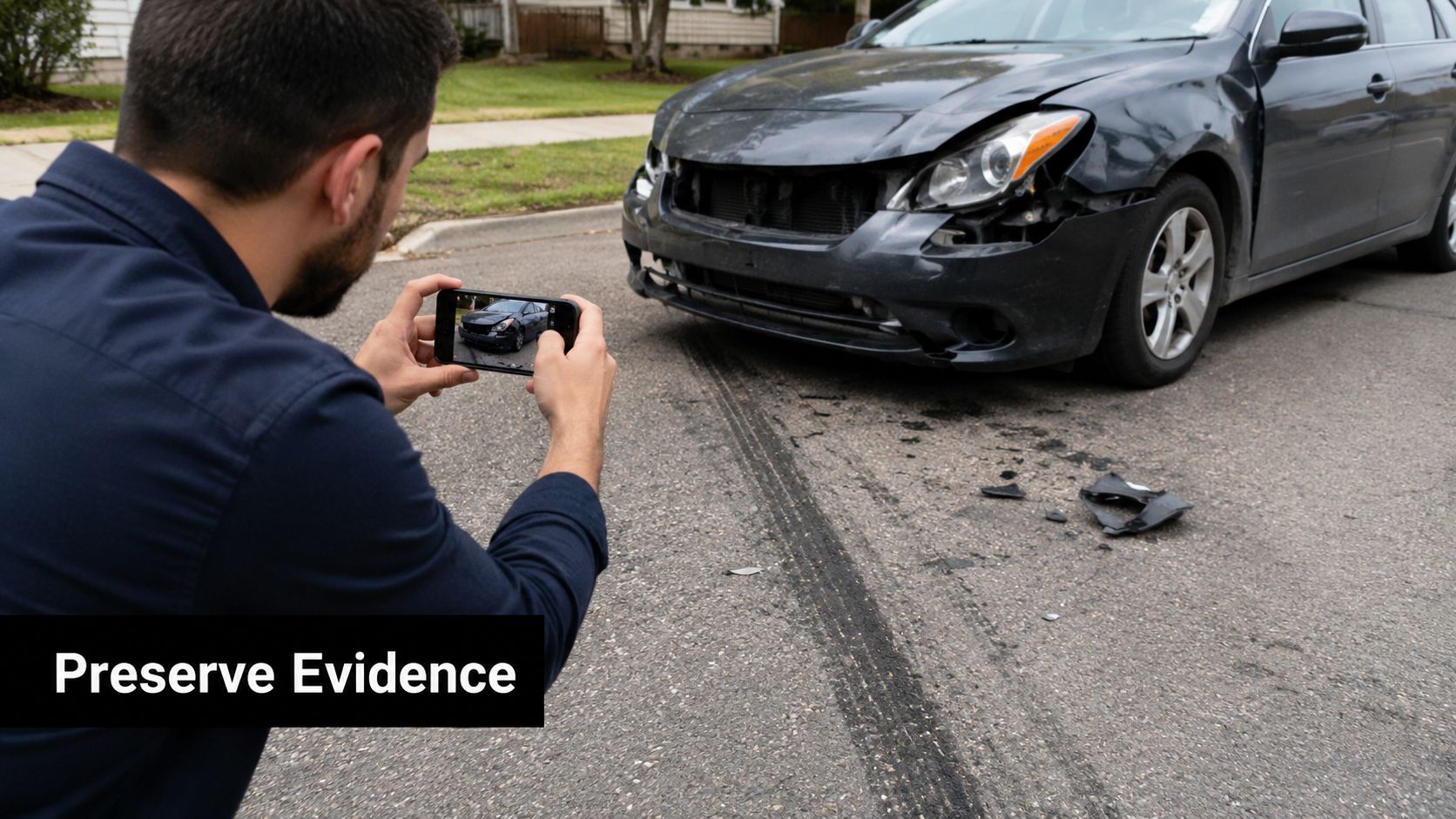
What to photograph first
Start wide, then go tight. Think like someone who wasn't there and has to reconstruct the collision later.
- Wide-angle scene shots: Capture where each vehicle sits in relation to lanes, curbs, medians, and intersections.
- Vehicle damage: Photograph front, rear, both sides, and any interior damage that may relate to impact.
- Road evidence: Get skid marks, broken glass, scattered debris, fluid spills, and gouge marks.
- Context clues: Include stop signs, traffic lights, speed-limit signs, lane arrows, and weather conditions.
- Identifiers: Take pictures of license plates, insurance cards, and if visible, registration details.
If it's a truck crash on I-270 or a multi-vehicle wreck in the Denver metro area, take more images than you think you need. Different angles often answer later questions about sequence, lane position, and visibility.
Write down what your camera won't capture
Photos show objects. Notes preserve timing and perception.
Write down the date, time, exact location, travel direction, weather, road condition, and anything unusual, like a nonworking signal or a delivery van stopped in a travel lane. If you smelled alcohol, heard a driver admit they “didn't see the light,” or noticed a commercial vehicle logo, record it calmly and accurately.
The best accident evidence is boring. Time-stamped, specific, and free of drama.
This visual example can help you think through scene coverage before memories blur.
What doesn't work is selective documentation. A close-up of your bumper alone won't explain an intersection crash. You need the whole chessboard, not just one piece.
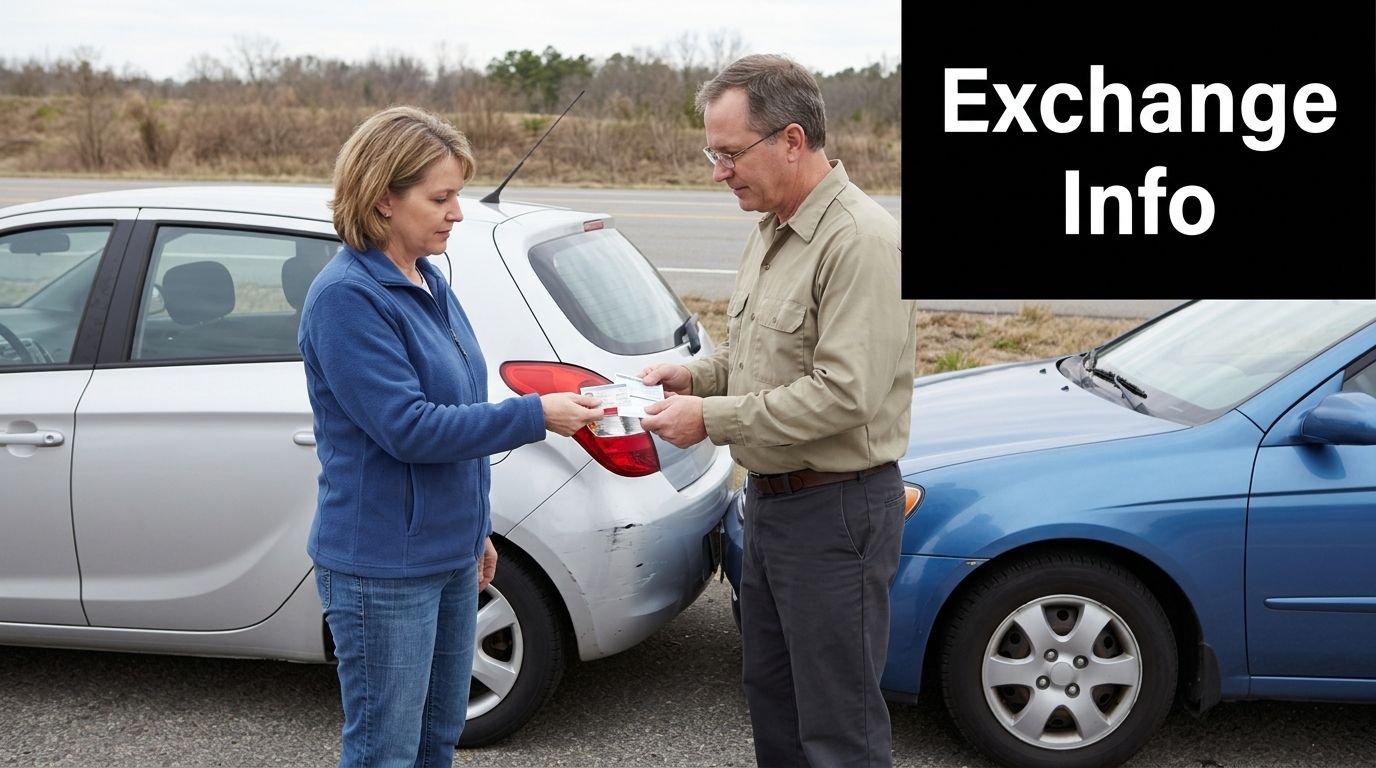
3. Exchange Information with Other Parties Involved
After safety and photos, gather names and coverage details from everyone involved. Keep it businesslike. You're building a clean record, not hosting a roadside deposition.
That includes the obvious details, like driver's license and insurance card information, but also the details people forget until later. Was the driver operating a company vehicle? Was a rideshare sticker in the windshield? Did the car belong to someone else? Those facts can matter a lot if coverage questions come up.
Collect more than the minimum
Get full legal names, phone numbers, email addresses, physical addresses, driver's license numbers, plate numbers, insurer names, and policy information if available. Photograph cards rather than trusting your memory. In a downtown Denver collision involving a delivery driver or a truck operator, also note employer information and any unit number on the vehicle.
If there are multiple drivers, don't leave with information from only the person who spoke to you first. In chain-reaction crashes, the middle vehicle, rear vehicle, and lead vehicle can each point to someone else. You want names tied to cars, not a blur of half-remembered first names.
Stay polite and say less than you think
This part trips people up. They want to be decent, which is good, but they also start narrating fault. “I'm sorry” can sound humane, but after a crash it can also become a problem if it's treated like an admission.
Use language like this instead:
- Confirm basics: “Let's exchange insurance and contact information.”
- Decline fault talk: “I'd rather stick to the facts until the report is done.”
- Document identifiers: “Can I photograph your insurance card and license plate?”
- Avoid side deals: “I'm going through insurance.”
Don't accept “Let's just handle this later” as a substitute for getting the details now. Informal promises disappear fast, especially when repair estimates rise or injuries show up later.
Colorado crashes often involve tourists, commuters, commercial drivers, and out-of-state plates. That makes complete information even more important. If the other person is flustered or evasive, stay calm and let the police handle it.
4. Obtain Witness Contact Information and Statements
Independent witnesses can break a deadlock. When two drivers tell two different stories, the person waiting at the bus stop or standing outside the gas station may become the most credible voice in the file.
Witnesses don't need a perfect view to matter. A person who saw one car run a red light, heard a horn just before impact, or watched a truck drift across a lane may fill in a key gap. In Colorado intersection and highway cases, that outside perspective often matters more than people realize.
Ask fast, before people leave
Most witnesses want to help, but they also want to get on with their day. Approach them respectfully while they're still there.
Ask for their name, phone number, email, and a short description of what they saw. If they're willing, write their words down as closely as possible. Don't improve the wording. Don't lead them. “What did you see?” works much better than “You saw that truck hit me, right?”
A practical example: after a Morrison Road collision near Golden, a gas station employee may have seen the light sequence. In a multi-vehicle crash near Denver, another driver stopped behind the scene may have watched the entire chain reaction develop.
Look beyond people standing on the sidewalk
Witness evidence isn't limited to human memory. Nearby businesses may have cameras. Homes may have doorbell footage. Commercial vehicles may have dash cameras. Even if you can't collect the footage yourself at the scene, note where it might exist.
Useful witness steps include:
- Write down where the witness stood: Corner, parking lot entrance, sidewalk, adjacent vehicle, or business doorway.
- Note business names: A nearby store name is easier to trace later than “someone from a shop.”
- Share witness details with police: Don't keep the information to yourself.
- Follow up quickly: Memories sharpen less with time, not more.
A neutral witness can do what two arguing drivers usually can't. Make the facts less negotiable.
What doesn't work is waiting until days later and hoping witnesses can still be found. By then, people forget, move on, or stop answering unknown numbers.
5. Seek Immediate Medical Evaluation and Begin Treatment Records
This is the step people skip when they're trying to be tough, practical, or inexpensive. It often backfires.
The National Safety Council's injury data cited in its motor-vehicle overview estimated 5.1 million injuries from motor vehicle accidents in 2023, which is one reason post-crash guidance consistently includes medical evaluation even when symptoms don't seem dramatic at first (NSC motor vehicle injury overview). A crash can leave you standing, talking, and driving home while still setting up neck pain, back pain, concussion symptoms, or other problems that become clearer later.
Mild symptoms can turn into big issues
Head injuries are a good example. People often say, “I didn't hit that hard” or “I felt okay after.” That doesn't settle much. Public guidance on post-crash injuries emphasizes that concussion and mild traumatic brain injury symptoms can appear or worsen over hours to days, including headache, dizziness, nausea, confusion, sleep changes, and memory problems (post-crash symptom guidance).
If you struck your head, lost awareness even briefly, feel foggy, or develop worsening symptoms later, get evaluated. In Colorado, that may mean the ER for more urgent signs, or urgent care and prompt follow-up for less acute symptoms. The point is timing and documentation.
Build the medical paper trail from day one
Tell every provider the same core fact. You were in a motor vehicle crash, and these symptoms began after it. That helps the record connect the event to the injury.
Do a few things consistently:
- Describe all symptoms: Don't just mention the worst one.
- Follow recommendations: Missed appointments and ignored referrals create gaps.
- Save everything: Discharge papers, imaging reports, prescriptions, bills, and visit summaries.
- Keep a symptom log: Note headaches, sleep problems, pain flares, dizziness, and daily limitations.
If an insurer later requests an evaluation by its chosen doctor, it helps to understand the process behind an independent medical examination. The name sounds neutral, but in practice you should approach it carefully and with preparation.
What works is prompt, consistent care. What doesn't work is waiting until the pain becomes impossible to ignore, then trying to reconstruct when it started.
6. Report the Accident to Your Insurance Company Promptly
A lot of people delay this because they dread the call. Don't. Early notice protects you more than silence does.
Major insurers and consumer guidance consistently stress quick reporting. Allstate advises drivers to call the insurer while still at the scene or use its mobile app if available, and California's Department of Insurance similarly advises immediate notice after an accident (Allstate accident reporting guidance). The practical point is simple. Policies often require prompt reporting, and details are freshest right away.
Give facts, not theories
When you report the crash, stick to the basics. Date, time, location, vehicles involved, responding agency, and whether you sought medical care. If the adjuster asks you to guess speed, distance, or fault percentages, slow the conversation down.
Good reporting sounds like this:
- State the event: “I was involved in a collision at this location and time.”
- Identify documents: “The police responded, and I have the report information.”
- Describe injuries carefully: “I'm being evaluated” or “I'm receiving treatment.”
- Avoid speculation: “I'm not in a position to guess about fault.”
If your insurer has an app, using it at the scene can help preserve photos and first-notice details. If not, keep your own written log of every call, representative name, claim number, and follow-up request.
Don't let the first statement become the whole case
Early claim calls matter because adjusters often rely heavily on the first version they receive. That's why careful wording is so important, especially when injuries are still developing or fault is disputed.
For a fuller breakdown of handling these conversations, review how to deal with insurance after car accident. If you want a broader consumer-facing overview, these expert tips for auto claims can also help you prepare.
Be prompt, but don't be chatty. Insurance reporting should be accurate, short, and documented.
What doesn't work is disappearing for days, then trying to explain missing details from memory. Delay gives everyone less to work with except the dispute.
7. Consult with a Personal Injury Attorney
Not every crash needs a lawyer. Many do.
You should strongly consider legal help if you were injured, if a truck or company vehicle was involved, if fault is being disputed, or if an insurer is already pushing for a quick statement or low-value resolution. In Colorado, attorney involvement is often less about being aggressive and more about organizing the file correctly before avoidable mistakes pile up.
Early legal help changes the quality of the record
A good lawyer doesn't just “fight the insurance company.” They help preserve evidence, identify missing records, coordinate witness follow-up, and make sure your medical story and crash story line up in a way that's clear and defensible.
That matters in real-world Colorado scenarios:
- Truck collisions on major corridors: There may be company records, driver logs, onboard data, and layered insurance issues.
- Multi-vehicle crashes in the Denver metro: Liability can shift as each insurer tries to place blame elsewhere.
- Brain injury cases: Mild early symptoms can become a serious long-term issue if nobody documents them correctly.
A lawyer also helps you avoid damaging shortcuts. One of the most common is settling before the injury picture is stable. Another is giving broad authorizations or recorded statements without understanding how they may be used.
Ask practical questions, not just comforting ones
When you speak with a lawyer, ask how they handle communication, evidence collection, medical coordination, and disputed liability. Ask who will handle your case. Ask what they need from you now, not just what they promise later.
If you want to understand the role in concrete terms, read what does a car accident lawyer do. If attorney costs are one of your concerns, this guide to attorney fee deductions may help you frame the financial side, though your specific situation still needs direct legal and tax advice.
A consultation shouldn't leave you more confused. It should help you see the path ahead more clearly.
8. Maintain Comprehensive Records and Document Damages
Once the crash scene is gone and the initial calls are finished, your case lives or dies on records. Think of this stage like building a file cabinet that tells the story without you in the room.
That story should show three things clearly. What happened. What it cost. How it changed your daily life.
Build one master file and keep feeding it
Create one digital folder, one paper folder, or both. The system matters less than consistency. If a receipt, record, estimate, bill, work note, or prescription relates to the crash, put it in that file the same day.
Keep these categories separate so nothing gets lost:
- Medical records: Visit summaries, imaging, referrals, therapy notes, prescriptions, and bills.
- Vehicle loss documents: Repair estimates, photos, rental records, towing invoices, and total-loss paperwork.
- Work and income records: Pay stubs, missed-time confirmations, self-employment records, and supervisor emails.
- Out-of-pocket expenses: Pharmacy purchases, travel to appointments, childcare, household help, braces, or medical devices.
If you're self-employed, document missed projects, canceled jobs, or reduced capacity with the same care an employee would use for wage loss. Vague income claims are easy to challenge. Clear records are not.
Your daily journal matters more than people think
Medical charts rarely capture the full texture of recovery. They may note “pain improving” while you still can't sleep, drive comfortably, focus at work, or pick up your child without symptoms flaring.
Use a simple running log. Record pain, headaches, dizziness, mood changes, sleep disruption, and tasks you can't do or can only do with help. Keep it factual. “Couldn't sit through a full work meeting,” “needed rides to physical therapy,” and “missed family event because light sensitivity triggered a headache” are more useful than dramatic language.
The strongest damages file usually isn't the loudest one. It's the one with dates, receipts, treatment records, and consistent notes.
Colorado injury claims often turn on credibility. Detailed records make your losses easier to evaluate and harder to dismiss.
8-Step Post-Accident Action Comparison
| Action | Complexity 🔄 | Resources ⚡ | Expected Outcomes ⭐📊 | Ideal Use Cases 💡 | Key Advantages |
|---|---|---|---|---|---|
| Ensure Safety and Call Emergency Services | Low, immediate, procedural 🔄 | Phone, hazard lights, emergency dispatch ⚡ | ⭐ Official police report; 📊 prompt medical response and scene control | Severe injuries, active hazards, multi-vehicle collisions 💡 | Creates official record; timely medical care |
| Document the Accident Scene Thoroughly | Moderate, requires time and safe access 🔄 | Smartphone/camera, time, safe vantage points ⚡ | ⭐ High-quality visual evidence; 📊 preserves scene for disputes | When fault is unclear or scene will be altered/cleaned 💡 | Objective proof for reconstruction and claims |
| Exchange Information with Other Parties Involved | Low, straightforward but sensitive 🔄 | Notepad/phone, ability to collect IDs/insurance ⚡ | ⭐ Enables claims processing; 📊 verifies parties and coverage | All accidents, especially multi-party incidents 💡 | Prevents identity disputes; essential for filings |
| Obtain Witness Contact Information and Statements | Moderate, requires prompt outreach 🔄 | Phone/recorder, consent, quick approach ⚡ | ⭐ Third-party accounts; 📊 strengthens liability arguments | Disputed accounts, hit-and-run, limited physical evidence 💡 | Neutral corroboration that boosts credibility |
| Seek Immediate Medical Evaluation and Begin Treatment Records | Low–Moderate, medically urgent but routine 🔄 | Emergency/urgent care, diagnostics, record-keeping ⚡ | ⭐ Medical documentation of injuries; 📊 supports damages claims | Any injury or potential delayed-symptom case 💡 | Establishes causation and prevents worsening injury |
| Report the Accident to Your Insurance Company Promptly | Low, time-sensitive administrative step 🔄 | Policy info, police report number, documentation ⚡ | ⭐ Claim opened; 📊 adjuster assigned and coverage verified | Filing repairs, medical bills, or liability claims 💡 | Preserves coverage and creates formal claim record |
| Consult with a Personal Injury Attorney | High, legal strategy and coordination 🔄 | Attorney, medical/legal experts, time for investigation ⚡ | ⭐ Professional negotiation; 📊 higher settlement/litigation readiness | Significant injuries, contested liability, complex cases 💡 | Protects rights; maximizes recovery; expert representation |
| Maintain Comprehensive Records and Document Damages | Moderate, ongoing organizational effort 🔄 | Physical/digital files, receipts, employer and medical records ⚡ | ⭐ Detailed damage valuation; 📊 substantiates full compensation | Long recoveries, multiple providers, lost-income claims 💡 | Enables accurate damage calculations and stronger claims |
From Chaos to Clarity: Taking Control of Your Recovery
A car crash scrambles more than your vehicle. It scrambles your routine, your concentration, your sense of safety, and often your finances. That's why the right steps to take after car accident aren't just about checking boxes. They help you regain control when the situation feels like it's running ahead of you.
Chronology matters. In the immediate aftermath, focus on safety, emergency response, and preserving the scene. In the short term, get medically evaluated, notify your insurer, and avoid casual statements that can be turned against you later. In the ongoing phase, keep records, follow treatment, and get legal guidance if the injury, liability, or insurance issues become more than you can reasonably manage alone.
For Colorado drivers, this practical sequence is especially important. Crashes on high-speed corridors, winter roads, and crowded metro intersections often produce the same pattern. People underestimate injuries, overtalk at the scene, trust memory instead of documentation, and wait too long to get help. Those choices don't just make the process harder. They can weaken the proof you need for medical care, insurance benefits, and any legal claim that follows.
What works is disciplined, boring, and clear. Call for help. Photograph everything. Exchange the right information. Get checked by a medical professional. Report the crash promptly. Keep your records in order. If the case becomes complicated, bring in a lawyer before you're reacting to someone else's deadlines and someone else's version of events.
What doesn't work is hoping a serious problem will sort itself out. A delayed concussion doesn't care that your bumper looked minor. A disputed liability case doesn't improve because everyone seemed polite at the scene. An insurance file doesn't become stronger because you intended to save the receipt but forgot.
You don't have to handle the aftermath alone. For Colorado crash victims dealing with injuries, truck wrecks, brain injuries, or difficult insurance issues, Nares Law Group LLC is one relevant option for understanding your rights and next steps. The firm is Denver-based and represents injured people through investigation, treatment coordination, negotiation, and litigation.
The goal after a crash isn't to become an expert in claims law overnight. It's to protect your health, preserve your evidence, and make steady decisions that support recovery. One good step at a time is enough. That's how you move from chaos to clarity.
If you were hurt in a Colorado crash and need clear guidance on what to do next, Nares Law Group LLC offers a place to start. You can use a consultation to explain what happened, understand your options, and get practical direction on protecting your health, records, and legal rights.