You're home from the hospital, your phone won't stop buzzing, and the insurance adjuster is already circling. The other driver's story sounds cleaner than yours, the car is wrecked, and you're sore in places that didn't hurt at the scene. If that's where you are, stop trying to be polite and start protecting proof.
In Colorado, how to prove negligence is not about telling a sad story. It's about building a record that shows duty, breach, causation, and damages, then keeping the insurer from twisting your own words against you. The claim gets won when the evidence is collected in the right order and preserved before it disappears.
The First 48 Hours After a Colorado Accident
The first 48 hours are where good claims are saved and bad claims are buried. If you've just been hit on an icy Denver interchange, don't waste time arguing at the scene or reassuring the other driver that “it's probably fine.” Call 911, get an official report started, and make sure the crash is documented by law enforcement while the scene is still intact.
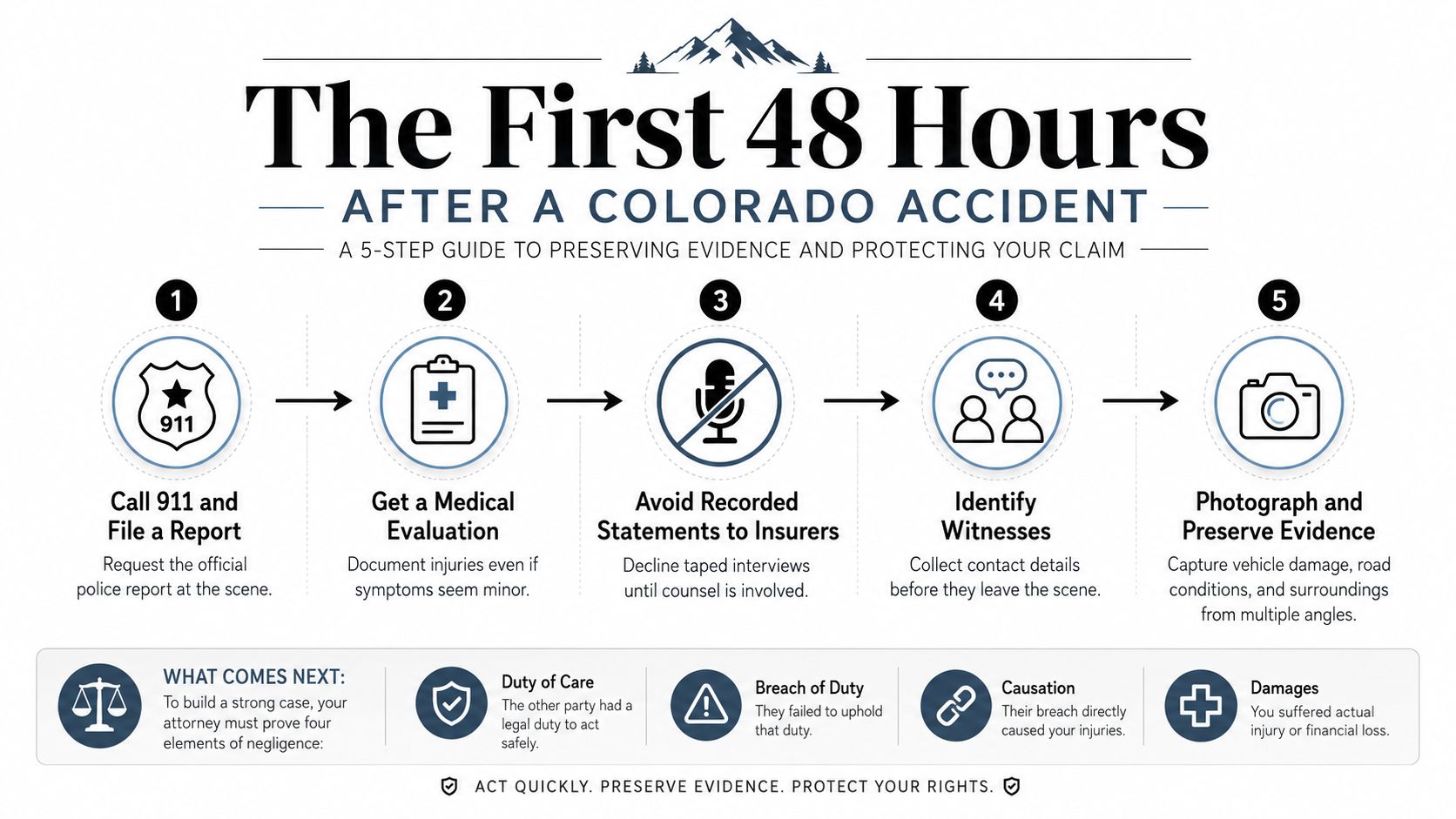
A medical check matters even when you think you just walked away with soreness. Headaches, neck pain, and other delayed symptoms can show up later, and if you wait to get evaluated, the insurer will say your injuries came from somewhere else. If you want a plain-English resource on delayed symptoms, The Patients Guide recovery insights is worth reading because it helps people recognize why an apparently minor crash can still produce real medical problems.
Don't hand the insurer a clean defense
Recorded statements are trap doors. The adjuster's job is not to help you, it's to shape your words into a liability argument, a causation argument, or a blame-shifting argument. If someone asks for a taped interview before you've spoken to a lawyer, say no.
The scene also disappears fast. Witnesses leave, snow melts, cars get moved, and skid marks get covered. That's why I want contact information, photos, and the report number before you leave the shoulder, even if you feel awkward doing it.
Practical rule: preserve proof first, explain later. Politeness at the scene can cost you leverage for months.
If you need a plain checklist for the immediate aftermath, the internal guide on steps to take after a car accident is the kind of thing you should keep open on your phone while the details are still fresh.
The reason this matters is simple. Negligence cases live or die on whether you can prove duty, breach, causation, and damages with evidence that still exists when the claim is filed. The crash itself is not enough. You need a record that can survive insurance scrutiny.
The Four Elements of Negligence Explained
A negligence case wins on proof, not anger. You need facts that fit together and show duty, breach, causation, and damages. If one piece is weak, the insurer will use that gap to cut the claim.
Duty and breach are separate questions
Every driver on a Colorado road owes other people a duty to act reasonably under the conditions in front of them. That part is usually easy to show. The main issue is breach, meaning the driver did something a careful person would not have done, such as speeding on ice, following too closely, or looking away from traffic.
You do not prove breach by saying the other driver was careless. You prove it with the road conditions, the weather, what each driver saw, and what a reasonable driver would have done instead. Photos, witness statements, and the official report start to matter fast because they turn a blame argument into concrete evidence.
Causation is where weak claims fall apart
Cornell Law's negligence overview explains that causation splits into cause-in-fact and proximate cause, and that cases often fail when the connection between conduct and injury is too remote. In plain English, you have to show the crash happened because of the bad conduct, and that the injury flowed from that crash in a way the law recognizes. Cornell Law on negligence
That distinction matters. A driver can act badly and still escape liability if the defense convinces the factfinder that something else caused the harm. So when a client tells me, “The other driver was obviously at fault,” I keep going. I ask what evidence proves the bad driving caused this injury, this treatment, and this wage loss.
The cleanest case is the one where each fact points to the next fact without a gap the insurer can exploit.
Damages turn the claim into money
Damages are the records that show what the crash cost you. Medical bills, wage loss records, and other legally recognized harm turn an injury into a compensable claim. Without damages, you may have an incident. You do not have a meaningful personal injury case.
A jury does not guess at damages. It looks for treatment notes, diagnostic records, pay documentation, and proof that the injuries changed your life in ways the law can measure. If you cannot connect the injury to documented losses, the defense will push to reduce the claim or deny it outright.
The same logic helps explain why some cases rely on the doctrine covered in what is res ipsa loquitur, where the circumstances themselves can point to negligence even when parts of the mechanism are hidden.
The paper trail matters too, and the right discovery plan matters just as much. A solid guide to pre-trial transparency helps expose the documents and witness accounts the insurer would rather keep buried.
Evidence That Actually Proves Your Case
The best negligence files don't read like stories. They read like reconstructions. You want the kind of evidence that shows what happened before, during, and after the crash, not a memory cleaned up weeks later.
Start with what still exists
Scene photos and video are the first layer. Capture vehicle damage from multiple angles, road conditions, traffic signals, lane markings, ice, debris, and the position of the cars before anything gets moved. A single wide shot is not enough. You want the scene to be understandable without your explanation.
Then get the police report and every witness name you can collect. Eyewitnesses help establish sequence, lighting, weather, driver behavior, and whether the other person admitted fault. If they leave the scene, your version becomes a lot easier for the defense to attack.
Build the paper trail while it is fresh
Medical records matter more when they tie specific complaints to specific diagnoses and treatment decisions. Save discharge paperwork, referral notes, imaging reports, prescriptions, and every follow-up instruction. If you skip visits or wait too long between appointments, defense counsel will use that gap to argue the injury wasn't serious or wasn't caused by the crash.
Wage loss proof should come from your employer, not from your memory. Get pay stubs, a supervisor letter if available, and records showing when you missed work and why. If your job changed because you couldn't lift, sit, stand, or drive the way you normally do, document that too.
Keep a contemporaneous record of pain and limitations
A personal journal is useful because it captures the day-to-day effects that formal records often miss. Write down sleep problems, headaches, missed activities, medication side effects, and the tasks you can't do anymore. This isn't about sounding dramatic. It's about preserving the details while they're still real.
The reason contemporaneous documentation beats reconstructed memory is simple. People remember in broad strokes. Claims get won on specifics. A journal, medical notes, and a clear timeline help your lawyer match your injuries to the crash and help explain the pattern to the insurer.
If you want a plain explanation of how discovery works when both sides start demanding proof, the guide to pre-trial transparency is a useful reference because it shows why organized records matter once the defense starts asking questions.
Using Expert Witnesses and Eyewitness Testimony
Eyewitnesses and experts do different jobs, and you need to know the difference. Witnesses tell the story of what happened. Experts explain what that story means in technical, medical, or reconstruction terms.
Eyewitnesses anchor the event
A good eyewitness can establish the sequence of impact, traffic flow, weather, lighting, speed cues, and driver behavior. That matters because negligence is about whether a reasonable person would have acted differently under the same circumstances. A neutral witness can be the difference between “he said, she said” and a credible account of how the crash unfolded.
Don't treat witnesses like an afterthought. Get names, phone numbers, and short statements while they're still at the scene. If they saw the other driver looking down at a phone or failing to brake, that detail can become central later.
Experts turn facts into proof the jury can trust
Accident reconstructionists help explain mechanics, impact angles, and vehicle movement. Medical experts explain diagnoses, prognosis, and the link between the collision and the injuries. In serious cases, life-care planners can help identify future medical needs and long-term support issues.
Colorado Rule of Evidence 702 governs expert testimony, and defense lawyers know how to attack an expert's methodology. If the expert's process is shaky, the opinion gets weaker fast. That's why your lawyer needs experts who can defend their methods, not just their conclusions.
Bottom line: eyewitnesses prove what happened, experts explain why it matters.
Hiring the wrong expert can hurt a claim more than not hiring one at all. A qualified lawyer will know when to bring in reconstruction, medicine, or both, and will use those opinions to tie breach, causation, and damages together in a way insurance carriers can't brush aside.
For a practical overview of how expert proof fits into a claim, the internal resource on what is expert witness testimony is a good reference point.
How Comparative Negligence Affects Your Recovery
Colorado insurers love one move, they try to make you share enough blame that your recovery shrinks or disappears. Under Colorado's modified comparative negligence rule, a plaintiff who is more than 50 percent at fault recovers nothing. That's why the defense cares so much about what you say in the first days after the crash.
How the blame shift happens
The insurer wants your recorded statement because it can use small inconsistencies later. It wants broad medical authorizations because it can dig for old complaints, unrelated conditions, and anything it can frame as the cause of your pain. It may also review social media for posts, photos, or comments that make you look more active than your records suggest.
Independent medical exams are another common defense tool. They are not neutral in the way injured people hope they are. The defense hires the doctor, and the defense is looking for opinions that reduce the injury, question the treatment, or create a new fault narrative.
What protects your leverage
Stay off the record until counsel is involved. Don't sign a blanket release that gives the insurer access to every page of your medical history. Keep your social media quiet or, better yet, stop posting until your claim is resolved. Treat consistently with one provider whenever possible so the records show a stable and believable treatment path.
The reason this matters is its impact. Comparative negligence is not just a courtroom issue. It changes negotiation strategy from day one, because every unnecessary statement can become the defense's exhibit A. If you give the carrier room to argue that you were distracted, speeding, inconsistent, or exaggerating, you've made their job easier.
A lawyer's job here is not abstract. It is to cut off the blame game, keep the record tight, and stop the insurer from inflating your fault percentage with cherry-picked details. That's how you protect value before settlement talks ever begin.
Colorado Deadlines You Cannot Miss
Deadlines are not background trivia. They decide whether a claim stays alive or dies on the vine. In Colorado, the general personal injury filing window is two years, but claims against government entities can come with much shorter notice rules, often in the 60 to 180 day range, and special tolling rules may apply for minors and some injured people. The practical point is simple, your calendar starts running immediately.
The clock starts before you feel ready
Do not wait to investigate while you are still trying to recover. Evidence disappears fast, especially in trucking and commercial cases, where companies move quickly to lock down records and shape the story. If you sit on your hands, you can lose proof even though the filing deadline has not arrived yet.
Insurance deadlines can come before the lawsuit deadline. UM/UIM notice requirements, policy reporting rules, and Medicare compliance issues can all create trouble long before a court filing is due. Miss one of those, and you can damage the claim even if the injury is real.
Build a deadline system now
Put every date in writing, then verify it with counsel. Include the crash date, first treatment date, missed-work dates, notice deadlines, and any government-entity deadlines that apply. If a city vehicle, county vehicle, or other public actor was involved, treat the claim like it has a short fuse.
Practical rule: if there is any chance a public entity is involved, get legal help early. The notice window can be far shorter than people expect.
Colorado law gives you a filing deadline, but advantage starts to decay long before that. The sooner you collect records and identify the defendant, the harder it gets for the insurer to argue that your claim is speculative, late, or unsupported.
Hiring a Lawyer and Preparing Your Claim
A good consultation should feel organized, not salesy. Ask the lawyer who will handle your file, what the firm does on investigation, treatment coordination, negotiation, and trial prep, and how often you'll get updates. Fee structure matters too, so ask whether the case is handled on contingency or hourly terms and what costs you may be expected to reimburse later.
Bring the documents that matter most. Medical records, photos, the accident report, wage proof, and a simple timeline of symptoms give a lawyer something concrete to work with on day one. If you have voicemails from the adjuster, save those too.
Nares Law Group LLC is one option for Colorado crash victims who want investigation, medical coordination, negotiation, and trial handling under one roof. A firm should be able to explain the claim without jargon and show you how it plans to preserve proof, fight blame-shifting, and document damages.
You do not need to master every rule to protect your case. You need to start preserving evidence, stop talking to the insurer carelessly, and get a lawyer who knows how to turn the facts into a provable file.
If you were hurt in a Colorado crash and the insurer is already pushing for a statement, don't guess your way through it. Contact Nares Law Group LLC to talk through the evidence you have, the proof you still need, and the next moves that protect your claim.