You're standing beside a damaged car, trying to decide whether to call your employer or the insurance company first. Your neck hurts, the tow truck is on its way, and the emergency-room bill is already becoming a concern. Then an adjuster calls, asks how you're feeling, and starts describing the crash as a minor accident before you've had time to understand what happened.
That early conversation can shape your car accident injury compensation claim. Insurance companies want a quick statement, an early release, and a narrow version of your losses. Your job is to preserve evidence, complete appropriate medical care, identify every available insurance policy, and avoid accepting money before you know what the injury will cost.
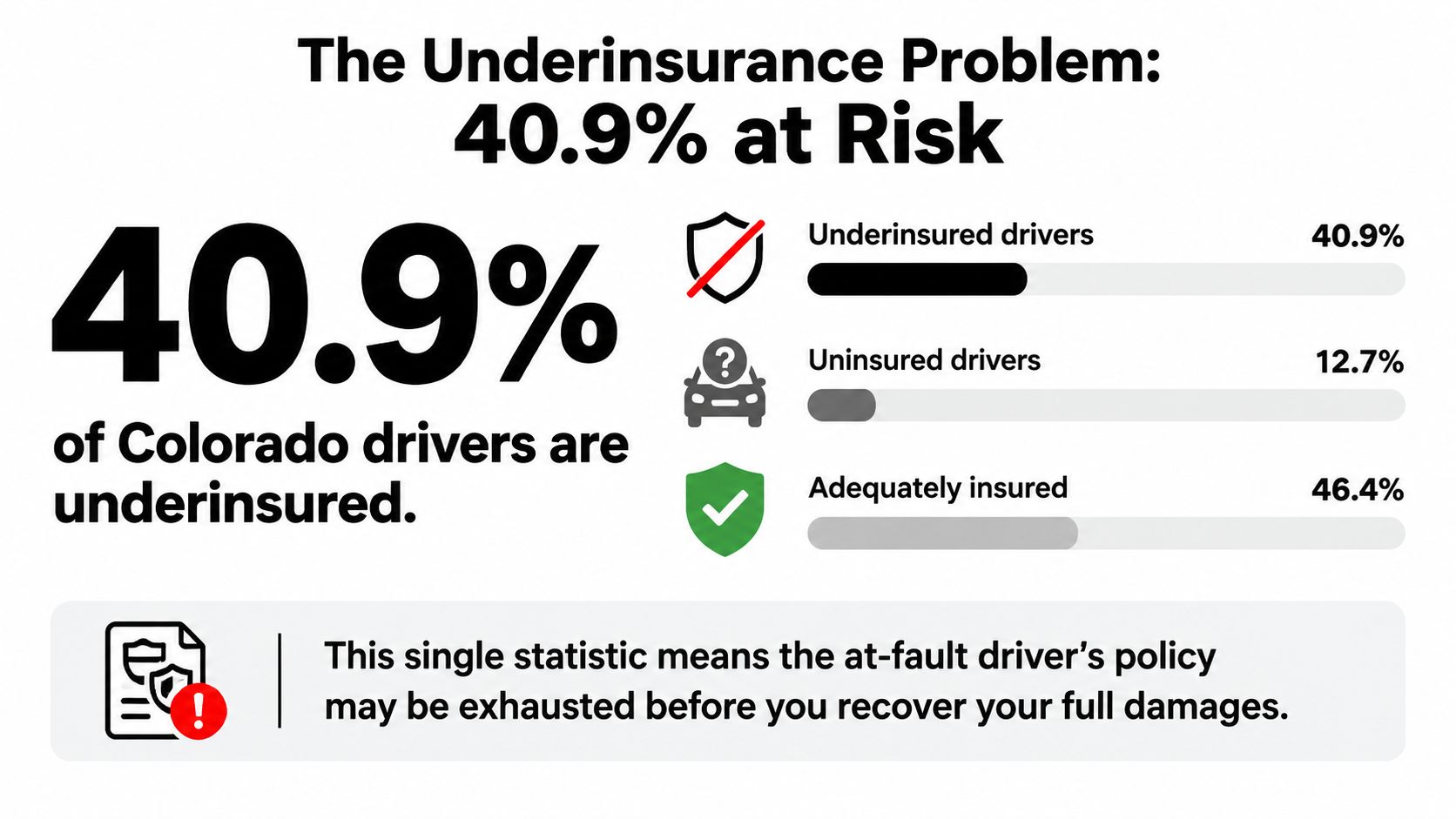
The most important warning is coverage. The Insurance Research Council reported that 15.7% of drivers nationwide were underinsured in 2022, while Colorado's underinsured-motorist rate reached 40.9% that year, according to the data summarized by Case Worth Now's coverage analysis. A strong claim can still produce a disappointing recovery when the at-fault driver's policy runs out. This guide treats compensation as a working playbook, not legal theory.
The First Days After a Crash and Why Compensation Exists
A rear-end collision on an icy Colorado highway rarely ends when the vehicles stop moving. You may spend the next few hours waiting for a tow truck, answering questions from a police officer, and riding to the emergency room. The following morning brings missed shifts, prescription costs, vehicle problems, and an insurance adjuster who sounds helpful while trying to frame the crash as a low-impact event.
That pressure exists because compensation claims are not paid automatically. The injured person must connect the other driver's conduct to the collision, the collision to the injuries, and the injuries to measurable financial and personal losses. The legal system uses damages to shift those costs back toward the person or entity responsible for causing the harm.
Compensation follows the harm
A claim can include medical treatment, lost income, reduced earning ability, vehicle-related expenses, physical pain, emotional distress, and the effect of the injury on ordinary life. A soft-tissue injury that resolves with consistent care presents a different valuation problem from a spinal injury that requires surgery or a brain injury that changes someone's ability to work.
Medical records and wage documents establish the foundation, but the final value also depends on future consequences. A claimant who returns to normal activities may have a smaller long-term claim than someone who needs continuing treatment, cannot return to the same occupation, or requires help with daily tasks.
Practical rule: Don't let an adjuster define the value of your injury before your doctors can define the recovery path.
The next decisions matter. Report the crash, seek appropriate medical care, preserve photographs and communications, and avoid casual statements that minimize symptoms. You'll need to understand the three damage categories, the calculation methods insurers use, the evidence that supports future losses, and the coverage available when the other driver cannot pay enough.
The underinsurance problem frames every serious claim. Before you discuss settlement, find out whether the at-fault driver has enough liability coverage and whether your own household has uninsured or underinsured-motorist protection.
The Categories of Compensation You Can Recover
Car accident damages generally fall into economic damages, non-economic damages, and, in unusual cases, punitive damages. The categories overlap in real life, but separating them helps you identify what evidence belongs in the claim.
Economic damages reimburse measurable losses
Economic damages cover losses that can be supported with bills, records, invoices, or credible projections. They may include:
- Medical expenses: Emergency care, hospital treatment, physician visits, medication, physical therapy, imaging, injections, surgery, and related rehabilitation.
- Future medical care: A physician may recommend additional injections, a fusion procedure, counseling, or in-home assistance. Those costs require medical opinions and, in complex cases, a life-care plan.
- Lost wages: Pay records and employer statements can establish missed work, reduced hours, and used leave.
- Diminished earning capacity: A concussion that prevents a teacher from managing a classroom can affect future earning ability even if the person eventually finds different work.
- Out-of-pocket costs: Mileage to appointments, transportation, rental-car expenses, medical equipment, and household help may belong in the claim when documented.
A herniated disc illustrates the difference between past and future damages. The initial medical bills show what the injury has already cost. A treating surgeon's opinion may establish that future treatment is reasonably necessary, while employment evidence can show how the injury affects income.
Non-economic damages describe the human cost
Pain and suffering, emotional distress, sleep disruption, loss of enjoyment of life, scarring, disfigurement, and relationship effects don't come with ordinary receipts. The proof comes from treatment notes, testimony, photographs, activity changes, and consistent descriptions of how the injury affects daily life.
A concussion may prevent someone from reading, driving, teaching, or participating in family activities. Those limitations matter even when the medical bills alone don't capture them.
Punitive damages serve a different purpose
Punitive damages punish unusually reckless or wrongful conduct. They don't reimburse ordinary medical losses. They're difficult to obtain and depend heavily on state law and the facts of the driver's conduct. In Colorado, punitive awards are capped at the amount of compensatory damages.
| Damage Category | What It Covers | Common Examples |
|---|---|---|
| Economic | Financial losses caused by the crash | Medical bills, future care, lost wages, reduced earning capacity, transportation |
| Non-economic | Physical and personal effects | Pain, emotional distress, scarring, loss of enjoyment, relationship impact |
| Punitive | Punishment for extreme misconduct | Exceptionally reckless conduct, where permitted by law |
The key is completeness. Listing only the hospital bill gives the insurer an incomplete picture and makes it easier to ignore future care, income loss, and the daily consequences of the injury.
How Compensation Is Actually Calculated
A strong injury claim can still produce little money if the available insurance is low. Adjusters value more than a diagnosis. They review treatment records, recovery time, objective findings, work disruption, credibility, fault, and policy limits. Courts also require evidence, not a guaranteed formula.
Start with verified losses
The calculation begins with medical expenses and documented income loss. Future care needs medical support linking the treatment to the crash. A treating physician should explain that connection, while a life-care planner or medical economist may estimate long-term costs.
Non-economic damages require judgment. Lawyers and adjusters may discuss a per diem method, assigning a daily value to pain during recovery, or a multiplier method, applying a factor to economic losses. Published guidance commonly discusses roughly 1.5 to 5 times economic losses, but that range is not a legal entitlement or dependable calculator, as explained in this guide to typical car accident settlement amounts.
The evidence determines where a claim falls. Clear fault, imaging findings, lengthy treatment, permanent impairment, credible testimony, and substantial wage loss support a higher valuation. Treatment gaps, inconsistent statements, prior similar injuries, disputed causation, or social-media posts that contradict reported limitations give insurers reasons to reduce an offer.
Severity changes the valuation
A short-lived sprain usually involves limited treatment and little income loss. A fracture or concussion may require imaging, injections, or extended therapy, increasing both medical expenses and time away from work. A herniated disc followed by surgery can add future restrictions, additional care, and reduced earning capacity.
Permanent impairment changes the analysis again. A traumatic brain injury may require neuropsychological testing, vocational analysis, and life-care planning because cognitive limitations can affect earnings and independence for years. Scarring, lasting pain, and restrictions on ordinary activities also make the claim more serious.
Settlement discussions often group these fact patterns into broad bands, from the low five figures for limited injuries, to mid-five-figure to low-six-figure outcomes for significant treatment and wage loss, and potentially six or seven figures for catastrophic injuries. These are practical benchmarks, not promises. The medical record, functional impact, and available coverage control the result. For a practical discussion of car accident settlement payouts, review the factors used to evaluate those claims.
The arithmetic matters, but coverage can matter more. A claim may be worth far more than the policy available to pay it.
The Underinsurance Problem That Changes Everything
A serious injury claim can exceed the at-fault driver's policy quickly. In Colorado, underinsured drivers are common enough that checking available coverage must happen before settlement, not after. The Case Worth Now 2026 settlement analysis illustrates the problem: a $90,000 surgery can exceed Colorado's stated $25,000 per person liability minimum before wage loss, future treatment, or pain is considered.
Underinsured-motorist coverage, usually called UIM, can help when the at-fault driver carries liability insurance but not enough to pay the damages. Uninsured-motorist coverage, or UM, applies when the responsible driver has no usable liability coverage. You claim these benefits from your own insurer because your policy provides protection for this situation.
Check every policy before settling
Review your declarations pages, household vehicles, and policies held by resident relatives where applicable. Some policies and jurisdictions permit stacking, which may combine coverage from multiple vehicles or policies. The policy language and state rules control. Do not sign a release from the at-fault carrier until you identify possible UIM coverage and obtain any required insurer consent.
Colorado, Texas, and New York show why local rules matter. The stated liability minimums are $25,000 per person in Colorado, $30,000 in Texas, and $25,000 in New York. A $90,000 surgery exceeds each stated floor, leaving no meaningful room for lost income or later care.
The same review should include health insurance, med-pay coverage, liens, and subrogation rights. A health insurer or benefit plan that paid medical bills may seek reimbursement from the recovery. Calculate that obligation before accepting an offer, because the gross settlement is not the amount you necessarily keep.
For a plain-English explanation, read this guide to underinsured versus uninsured motorist coverage. The Duncan Associates Insurance Brokers resource on underinsured motorist coverage offers further insurance background.
Do not accept a quick check because it helps today. First establish your medical outlook, identify every applicable policy, and determine whether your own UIM coverage can pay the gap.
The Claim Process From Crash to Settlement
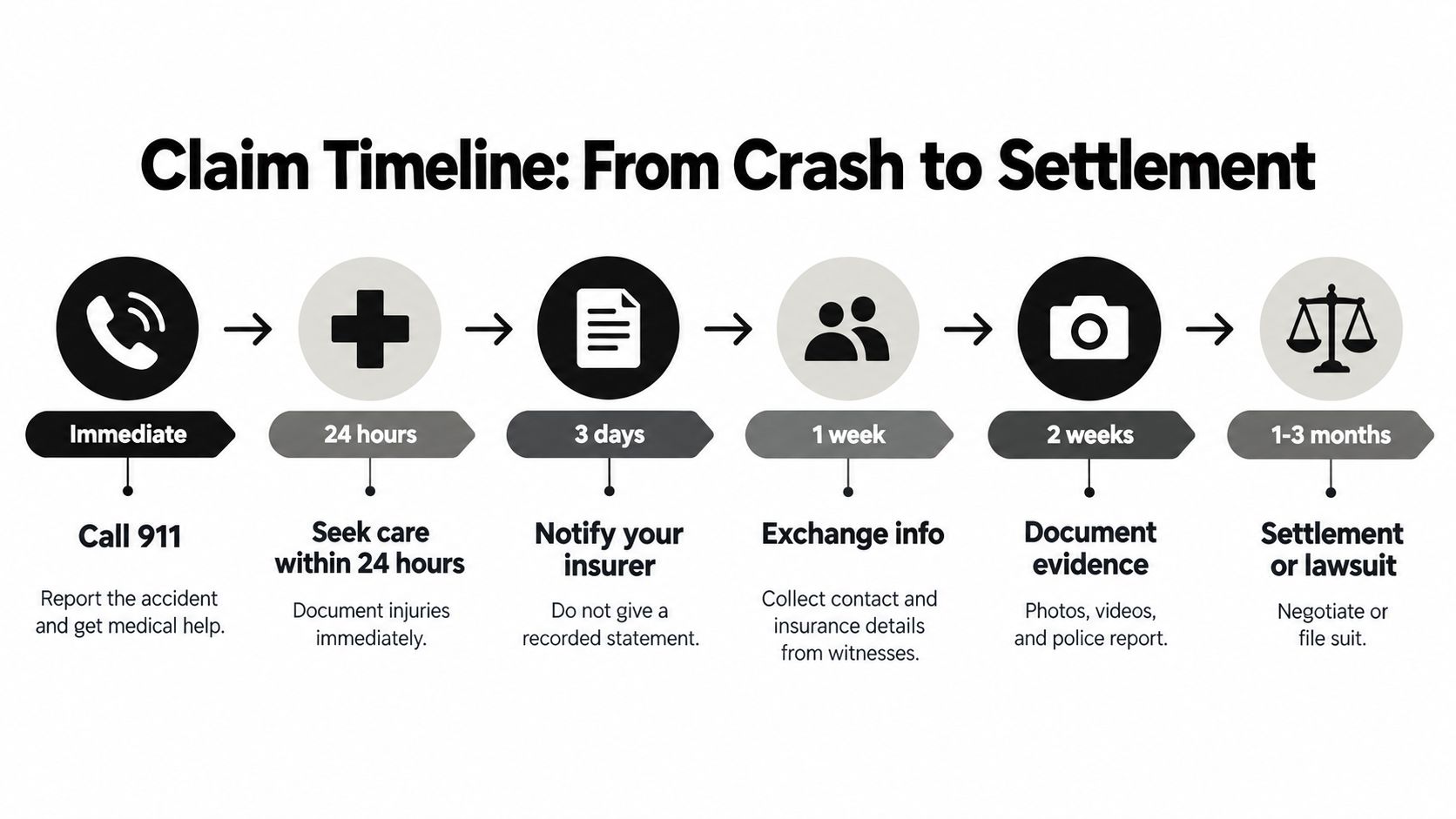
The claim begins at the scene, but the evidence-building process continues through treatment and negotiation. Each step affects the next one.
- Call 911 and request medical help. Give an accurate account, avoid arguing about fault, and obtain the responding agency's information.
- Seek prompt medical care. A medical visit within 24 hours is the practical target identified in the plan notes. Tell the provider every symptom, even if it seems minor.
- Notify the insurer carefully. Report the collision, but don't give a recorded statement before understanding your rights.
- Preserve documents. Save photographs, repair estimates, medical records, prescriptions, wage records, and every letter or email from the carrier.
- Complete the medical course or reach maximum medical improvement. A demand made before the prognosis is clear can undervalue future care.
- Prepare the demand and negotiate. The demand should connect liability, causation, treatment, wage loss, future needs, and non-economic harm.
Treatment duration affects expectations. Soft-tissue cases often resolve in three to six months, surgical cases commonly run nine to eighteen months, and litigated cases can exceed two years, as described in the assignment's planning data. These are practical ranges, not deadlines.
Fault rules change the leverage
Colorado uses modified comparative negligence with a 50% threshold, Texas applies a 51% bar, and New York follows pure comparative fault, according to the jurisdictional framework supplied for this guide. The facts assigned to you can reduce or eliminate recovery depending on the state, so don't make admissions about speed, distraction, or following distance without legal advice.
The filing deadline also matters. The supplied state notes identify two years in Colorado and Texas and three years in New York for the relevant injury claims. A pending negotiation doesn't necessarily protect the lawsuit deadline.
For a practical overview of the mechanics of notifying and presenting a claim, see how to file insurance claims. Pain can also complicate treatment decisions, so a resource on personal injury pain management from Midwest Pain & Wellness may help you understand why symptom control and documentation should proceed together.
The Evidence That Makes or Breaks a Claim
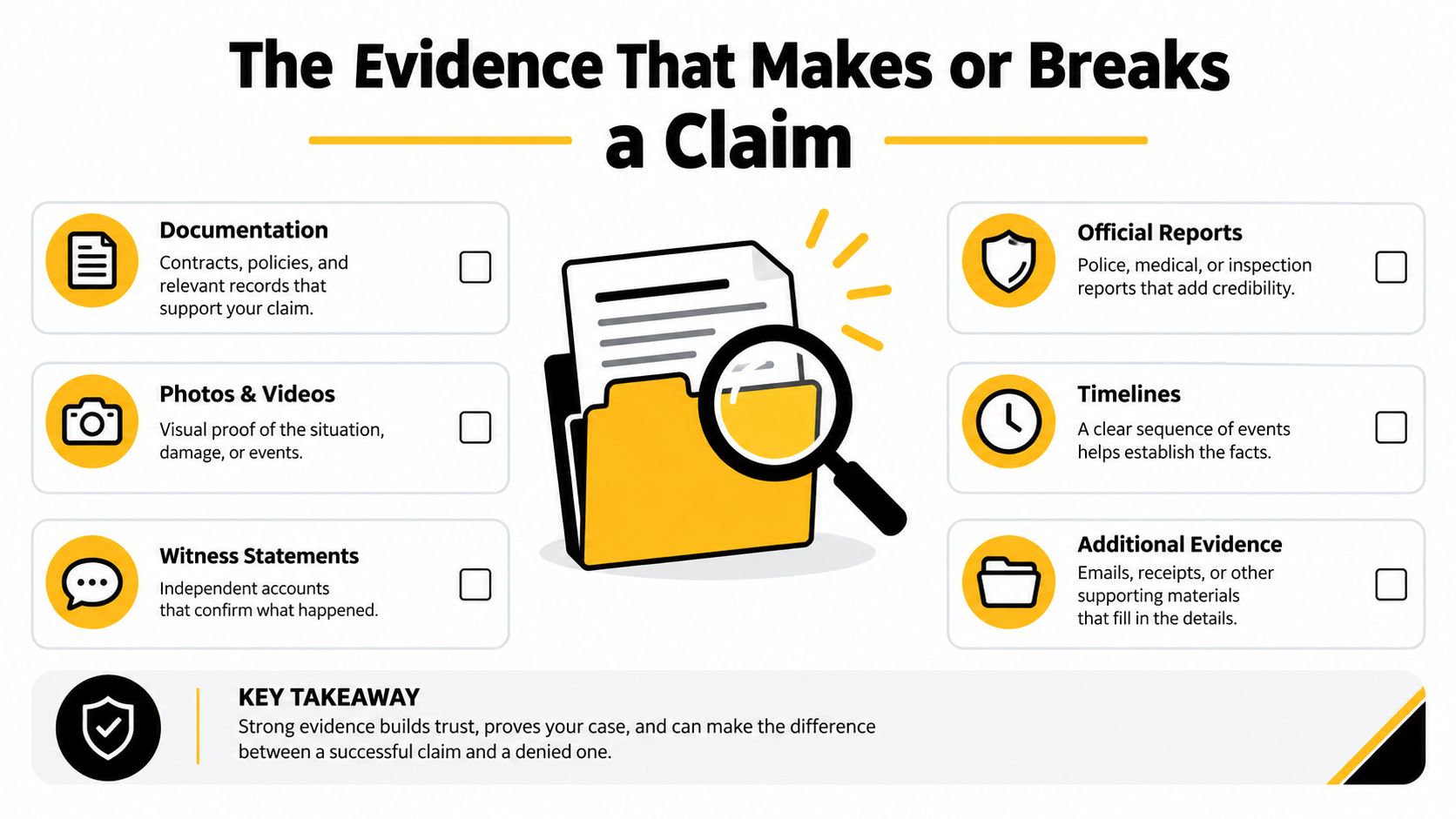
A persuasive claim answers four questions: Who caused the crash? What injury did it cause? What did it cost? What will it cost next? Every piece of evidence should serve one of those questions.
Liability evidence
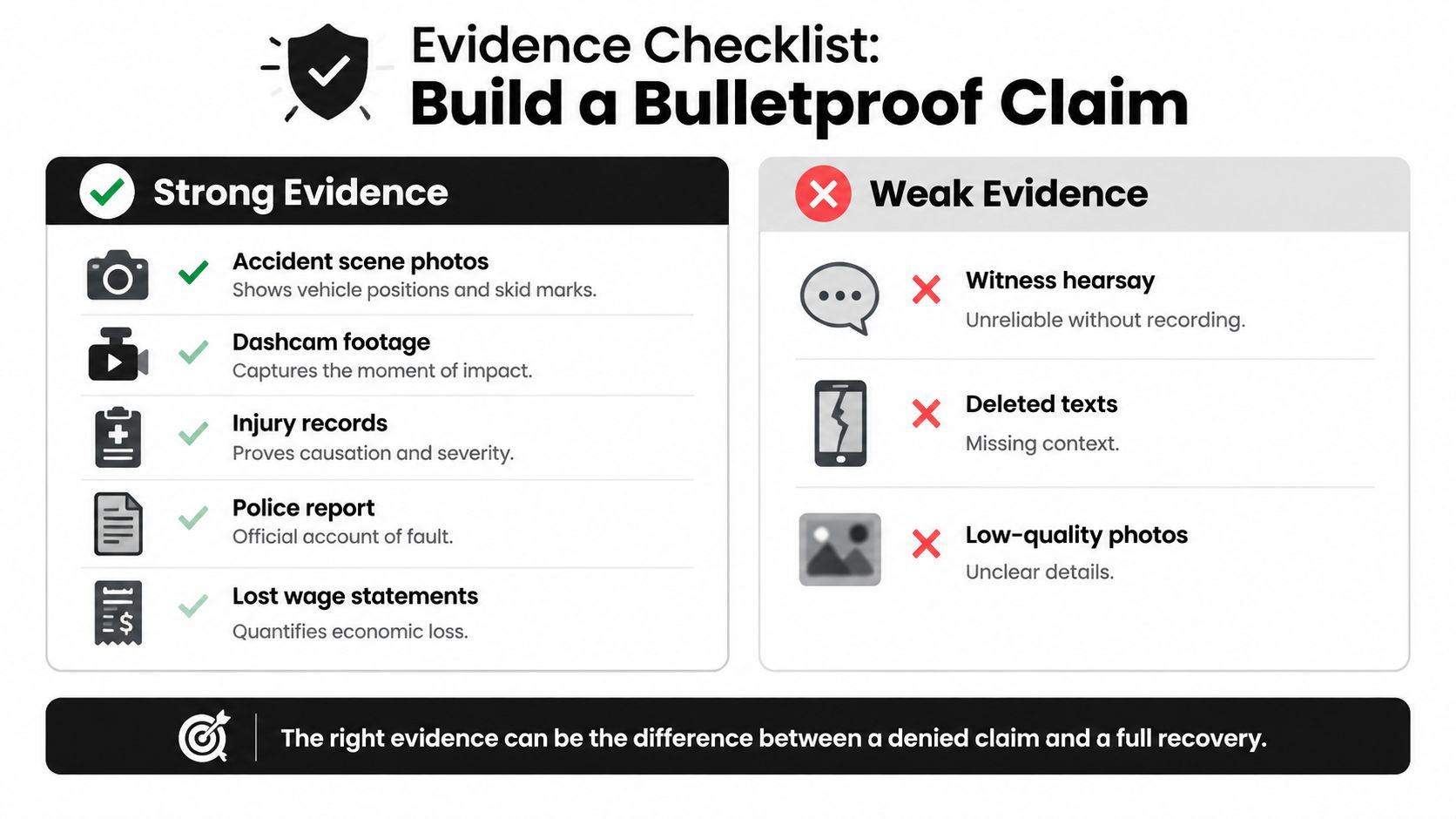
Scene photographs show vehicle positions, road conditions, damage, skid marks, traffic controls, and debris. Video from a dashcam, nearby business, or witness can establish timing and impact. The police report may record statements, diagrams, citations, and observations, but it can contain errors. If an officer misunderstood your account, address the mistake through the appropriate process rather than assuming the report will correct itself.
Vehicle damage can also help explain force and mechanism. A salvage auction accident lookup resource from Cararam may provide background when a vehicle's prior history becomes relevant, but it doesn't replace crash-specific evidence.
Causation and severity evidence
Medical records work best when they show a consistent timeline. Tell treating providers what hurts, when symptoms began, what activities changed, and whether the condition is worsening. Imaging, physician notes, specialist referrals, and treatment recommendations help distinguish a documented injury from a vague complaint.
For brain injuries, the strongest proof often combines emergency-room records showing disorientation or loss of consciousness, CT or MRI findings, neuropsychological testing, longitudinal physician notes, and functional or vocational assessments. Traumatic brain injury claim guidance explains why objective medical and economic evidence becomes especially important when cognitive limitations affect future work and care.
Financial and daily-life evidence
Employers can document missed work, reduced duties, and wage rates. Tax records may help establish historical earnings, while vocational experts can address future capacity. A daily pain journal can preserve details that medical appointments don't capture, including sleep disruption, household limitations, missed activities, and medication effects.
Gaps in treatment give the insurer an argument that the crash didn't cause the continuing condition.
Keep the journal factual, not theatrical. Preserve messages, calendars, receipts, and photographs. Assume social-media posts may be reviewed or subpoenaed, especially when a public activity appears inconsistent with claimed limitations. Evidence collection is continuous. The scene starts the record, but treatment, work, family observations, and daily restrictions complete it.
Negotiation Tactics and When to Hire a Lawyer
Self-handling can make sense when fault is undisputed, injuries are minor and fully resolved, treatment is complete, there's no wage or future-care claim, and coverage clearly exceeds the documented loss. Even then, read the release carefully. The first offer is a starting position, not a verdict on what your claim is worth.
Anchor negotiations in organized proof. Present medical records, bills, wage documentation, photographs, and a clear explanation of future care. Make the demand after the medical picture is reasonably developed, respond in writing, and don't let an adjuster turn a sympathetic conversation into an informal recorded statement.
The warning signs justify counsel
Bring in a lawyer when the carrier disputes fault, blames you for the crash, minimizes a serious injury, sends a denial, points to low policy limits, raises a preexisting condition, or pressures you to settle before treatment ends. A lawyer can investigate coverage, preserve evidence, coordinate records, evaluate liens, and frame future losses that an adjuster won't volunteer to include.
Colorado's modified comparative negligence rule makes fault arguments especially important. A careless statement can reduce settlement power, and a recorded interview may give the insurer language it can use against you. Litigation also matters strategically. The credible possibility of a lawsuit can force the carrier to evaluate courtroom risk rather than treating the claim as a routine file.
Understand the fee agreement
Personal injury lawyers commonly use contingency agreements, meaning the fee comes from the recovery rather than an upfront hourly bill. The written agreement should explain the percentage, litigation expenses, medical liens, case costs, and what happens if there's no recovery. Ask whether expenses are deducted before or after the fee is calculated.
| Situation | Self-Handle | Hire a Lawyer |
|---|---|---|
| Minor injury, clear fault, complete recovery | Reasonable if records are organized | Useful for reviewing a release |
| Serious treatment or possible surgery | Risky because future losses are uncertain | Strongly consider representation |
| Disputed liability or comparative fault | Limited negotiating leverage | Counsel can investigate and develop fault proof |
| Low limits or possible UIM claim | Coverage may be overlooked | Lawyer can coordinate policies and releases |
| Denial, recorded statement request, or deadline concern | High risk of procedural mistakes | Get advice promptly |
Nares Law Group LLC handles motor-vehicle claims by evaluating liability, medical damages, insurance coverage, liens, and settlement strategy before clients give up their rights. That kind of review shifts the insurer's pressure away from an injured person who is trying to recover.
Putting It Together With State-Specific Notes
Use this checklist during the next few days:
- Get medical care and follow recommendations. Report every symptom and keep appointment records.
- Preserve the scene evidence. Save photographs, video, witness details, vehicle information, and the police-report contact.
- Notify the right insurers. Report the crash, identify your UM and UIM policies, and avoid a recorded statement until you've received advice.
- Track financial harm. Keep wage statements, employer communications, prescriptions, mileage, transportation receipts, and household-help costs.
- Protect the future claim. Don't sign a release while treatment, prognosis, coverage, or liens remain unresolved.
- Get help when the facts demand it. Serious injuries, disputed fault, limited coverage, or a looming deadline justify an early case review.
State law changes the strategy. Colorado uses modified comparative negligence at the stated 50% threshold, and the supplied notes identify DMV SR-1 reporting requirements when an accident involves injury. Texas applies the stated 51% comparative-fault bar and may impose caps on medical damages in certain cases. New York is a no-fault state, so PIP filing requirements can affect the path toward a lawsuit.
Colorado's underinsurance rate makes policy review essential. Don't assume the other driver's limits match the cost of surgery, rehabilitation, lost earnings, and permanent impairment. Identify household coverage before signing a liability settlement, and ask how stacking, consent, med-pay, and subrogation affect the net recovery.
Compensation is built in the first weeks after a crash. Prompt care, consistent reporting, preserved evidence, and careful insurance communications create an advantage long before anyone drafts a demand letter.
Nares Law Group LLC helps injured people evaluate liability, medical losses, lost income, insurance coverage, liens, and settlement strategy in car accident injury compensation claims. Visit Nares Law Group LLC to request a case review before an insurer's offer or release limits your options.