Most car accident settlement payouts fall in a broad band of roughly $3,000 to $75,000, with a national median near $23,900 and a mean near $31,000. Serious injury cases can push well past that range.
You may be staring at an insurer's first offer right now, trying to decide whether it will cover the emergency bill, follow-up treatment, missed paychecks, and the disruption the crash has caused at home. The number on that letter may look substantial until medical providers, health insurers, attorneys, and government programs claim portions of it.
The headline average rarely tells you what you'll keep. Policy limits, documented losses, medical inflation, liability disputes, and liens usually matter more than a national average pulled from claims that may have little in common with yours.
What a Car Accident Settlement Payout Really Means
Suppose an adjuster offers you a check after a rear-end collision. You still have neck pain, your doctor hasn't determined whether more treatment is necessary, and your employer has only confirmed part of your missed time. That offer isn't a final answer to what your claim is worth. It's the insurer's proposed price for ending the claim before you know the full cost.
A car accident settlement payout is the gross compensation paid to resolve a claim. The payment usually comes from an insurance carrier, although a defendant may personally contribute when coverage doesn't satisfy the proven losses. A settlement can include economic damages, such as medical expenses, lost wages, and out-of-pocket costs, along with non-economic damages, such as pain, emotional distress, and loss of enjoyment of life.
You can receive money through two basic channels:
- Insurance settlement: You negotiate with the carrier before filing suit or while a lawsuit is pending, then sign a release in exchange for payment.
- Judgment: You take the case through trial, and a judge or jury awards damages. Collecting that judgment can still depend on available insurance and collectible assets.
Most personal injury claims resolve without a trial. The reason is practical. Both sides face uncertainty, expense, delay, and evidentiary risk when they ask a jury to decide the result.
The number on the settlement agreement is gross recovery. Your real result is the net recovery after every valid deduction.
Before signing, understand what a settlement agreement does, especially its release language. A release commonly ends your right to seek more money for the crash, even if later treatment reveals a condition you didn't know about.
Accurate accident documentation also starts early. Reviewing Vektracer accident report data can help you understand the kinds of information that may matter when reconstructing what happened, although your own police report, photographs, medical records, and witness evidence will control your claim.
Typical Settlement Ranges You Can Compare To
Published figures are useful only when you understand what they measure. A median identifies the midpoint, meaning half the claims fall below it and half above it. A mean adds all payouts and divides by the number of claims. Large catastrophic recoveries can pull the mean upward, which is why the mean near $31,000 is higher than the median near $23,900 in the cited Insurance Research Council data (settlement statistics).
Those figures place many bodily-injury claims in a broad range of approximately $3,000 to $75,000 or more, but that range isn't a promise. Minor soft-tissue claims generally occupy the lower end when treatment is brief and the claimant returns to normal function. Documented fractures, disc injuries, concussion symptoms, or extended treatment can move a claim toward the middle or above it. Permanent impairment, surgery, traumatic brain injury, paralysis, or substantial future care can produce recoveries far beyond ordinary claims.
A California benchmark shows why geography and claim severity matter. For bodily-injury liability claims in 2021, the reported average claim severity was $51,634.68, according to the source's discussion of insurance claim data (California settlement analysis). That figure reflects a large, expensive market and shouldn't be treated as a Colorado valuation.
Read the range without fooling yourself
| Injury Severity | Typical Payout Range | Median Estimate | Notes |
|---|---|---|---|
| Minor or soft-tissue injury | Qualitatively, the lower end of the broad range | No reliable universal median | Treatment duration, objective findings, and recovery matter |
| Moderate injury | Qualitatively, the middle of the broad range | No reliable universal median | Ongoing care, imaging, injections, fractures, or concussion symptoms can increase value |
| Serious or permanent injury | Often above the broad range | No reliable universal median | Surgery, impairment, lost earning capacity, and future care drive valuation |
Some published case summaries report a national average around $30,416, while another analysis of more than 4,500 cases reports an average closer to $37,248.62. State-level figures can diverge dramatically, with one cited summary listing New York at $287,000 and California at $185,000, compared with that national figure (why averages mislead consumers). The important point isn't selecting the most flattering number. It's recognizing that catastrophic claims can distort averages and that coverage limits may control an individual result.
Colorado readers should use national data as a rough orientation, not a prediction. Your medical proof, fault evidence, available insurance, and likely future losses are more useful than comparing your injury to an extreme state average. For head trauma, review the distinct valuation issues discussed in average settlements for traumatic brain injury.
What Drives the Size of Your Payout
An adjuster doesn't value your claim based on the crash photograph alone. The carrier examines proof of loss, fault, medical causation, prognosis, and coverage, then argues over each disputed component.
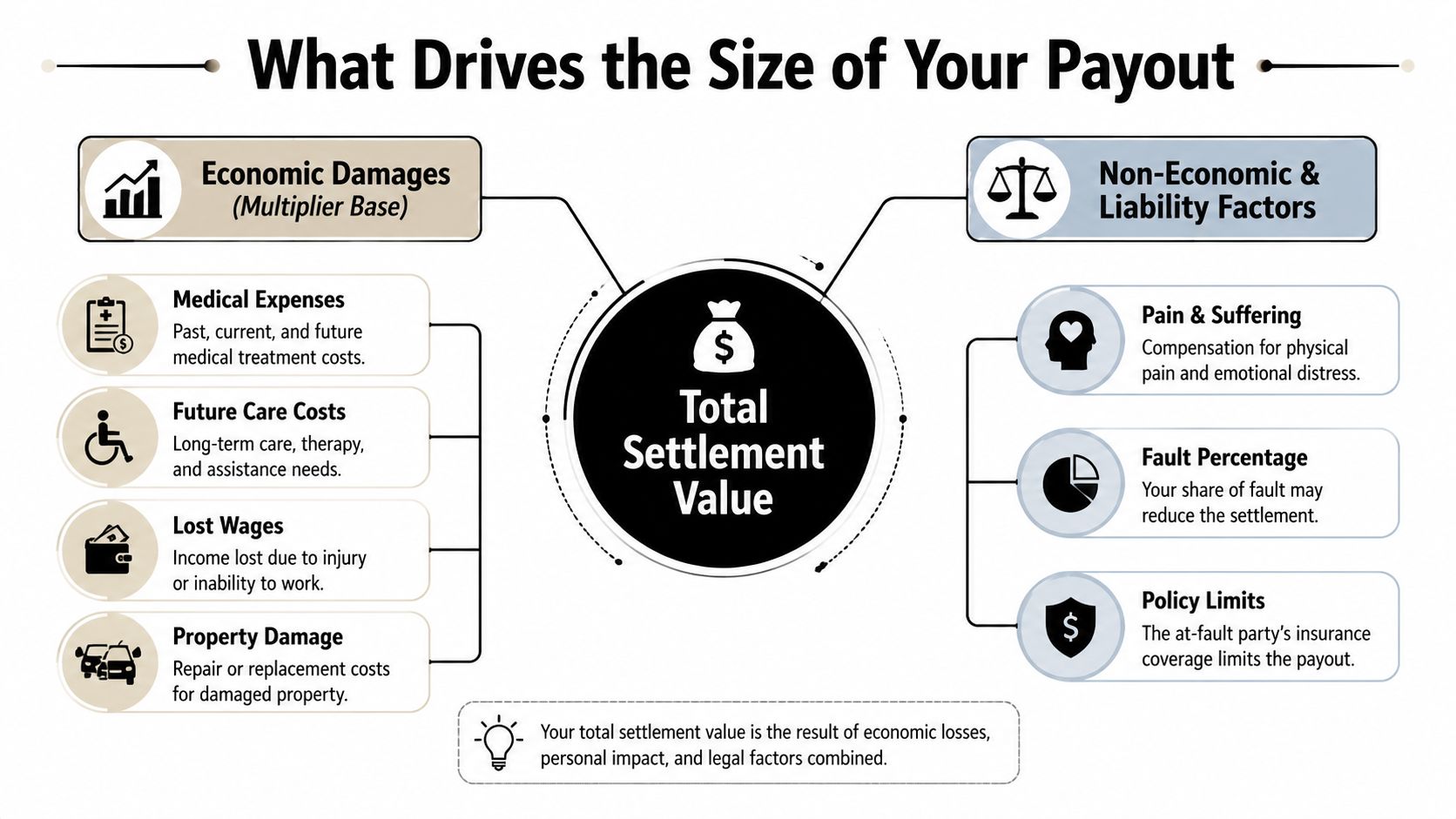
Economic losses create the foundation
Start with the bills and financial records:
- Medical expenses: Include emergency care, imaging, specialist visits, therapy, medication, surgery, and reasonably supported future treatment.
- Lost wages: Payroll records, tax documents, and employer verification connect the injury to the income you missed. A common calculation divides annual salary by 2,080 work hours, then multiplies the result by missed work hours, as explained in how lost wages are calculated.
- Reduced earning capacity: If your restrictions prevent you from returning to the same job or earning at the same level, the claim may include future income loss.
- Out-of-pocket costs: Transportation, medical equipment, household help, and other documented expenses can support the economic-damages calculation.
You can review the mechanics of economic damages calculation before assembling your records. Keep the documents chronological. Missing records create openings for the insurer to argue that an expense is unrelated, excessive, or unproven.
Fault and human consequences change the result
The carrier will investigate whether you caused or contributed to the collision. A percentage of fault can reduce your recovery under applicable comparative-negligence rules. Liability evidence includes traffic-camera footage, vehicle damage, scene photographs, crash reports, witness accounts, cellphone evidence, and expert reconstruction when necessary.
Non-economic damages account for the harm that invoices can't capture. The claim may address pain, emotional distress, interrupted sleep, loss of normal activities, scarring, disfigurement, and the effect on family life. A detailed treatment record and consistent personal account are stronger than a bare assertion that the crash was difficult.
Long-term cases require more than current bills. Doctors may need to explain future care, permanent restrictions, impairment, and whether symptoms will affect work or daily activities. Vocational professionals and life-care planners can translate those limitations into a defensible damages model.
Policy limits can cap recovery even when liability is clear and the injuries are genuine. Check every available policy, including underinsured motorist coverage, before evaluating the offer.
How Insurance Companies Calculate Settlement Offers
Adjusters often begin with a valuation model rather than a blank sheet of paper. A common framework adds economic damages, applies a pain-and-suffering multiplier ranging from 1.5 to 5, then adjusts the result for fault, policy limits, and other available coverage. That framework is only a starting point, not a legal rule or guaranteed formula.
The carrier may use paid medical amounts instead of the full billed charges, challenge whether future treatment is necessary, or apply internal assumptions to future losses. It may also overlook additional coverage unless someone identifies the policy and makes a specific demand. A projected care plan unsupported by a treating physician can receive little weight, even when the injured person's symptoms are real.
Claims software, billing codes, venue data, prior medical records, and adjuster-selected comparables can compress the offer further. These systems can organize information, but they can't replace a physician's explanation of causation or a careful account of how the injury affects work and daily life.
A strong demand package forces the carrier to confront the evidence. It should connect the crash to the diagnosis, identify past and future treatment, prove wage loss, explain disputed liability, and calculate the effect of any permanent restrictions. Independent medical narratives, life-care planning, and economist analysis can require the adjuster to recalculate rather than repeat an automated figure.
The mechanics are easier to follow visually:
The exact valuation depends on the claim, but the recurring weakness is predictable. Insurers calculate from the evidence most favorable to their position. Your job, usually with counsel, is to make the complete medical and financial picture impossible to ignore.
How Long Settlement Payouts Actually Take
A settlement doesn't start with a check. It starts with treatment, investigation, records collection, and a decision about whether your medical condition has stabilized enough to value future care.
Minor cases may resolve after treatment ends and liability is clear. Moderate injuries take longer when imaging, injections, surgery, or ongoing rehabilitation remain unresolved. Serious injuries, commercial-vehicle claims, and disputed-fault cases can continue through litigation, expert discovery, mediation, and trial preparation.
| Case Type | Median Time to Settlement | Typical Range |
|---|---|---|
| Minor injury with clear liability | No reliable universal median | Often several months after treatment concludes |
| Moderate injury with ongoing care | No reliable universal median | Commonly longer than a minor claim, depending on prognosis |
| Serious, commercial, or disputed case | No reliable universal median | May extend for years, particularly if litigation is necessary |
Colorado's general personal-injury filing deadline is three years from the date of loss, but waiting doesn't make the case safer. Evidence fades, witnesses become difficult to locate, and insurers may impose notice requirements. Before treatment records are complete, review practical insurance issues in this insurance guide.
Recorded statements, independent medical examinations, medical-lien negotiations, and final release processing can add time after the core settlement is reached. A quick offer is valuable only when it fairly accounts for the injury and you understand what you're giving up.
Steps That Maximize What You Take Home
The strongest claims usually begin with disciplined ordinary actions. You don't need to build a trial file alone, but you do need to preserve the evidence before it disappears.
Build the record immediately
Report the collision, obtain the police report number, and photograph the vehicles, debris, roadway, traffic controls, and visible injuries. Save photographs in their original form and write down what you remember before details blur.
Get medical attention promptly, then follow reasonable referrals. A treatment gap gives the insurer a simple argument that the injury was minor, unrelated, or resolved. If you can't attend an appointment, document why and reschedule rather than disappearing from care.
Prove every financial loss
Create one claim folder, whether physical or digital. Add medical bills, explanation-of-benefits statements, prescriptions, mileage, parking, wage records, employer letters, tax documents, and receipts for household assistance.
Ask your treating providers to document diagnosis, causation, restrictions, prognosis, and future recommendations. A bill proves that money was charged. A medical narrative explains why the charge and future care belong in the claim.
Control the negotiation
Don't give the adverse carrier a recorded statement before an attorney reviews the request. Answer accurately, but don't guess about speed, fault, symptoms, or recovery. Avoid social-media posts that contradict your reported limitations.
The first offer is often designed to close the file before the full damages picture develops. Don't reject it emotionally. Reject it analytically, identify what it omits, and respond with a documented demand that addresses treatment, income, liability, future care, and coverage.
You can also review practical guidance on how to overcome adjuster negotiation tactics. The decision to settle or file suit should account for the evidence, venue, comparative-fault risk, defendant solvency, and the effect of liens on the final amount.
Negotiate the net result, not just the gross number. A large offer can disappoint if medical balances, subrogation claims, fees, and costs consume it.
Before accepting, identify every lien and request reductions where the facts support them. Medicare and health-plan interests require careful handling, and signing a release without resolving them can create problems after the check arrives.
Colorado Rules That Change a Denver Payout
Colorado's modified comparative-negligence rule can reduce a recovery when the injured driver shares fault. Under C.R.S. § 13-21-111, a claimant generally must remain below the applicable fault threshold to recover, and the award is reduced according to the assigned share of responsibility. That makes intersection evidence, lane positioning, speed, and witness testimony central to valuation.
Colorado also requires drivers to carry minimum liability coverage of $25,000 per person and $50,000 per accident for bodily injury. Those limits can be inadequate for a serious injury, so your own underinsured-motorist coverage may become the practical source of additional recovery.
Other issues can change the analysis, including alcohol-service liability, insurance verification, uninsured drivers, and the Colorado Auto Accident Medical Payment or insurance-plan rules that may affect payment timing and available benefits. The correct venue can also influence litigation strategy, discovery, mediation, and trial presentation.
Don't sign a release until counsel confirms the responsible parties, applicable policies, jurisdiction, filing deadline, and lien obligations. The Colorado Department of Insurance may be relevant when an insurer's conduct raises regulatory or bad-faith concerns, but a complaint doesn't replace preserving your lawsuit deadline.
Questions Injured Drivers Ask Most
Are car accident settlements taxable?
Compensation for physical injuries is generally treated differently from amounts allocated to lost wages or interest. Because tax treatment depends on the settlement language and your circumstances, have a tax professional review the allocation before signing.
How long do I have to file in Colorado?
The general personal-injury limitations period is three years, but notice provisions, policy requirements, and evidence problems can shorten the practical timeline. Contact counsel well before the deadline.
Will the at-fault driver's insurance rate increase?
It may. The other driver's premium has nothing to do with your right to pursue compensation for proven losses.
What happens if the driver has no insurance?
Look for uninsured-motorist coverage under your policy and determine whether any applicable Colorado program or coverage source can respond. Your own insurer may still dispute liability, causation, or damages, so treat the claim seriously.
What happens to medical liens?
Medical providers, health insurers, and Medicare may assert reimbursement or subrogation interests. Resolve those claims before accepting a final number and negotiate reductions where possible. Otherwise, the gross payout can substantially overstate what you keep.
Should I accept the first offer?
Usually not before treatment and future-care questions are clear. A quick settlement can make sense for a fully healed injury with complete documentation and a fair offer. It's a poor choice when symptoms continue, surgery remains possible, liability is disputed, or policy limits and liens haven't been investigated.
Bring the crash report, photographs, insurance information, medical records, bills, wage documentation, correspondence from adjusters, and any settlement offer to a consultation. Those documents let an attorney evaluate the actual drivers of value rather than guess from an average.
Nares Law Group LLC helps injured drivers evaluate liability, medical damages, lost wages, insurance coverage, liens, and settlement strategy before they sign away their rights. Visit Nares Law Group LLC to request a consultation and discuss what your gross payout and likely net recovery may look like.