You're standing on the shoulder of the road in Colorado, trying to make sense of bent metal, a shaking hand, and a state trooper asking routine questions while traffic keeps flying by. That moment feels chaotic, but the motor vehicle crash report created at the scene can shape everything that follows, from the insurance adjuster's first call to the way a lawyer frames fault later on. I've pulled hundreds of these reports for injured clients, and I can tell you the same thing every time, the report matters, but it is not the whole truth.
What a Motor Vehicle Crash Report Actually Is
A crash report is the first official written record of a collision. In Colorado, you'll often see a State of Colorado DR 3447 or a similar agency form, completed by the officer at the scene or shortly afterward, while the details are still fresh. That report usually captures the time, location, vehicles involved, reported injuries, witness names, and a narrative or diagram based on the officer's perception of what happened.
That last part matters more than you might realize. The report is not a neutral replay of the crash; it is the officer's documented view of the scene, built from what they saw, what the drivers said, and what the physical evidence suggested at that moment. If you're also dealing with citations, it helps to think ahead about how they may interact with your injury claim, and a practical resource on handling traffic tickets after a crash can help you separate the criminal or traffic side from the civil claim side.
Why the report has legal weight
Insurers, attorneys, and courts rely on the report because it is contemporaneous and official. That does not make it perfect, but it does make it influential. A clean report can speed up a claim, while a sloppy or incomplete one can create friction that lasts for months.
In Colorado, drivers are also expected to make sure a crash gets reported when the law requires it, especially when there's death, injury, or apparent property damage over the applicable threshold. If you treat the report like a formality, you'll miss its real function. It becomes the paper trail that opens, and sometimes constrains, the rest of the case.
Practical rule: treat the report as the starting document, not the final answer. If it says the wrong lane, wrong vehicle, or wrong sequence, you need to correct the record fast.
Breaking Down the Sections and Fields
The useful parts of a crash report are not buried in legal jargon. They're in the boxes adjusters circle, the diagram lawyers enlarge, and the narrative that often gets quoted back to you later. If you know what each field means, you can spot where the report helps your case and where it leaves out critical facts.
The administrative header and vehicle data
The top section usually gives you the case number, reporting agency, date, time, weather, road surface, lighting, and similar scene conditions. That information sounds mundane, but it anchors the collision in a specific place and moment. If those details are wrong, the rest of the document can feel shaky.
Vehicle fields matter just as much. They typically list year, make, model, plate, insurance carrier, and sometimes policy information. That's the first place an adjuster checks when confirming who to contact and whether coverage might exist.
Occupants, injury coding, and the diagram
Occupant data often includes the driver, passengers, restraint use, ejection, and coded injury severity. Those codes can affect how an insurer reads the claim before anyone looks at hospital records. The diagram carries outsized weight because it reduces a messy event to a visual story of direction, impact point, and vehicle position.
The narrative section is where officer perception becomes most obvious. This is the officer's own description of what happened, and it often includes contributing factors or violation codes. Even when fault isn't formally assigned, that narrative gets reused by adjusters as if it were a verdict.
Crash Report Sections What Is Recorded vs What Is Often Missing
| Report Section | What It Records | Common Gaps |
|---|---|---|
| Administrative header | Date, time, location, weather, lighting, agency, case number | Exact visibility changes, temporary hazards, video timing |
| Vehicle information | Vehicle description, plate, insurance details | Prior damage, mechanical defects, data from vehicle systems |
| Occupant data | Names, restraint use, ejection, injury codes | Delayed symptoms, diagnosis changes, hidden soft-tissue injury |
| Diagram | Vehicle positions, travel paths, point of impact | Signal timing, lane closures, post-impact movement nuance |
| Narrative | Officer's summary and perceived sequence | Competing witness accounts, phone data, driver fatigue, distraction detail |
The strongest reports are precise. The weakest ones are tidy but incomplete. That difference decides more claims than most drivers ever see.
How to Get Your Colorado Crash Report
In Colorado, don't request the report the same day unless you enjoy hearing that it isn't ready yet. The investigating agency usually has to finalize it first, and that can take several business days after the crash. If you were hit on private property or in a hit-and-run matter, the report sits with the agency that had jurisdiction, not some generic statewide mailbox.
The practical route is the online portal, CDRPOnline at crashreports.colorado.gov. Drivers, passengers, and authorized representatives can search by case number, date, and name, then pay the required fee by card once the record is available. Some fatal and serious-injury reports carry access restrictions, so if you're not seeing it online, don't assume it doesn't exist.
What to do if the report isn't ready
Wait for finalization, then check again. Many people waste time demanding a copy too early, when the core issue is just that the agency hasn't closed the file yet. If online access doesn't work, go old school and request it by mail or in person through the Colorado State Patrol or the local records unit.
A separate guide on how to obtain an incident report is useful if you're trying to compare agency procedures or track down a record that's being routed through the wrong office. That kind of administrative mistake is common enough to slow a claim for no good reason.
Practical rule: download or print multiple copies the day you get it. Before you send it to an insurer, check for redactions so you don't accidentally rely on a version that hides key personal information.
What Crash Reports Routinely Miss
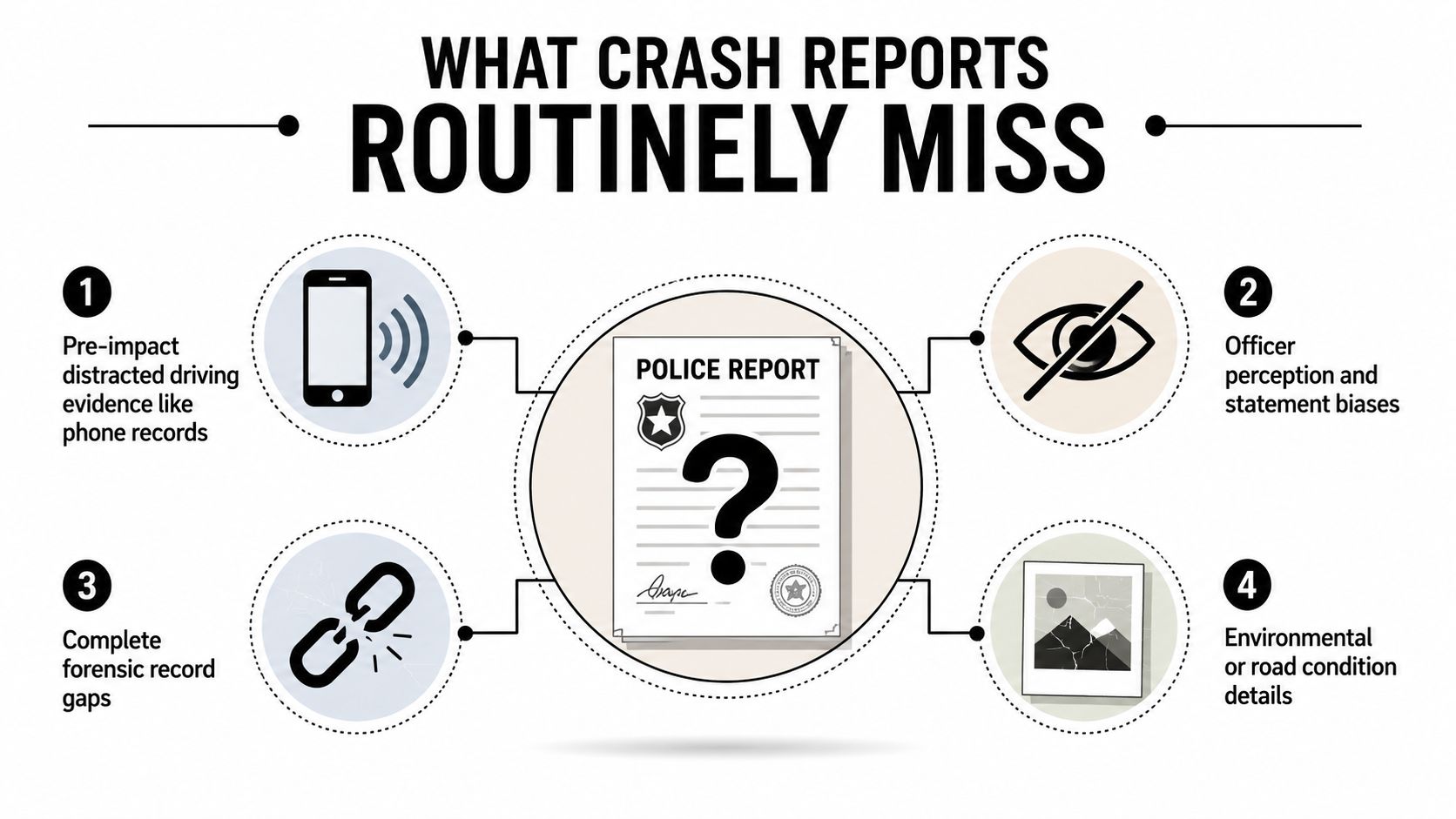
A crash report is a snapshot, not a full forensic file. That's the mistake people make. They assume the officer's paper is a complete account of causation, but real crash analysis usually starts where the report stops.
The missing evidence that changes liability
Police reports often leave out pre-impact distraction evidence like phone records, infotainment logs, and in-cab telematics. They also miss drowsy-driving signals unless someone independently digs into work logs, rest breaks, or a driver's routine. If impairment is involved, the report may list a DUI-related issue, but it usually won't give you the full picture of substance type, timing, or the chain of events around it.
The report also tends to skip road design defects, missing signage detail, vehicle defect clues, and post-crash vehicle movement. Those omissions matter because each one affects causation. If the insurer can say, “the report doesn't show it,” they'll use that gap to shrink your claim.
ADAS data sits outside the report
Modern vehicles create evidence the report never touches. Forward-collision warnings, automatic braking events, and electronic data recorder downloads can show what the car itself knew before impact. A lawyer has to request that information separately, and often quickly, because it doesn't live in the officer's file.
Bottom line: if the report is the first page of the story, the rest of the evidence has to be built around it. Don't let an incomplete narrative become the whole defense file.
The broader reporting problem is real, and it shows up when police and hospital data don't line up. That mismatch is part of why a crash report should never be treated as the final word on how bad the crash was or why it happened. In Colorado cases, I treat the report as a lead, then build a parallel evidence file on top of it.
Fixing Errors and Preserving Outside Evidence
Start with the obvious mistakes. Compare the report against your photos, dashcam footage, and own memory within days of receiving it. Wrong plate numbers, wrong direction of travel, omitted vehicles, and a misplaced point of impact are the kinds of errors that can snowball if you let them sit.
How to correct the paper trail
Submit a written amendment request to the responding agency, and attach proof. Keep it factual and specific, because vague complaints rarely move anyone. A supplement may get added to the file, but don't assume the officer will rewrite every conclusion just because you disagreed with it.
Preserving outside evidence is the part most people botch. 911 audio, traffic-camera footage, business surveillance video, EDR data, and ECM downloads can disappear fast if nobody asks for them. If a store camera captured the intersection, send a preservation letter before the system overwrites the video.
The law-firm guide on what is spoliation of evidence is worth reading if you're trying to understand why early preservation letters matter. Once evidence is gone, you're stuck arguing about what might have shown up instead of proving what happened.
Your first 30-day evidence list
- Photos and video: save every image from the scene, the vehicles, and your injuries.
- Witness details: get names, phone numbers, and short written statements while memories are fresh.
- Medical records: keep every urgent care note, imaging result, and discharge instruction.
- Digital evidence requests: send preservation letters for video, telematics, and 911 recordings.
- Repair and towing records: hold onto every invoice and storage document.
How the Report Is Used in Insurance Claims and Litigation
Adjusters lean on the report early because it gives them a fast story. They use the diagram, fault indicators, and contributing factors to decide how much friction your claim might have and how hard they want to push back. If the report supports you, it can help move the claim toward resolution. If it doesn't, the insurer will use the weak points to justify a low opening position.
A Colorado claim often turns on how the report's details line up with the rest of the evidence. If the contributing-circumstances section on the report points to one driver's failure, that can anchor negotiations. If the facts are muddy, the carrier will try to treat both drivers as partly responsible and drag out the process.
The same document matters in litigation, but in a different way. At trial, the report can become a public record, the officer can testify, and any mismatch between the narrative and the video or witnesses can be used to impeach credibility. That's why a report that looks harmless at first can become either a useful exhibit or a problem you need to explain away.
Two real-world claim patterns
A rear-end collision with matching damage photos and a report that cites following too closely usually gives the injured driver a strong position. The report and the photos tell the same story, so the insurer has less room to argue.
A left-turn crash with an officer narrative that gets the signal phase wrong is a different fight. If traffic-camera reconstruction later shows the turn was protected or the light cycle was different, the report stops being the main event and becomes just one weak layer in the file.
How report details shift outcomes
| Report Element | Insurance Claim Impact | Litigation Impact |
|---|---|---|
| Clear diagram | Helps establish sequence and narrow disputes | Supports witness and expert testimony |
| Contributing-circumstance code | Gives adjusters a basis for early fault assessment | Can support argument structure at mediation or trial |
| Narrative mismatch | Gives the carrier room to delay or discount | Can be impeached with video, photos, and records |
| Missing witness or vehicle info | Slows claim development and coverage review | Creates openings for supplementation and discovery |
A claims guide on how to file insurance claims is useful if you're trying to keep the reporting process from drifting into delay tactics. Insurers move fast when the report helps them, and you need to move just as fast when it doesn't.
Next Steps After You Have the Report in Hand
Treat the report like evidence, not closure. Read it line by line, compare it against your photos and medical notes, and store a backup copy in cloud storage and offline storage the same day you receive it. Don't post about the crash on social media, because casual comments and photos get pulled into claim disputes all the time.
Your medical file matters just as much as the report. Follow treatment, keep appointments, and write down pain, missed work, sleep trouble, and daily limitations from day one. Insurance carriers love gaps in care because they use them to argue that the injuries weren't serious or weren't caused by the crash.
What not to say to insurers
Do not give a recorded statement to the other driver's insurance carrier before you've spoken to counsel. Don't guess about speed, fault, or prior conditions, because those guesses get repeated later as if they were facts. If you're unsure, say you're unsure.
This is the point where legal help pays for itself. A Colorado personal injury attorney can request supplements, demand additional records, coordinate medical documentation, and keep the report from being used against you out of context. In a serious injury case, that kind of coordination usually matters more than whatever the first adjuster says on the phone.
Keep your story consistent, keep your records organized, and let the paper trail do the arguing for you.
If you're dealing with a crash report that feels incomplete, confusing, or flat-out wrong, Nares Law Group LLC can review the document, help gather the missing evidence, and build the claim around the full picture instead of one officer's first draft. Visit Nares Law Group LLC to get practical help from a Colorado injury firm that handles crash investigations, insurance disputes, and serious injury claims.