You hear the horn a fraction of a second before the impact. Then comes the glass, the airbag, the pain, and a rush of questions. Which driver had the light? Did anyone see the turn? Was the signal working correctly? While you're still in the hospital or waiting for a tow truck, an insurance adjuster may already be deciding how to describe the crash.
An intersection collision rarely turns on one sentence in a police report. Signal phases, camera footage, sight lines, vehicle data, roadway design, and witness accounts can change the liability analysis. If you were hurt in Denver or elsewhere in Colorado, an intersection accident lawyer can help protect the evidence and prevent a quick insurance narrative from becoming the permanent version of what happened.
The Aftermath of an Intersection Collision
The first hours after a crash are disorienting. You may be trying to understand a diagnosis, arrange transportation, contact family, and answer questions from law enforcement while your vehicle sits damaged at the intersection. Pain can also appear gradually. A person who feels only shaken at the scene may later face neck, back, pelvic, or head symptoms that affect work and daily life.
The legal vulnerability begins immediately. Drivers often say, “I'm sorry,” describe what they think happened, or agree with a suggestion that they may have been distracted. Those ordinary reactions can later appear in an insurer's file as an admission. You don't need to argue with the other driver, speculate about fault, or provide a recorded statement before you understand the facts.
Protect your health before the claim
Call 911 when someone is injured or the collision creates a safety risk. Accept medical evaluation even if you believe you can walk away. Medical records create a contemporaneous account of symptoms, and prompt treatment can help doctors identify injuries that aren't obvious during the first examination.
Pelvic pain deserves particular attention after a vehicle impact, especially when sitting, walking, or getting in and out of a car becomes difficult. A physical therapist's resource on treating pelvic pain post-accident may help you understand why follow-up care matters, but it doesn't replace an examination by your physician or emergency provider.
Treat the first account as incomplete
A police report may identify a suspected violation, but it usually doesn't answer every important question. Officers may arrive after vehicles move, traffic resumes, witnesses leave, or signal conditions change. The report may also reflect what people said under stress rather than what a reconstruction supports.
Practical rule: Give truthful, concise information. Don't guess about speed, signal timing, distance, or fault.
An intersection accident lawyer typically begins by identifying what could disappear first. That may include nearby business video, traffic-camera footage, vehicle damage, debris patterns, electronic records, and the memories of people who saw the collision. Your priority is recovery. Your legal team's priority is making sure the evidence survives long enough to tell the full story.
Why Intersections Are High-Risk Zones
A driver enters on a green signal, a pedestrian begins crossing, and a turning vehicle blocks the view of both. Within seconds, the case may involve signal timing, sight distance, roadway design, and competing accounts of who had the right of way. A side-impact collision can direct substantial force into the occupant compartment. A turning crash can injure a pedestrian or cyclist outside the vehicle.
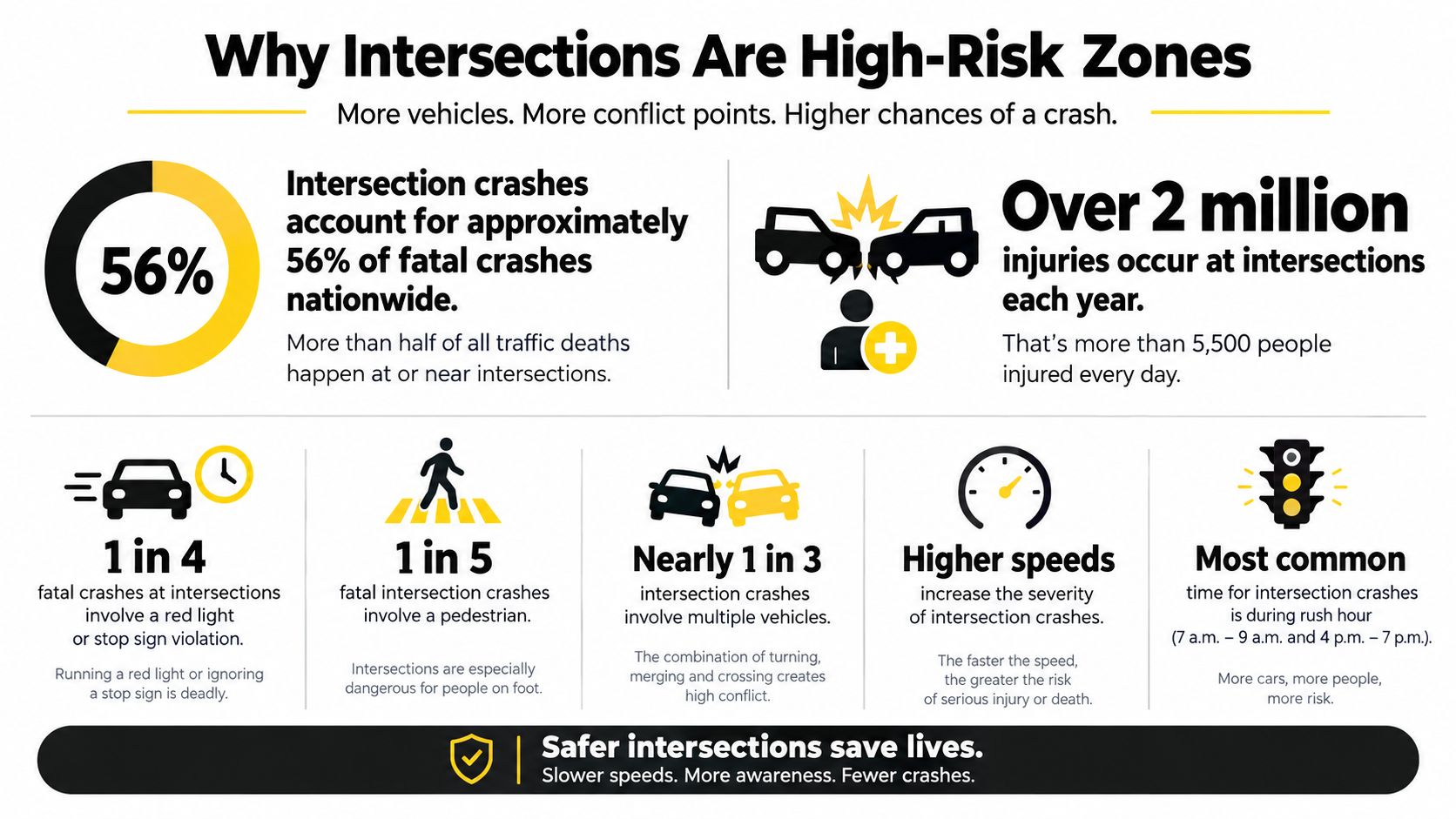
Federal safety data show why these cases demand close analysis. The Federal Highway Administration attributes roughly one-quarter of U.S. traffic fatalities and about one-half of traffic injuries to intersections. Its summary of National Highway Traffic Safety Administration data records 12,036 intersection-related fatalities in 2022, compared with 10,148 in 2018. (Federal Highway Administration intersection safety summary)
Different controls create different questions
At a signalized intersection, investigators may examine phase timing, yellow intervals, all-red clearance, detector operation, and whether each driver had a lawful path through the crossing. The same federal series reports that fatalities involving signalized intersections rose from 3,347 in 2018 to 4,204 in 2022. Fatalities involving red-light running at signalized intersections increased from 871 to 1,272 during that period.
Stop-sign cases require a different examination. An NHTSA study, the most recent intersection analysis available, estimated that 2,307,000 crashes occurred at U.S. intersections in 2008, representing about 40% of all crashes recorded nationwide that year. The study estimated 7,421 fatal intersection crashes and approximately 733,000 intersection crashes involving at least one injured occupant. (NHTSA intersection crash analysis)
At a stop sign, evidence may show stopping distance, visibility, gap judgment, or whether a vehicle entered before the path was safe. At an uncontrolled intersection, investigators may need to assess customary traffic flow, sight lines, signage, and the physical layout rather than a signal record.
Vulnerable road users face additional exposure
Drivers are only part of the investigation. The federal series recorded 983 pedestrian deaths and 182 bicyclist deaths involving signalized intersections in 2022. A turning driver's view may be blocked by another vehicle, a sign, weather, darkness, or the corner's geometry.
A strong claim therefore requires more than a simple right-of-way argument. An intersection accident lawyer must test whether the evidence supports driver negligence, a roadway-design defect, a signal problem, or several causes operating together. That work can include signal records, crash reconstruction, road measurements, and evidence from near-miss detection systems.
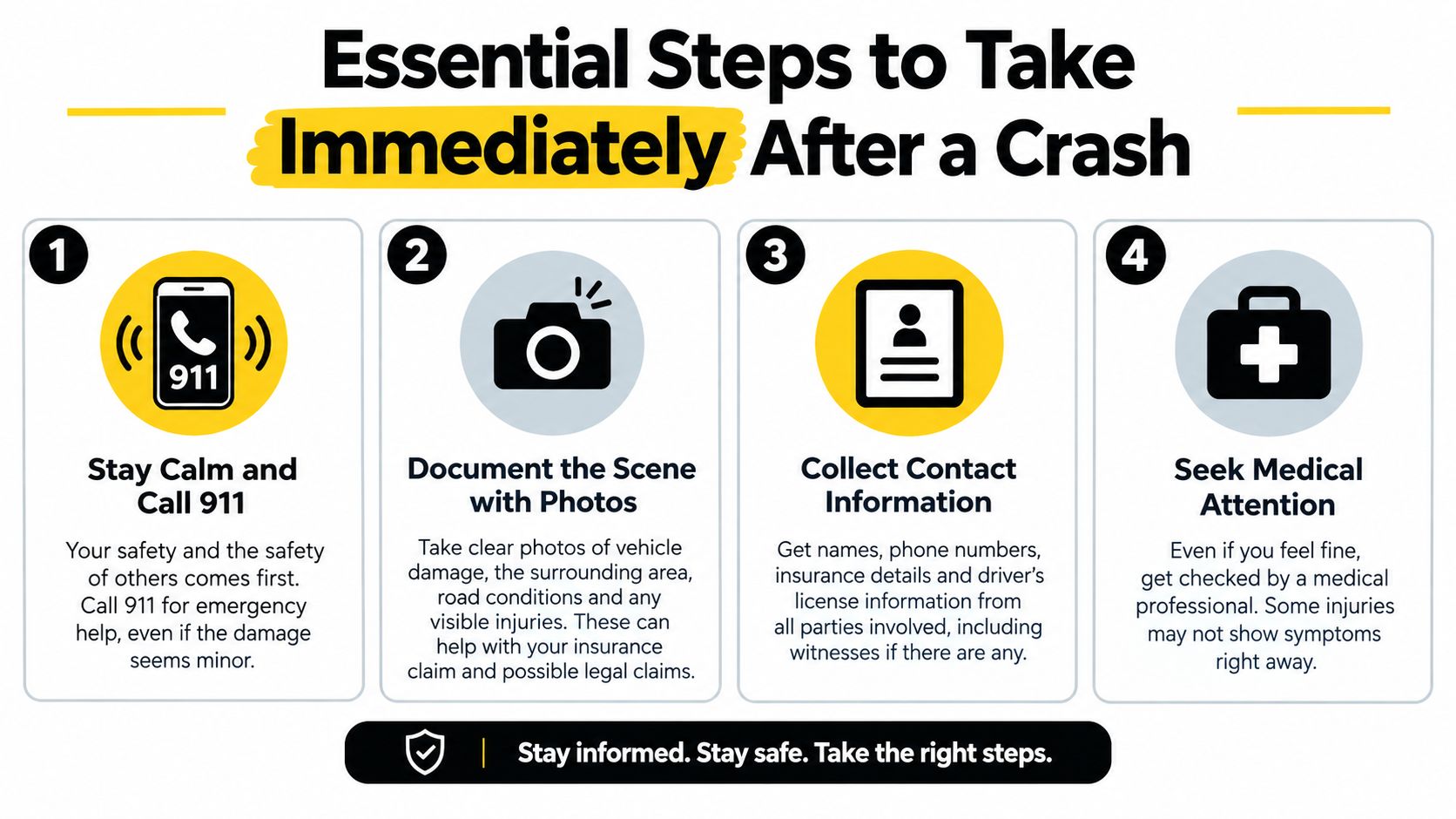
Essential Steps to Take Immediately After a Crash
Your actions should be simple and safety-focused. You may be injured, frightened, or unable to move normally, so ask another person to help when necessary.
-
Call 911 and remain safe. Move out of traffic only if you can do so safely. Tell the dispatcher about injuries, hazards, blocked lanes, and any person who may need urgent care. Don't leave the scene unless medical personnel transport you or authorities direct you to leave.
-
Obtain medical care. Report every symptom, including headache, numbness, dizziness, abdominal discomfort, pelvic pain, and changes in concentration. Follow-up visits matter when symptoms develop later. Keep discharge papers, prescriptions, referrals, and appointment information.
-
Document what remains visible. If you can safely use a phone, photograph vehicle positions, damage, lane markings, traffic signs, signal heads, skid marks, debris, lighting, weather, and obstructions. Take wide images that show the intersection and closer images that show impact points. Don't place yourself in a travel lane to obtain a better angle.
-
Identify witnesses and preserve communications. Ask witnesses for names and contact details, but don't coach their account. Save photographs, text messages, dash-camera files, rideshare information, and notes about what you remember. Write down the sequence while it's fresh, clearly labeling guesses as guesses.
The Nares Law Group guide on what to do in a motor vehicle accident provides additional practical guidance for the immediate aftermath. You should also notify your own insurer as required by your policy, but keep the report limited to basic facts and avoid giving a recorded statement about fault or the full extent of your injuries before receiving legal advice.
Preserve before you explain. A video file, witness contact, or photograph can answer a disputed question more reliably than a memory formed in shock.
Don't repair, sell, or discard a damaged vehicle before it has been documented and evaluated. If the vehicle must be moved or stored, keep the location records and tell your lawyer where it can be inspected.
Common Causes and Fault Determination at Intersections
A red-light allegation rarely settles an intersection case by itself. One driver may have entered during the red phase, misjudged a gap, turned across a pedestrian's path, or failed to yield. Yet a blocked sign, faded lane marking, obstructed sight line, or poorly timed signal may have contributed. Liability often depends on how those conditions interacted, not on who had the right of way alone.
Driver conduct is only the starting point
Investigators commonly examine:
- Right-of-way violations: Did a driver fail to yield, ignore a stop sign, or proceed while cross traffic presented an immediate hazard?
- Signal compliance: Did the vehicle enter after the red phase began, or was it already lawfully inside the intersection?
- Turning movement: Did a left-turning vehicle have a protected phase, and could the driver see pedestrians or cyclists?
- Distraction and impairment: Do phone records, witness accounts, or vehicle data support a theory about attention or reaction time?
- Vehicle condition: Did tire, brake, steering, or lighting problems affect the driver's ability to stop or see?
The NHTSA intersection analysis cited earlier identifies different fatality patterns at signal-controlled, stop-sign-controlled, and uncontrolled intersections. Its discussion of stop-sign crashes includes failures to obey the sign and failures to yield. That distinction can shape the investigation. A stop-sign case may turn on visibility and gap judgment, while a red-light case may depend on signal-phase records and the vehicle's timing of entry.
Roadway responsibility can change the case
A municipality, transportation agency, contractor, commercial carrier, fleet operator, or vehicle manufacturer may become relevant under the facts and Colorado law. That does not mean every crash supports a claim against a public entity or manufacturer. It means the investigation should test whether roadway design, maintenance, vehicle condition, or another party's conduct contributed alongside the driver's actions.
The practical trade-off is speed versus completeness. An insurer may seek a quick statement based on the police report, while a careful liability review may require signal records, maintenance histories, roadway plans, nearby video, and expert analysis. Near-miss records or recurring visibility problems can also help show that the intersection presented a known risk, even when the immediate dispute appears to involve only two drivers.
Before deciding whether your own policy can pay for vehicle damage while responsibility remains disputed, review a neutral guide on when to choose collision coverage. Coverage and liability are related, but they are separate questions. An intersection accident lawyer should preserve both lines of inquiry before an insurer's early account becomes the accepted version of events.
The Hidden Evidence in Modern Crash Investigations
“My word against theirs” is often an incomplete description of an intersection case. The useful evidence may exist in systems that neither driver can see, including traffic controllers, event-data recorders, dash cameras, connected-vehicle applications, and nearby security systems.
A signal investigation can seek phase and timing records, yellow and all-red intervals, maintenance logs, detector-loop or sensor data, camera images, and records of signal-program changes. Those materials can test competing explanations. A vehicle may have entered after red onset, remained in the intersection during a lawful maneuver, or encountered a detection or timing problem that reduced the available clearance.
Near misses can provide context
Traditional crash databases concentrate on completed collisions. They don't necessarily capture repeated evasive maneuvers, close calls, truck encroachment, blocked sight lines, or conflicts involving pedestrians and cyclists. That gap can matter when a family asks whether a dangerous condition existed before the injury event.
A 2026 U.S. Department of Transportation study evaluated LiDAR and AI/ML systems designed to detect trajectory-level conflicts at signalized intersections. The New York City demonstration used an 8,000-frame annotated roadside LiDAR dataset and found that combining direction-agnostic and longitudinal time-to-collision measures could identify lateral-intrusion conflicts that a single metric missed. (U.S. Department of Transportation LiDAR and AI/ML study)
Near-miss information doesn't automatically prove negligence. It may support notice, visibility, causation, or negligent-design theories when combined with admissible evidence. The lawyer still must establish what the data measures, who collected it, whether it was preserved, and whether an expert can explain it to a judge or jury.
Vehicle technology creates new questions
Event-data recorders may help evaluate speed, braking, seat-belt use, and related vehicle information, subject to the vehicle and the applicable access rules. Connected systems can create alerts or records, but an alert doesn't prove a driver received, understood, or could reasonably act on it. A warning can also raise a separate question about whether a system performed as designed.
A Department of Transportation evaluation reported that connected-vehicle applications in a Tampa study area were estimated to avoid 24 potential pedestrian crashes, while several other applications were estimated to prevent 17 additional potential crashes. (U.S. Department of Transportation connected-vehicle evaluation) Safety technology may reduce severity without eliminating disputes about fault.
An accident reconstruction specialist can help counsel evaluate vehicle movement, damage, timing, visibility, and digital records. The practical challenge is preservation. Video, controller logs, telemetry, and connected-device data may be overwritten or restricted, so a lawyer should send targeted preservation requests early.
Understanding Comparative Negligence in Colorado
Colorado's modified comparative negligence rule can reduce compensation when an injured person shares responsibility, but it doesn't treat every mistake as an automatic bar. A plaintiff may recover when their assigned fault is not more than 50%, with the recovery reduced by the percentage of fault assigned to them. The exact application depends on the facts, the claims, and the parties involved.
Consider a hypothetical intersection case. A jury finds that the other driver entered against the signal, but also finds that the injured driver was moving too quickly for the visible conditions. If the injured driver receives a fault allocation that remains within Colorado's recovery threshold, the damages award is reduced rather than eliminated. The important point is that the allocation must be supported by evidence, not an insurer's convenient assumption.
How insurers shift the focus
Adjusters may emphasize a delayed medical visit, an uncertain statement at the scene, a missed appointment, or an old injury. They may argue that these facts show the injured person caused the crash or that the collision did not cause the current condition. Those arguments require a response grounded in records, testimony, signal evidence, medical opinions, and the physical mechanics of the impact.
The Colorado comparative negligence resource explains the rule in more detail. A lawyer's job isn't to promise that fault will disappear. It's to challenge unsupported blame and make sure the fact finder considers every relevant cause.
A fault percentage is a conclusion, not a starting fact. The evidence must explain why that percentage belongs in the case.
Comparative negligence also makes multi-party investigation important. If signal operation, roadway maintenance, a commercial vehicle, or another driver contributed to the event, assigning all responsibility to the injured person can distort the analysis. Preservation and reconstruction help separate what each party did from what the intersection itself made more likely.
How a Specialized Lawyer Fights for Your Rights
An intersection accident lawyer starts by protecting the claim from avoidable damage. That includes reviewing the crash report, identifying deadlines and insurance coverage, arranging evidence preservation, collecting medical records, and determining whether the scene, vehicles, signal system, or roadway requires expert inspection.
The lawyer then builds the liability theory around evidence rather than assumptions. Depending on the collision, that may involve a reconstruction professional, medical experts, engineers, vehicle-data analysis, witness interviews, photographs, video requests, and records from public agencies or commercial operators.
The work continues after the first demand
A serious injury claim must account for more than current medical bills. It may involve future treatment, reduced earning capacity, rehabilitation, pain, limitations on daily activities, and the effect of the injury on family life. The documentation should match the injury and the prognosis, not a generic settlement formula.
Insurance companies understand that injured people need money quickly. They may use that pressure to propose a release before the medical picture is clear. A lawyer can evaluate the offer, explain what rights the release would waive, negotiate from documented damages, and file suit when negotiation doesn't produce a fair result.
Nares Law Group LLC handles motor vehicle injury claims, including intersection crashes, through investigation, insurance negotiations, and litigation when appropriate. The firm's work can include coordinating medical information, evaluating fault, and pursuing compensation for the consequences of a collision while the client focuses on treatment.
If you were injured in an intersection crash, Nares Law Group LLC can review the collision, help preserve signal and vehicle evidence, and address insurance communications on your behalf. Visit Nares Law Group LLC to learn about a consultation and discuss the facts before important evidence or legal options are lost.