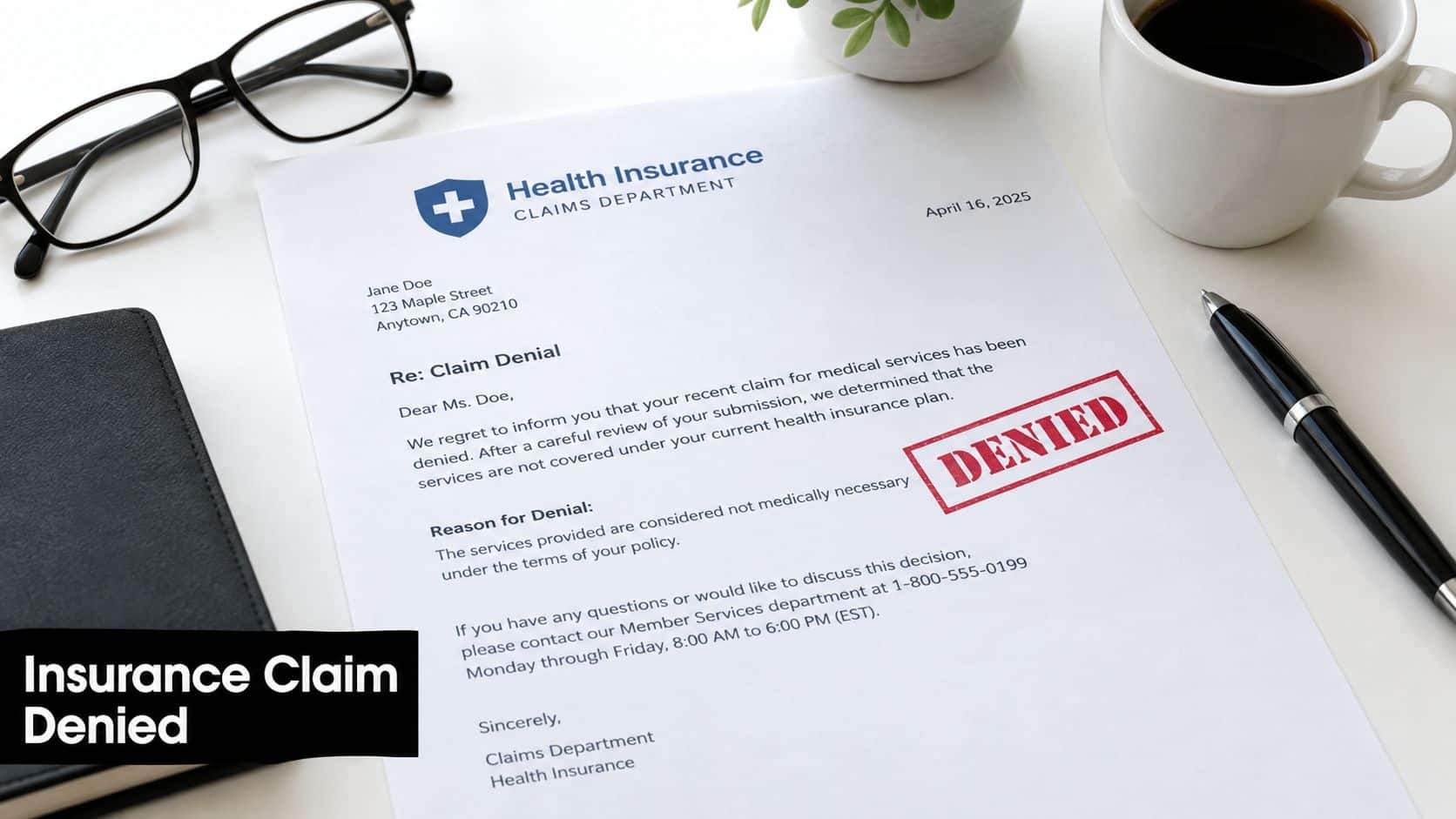
You open the mail after a serious crash and find exactly what you feared: the insurer has denied the claim, blamed someone else, or offered far less than the bills and losses justify. Your medical providers still expect payment, your vehicle needs repairs, and the adjuster wants you to accept a decision you don't understand.
An insurance dispute letter is your first formal opportunity to change that record. It isn't an emotional reply to bad news. It should identify the decision, test it against the policy and evidence, and state the correction you expect. Done properly, the letter can support reconsideration, regulatory review, appraisal, negotiation, or litigation.
When an Insurance Claim Gets Denied
Consider a common accident scenario. After a collision, the insurer accepts that the crash happened but says the vehicle damage is worth less than the repair estimate. The adjuster also questions several medical charges because the treatment continued after the initial emergency visit. A phone call may produce another explanation, but it usually won't create a reliable record of what the insurer considered or why it rejected the disputed amounts.
A carefully prepared letter changes the conversation. It can say, in substance: this is the policy, this is the claim, this is the decision, these exhibits answer the stated reasons, and this is the specific action requested. That sequence gives the insurer a file it can reassess instead of another general complaint.
Why the written record matters
Insurance disputes commonly involve denied coverage, delayed investigation, disputed liability, low valuations, exclusions, or administrative errors. The United Kingdom's Financial Ombudsman Service received 158,900 new complaints about financial businesses between January and June 2025, compared with 133,000 during the same period in 2024, an increase of approximately 19.5%; it resolved complaints in favor of consumers in 32% of cases during the first half of 2025, compared with 35% in the same period of 2024. Those figures cover financial complaints generally, not only insurance disputes, but they show how a written complaint can become part of a record later reviewed by an independent body. (Financial Ombudsman Service complaints data)
A dispute letter also helps separate what is agreed from what remains contested. If the insurer accepts liability but disputes the valuation, focus on the valuation. If it questions medical causation, provide the records and provider explanation that address that issue. A focused disagreement is more useful than a long account of every frustration since the accident.
Practical rule: Write the letter so a new adjuster, regulator, or judge could understand the dispute without calling you for the missing pieces.
Before sending it, review the applicable policy and, where the disagreement concerns broader contract interpretation, consider the guidance on insurance contract disputes. Health-related coverage questions may also require understanding how supplemental coverage fits alongside other benefits, and a plain-language resource on bien choisir sa complémentaire santé can help readers identify the separate coverage documents they may need to collect.
What Makes an Insurance Dispute Letter Effective
The letter should operate like a claim-reconsideration record, not a diary of everything that went wrong. The National Association of Insurance Commissioners recommends attaching the policy, bills, records, denial notice, and other evidence; keeping a detailed communication log; using the insurer's own policy language; stating the outcome sought; and limiting the narrative to verifiable facts. (NAIC complaint guidance)
Start with identification and the disputed decision
Put the insured's name, address, phone number, email address, policy number, claim number, loss date, and assigned adjuster near the top. Identify the decision being challenged, including the date of the denial, valuation, payment explanation, reservation of rights, or delay notice.
Then quote or accurately paraphrase the relevant policy provision. Don't write that the policy “clearly covers everything” when the actual provision contains conditions, exclusions, or limits. State the requested remedy in the opening paragraph, such as reconsideration of coverage, payment of an undisputed amount, correction of a valuation, a written explanation, or identification of information the insurer still needs.
Build a chronology that answers the adjuster's questions
A short dated chronology often carries more weight than several pages of indignation. Include the accident or loss, notice to the insurer, inspections, medical treatment, repair estimates, document submissions, calls, promises, payments, and the disputed decision.
Use a table when the sequence is complicated:
| Date | Event | Supporting exhibit |
|---|---|---|
| Date of loss | Accident or covered event occurred | Police report or incident record |
| Notice date | Claim reported to insurer | Claim acknowledgment |
| Inspection date | Vehicle or property inspected | Photographs and estimate |
| Decision date | Denial or valuation issued | Denial or payment letter |
| Submission date | Additional proof delivered | Email receipt and exhibit index |
Match each assertion to evidence
A medical bill alone may show a charge, but it may not explain why the treatment relates to the collision. Pair medical bills with relevant records, provider opinions, diagnostic results, or a concise causation explanation where appropriate. Likewise, a repair estimate should identify the damaged parts, labor, photographs, and any reason the insurer's valuation is incomplete.
Common weaknesses include an unsupported lump-sum demand, omitted wage-loss proof, no documentation of future care, misstated policy language, and reliance on oral promises. Send copies, preserve the originals, number the exhibits, and record every call with the date, participants, subject, and promised follow-up.
Building Your Evidence and Demand
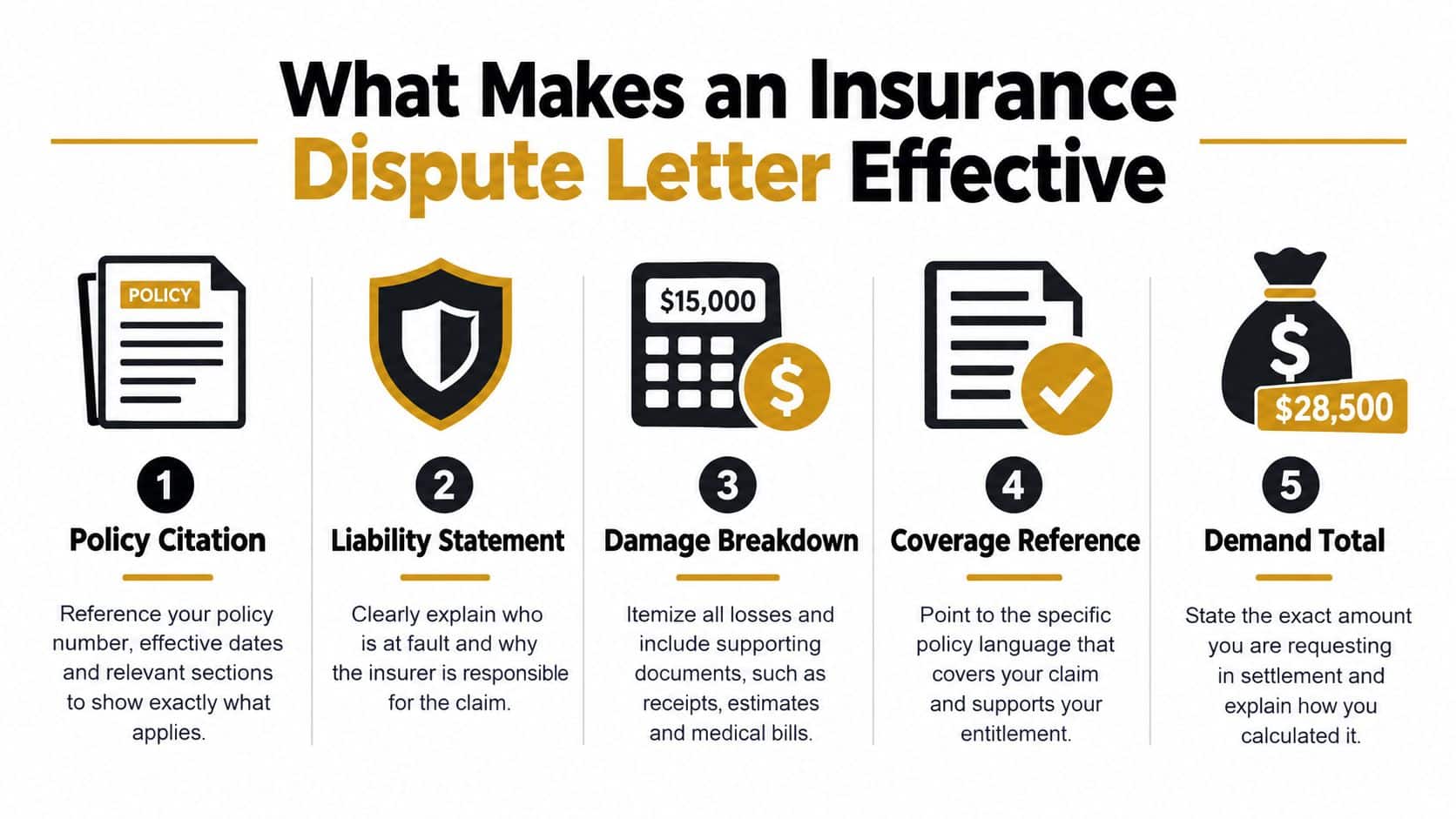
A persuasive demand isn't built around the largest number you can write. It is built around the insurer's evaluation questions: Who is responsible? What damage occurred? Does the policy respond? What payment or correction follows from the proof?
For each disputed issue, identify the insurer's stated rationale and answer it with an exhibit. If the insurer says the collision didn't cause a particular injury, point to the relevant treatment chronology and medical opinion. If it says the vehicle can be repaired for less, identify the line items, parts, labor, photographs, and independent estimate that support your calculation. If it invokes an exclusion, quote the exclusion and explain why the facts don't satisfy it, or why an exception or separate provision applies.
Separate the categories of loss
Don't present one unexplained total. Organize the demand so the reader can test every component:
- Past medical charges: Identify each provider, date range, billed amount, payments, balances, and related records.
- Future care: Use a qualified medical opinion or treatment plan instead of predicting a diagnosis or recovery yourself.
- Wage loss: Attach employer confirmation, payroll material, schedules, or business records that connect the missed work to the injury.
- Property damage: Include photographs, estimates, inspection findings, valuation reports, towing, storage, and other documented expenses.
- Non-economic harm: Describe pain, limitations, sleep disruption, activities affected, and functional changes factually, without exaggeration.
This structure lets the adjuster accept an undisputed part while identifying the precise basis for any remaining disagreement. It also prevents a later reviewer from treating the demand as an arbitrary figure.
Write for negotiation without weakening the claim
Claims Journal reports a survey-based industry estimate that approximately 98–99% of litigated files ultimately resolve through negotiation, while the median share of files in which claim professionals conveyed an offer was below 50%; it also reports that defense counsel made the first offer in roughly 25% of files. These figures aren't a promise about your case or a universal industry benchmark. They support a practical point: the first letter should preserve room for informed negotiation while creating a record strong enough for escalation. (Claims Journal report on negotiated resolutions)
Avoid admissions such as “I wasn't paying attention,” speculative medical conclusions, unrestricted authorizations for every medical record, social-media explanations, and premature releases. A release can extinguish claims beyond the payment under discussion. If the insurer asks for more information, respond carefully and in writing, limiting production to material reasonably connected to the disputed issues.
Insurance Dispute Letter Template and Sample Language
A useful template gives the insurer a clear route through the file. Keep the tone firm and professional, and adapt every sentence to the actual policy and evidence.
Header and opening position
Use the following structure:
Your information
Name, address, phone, email
Insurer information
Claims department, adjuster, address, email or portal
Re: Insured, policy number, claim number, date of loss
I am writing to request reconsideration of the decision dated [date], which [denied coverage, valued the damage at, reduced payment, or delayed resolution]. The decision does not account for [specific evidence or policy provision]. I request [specific corrective action] and written confirmation of the information considered in the review.
Don't label a letter “appeal” unless that term fits the insurer's procedure, but make the purpose unmistakable. Include the response date required by the policy, claim instructions, or applicable process. Avoid inventing an arbitrary deadline that has no contractual or procedural basis.
Chronology and policy analysis
Follow the opening with a concise chronology. For each important event, identify the exhibit:
On [date], I reported the loss and provided [document]. On [date], the insurer inspected [vehicle, property, or records]. On [date], the insurer issued [decision]. Exhibit [number] shows [fact]. The decision conflicts with Section [number], which provides [accurate policy language], because [fact-based explanation].
If the insurer has not explained its reasoning, ask directly:
Please identify the specific policy provision relied upon, the facts applied to that provision, and any information you contend is missing. Please also confirm whether the enclosed records were reviewed.
Demand and attachments
End with an itemized request:
Based on the enclosed records, I request [coverage confirmation, corrected valuation, payment of the undisputed amount, reimbursement of listed expenses, or a new written determination]. The requested amounts are itemized in Exhibit [number]. Please respond in writing by [appropriate date] and identify any additional information needed to evaluate each disputed item.
List every attachment by number and title. Keep a complete copy of the letter, exhibits, delivery confirmation, and final submission packet. For a more formal settlement presentation, review how a settlement demand letter differs from a claim-reconsideration letter, because the documents serve related but distinct purposes.
Next Steps If Your Dispute Is Rejected
A rejection doesn't end the process, but it does change the task. Stop treating the dispute as a series of informal calls and preserve the file as an escalation record.
Preserve the complete submission
Save the denial, your letter, every exhibit, delivery proof, claim notes you received, payment records, and communication log. Create an indexed folder with a chronology at the front. If the insurer says it didn't receive a document, your submission receipt and exhibit index can resolve that factual dispute.
In Colorado, the Division of Insurance can require an insurer to investigate a complaint thoroughly and can address unreasonable delays, but Colorado law doesn't impose one universal claims-handling timeframe for every situation. Calendar the policy's notice, proof-of-loss, appraisal, and suit-limitation provisions separately. A regulator complaint can support accountability, but it doesn't replace a contractual deadline or pause a limitations period.
The Colorado Division of Insurance accepts complaints through its Consumer Portal, with supporting documents uploaded afterward. Before filing, identify the precise conduct at issue: failure to consider evidence, unexplained delay, incorrect application of policy language, incomplete investigation, or an unsupported valuation. The regulator needs a reviewable record, not just a statement that the adjuster was unfair.
Escalate with a defined objective
Ask the regulator to address a specific administrative problem, such as whether the insurer considered submitted records or explained its coverage position. Don't expect the regulator to act as your personal trial lawyer or determine every disputed damages question.
If the claim involves serious injuries, policy interpretation, or deadlines that could affect litigation, consult counsel before signing a release or authorizing broad records access. People dealing with several legal problems at once may find it useful to compare family and employment lawyers, but an insurance dispute arising from a crash requires someone experienced with injury claims, coverage, and settlement strategy. A lawyer handling an insurance dispute can assess the policy, evidence, regulatory options, and litigation deadlines together.
The next decision may be negotiation, appraisal, a formal complaint, mediation, or a lawsuit. Each carries trade-offs in cost, speed, information access, and bargaining power. Don't let continued discussions make you miss a filing deadline.
Use the following resource alongside your written file:
Nares Law Group LLC helps injured people evaluate denied claims, disputed valuations, medical documentation, and insurer responses while protecting important deadlines. Visit Nares Law Group LLC to request a consultation and discuss the evidence, policy language, and next step for your insurance dispute.