You're standing beside a damaged vehicle, hearing traffic pass while your hands shake and your thoughts arrive out of order. You may be wondering whether to call your insurer, exchange information, or take photographs. Those questions can wait. What to do in a motor vehicle accident starts with safety, medical triage, and preservation of reliable information.
The first minutes can affect your health, while the next hours can determine whether important medical and digital evidence remains available. Use this guide as a practical sequence, but follow emergency-dispatcher and healthcare instructions whenever they differ from general information.
Immediate Safety and Medical Triage After Impact
For a moment after impact, people often notice ringing ears, sudden silence, or a strange calm. A driver may look at a passenger and ask, “Are you okay?” before realizing that they're bleeding, dizzy, or unable to remember what happened. Shock can make a serious injury feel distant, so the order of decisions matters.
Treat the crash as a safety and medical emergency, not as an insurance or legal discussion.
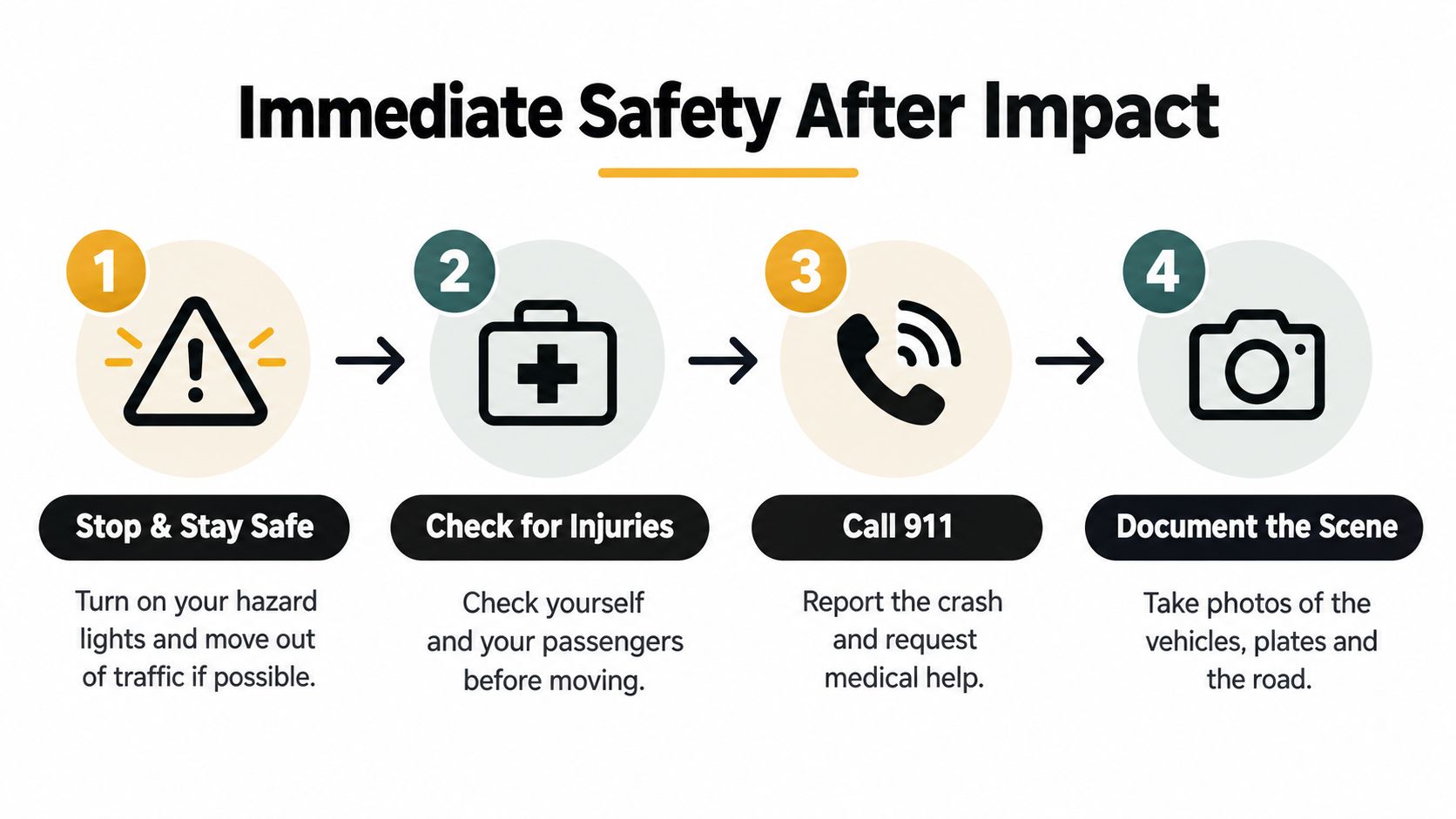
Stop and assess the surroundings. Turn on hazard lights. Look for moving traffic, fire, leaking fuel, unstable vehicles, or downed wires. Move out of traffic only when it's safe, and don't leave a vehicle if doing so creates a greater danger.
Call the local emergency number. Give the exact location, the number of vehicles, visible hazards, and suspected injuries. Tell the dispatcher about unconsciousness, severe bleeding, breathing problems, or possible head or neck trauma.
Limit unnecessary movement. Unless there's an immediate threat, don't pull an injured person from a vehicle or move their head and neck. A suspected spinal injury needs stabilization and professional evaluation. Apply firm pressure to ordinary external bleeding, monitor breathing and alertness, and follow dispatcher instructions.
Accept medical evaluation. Don't let someone who is dizzy, confused, drowsy, or injured drive to care. Emergency guidance for head trauma identifies inability to awaken, abnormal breathing, worsening confusion, seizures, repeated vomiting, slurred speech, unequal pupils, new weakness or numbness, and a worsening persistent headache as reasons for immediate care. The EMT's role when arriving at a motor vehicle crash can help explain why these assessments matter.
The need for prompt evaluation isn't theoretical. CDC surveillance estimated approximately 3.4 million emergency-department visits for motor-vehicle crash injuries annually in the United States during 2017–2018, an overall rate of 10.7 visits per 1,000 people. People aged 15–24 had 18.2 visits per 1,000, compared with 6.7 per 1,000 among people aged 45 and older. CDC data also identified approximately 2.8 million traumatic-brain-injury-related emergency visits, hospitalizations, and deaths in 2013, including about 2.5 million emergency visits. These figures are reported in the CDC's motor-vehicle crash injury data brief.
Don't argue about fault at the roadside. Don't apologize in a way that could be misunderstood as an admission. First make sure people are safe, responders have accurate information, and every potentially serious injury receives appropriate attention.
Preserving Evidence and Documenting the Scene
Once emergency needs are addressed, create a record while the scene is still understandable. Memory becomes less dependable after a frightening collision, and physical conditions can change as vehicles are moved, traffic resumes, or weather shifts. Your job isn't to conduct a private accident investigation. It's to preserve neutral information.
Record the people and official details
Ask the responding agency for its incident or report number and record the date, time, exact location, road conditions, and weather. Collect names and contact information for drivers, vehicle owners, passengers, witnesses, and insurers. If you can't safely gather this information yourself, ask a passenger, responder, or another trusted person to help.
Write down what you personally observed, using factual language. “The sedan was in the left lane” is more useful than “the other driver caused everything.” Don't speculate about speed, impairment, or fault, and don't argue with another driver.
Photograph context before close-ups
When it's safe and permitted, photograph or video the overall scene before vehicles are moved. Start with wide images that show vehicle positions, lanes, intersections, signs, signals, and nearby landmarks. Then capture closer images of damage, license plates, skid marks, debris, traffic controls, property damage, and visible injuries.
A useful sequence includes:
- Wide scene views: Show how the vehicles and roadway relate to each other.
- Vehicle positions: Capture each vehicle from multiple angles before repairs or towing.
- Road evidence: Photograph lane markings, signs, signals, debris, and skid or tire marks.
- Injuries and damage: Take clear images without editing the original files.
- Identifying information: Record plates, commercial-vehicle markings, and relevant property damage.
Keep the original photographs and videos. Don't crop, filter, overwrite, or delete them. Make read-only backups and maintain a simple log showing when an item was created, copied, or provided. This approach follows the evidence-preservation principles summarized in the CDC-hosted crash documentation resource.
Practical rule: Photograph first when safe, describe second, and speculate never.
Preserve more than photographs
Save dashcam footage, vehicle telematics, relevant phone-location records, repair estimates, towing and storage receipts, medical records, prescriptions, wage-loss documentation, and a dated symptom diary. Ask medical providers to document the crash mechanism, reported symptoms, examination findings, diagnoses, restrictions, and follow-up plan.
Don't post accident commentary publicly. Social-media statements can be incomplete, emotional, or taken out of context. Don't rely on a single phone or a single cloud account. Preserve original files in more than one secure place.
Evidence can also be damaged by careless handling. Moving vehicles before documenting them, deleting digital files, editing photographs, or reconstructing events from memory can make later review harder. Learn why these problems matter in this explanation of what is spoliation of evidence, then treat every original record as something to preserve rather than recreate.
Understanding Delayed Symptoms and Hidden Injuries
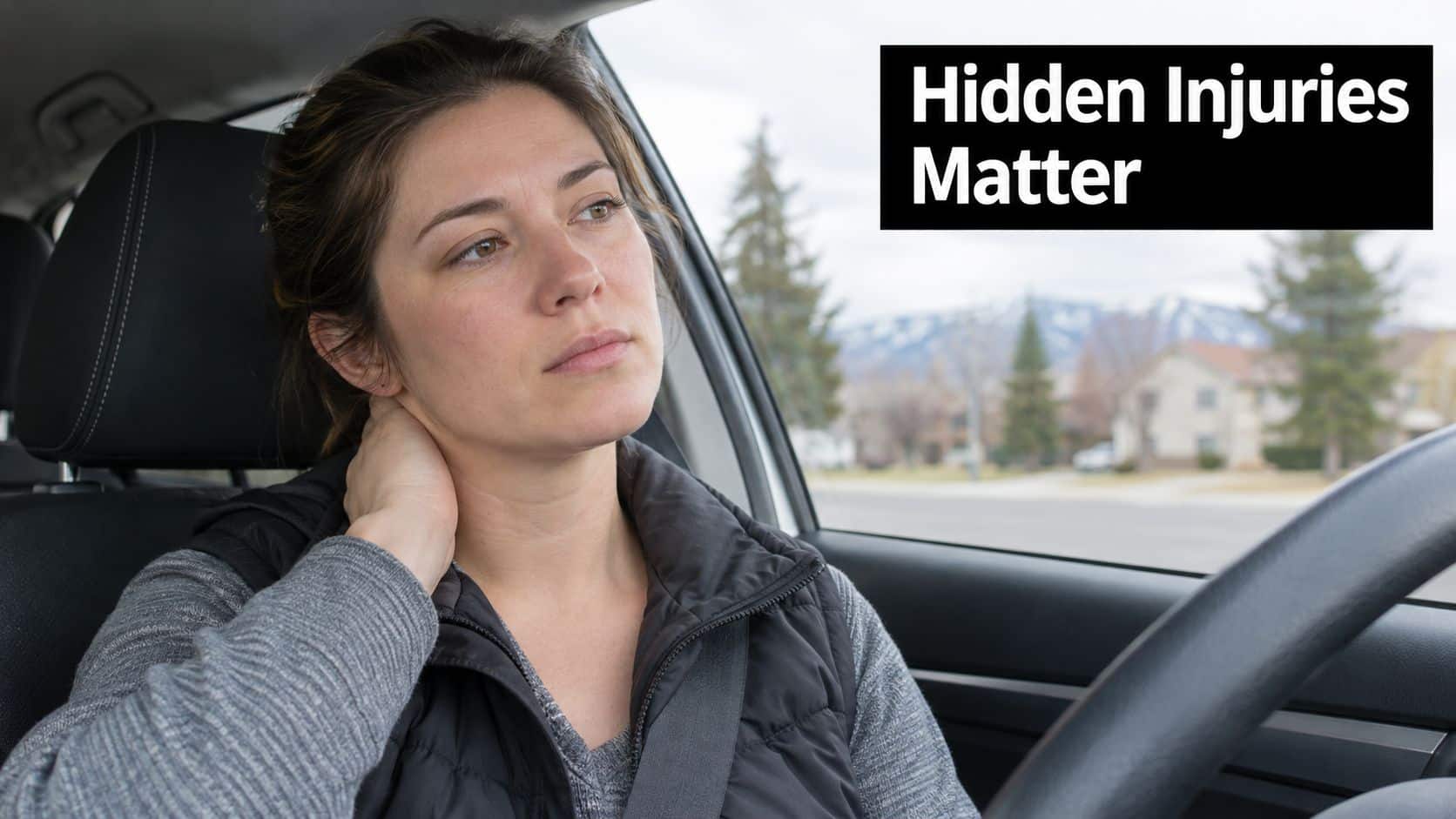
A crash can feel finished before the injury has fully announced itself. You may walk away, answer questions clearly, and even believe you escaped with soreness, only to notice hours later that your head feels heavy, your neck stiffens, or your thoughts do not line up the way they usually do. That pattern matters most in the first 48 hours, when symptoms tied to concussion, neck trauma, or internal injury can sharpen after the scene is over.
Adrenaline and shock can dull pain at the worst possible time. A person who struck a window, headrest, steering wheel, or airbag may not recognize right away that the brain and body absorbed more force than the first impression suggests. The delay matters for medicine first. A clinician who never sees the symptom cannot treat it, and no later note can replace that examination. NHTSA's 2025 National Roadway Safety Strategy progress report discusses deaths that occur after survival of the initial crash phase, which is one reason careful post-collision monitoring matters even when the roadside picture seems stable.
Know the warning signs
Seek emergency care for:
- Neurological changes: Worsening headache, confusion, repeated vomiting, weakness, numbness, slurred speech, seizure, unusual sleepiness, or loss of consciousness.
- Breathing concerns: Difficulty breathing, abnormal breathing, or a person who can't be awakened.
- Pain that escalates: Severe abdominal pain or increasing neck and back pain.
- Functional changes: New imbalance, memory gaps, unusual behavior, or difficulty completing ordinary tasks.
Do not drive yourself if you are dizzy, confused, drowsy, or otherwise impaired. Have a responsible adult stay with you until a healthcare professional evaluates the situation, especially after any blow to the head or any gap in memory about the impact.
Document symptoms as health information
Treat your symptom log like a timeline a doctor can use. Write down the date, approximate time, what you felt, how strong it was in ordinary language, what activity it interrupted, what medication you took, and whether the problem improved or got worse. “I lost track of a short text message halfway through reading it” is more useful than “I felt off.”
That kind of record also helps address the digital evidence gap that often follows a delayed crash. If your symptoms changed after you left the scene, your notes can help connect what your body was doing with later medical visits and any time-stamped vehicle or phone records preserved elsewhere. Tell clinicians about symptoms even if they appeared later, follow discharge instructions, keep discharge papers, bills, prescriptions, and referrals, and review this guidance on delayed symptoms after a car accident for added context. Emergency warning signs still call for immediate care, not more reading.
Navigating Connected Vehicle Data and Communications
You may leave a crash scene with photos, an exchange of insurance details, and a police report number, yet some of the most useful records were never in your hands. A connected vehicle can create its own trail in the background, including crash alerts, location information, event-data-recorder entries, app activity, and communications sent through the vehicle's service platform. In a delayed-crash case, that gap matters. Symptoms may surface hours later, while digital records can be overwritten, stored by different companies, or released only through specific requests.
Compare ordinary records with connected data
| Ordinary crash record | Connected-vehicle record |
|---|---|
| Scene photographs and videos | Crash alerts and telematics records |
| Driver and witness information | Event-data-recorder information |
| Medical records and symptom notes | App logs, vehicle communications, and location data |
| Repair, towing, and storage records | Manufacturer or service-provider data |
| Incident or police report | 911-related automatic notification records |
Treat these as two parallel evidence streams. One shows what people saw and recorded. The other may show what the vehicle sensed and transmitted.
Preserve both. Photograph the infotainment screen if it shows an alert. Save app notifications and screenshots. Write down the connected-service account tied to the car, and avoid deleting call logs, texts, or app messages linked to the incident. Before authorizing repairs, ask whether any stored data could be altered or erased during inspection, battery replacement, software updates, or parts removal. If serious injury or fault is disputed, a lawyer or qualified investigator may need to send a preservation request quickly, especially within the first 48 hours.
Public-safety systems are also changing. In June 2025, Toyota Connected and Intrado announced delivery of Advanced Automatic Collision Notification data to public-safety answering points in a format designed for 911 workflows, as described in their announcement about connected collision data. NHTSA has also described manufacturer crash-reporting obligations under an amended standing order effective June 16, 2025. A personal 911 call remains necessary, and access to these records is never automatic for the people involved.
If pain or restricted movement continues after medical evaluation, discuss follow-up care with a licensed clinician. This can matter when the body absorbs force in ways that are not obvious at the scene. A plain-language guide to osteopathic care at Restore Osteopathic explains one possible approach, but treatment choices belong with your healthcare team.
When to Seek Legal Counsel for Serious Cases
A minor crash with no injury, no dispute, and straightforward property damage may be manageable through ordinary insurance channels. The calculation changes when the injury is serious, the facts are contested, or multiple parties may share responsibility. Early legal advice can protect evidence and prevent a rushed decision before the medical picture is clear.
Certain cases require deeper investigation
Seek counsel promptly when the collision involves a traumatic brain injury, spinal injury, permanent impairment, a fatality, a commercial truck, a commercial vehicle, disputed fault, or an insurer that pressures you to provide a recorded statement or accept a quick settlement. These matters often involve more than two drivers and one policy. They may require review of vehicle maintenance, driver qualifications, electronic logs, company policies, roadway design, event data, witness accounts, and medical projections.
A truck or commercial-vehicle case can also involve a company, contractor, owner, maintenance provider, or insurer with separate records and representatives. A wrongful-death case adds the needs of surviving family members, including careful coordination around evidence, estate issues, and the losses caused by the death. A brain-injury claim may require longitudinal medical evidence because the most important effects can involve memory, concentration, behavior, work capacity, or relationships rather than a visible wound.
Serious injury cases are difficult because the consequences may continue developing while the evidence is already disappearing.
Be cautious with early insurer communications
Notify your own insurer as required by the policy and provide accurate basic facts. You don't need to guess about fault, minimize symptoms, or offer a broad medical history before understanding why it's requested. Keep records of calls, letters, claim numbers, requests, and deadlines.
An attorney can investigate the collision, coordinate with medical providers, preserve records, communicate with insurers, evaluate potential claims, and negotiate or litigate when appropriate. That doesn't mean every case should go to trial. It means an injured person has someone assessing the full medical and factual picture before signing away rights.
You don't have to wait until an insurer denies a claim to ask questions. A consultation can clarify what evidence matters, which parties may be involved, and whether handling the claim alone creates avoidable risk.
Next Steps and Key Considerations in Colorado
After the scene is safe, organize the next decisions in a practical order. Colorado cases can involve deadlines and procedural requirements that depend on the parties, the type of claim, the governmental entities involved, and the facts of the collision. Don't rely on a generic online deadline. Ask a Colorado attorney to identify the deadlines that apply to your situation.
Use the first hours well
Medical follow-up comes before claim strategy. Keep every discharge paper, bill, prescription, referral, work note, and appointment record. Report new or worsening symptoms accurately, and follow the treatment plan unless a clinician changes it.
Create one secure folder for the crash. Include:
- Scene materials: Original photographs, videos, dashcam files, and notes.
- People and reports: Contact information, witness details, insurer information, and the incident or report number.
- Medical records: Discharge instructions, bills, prescriptions, diagnoses, restrictions, and follow-up appointments.
- Financial records: Wage-loss information, transportation expenses, towing and storage receipts, and repair estimates.
- Digital evidence: Telematics, app notifications, event-data information, relevant messages, and 911 records or request details.
Name files consistently and keep the originals unchanged. A simple log should identify what each file is, when it was created, where it's stored, and whether it was shared. Don't post about the crash, delete relevant app data, or authorize repairs that may destroy vehicle evidence before preservation questions are addressed.
Colorado decisions deserve individualized advice
You may need legal guidance if injuries persist, treatment is ongoing, fault is disputed, a commercial truck is involved, a loved one died, or the insurer requests a recorded statement or broad authorization. Government vehicles and public entities can involve special notice requirements. A lawyer should review those issues early rather than after a deadline has passed.
Property damage also deserves careful documentation. If the vehicle's resale value may have changed after repairs, ask a qualified appraiser whether you should file a car value loss report. Keep repair photographs, invoices, estimates, and valuation materials together.
Nares Law Group LLC is a Denver-based personal injury firm that handles motor-vehicle crashes, truck wrecks, traumatic brain injuries, and wrongful-death matters, including investigation, medical-treatment coordination, insurance negotiations, settlement, and trial. The firm also offers free consultations and resources for injured families. A consultation doesn't replace medical care, but it can help you understand what to preserve and which next steps fit your circumstances.
The central sequence is simple: protect people, obtain medical care, preserve original evidence, monitor delayed symptoms, protect connected data, and seek advice when the stakes are serious. If you're in immediate danger or experiencing emergency symptoms, call emergency services now.
If you or a family member has been injured in a motor vehicle crash, Nares Law Group LLC offers crash investigation, medical-treatment coordination, insurance negotiation, and representation in serious injury, trucking, traumatic brain injury, and wrongful-death cases. Contact the firm for a free consultation so you can discuss the evidence, medical concerns, and legal deadlines affecting your situation.