The other car is gone. You're sitting with a damaged vehicle, a shaking hand, and perhaps a sore neck that didn't hurt until you stopped moving. You may have caught only a color or part of a license plate, and you're wondering who will pay if police never find the driver.
Being a victim of hit and run doesn't mean you have to solve the case yourself before getting help. Your immediate priorities are medical care, a reliable record of what happened, and notice to the insurers that may cover your losses. A nonfatal crash with no suspect still deserves careful attention, especially when symptoms and expenses emerge later.
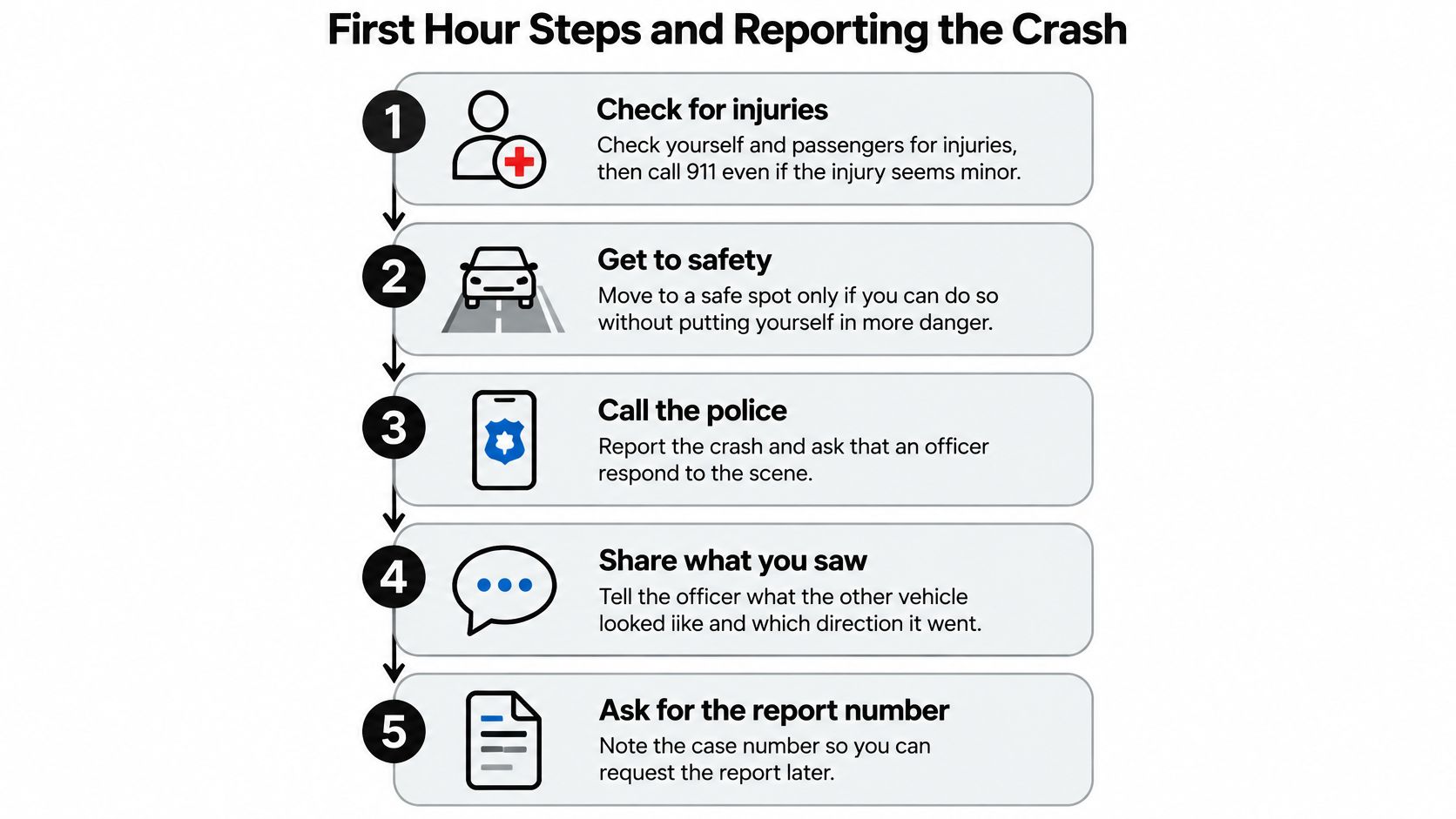
First Hour Steps and Reporting the Crash
- Check for injuries and call for help. Check yourself and your passengers, then call emergency services if anyone may be injured, even if the injury seems minor. Give dispatch your location and explain that the other driver left.
- Get to safety if you can. Move out of traffic only if doing so won't put you at greater risk or worsen an injury. Don't chase the fleeing driver.
- Record the setting. Note the time, exact location, direction of travel, lighting, and weather. Include the nearest intersection, exit, or recognizable business.
- Write down the vehicle description. Record any partial plate, color, body style, visible damage, stickers, or direction of escape. Separate what you remember clearly from what you're unsure about rather than guessing.
- Get witness contact details. Ask nearby people for their names and phone numbers before they leave. Ask whether they saw the impact, the vehicle leaving, or both.
- Photograph what you safely can. Capture your vehicle, the roadway, debris, and visible marks without stepping into traffic. Leave dangerous or potentially important fragments for investigators to handle.
- Get the officer's information. Ask for the responding officer's name, agency, and report number. If no officer responds, ask dispatch how to file a report with the agency responsible for that location.
Use this checklist to keep the immediate priorities in view.
Notify the Right People Without Guessing
Start with police or the agency responsible for the roadway. If the crash happened on a county or state road, dispatch can direct you to the appropriate department. Have the date, location, vehicle description, witness contacts, and any photographs available.
Next, notify your own auto insurer promptly, within the notice requirements in your policy. Provide the report number if available, but don't delay notice because the completed report isn't ready. Ask for a claim number and written instructions identifying the documents the insurer needs.
Then contact your health insurer about treatment coverage and billing procedures. Notify your employer if injuries affect attendance or duties, and ask how to document missed work or reduced hours. Your employer needs work restrictions and absence information, not necessarily your entire medical history.
Practical rule: Give a short, accurate account. Don't turn uncertainty into a definite statement just because someone asks you to fill a gap.
Before agreeing to a recorded insurance statement, ask whether your policy requires it and consider getting legal advice. Don't speculate about fault, speed, or your recovery, and don't describe yourself as uninjured just because you haven't been evaluated. At the same time, don't ignore a contractual cooperation requirement.
A Minor-Looking Crash Still Needs Documentation
In 2023, police reported more than 919,000 hit-and-run crashes, causing approximately 242,000 injuries, according to AAA's hit-and-run analysis. The practical problem isn't limited to catastrophic scenes.
Kentucky's 2025 figures classified 92.8% of reported hit-and-run incidents as property-damage incidents, while hit-and-run crashes caused 1,117 injuries, according to Kentucky Traffic Collision Facts. Those categories shouldn't persuade you to dismiss pain or skip an evaluation.
Before leaving the scene, if your condition allows, confirm that you have:
- Report information: The case number or instructions for obtaining it.
- Witness contacts: Names and a reliable way to reach them.
- Scene photographs: Original files saved on your phone.
- A medical plan: Emergency care when needed, or an evaluation arranged promptly.
Medical Care and Symptoms That Show Up Later
Symptoms after a hit and run and the right response
| Symptom | When to get care | What to tell the doctor |
|---|---|---|
| Sudden severe headache, vomiting, confusion, or loss of consciousness | Emergency care now | Time of impact, head contact, and any loss of consciousness |
| Neck or back pain, numbness, or weakness in a limb | Same-day evaluation; emergency care for new weakness or severe symptoms | Exact location and whether pain spreads or worsens |
| Dizziness, memory gaps, or light sensitivity | Prompt assessment; don't drive while impaired | Which symptoms started when, and any sleep changes |
| Headaches, irritability, or trouble concentrating over days | Arrange a doctor visit promptly rather than waiting for symptoms to resolve | Daily symptom notes and effects on work |
| Bruising, soreness, or pain that seems minor | Medical evaluation, with follow-up if it persists or worsens | Every area that hurts, including areas initially overlooked |
These are general triage directions, not a diagnosis. If symptoms are severe, worsening, or frightening, seek emergency help rather than waiting for an appointment.
Why an Early Exam Isn't the Last Word
An initially reassuring examination doesn't establish that every possible injury has been ruled out. Symptoms may become noticeable after the immediate stress subsides, and some problems become clearer when you return to reading, driving, working, or sleeping.
Pedestrians and cyclists have no surrounding vehicle structure to absorb an impact. In 2023, hit-and-run crashes involved 25% of pedestrians killed and 23% of pedalcyclists killed in U.S. traffic crashes, according to NHTSA's hit-and-run traffic safety facts. These are fatality figures, not estimates of an individual survivor's injury risk, but they underscore why an apparently brief impact deserves attention.
Tell the clinician how the collision happened, whether your head struck anything, and every location that hurts. Disclose prior injuries and conditions so the record can distinguish your baseline from new symptoms or aggravation. Our guidance on delayed symptoms after a car accident can help you organize what to report.
Track Function, Not Just Pain
Keep a daily symptom log using plain observations: difficulty following a conversation, waking repeatedly, or needing help carrying groceries. Attend recommended specialist appointments, and retain bills, prescription receipts, and treatment-related mileage records.
Emotional distress also deserves care. Embodied Living Counseling's explanation of the signs of complex versus single-event trauma offers useful context for discussing trauma responses with a qualified clinician, without replacing an individualized assessment.
Don't minimize symptoms to sound resilient, and don't exaggerate them to strengthen a claim. Accurate medical records help treatment and establish what the crash changed.
How to Document Evidence Before It Disappears
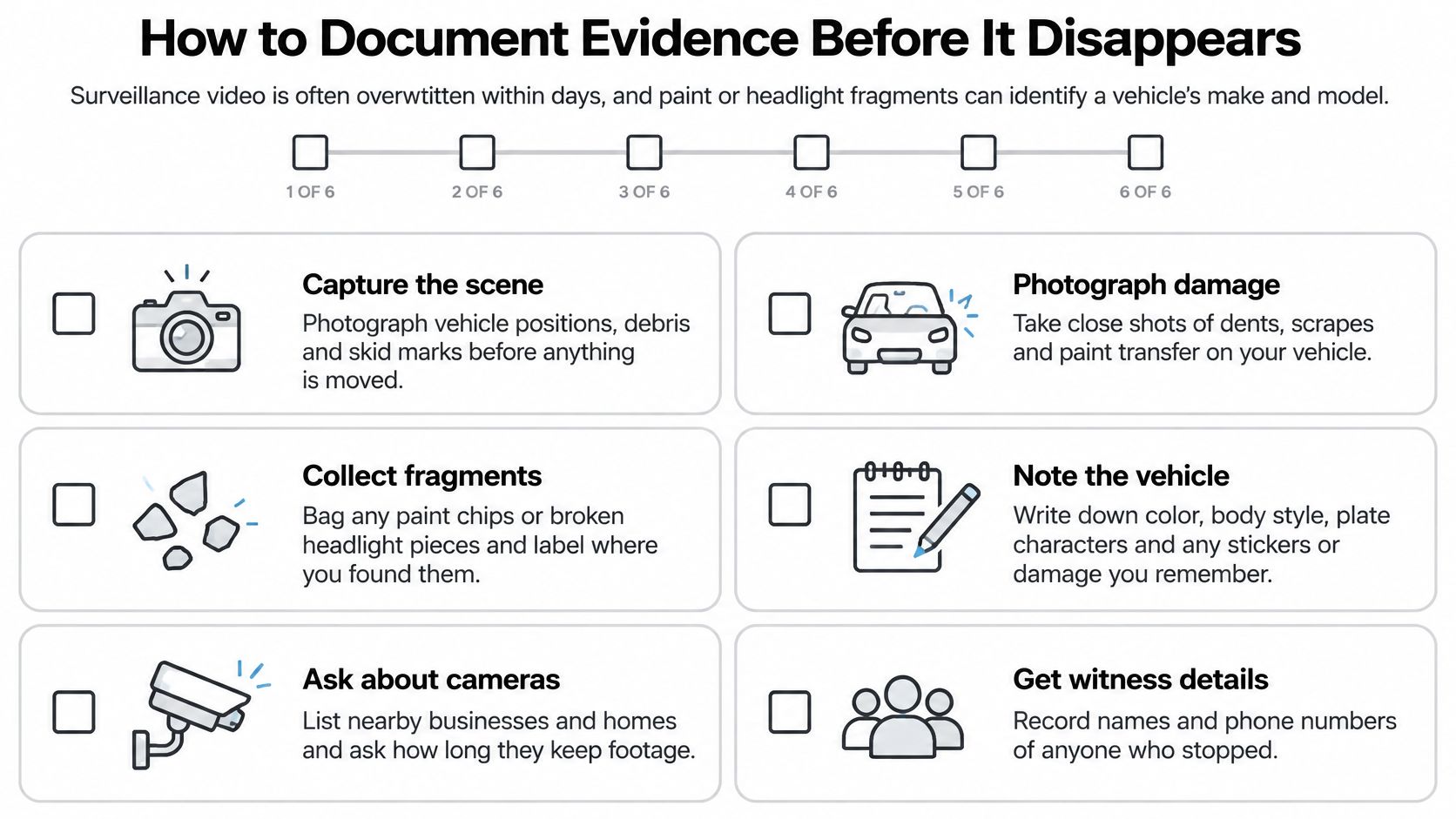
Surveillance footage is the evidence most likely to vanish first. Ask nearby businesses and residents to preserve recordings immediately, before a system overwrites the crash or the vehicle's approach or departure. Physical fragments matter too. A headlight fragment can help investigators narrow the vehicle's make or model, so leave larger pieces where they lie for police to collect. If an officer asks you to hold an item, keep it separate, dry, and labeled with where it was found.
Use this visual checklist to identify evidence worth preserving.
Build a Record Without Disturbing the Scene
- Photograph from wide to close. Start with the roadway, lanes, signs, and vehicle position, then move to damage, debris, and paint transfer. Wide shots show where close-up details belong.
- Let investigators handle trace evidence when possible. Don't enter traffic or pick up sharp glass. If an officer directs you to retain an item, keep fragments separate in clean, dry containers and label where they were found.
- Preserve clothing and footwear. Don't wash, repair, or discard them. Keep dry items separately in paper bags, and ask investigators how to handle anything wet or potentially containing biological evidence.
- Identify camera owners. Record the camera location, relevant time, contact person, and whether police must make the formal request. Ask the owner to save footage covering the crash and the vehicle's approach or departure.
- Save original files. Retain photographs, dashcam recordings, and video with their metadata, plus a backup. Screenshots and social-media copies may omit details investigators need.
- Write a factual timeline. Describe your route, the impact, what you saw afterward, and where you received care. Mark uncertainty clearly and add later recollections as dated additions.
- Create a loss folder. Save repair estimates, towing and rental receipts, damaged-property photographs, and wage records. Ask your employer to document missed hours and any change in duties.
A partial plate can still be useful when combined with vehicle features and location. This guide to hit-and-run license plate evidence explains how to organize those details without overstating what you remember.
This video provides additional context for documenting a hit-and-run claim.
Avoid Creating New Evidence Problems
Don't polish away paint transfer, discard a broken phone case, or authorize disposal of damaged property before documenting it and checking inspection needs. Necessary repairs shouldn't remain on hold indefinitely, but coordinate photographs and inspections before the evidence changes.
Preserve the original, then make a working copy. That applies to a video file as much as a damaged jacket.
Avoid posting crash theories, injury updates, or arguments online. During the investigation, the firm collects medical records, accident reports, witness statements, and expert opinions to establish liability and damages. When the driver is never found, that record is what fills the gap between what happened and what an insurer may owe. A consistent, intact record is more useful than a public account assembled while you're still shaken.
Insurance Coverage When the Driver Is Never Found
Coverage that may pay after a hit and run
| Coverage | What it pays | Check on your policy |
|---|---|---|
| Uninsured motorist bodily injury | Covered medical bills, lost wages, and pain and suffering, up to limits | Whether included, its limit, and requirements for an unidentified vehicle |
| Uninsured motorist property damage | Covered vehicle repair or replacement, potentially after a deductible | Deductible and whether unidentified hit-and-run vehicles qualify |
| Medical payments | Covered medical bills regardless of fault, up to a limit | Limit, eligible expenses, and treatment submission requirements |
| Personal injury protection | Covered medical costs and lost income where available | Whether included and applicable benefit periods |
| Health insurance | Treatment costs under the health plan | Network rules, patient cost-sharing, and reimbursement rights |
| Workers' compensation | Covered treatment and wage replacement for qualifying work-related crashes | Employer reporting procedure and applicable notice deadline |
Your own coverage may be the practical starting point, even though you didn't cause the crash. That doesn't guarantee payment: the policy's definitions, exclusions, conditions, and available limits still control.
Read More Than the Declarations Page
The declarations page identifies purchased coverage and limits. Obtain the full policy and endorsements as well, particularly the language defining an uninsured or unidentified vehicle and any reporting, contact, corroboration, or inspection requirements.
For the broader safety context, NHTSA's latest hit-and-run fact sheet reports 2,758 fatalities in crashes involving hit-and-run drivers in 2024. For an individual survivor, however, the payment question requires reading the actual contract and applicable state law, not relying on national crash totals.
Our explanation of uninsured motorist coverage can help you understand the terminology before reviewing your documents. Ask whether you qualify as an insured under any applicable household policy, including if you were walking or cycling.
Move the Claim Toward a Written Decision
- Report the claim: Identify the crash as a hit and run and request review under every potentially applicable coverage.
- Provide the police reference: Submit the report number and supplement it with the report when available.
- Document the demand: Send medical bills, wage verification, and supporting records through a traceable submission method.
- Request a written position: Ask which coverage applies, what remains missing, and the policy language supporting any refusal.
Your insurer may challenge whether the crash caused a condition, whether treatment was necessary, or how much an injury affects your ability to work. A medical expert can explain causation and functional consequences; an accident reconstruction expert can address how the impact occurred. We have access to both types of experts who can testify about the cause and impact of an injury.
Before accepting payment: Confirm whether it resolves only vehicle damage or also releases injury claims. A check and a release aren't interchangeable.
Keep separate records of what each insurer pays. Health-plan reimbursement obligations and coordination between benefits can affect what you ultimately retain, so a payment total alone isn't a complete settlement analysis.
Recovery When the Driver Is Never Found
An insurance shortfall doesn't necessarily end your options. The right next step depends on the type of loss, whether another responsible party exists, and the rules where the crash occurred.
Check Remaining Routes in Priority Order
- Investigate state victim compensation eligibility promptly. Some programs may assist qualifying hit-and-run victims with medical expenses, lost income, or counseling. Eligibility, police-reporting requirements, application windows, and payment limits differ by state, so confirm the rules with the program or local counsel.
- Keep pending insurance claims active. Submit new supporting information in writing and ask for confirmation of receipt. If an adjuster stops responding, send a dated follow-up identifying the outstanding decision rather than relying only on voicemail.
- Request any denial in writing. Ask for the factual reason, policy provision, and available review or appeal procedure. Whether the appropriate next step is reconsideration, a regulatory complaint, arbitration, or litigation requires a policy-specific assessment.
- Evaluate a civil claim if the driver is identified. Identification may permit a claim for injuries and property damage, but it doesn't establish available insurance or collectible assets. Don't assume the investigation pauses a lawsuit deadline.
- Ask about restitution if charges are filed. A criminal court may order repayment of qualifying losses. Restitution isn't a guaranteed substitute for insurance or a civil recovery, and collection can remain difficult.
Calculate the Unpaid Balance
Maintain a ledger showing each expense, the amount billed, adjustments, payments, and the balance still owed. Track wage loss separately so missed earnings aren't buried among medical receipts.
A local attorney can assess applicable programs and filing deadlines without assuming that every hit-and-run victim qualifies for the same assistance. The useful question is whether money was paid, but which documented losses remain unpaid and which legal route can address them.
Confirm Your Options Before the Deadline
Don't wait for police to identify a suspect before confirming your rights. Use your next review of the claim to answer these questions:
- Coverage: Does my policy include uninsured motorist coverage, and what are its limits?
- Notice: Have I notified every potentially relevant insurer?
- Treatment: Do my symptoms require specialist follow-up?
- Losses: Are bills, work restrictions, and missed earnings documented?
- Deadlines: Which reporting, benefit, and legal filing deadlines apply?
Prepare for a Useful Consultation
Assemble your police information, photographs, medical records, bills, and policy declarations in a single folder before calling. Include the full policy if available, but don't postpone getting advice because a document is missing.
Set aside time to review the paperwork while you can concentrate.

A personal injury attorney can examine the evidence and policy language, identify unresolved questions, and assess which claims remain available. Ask about experience handling hit-and-run and uninsured-motorist claims, how fees are structured, and what expenses you could owe.
At Nares Law Group LLC, we handle motor vehicle accident cases and work with medical and accident reconstruction experts on brain injury and crash-cause questions. We offer a free consultation for auto accident cases in Colorado; confirm our current consultation terms directly when arranging your appointment.
Nares Law Group LLC helps injured crash victims evaluate liability, document damages, and pursue available compensation when the responsible driver leaves the scene. Visit Nares Law Group LLC to request a consultation, and bring your police report information, insurance documents, and current medical records so we can assess your next steps.