You might be sitting at home after a crash, rubbing your neck, wondering why you still feel shaken but not obviously hurt. The car is in the shop, the paperwork has started, and everyone keeps asking if you're okay. If you walked away thinking you were fine, that feeling can be misleading, because delayed symptoms after a car accident often show up after the body's first survival response starts to fade.
The part that confuses people most is timing. Pain, dizziness, brain fog, stiffness, or nausea can appear after the crash scene is over, not because the injury is imaginary, but because the body can mask what happened for a while. That's why the first few days matter so much, both for your health and for the record you'll need if symptoms keep unfolding.
Why Delayed Symptoms After a Car Accident Are So Common
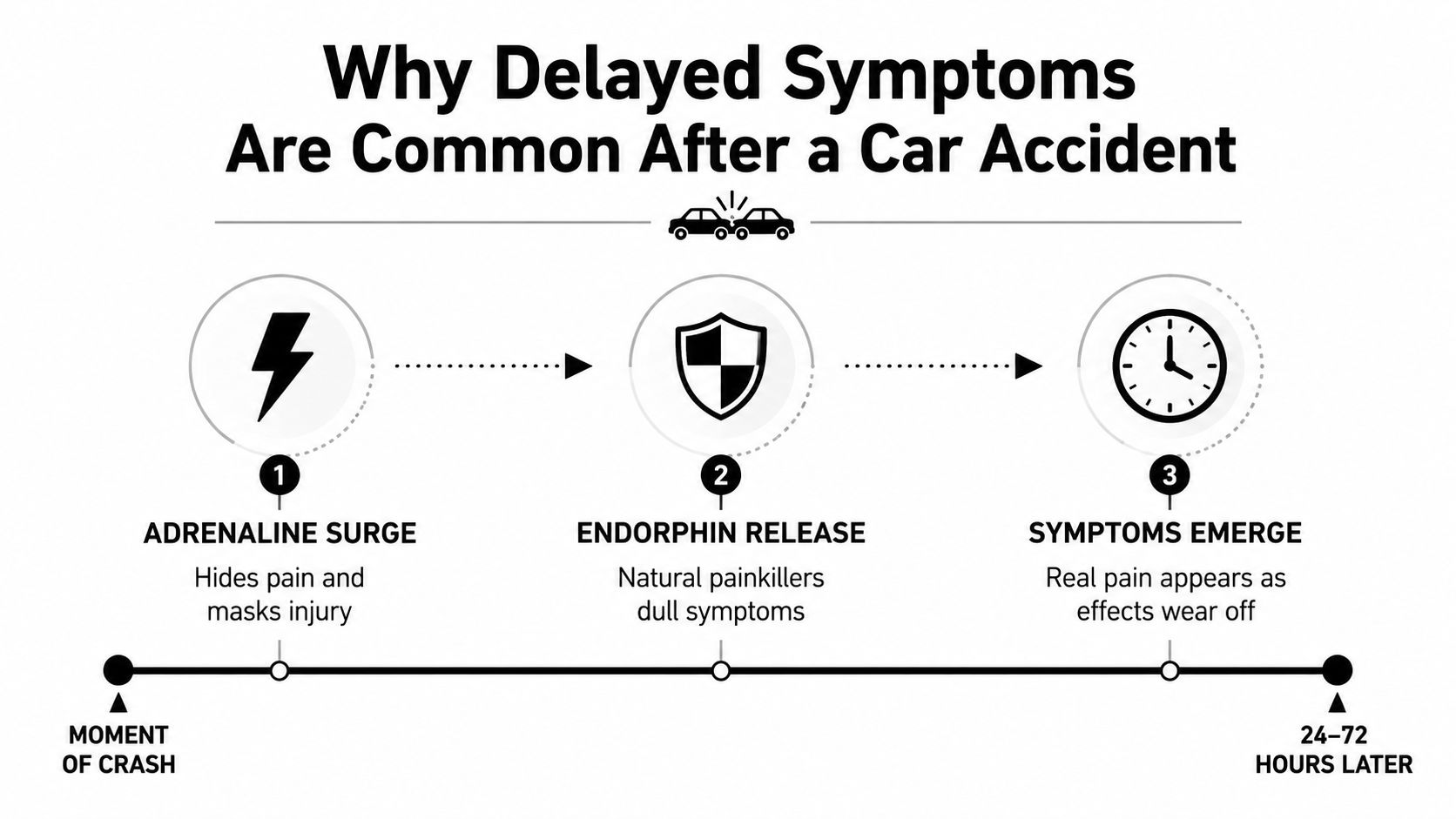
The first quiet hours after a crash can feel almost unreal. You're answering questions, getting home, checking the bumper, and trying to decide whether you're just rattled or injured. That uncertainty is normal, because adrenaline and shock can mask pain long enough to make a person believe they escaped without injury, even when the body is still dealing with collision forces. Medical guidance in the provided sources says delayed symptoms can show up within 24 to 72 hours and sometimes later, as inflammation, swelling, and tissue irritation build after the impact. See the physiology of the 24 to 72 hour masking window
A crash doesn't have to be violent-looking to cause real damage. Whiplash is the clearest example, with annual U.S. cases estimated at about 2 million to 3 million people per year, and one source reporting that 12% of people involved in car crashes are diagnosed with whiplash. Another widely cited estimate says about 1 in 5 crash victims do not feel symptoms immediately, which is why walking away feeling “fine” isn't proof that nothing happened. Delayed-injury patterns and whiplash data
What to do in the first 24 hours
Your job that first day is simple.
- Get checked if anything feels off. Even minor soreness deserves a medical evaluation if it's new after a crash.
- Write down what you notice. Start a plain-language symptom note with the time the feeling started, where it hurts, and what makes it worse.
- Don't use “I'm fine” as your only answer. If you're not sure, say you're still monitoring symptoms and want a medical opinion.
Practical rule: if your body feels different after the collision, treat that change as information, not drama.
For readers who are also feeling tense, shaky, or hyper-alert, the idea of recovery and survival mode can help explain why the body may stay on guard long after the impact. A useful overview of that nervous-system pattern is available in this survival mode recovery resource.
For a deeper look at why the motion of a crash can injure the neck even without a dramatic impact, this explainer on acceleration and deceleration injury mechanics is worth reading.
Common Delayed Injuries and the Timelines to Watch
Different injuries tend to announce themselves on different clocks. That's why a symptom list alone isn't enough. A sore neck the next morning, a headache two days later, or a change in concentration later in the week can point to very different body systems, even if the crash seemed “minor” at the scene.
Neck and soft-tissue injuries
Whiplash and related soft-tissue injuries often show up first because the neck absorbs rapid back-and-forth motion. A person may feel okay leaving the scene, then wake up stiff, lose range of motion, or notice pain when turning their head. If neck pain is paired with headache, shoulder pain, or trouble sleeping, that pattern deserves prompt medical attention. The symptom that means go to the ER now is neck pain with numbness, weakness, or trouble walking.
Concussion and traumatic brain injury
Brain injury symptoms can be subtle at first. The source material notes that concussion signs can emerge hours or days after the crash, and they can include headaches, dizziness, memory problems, concentration trouble, sensitivity to light, fatigue, nausea, vision changes, or hearing changes. Families sometimes notice the change before the injured person does. If there's confusion, fainting, slurred speech, or repeated vomiting, that's an emergency.
Spine, disc, and nerve injury
Back pain that deepens over the first few days, tingling, radiating pain, weakness, or numbness can point to spinal or disc involvement. These symptoms can become more obvious once inflammation builds or once normal movement starts stressing an injured area again. If bladder or bowel control changes, that's not a wait-and-see situation.
Internal bleeding and organ injury
This category is less common but far more dangerous. Abdominal pain, faintness, unusual fatigue, chest pain, or pain that worsens with breathing can be warning signs. The key point is that internal injury doesn't always look dramatic at the scene. Severe abdominal pain or shortness of breath should be treated as an emergency.
Psychological injury
PTSD, anxiety, sleep disruption, and driving fear can emerge later, especially once the person is back in a car, back at work, or trying to sleep. These symptoms can appear on a different timeline than physical pain, which is one reason a crash can feel “fine” one day and overwhelming the next. If panic, intrusive memories, or severe avoidance are affecting daily life, it's time to seek care.
Normal Soreness or Hidden Injury? How to Tell the Difference
The morning after a crash, a lot of people are asking the same question in private: is this just soreness, or is something wrong? You don't need medical training to make a better first call. Four simple decision rules help separate temporary soreness from a possible hidden injury.

Rule one, how long it's lasted
A little stiffness that improves over the day is different from pain that's still present, or worse, by day two or three. Soreness usually has some direction toward improvement. A hidden injury tends to linger, spread, or become more obvious when you try to use the body normally.
Rule two, whether it's getting better or worse
Ask yourself a plain question, is today easier than yesterday? If the answer is no, pay attention. Worsening headaches, expanding bruises, stronger back pain, or more severe neck stiffness are all signals that the body may be dealing with more than a temporary ache. A useful comparison for ordinary back soreness can be found in this post-exercise back soreness guide, but post-crash pain deserves more caution because the cause is different.
Rule three, whether it's one-sided or asymmetrical
Crash injuries often show a pattern. One shoulder hurts more than the other, one side of the neck locks up, one leg feels off, or pain radiates into one arm. Symmetry isn't a guarantee either way, but one-sided symptoms are more suspicious than generalized “I'm sore everywhere” discomfort.
Rule four, whether it affects daily function
If pain is interfering with sleep, work, driving, reading, concentrating, or getting dressed, it matters. That functional loss is often the point where a person realizes this isn't just ordinary recovery. You should also treat numbness in the limbs, changes in vision or speech, repeated vomiting, and severe headaches as immediate red flags, not symptoms to monitor at home.
Plain rule: if the pain is changing what you can do, it's worth getting documented.
How to Document Delayed Symptoms the Right Way
Documentation is the bridge between what your body is doing and what later decision-makers will believe. When symptoms are delayed, a clear record can show that the pain started after the crash and developed in a medically believable way. The goal isn't to create a dramatic file. It's to create a contemporaneous medical timeline that is hard to dismiss.
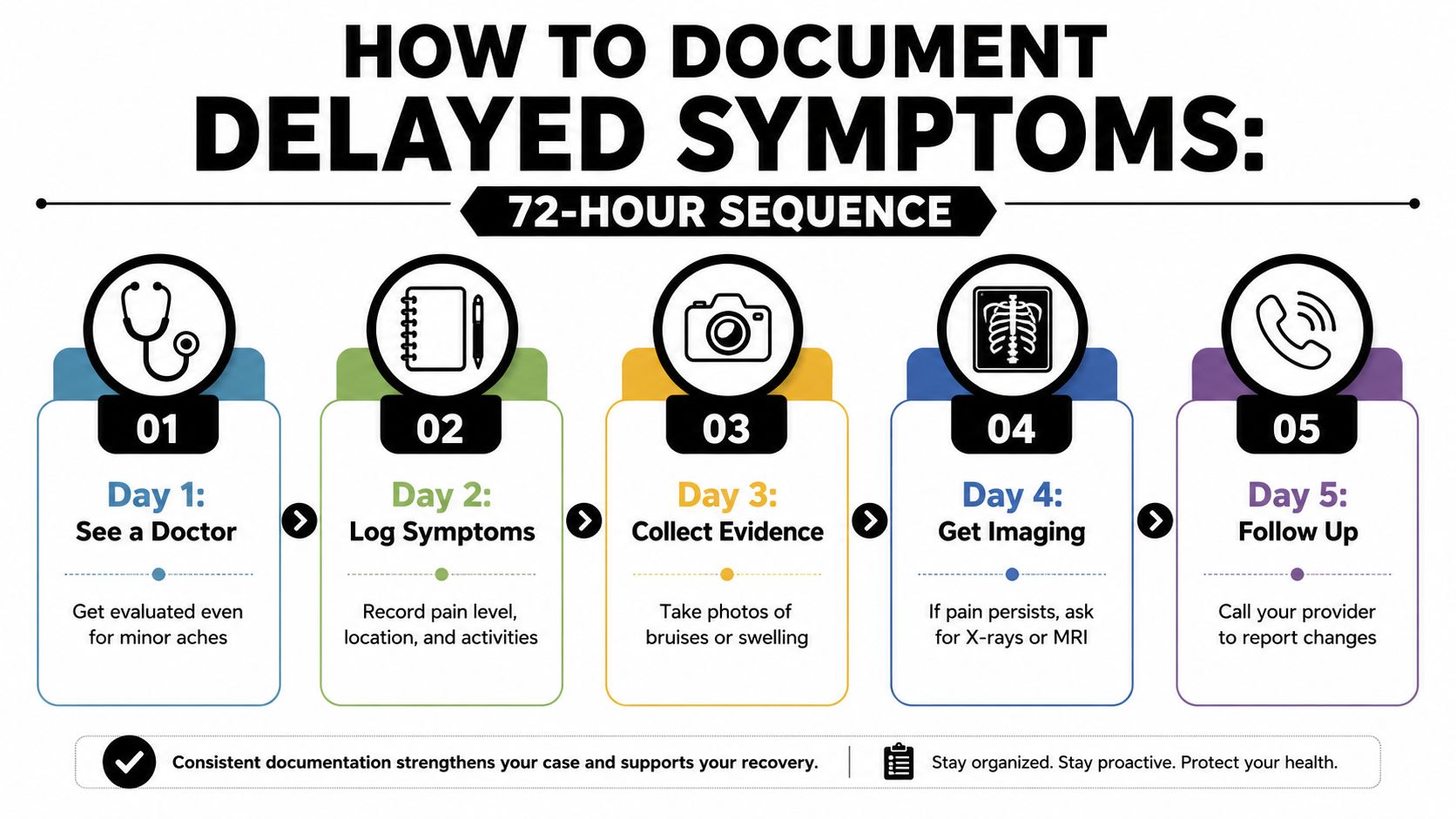
What to do in the first 72 hours
Start with a same-day or next-day medical visit if you can, even if the complaint feels small. Then keep a daily symptom journal with the basics, pain location, severity, what triggers it, and what daily tasks are harder because of it. The more specific you are, the more useful the record becomes.
You'll also want photos. Bruising, swelling, seatbelt marks, and vehicle damage can all help show impact forces and changing symptoms over time. Follow-up notes from any provider matter too, because they show whether symptoms improved, stayed the same, or got worse.
What belongs in the record
- Onset time: When you first noticed the symptom.
- Body location: Neck, back, head, shoulder, leg, or elsewhere.
- Functional limits: Trouble sleeping, working, driving, lifting, or concentrating.
- Treatment trail: Every visit, referral, prescription, and imaging result.
For a deeper look at how to collect records from providers, this medical records guide can help you stay organized.
Avoid guessing about causes when you speak to doctors or insurers. Say what you feel and when you noticed it. “My neck didn't hurt right away, but by the next morning I couldn't turn it fully” is better than trying to sound certain about an injury you haven't yet been diagnosed with.
Why Early Documentation Matters for Insurance and Legal Claims
Insurance adjusters pay close attention to gaps. If you wait days or weeks to report symptoms, they may argue the crash wasn't the cause, or that the injury must have come from something else. That's why the first records matter so much. A same-day visit, a symptom journal, photos, and follow-up notes create a cleaner causation chain than memory alone.
Medical imaging can help close that loop when a doctor thinks it's appropriate. X-rays, MRI scans, and other testing can show whether pain lines up with a structural injury or soft-tissue damage. Without that paper trail, delayed symptoms are easier for an insurer to wave away as ordinary soreness or unrelated strain.
There's also a communication issue. Don't give a recorded statement to the other driver's insurer before you've documented what changed and why. Don't minimize symptoms to sound tough, and don't speculate about how the injury happened if you're unsure. Adjusters listen for inconsistency, not just honesty.
Practical rule: if a symptom matters enough to change your routine, it matters enough to write down the same day.
A delayed-injury claim doesn't rise or fall on paperwork alone, but documentation often determines how seriously the claim is taken. The cleaner the record, the harder it is for the insurer to argue that the crash and the symptoms are strangers to each other.
Truck Crashes and Traumatic Brain Injuries Need a Different Playbook
A truck crash is not just a bigger car crash. The claims move differently, the evidence disappears faster, and the injury pattern can be more complex. If the at-fault vehicle was a commercial truck, the case may involve company records, driver logs, inspection issues, and data that needs to be preserved quickly. A useful overview of truck crash settlement issues is available in this truck accident settlement resource.
Traumatic brain injury cases also need special attention, especially when the crash didn't involve a dramatic head wound. Cognitive changes can look like stress, fatigue, or personality shifts to family members before anyone realizes there's a medical problem. Memory issues, sleep changes, irritability, and concentration trouble often deserve a specialist's review rather than a quick primary-care visit.
Three questions to ask a lawyer before signing
- Who will preserve the evidence? In truck cases, data and records can disappear quickly if no one sends preservation letters right away.
- Who handles the medical coordination? TBI and complex crash cases often need more than a general injury file.
- Who will explain the timing issue? If symptoms were delayed, the legal team should be able to connect the timeline to the medical proof.
One option for people seeking that kind of help is Nares Law Group LLC, a Denver-based personal injury firm that handles motor vehicle crashes, truck wrecks, and traumatic brain injury matters. The firm's role is case investigation, treatment coordination, negotiation, and trial work when needed, which can be useful when a delayed-symptom case is getting disputed.
Your 7-Day Action Plan and the Symptoms That Mean Go Now
A calm plan is easier to follow than a panic response. If you're unsure what to do after a crash, use the first week to build a record, check your body carefully, and escalate care when the symptoms tell you to.
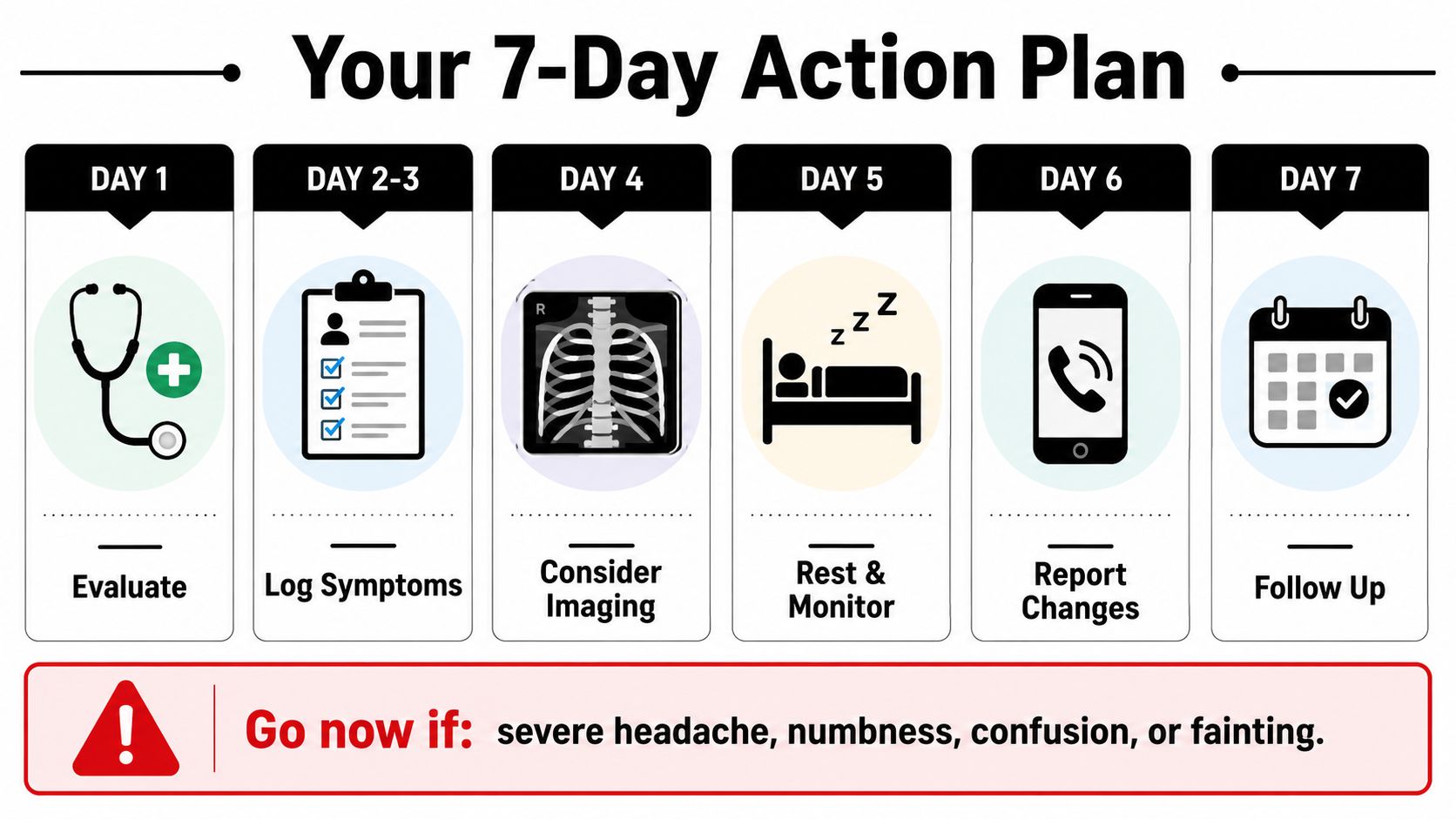
Day-by-day actions
- Day 1, Evaluate. Get a medical check if you have pain, dizziness, headache, stiffness, or anything that feels off.
- Day 2 to 3, Log symptoms. Write down where it hurts, how strong it is, and what tasks are harder.
- Day 4, Consider imaging. If pain persists or spreads, ask whether X-rays, MRI, or another test makes sense.
- Day 5, Rest and monitor. Don't push through activities that make symptoms flare.
- Day 6, Report changes. Update your provider if headaches, numbness, sleep problems, or mood changes have appeared.
- Day 7, Follow up. Reassess with a doctor if the symptom pattern hasn't settled.
Go now if you notice any of these
- Severe headache
- Numbness or weakness
- Confusion or fainting
- Repeated vomiting or major vision changes
The same rule applies if you develop chest pain, shortness of breath, slurred speech, trouble walking, or worsening abdominal pain. Those are emergency symptoms, not “let's see how it goes” symptoms. If you're still wondering whether the delay means the injury is minor, it doesn't. Delayed symptoms are part of how the body reacts after trauma, and getting the right medical record in place early can make the recovery and claim process much less confusing.
If your symptoms are still changing after a crash, Nares Law Group LLC can help you sort out the medical timeline, the documentation, and the insurance issues that often follow. The firm handles car crashes, truck wrecks, and traumatic brain injury matters, and it works with injured people who need a clear path forward after delayed symptoms start showing up. Visit Nares Law Group LLC to get help understanding your next step and protecting your claim.