When you start talking to an insurance adjuster, the entire process boils down to a few critical truths. You must document everything, understand their real job, and never, ever accept the first offer.
Success here isn't about telling a sad story. It's a business negotiation, pure and simple. You win by backing up every single part of your claim with cold, hard evidence and a clear calculation of what you're owed.
The Adjuster’s Playbook: Know Their Game

Before you even think about picking up the phone, you have to get one thing straight. The adjuster might sound friendly. They might sound concerned. But their job is to protect their company's bottom line by closing your claim for the least amount of money possible.
It's not personal. It’s business. Their performance is often measured by how much money they save their employer. Grasping this simple fact is how you start to shift the power back to your side of the table.
Common Tactics You’ll Hear on the First Call
From that very first call, the adjuster will use a set of proven strategies to gain an edge. Spotting these moves is your first line of defense. They are playing from a script, and once you know the lines, you can’t be caught off guard.
The table below breaks down some of the most common things you'll hear and how you should respond.
Common Adjuster Tactics vs Your Strategic Response
| Adjuster's Tactic | What It Really Means | Your Strategic Response |
|---|---|---|
| Requesting a recorded statement to "get your side of the story." | They are searching for contradictions or innocent statements (like "I'm fine") to use against you later. | Politely decline. You can say, "I'm not comfortable with a recorded statement at this time, but I'm happy to provide the information in writing." |
| Pushing for a quick settlement, sometimes just days after the accident. | They hope financial pressure will make you accept a low offer before you even know the full extent of your injuries and costs. | Never agree. State clearly, "I'm still in the process of treating my injuries and can't discuss a settlement until I know the full scope of my damages." |
| Downplaying your injuries or questioning your doctor's treatment plan. | They are trying to create doubt and reduce the value of your medical claims. | Don't argue. Simply state, "I am following my doctor's prescribed treatment plan." Let your medical records do the talking. |
Knowing these tactics ahead of time helps you stay calm and in control. The adjuster wants to steer the conversation, but you don't have to let them.
Key Takeaway: The adjuster's goal is to control the narrative and anchor the negotiation on their terms. Your job is to stay calm, provide facts only, and never agree to anything under pressure.
The Lowball Offer Is a Test, Not a Real Offer
One of the most predictable moves in the playbook is the initial "lowball offer." Don't be insulted—be prepared. This offer is strategically set far below your claim's actual value. It's designed to do two things: see if you’ll just give up and take it, and set a very low anchor for the negotiation, making any later (but still low) offer seem reasonable.
Insurance industry data shows a clear pattern. Those first settlement offers often represent just 25-40% of a claim's true value. Adjusters know exactly what they're doing. But here’s the good news: countering with solid, organized documentation can increase payouts by 40-60% or even more.
Don't get angry or discouraged by that first number. See it for what it is: an opening bid. A lowball offer is a signal that the insurance company is ready to negotiate. It’s your cue to come back with a counteroffer built on solid evidence.
Your preparedness is your greatest strength. Our guide on dealing with auto insurance adjusters digs deeper into their specific methods and how to stay one step ahead.
Building Your Claim with Undeniable Evidence

The most important part of any negotiation happens before you ever pick up the phone. Your real power doesn’t come from arguing with an adjuster—it comes from the rock-solid proof you’ve already gathered.
Think of yourself as building a case. Every photo, receipt, and doctor’s note is a brick in the wall of your claim.
When an adjuster sees a file that is organized, thorough, and backed by undeniable facts, the entire dynamic shifts. They know they aren’t dealing with someone they can easily push around. They’re dealing with someone who is serious.
Start with the Essential Documents
Your first job is to collect all the official records tied to the accident. These documents create an objective foundation for your claim, making it tough for an adjuster to argue with the basic facts.
Start hunting these down right away:
- The Official Police Report: This is ground zero. It establishes the who, what, when, and where of the crash and often contains the responding officer's initial thoughts on who was at fault.
- Vehicle Repair Estimates: Don't settle for just one. Get at least two or three written estimates from body shops you trust. This proves you’ve done your homework and prevents the adjuster from lowballing you with their “preferred” (cheaper) shop.
- Photos and Videos: Gather every single picture and video from the scene. Get shots of the vehicle damage, your injuries, the road conditions, and anything else that helps tell the story. You can never have too much visual evidence.
Having this file ready sends a clear message. It says you’re prepared, and it tells the adjuster you won't be dismissed.
Documenting Your Medical Journey
This is where claims are won or lost. Your medical records are the most important part of any personal injury claim. You have to prove not just that you were hurt, but the full extent of your injuries, the cost of your treatment, and what your future looks like.
A weak or incomplete medical file is the number one reason claims are undervalued.
Your medical evidence file needs to be complete. It must include:
- Every single bill from every provider: the ambulance, the ER, your doctors, specialists, chiropractors, and physical therapists.
- Medical records that clearly state your diagnosis and the treatment plan you were prescribed.
- Any notes or recommendations for future medical care you might need, like surgery or ongoing therapy.
You must draw a straight, undeniable line from the accident to your injuries. Any unexplained gaps in your treatment give the adjuster an opening to argue your injuries came from somewhere else.
Calculating Your Total Damages
Once you have your evidence, it's time to figure out what your claim is actually worth. In the legal world, we break damages down into two categories: economic and non-economic. You need to understand both to negotiate effectively.
Economic damages are the tangible, out-of-pocket losses you can prove with a receipt or a statement. Think of them as your "hard costs." You calculate them by adding up:
- Your total medical bills to date.
- The estimated cost of any future medical care.
- Lost wages from time you missed at work (you'll need a letter from your employer to verify this).
- The cost to repair or replace your property.
Non-economic damages are for the human cost of the accident. This is the legal term for "pain and suffering." It's compensation for the physical pain, the emotional distress, the anxiety, and the loss of enjoyment of life you’ve experienced. There's no invoice for this, but it is a very real—and compensable—part of your claim.
The strength of your evidence has a direct impact on your final settlement. The data doesn't lie: people who try to handle claims on their own typically settle for 30-50% less than those with professional advocates. We've seen initial offers on car accident cases jump to 80-100% of their fair value once they're challenged with a complete set of medical records and a clear wage loss statement.
The entire process of collecting your proof and calculating your losses is called preparing your "demand package." For a closer look, you can learn more about what happens during the demand preparation stage in our detailed guide. This is the powerful package you’ll present to the insurance company as your opening move.
Mastering the Negotiation Conversation
You’ve gathered your evidence. You’ve sent your demand letter. Now comes the part that feels the most intimidating: the phone call with the insurance adjuster. This is where all your preparation truly pays off.
Think of this conversation not as a confrontation, but as a strategic business discussion. Your goal isn't to win an argument; it's to reach a fair, logical conclusion based on the facts. The adjuster is just a person doing a job. Your calm confidence, backed by solid proof, is your most powerful asset. You are in control.
Setting the Stage for the Call
Before you even think about dialing or answering, have your entire claim file open right in front of you. This means your demand letter, a complete breakdown of your medical bills and lost wages, and your notes on how you calculated your pain and suffering. Most importantly, know the absolute minimum settlement figure you are willing to accept.
Never walk into a negotiation call cold. Fumbling for a date or a specific expense tells the adjuster you’re disorganized. Being able to instantly reference the exact cost of an MRI or a date you missed work sends a clear signal: you are serious, you are prepared, and you will not be pushed around.
Scripts for the Tough Moments
It's one thing to talk about being prepared, but what do you actually say when the pressure is on? The adjuster is trained to test your resolve. Let’s walk through some of the most common tactics and how to respond.
When You Get the Inevitable Lowball Offer
The first offer will almost certainly be low. Sometimes, it's offensively low. This is a standard tactic designed to see if you're desperate and to reset your expectations downward. Do not get angry. Do not get flustered. Simply put the ball back in their court.
Your Response: "Thank you for sharing that initial figure. Can you walk me through exactly how you arrived at that number? I'd like to see the specific records you used to value my medical treatment, lost income, and the non-economic side of my claim."
This response is perfect because it’s polite, it shows no emotion, and it forces the adjuster to justify their position. When they can’t, it opens the door for you to calmly point out the evidence they’ve clearly ignored.
When They Challenge Your Medical Care
Adjusters love to second-guess your doctor. They might call your physical therapy "excessive" or question why you needed a specific diagnostic test. Do not get drawn into a debate about medical science.
- Adjuster: "We think you had too many chiropractic visits."
- Your Response: "Every single treatment I received was prescribed by my doctor as medically necessary for my injuries. All of that is documented in the medical records I sent you."
That’s it. You are not a medical expert, and neither are they. The conversation ends there. Your doctor’s professional opinion, documented in writing, is the evidence.
When They Hint That You Were at Fault
Even when the police report clearly assigns 100% fault to their driver, an adjuster might try to muddy the waters. They might suggest you could have braked sooner or been more "aware." Shut this down immediately and firmly.
- Adjuster: "Well, if you hadn't been in that lane, the accident might not have happened."
- Your Response: "The police report and the evidence make it clear who was at fault. I’m not here to discuss hypotheticals. Let's stick to the documented facts of the claim."
The Words That Weaken Your Claim
Knowing what not to say is just as crucial. A few wrong words can give the adjuster all the leverage they need.
- Never say "I'm sorry" or admit any fault. It will be used against you, even if it’s just a polite habit.
- Never guess about your condition. Don't say "I feel fine now" or "I think I'm better." Stick to what the doctor's records say. Let the documents do the talking.
- Never give a recorded statement without first speaking to an attorney. You are not required to, and it only serves to help them, not you. Politely decline.
- Never signal you're in a hurry. Avoid saying things like "I really need this money to pay my bills." This tells the adjuster you’re under pressure and will likely accept a lower offer just to get it over with.
This is a strategic chess match, and there's a surprising dynamic that can work in your favor: high employee turnover. The claims industry often sees annual adjuster turnover rates of 9-11%, which can disrupt who is handling your case. You might be dealing with an overworked or inexperienced handler.
If you hit a wall, demanding to speak with a supervisor is a smart move. A fresh set of eyes might be more willing to offer a fair settlement simply to close an old file. You can find more data on how these industry metrics affect claims handling at Talli.ai.
Knowing When to Call for Backup
Most injury claims can be settled by talking directly with the adjuster. But what happens when the conversation stalls? When you feel like you’re hitting a wall, or that the person on the other end of the line simply isn't listening?
It’s crucial to know when the other side isn't playing fair. Recognizing the warning signs early tells you when it’s time to stop going it alone and bring in professional backup.
Spotting Insurance Bad Faith Tactics
"Bad faith" isn't just a phrase for a frustrating negotiation. It's a legal concept meaning the insurance company is failing to uphold its end of the bargain in a fair and reasonable way. It’s a serious problem, and the signs are usually clear if you know what you’re looking for.
If you see these tactics, the adjuster is no longer a negotiating partner. They've become an adversary.
- Unreasonable Delays: The adjuster “forgets” to return your calls, takes weeks to answer a simple email, or keeps saying they’re “still investigating” months after you sent everything they asked for. This is a classic stonewalling tactic designed to exhaust you into giving up.
- Refusing to Explain a Denial: If your claim is denied, even in part, the insurer must give you a specific, written reason that points to the exact language in the policy. A vague excuse like “it’s not covered” is a massive red flag.
- Misrepresenting the Policy: This is when an adjuster tells you something isn’t covered, hoping you won’t read the fine print yourself. We see it all the time. They count on you not knowing your own rights.
- Making Threats: An adjuster might try to bully you by threatening to close your file or give you "nothing" if you don't take their lowball offer right now. This is an unethical, high-pressure tactic, plain and simple.
When you’re facing these issues, the negotiation has broken down. An adjuster using these strategies isn't trying to find a fair number; they're trying to avoid paying you what you’re owed.
When You Absolutely Need an Attorney
Some situations are just too complex or have too much at stake to handle on your own. In these cases, trying to negotiate by yourself puts you at a severe disadvantage against the insurance company's army of lawyers. You should call an attorney immediately if any of these sound familiar.
1. Your Injuries Are Serious or Permanent
If you've suffered a life-altering injury—like a traumatic brain injury (TBI), spinal cord damage, or anything requiring surgery or long-term care—you need a lawyer. Calculating the true cost of future medical treatments, lost earning capacity, and the immense pain and suffering involved requires an expert analysis that goes far beyond basic math.
2. Fault for the Accident Is Disputed
Is the insurance company trying to pin some or all of the blame on you, even when the evidence says otherwise? Now you’re in a liability dispute. A good attorney can bring in accident reconstruction experts and use the legal discovery process to firmly establish the other party’s negligence.
3. The Offer Won't Cover Your Bills
This one is a deal-breaker. When the adjuster’s best offer doesn’t even cover your documented medical bills and lost wages, it’s a clear signal they aren't taking your claim seriously. This is a non-starter, and you need a professional to step in and force them to get real.
This decision tree helps visualize how you might think through an adjuster's offer and decide what to do next.
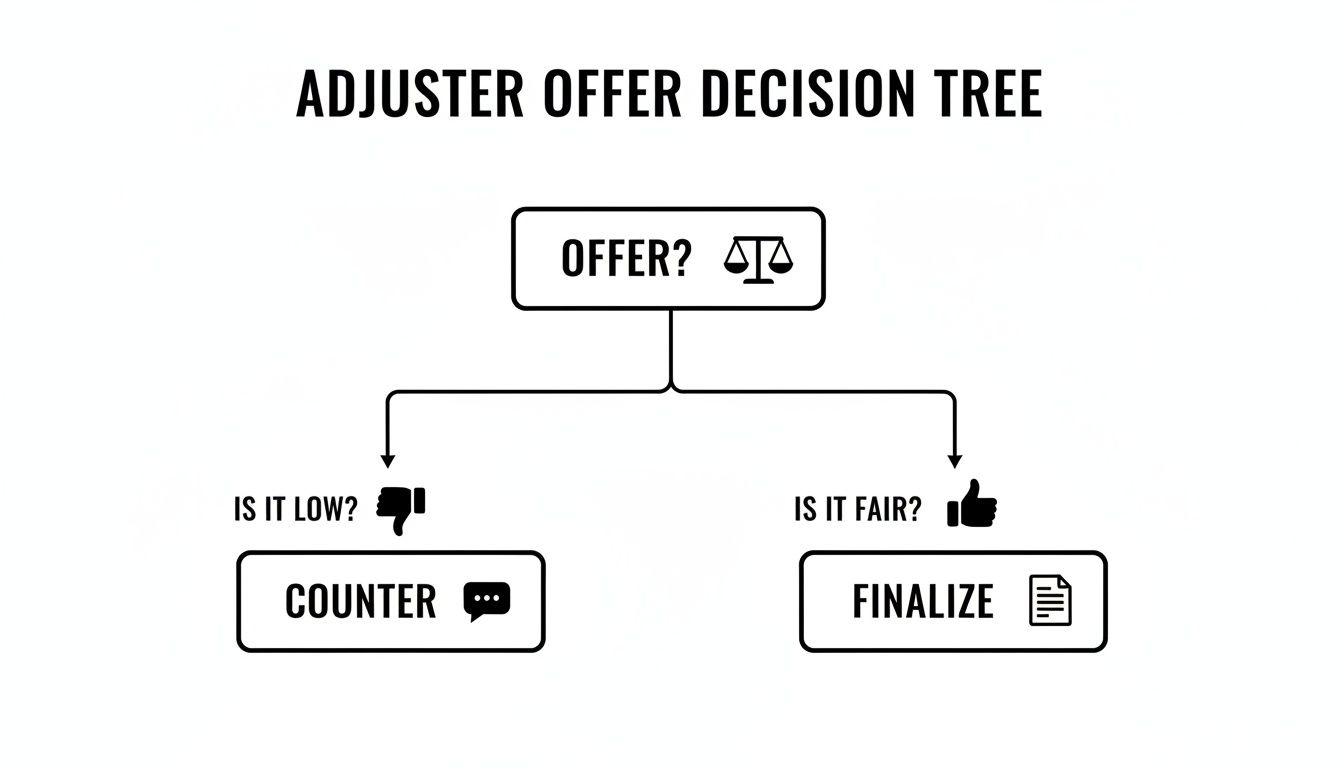
As you can see, a low offer isn't the end of the road. It’s a signal to begin a structured counter-negotiation. A fair offer, on the other hand, moves you toward closing the claim.
Key Insight: Don’t let an adjuster bully you. Recognizing bad faith isn't just about feeling frustrated; it's about identifying specific actions that show the insurer is not dealing with you fairly. This is your cue to escalate.
In many of these difficult standoffs, alternative dispute resolution methods can become a powerful part of the strategy. You can read our guide on these options to see how mediation or arbitration might fit in. Ultimately, calling for backup gives you the expertise and leverage you need to fight for the compensation you rightfully deserve.
Finalizing Your Settlement the Right Way
After all the back-and-forth, hearing the adjuster agree to a settlement number feels like a huge weight has lifted. You’ve fought hard, and it feels like it’s finally over.
But this is the most critical moment of your claim. A verbal promise is not a check in the mail. The steps you take right now will determine whether you actually get the money you’re owed and protect you from last-minute traps.
Get It in Writing Before You Sign a Thing
Don't let the relief of a verbal agreement cause you to drop your guard. Before you even think about signing a release, you need proof of the deal. An adjuster’s memory can be surprisingly fuzzy when it’s not in their favor.
The best way to lock it in is with a quick, polite email. This creates a simple but powerful paper trail.
Send something like this: "Thank you for our conversation today. To confirm, we have agreed to a full and final settlement of my claim for $XX,XXX. Please send over the written confirmation and the settlement release documents for my review."
This one simple step prevents any future "misunderstandings" about the settlement amount. It solidifies the agreement and officially kicks off the final paperwork.
Decoding the Settlement Release Form
Soon after, you’ll receive a document called a “Release of All Claims” or something similar. This is not just another form—it is the most important legal document you will sign in this entire process.
It’s a binding contract. Once you sign it, your right to seek any further compensation for this accident is gone forever.
Critical Warning: Once you sign the release, the claim is over. If you discover a new injury a month later or realize your recovery will take longer than expected, you cannot go back and ask for more money. The case is permanently closed.
Because this document is so final, you must review it with extreme care. Check these details line by line:
- The Settlement Amount: Does the number on the form exactly match the amount you agreed to? Don't sign if it's off by even a dollar.
- The Parties Being Released: The form should only release the at-fault driver and their insurance company. Watch out for vague, broad language that could release other parties you might have a claim against, like your own insurance company or even your doctors.
- The Scope of the Release: Make sure the document only covers the specific accident you’re settling. It shouldn’t accidentally release the insurer from future claims you might have under a completely different policy or for another event.
Given how much is at stake, having an attorney review the release form is one of the smartest things you can do. A good lawyer can spot hidden clauses or overly broad language that could come back to haunt you years from now.
Understanding Liens and Your Real Payout
Getting the settlement check doesn't mean all of that money is yours to keep. This is a surprise for many people. Before you see a dime, any outstanding liens on your settlement must be paid.
A lien is just a legal right that another party has on your settlement money to get reimbursed for bills they paid for you.
Common lienholders include:
- Health Insurance Companies: If your health insurer (like Blue Cross, United, or even Medicaid/Medicare) covered your medical bills, they have a legal right of "subrogation" to be paid back from your settlement.
- Medical Providers: Sometimes, a doctor or hospital will treat you under a "letter of protection." This means they agreed to wait for payment until your case settled, so they have a direct lien on your funds.
- Disability Insurers: If you received short-term or long-term disability benefits while out of work, that insurer may also have a lien on your settlement.
The insurance adjuster will not—and legally cannot—pay you until these liens are handled. This is where an experienced attorney can make a huge difference. We often negotiate with these lienholders to get them to reduce the amount they are owed.
Every dollar we save in lien negotiations is a dollar that goes directly into your pocket. Understanding this process is the key to knowing what your final, take-home amount will actually be and closing out your claim with complete confidence.
Navigating the Adjuster’s Playbook: Your Toughest Questions Answered
The phone rings. It’s the other driver’s insurance adjuster, and your stomach tightens. Even when you feel prepared, these conversations are designed to catch you off guard.
Knowing what to expect—and what to say—can make all the difference. Think of this as your guide to handling the adjuster's most common tactics, so you can protect your claim and keep control of the conversation.
"Can We Get Your Recorded Statement?"
The adjuster will often ask for a recorded statement right away, framing it as a routine step to "get your side of the story." Politely, but firmly, decline.
The true purpose of this recording isn't to help you; it's to lock in your answers early on. Adjusters are trained to ask subtle, leading questions that can easily be misinterpreted later. A simple "I'm doing okay" can be twisted to argue your injuries aren't serious. You are under no legal obligation to provide one.
What to Say: "I'm not going to provide a recorded statement right now. I'll be sending over all the necessary information and documentation in writing."
This response is professional and non-confrontational. It puts you in control, ensuring the information they receive is accurate, complete, and carefully reviewed.
"We Don't Think That Treatment Was Necessary."
This is a classic tactic to chip away at the value of your claim. An adjuster might question the number of physical therapy visits, the need for a specific diagnostic test, or the type of specialist you saw.
Remember, the adjuster is not a medical professional. Do not get drawn into a debate about your doctor's orders. Your job isn't to justify your medical care; it's to point them back to the facts.
- The Adjuster's Line: "It looks like you had an excessive number of chiropractic visits for this kind of injury."
- Your Response: "My doctor prescribed all of my treatments as medically necessary for my recovery. The records I sent you confirm that."
Stay calm and direct. If the adjuster continues to dispute legitimate, doctor-prescribed care, it’s a massive red flag. This can be a sign of insurance bad faith, and it’s a clear signal that it's time to get a lawyer involved.
"Are You Ready to Settle? We Have an Offer."
You should never accept the first settlement offer. It is almost always a lowball amount sent to see if you’re desperate enough to take it and go away.
More importantly, you shouldn’t even think about settling until your medical journey has reached a specific milestone. You must wait until you have either finished all your treatment or your doctor has declared you've reached Maximum Medical Improvement (MMI). MMI means your condition has stabilized and everyone has a clear understanding of your long-term prognosis and future medical needs.
Settling too soon is a trap. If you take the money and then find out you need surgery six months down the road, you can’t go back and ask for more. Once you sign that release, the claim is closed for good. Any future costs are on you.
"How Do You Put a Number on Pain and Suffering?"
This is the most challenging part of any claim. While you can negotiate for your own pain and suffering (also called non-economic damages), it's tough to do alone. There are no bills or receipts for anxiety, sleepless nights, or the inability to enjoy your life the way you used to.
To have any success, you need to build a powerful story supported by detailed evidence. This is where a pain journal becomes absolutely critical.
Document the specific, human impact of your injuries:
- You couldn't pick up your toddler for a month.
- You missed your family's annual camping trip.
- The constant pain made you irritable and distant with your partner.
- You had to give up your morning runs, which was your main source of stress relief.
This is where an experienced personal injury attorney provides immense value. We know the formulas adjusters use to calculate these damages, but more importantly, we know how to translate your personal loss into a demand that the insurance company has to take seriously. We build the case that turns your human experience into a figure they will respect.
Facing an aggressive insurance adjuster can be overwhelming, but you don't have to handle it alone. The team at Nares Law Group is here to protect your rights and fight for the full compensation you deserve. If you’re feeling pressured or believe the insurance company is treating you unfairly, contact us. We offer a free, no-obligation consultation to discuss your case and your options. Learn more about how we can help at https://www.nareslawgroup.com.
Written with Outrank