When you're dealing with a serious injury, the last thing you need is more uncertainty. One of the first questions almost every client asks is, "How long is this going to take?" The honest answer is, it depends.
A straightforward case might settle in just a few months. A complex case that goes to trial, on the other hand, can take several years. The path isn't determined by a formula, but by the unique facts of your accident, how seriously you were hurt, and how willing the insurance company is to be fair.
Your Personal Injury Lawsuit Timeline: A Quick Overview
Think of your case timeline like a road trip. Some routes are direct highways, while others involve winding back roads with unexpected detours. There’s no single ETA, but knowing the major landmarks helps you understand the journey ahead.
Most personal injury cases never see the inside of a courtroom. A fair settlement is the most common destination. But getting there requires navigating a few non-negotiable steps that protect the true value of your claim.
Key Factors Influencing Your Timeline
The timeline for a personal injury claim can swing dramatically. Simpler cases often wrap up in 5-7 months, while more complicated ones can stretch past 2-3 years. If you want a deeper look, you can review more details about what influences these timelines for injury claims.
A few key variables control the speed of your case:
- Maximum Medical Improvement (MMI): We can’t begin serious negotiations until your doctors have a clear picture of your long-term prognosis. This is the point where your condition has stabilized. We need to know this to account for all your future medical costs. Rushing this step is a mistake.
- Clarity of Fault: If it's obvious who caused the accident—like a clear-cut rear-end collision—things tend to move faster. When fault is disputed, a much deeper investigation is required, which takes time.
- Insurance Company Tactics: Some insurance adjusters negotiate in good faith. Others use delay tactics as a strategy, hoping to wear you down so you'll accept a lowball offer out of sheer frustration.
The biggest mistake you can make is grabbing a quick, early offer from an insurer. Rushing almost always means leaving money on the table—money you will desperately need for future medical care, lost wages, and the real-life impact of your injury.
To give you a clearer sense of the road ahead, we've outlined the major phases of a lawsuit and how long each one typically takes.
Estimated Timeline for Personal Injury Lawsuit Stages
This table breaks down the journey from the day you hire an attorney to the day your case is resolved. Each stage serves a critical purpose, from building the foundation of your claim to holding the at-fault party accountable.
| Lawsuit Stage | Typical Time Range |
|---|---|
| Investigation & Evidence Gathering | 1–4 Months |
| Demand & Negotiation | 2–8 Months |
| Filing a Lawsuit & Discovery | 6–18+ Months |
| Pre-Trial Motions & Mediation | 3–6 Months |
| Trial and Verdict | Varies (Can add 1-2+ years) |
Remember, this is just a general guide. Some stages may overlap, and others might move faster or slower depending on your specific situation. Later in this guide, we'll walk through what happens in each of these phases in much greater detail.
The Six Key Stages of a Personal Injury Case
When you're hurt, one of the first questions you have is, "How long will this take?" It's a fair question, but the answer isn't a single number. A personal injury case isn't one event; it's a journey with distinct stages.
Understanding this process helps make the path forward feel less overwhelming. Breaking it down shows you where you are, what's next, and why certain steps take the time they do.
The timeline can vary wildly, depending on the complexity of your case.
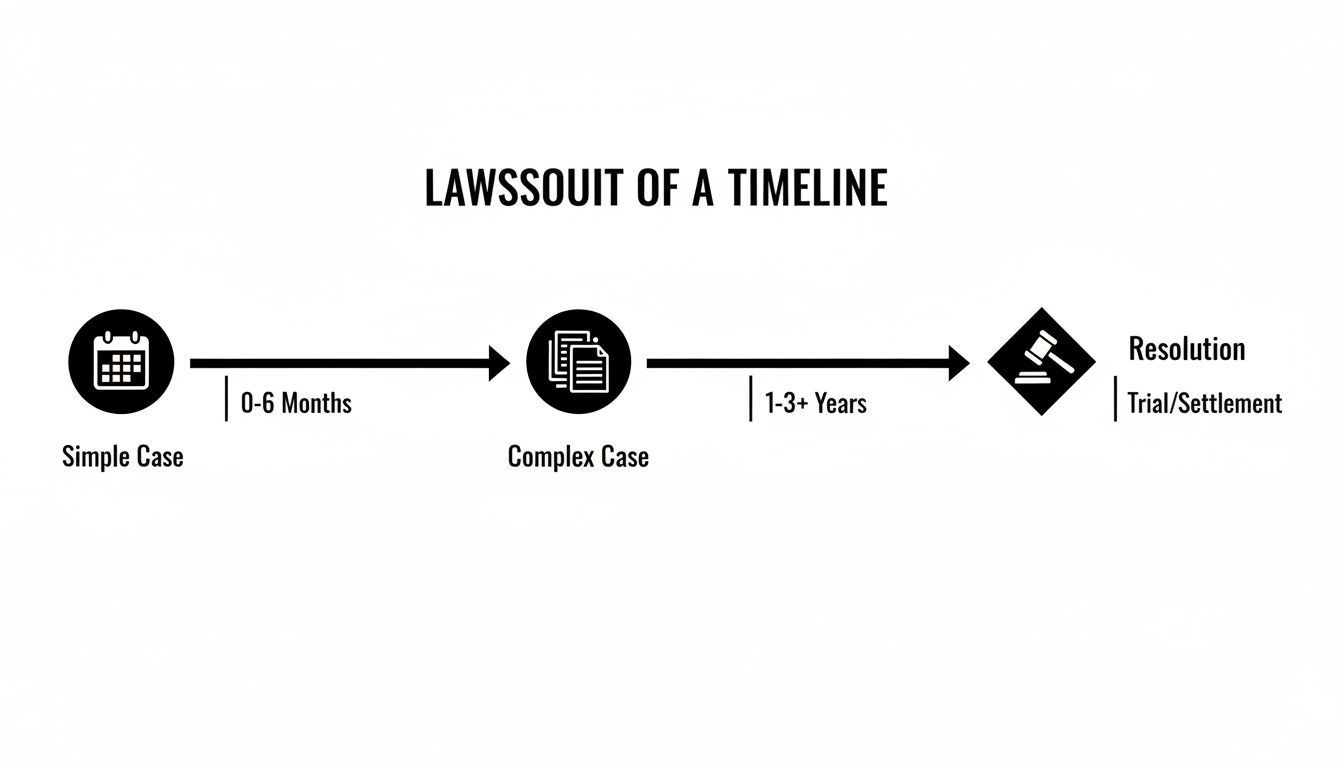
As you can see, a straightforward collision might wrap up in months, but a case with severe injuries or disputed facts will almost always take more than a year. These six stages explain why.
Stage 1: The Initial Investigation
This is where we lay the groundwork for your case. It starts the moment you hire us and usually takes between 1 to 4 months. Our team immediately gets to work gathering every piece of evidence we need to build a strong claim.
This goes far beyond just reading a police report. We are actively protecting your rights by:
- Collecting Medical Records: We track down and organize every medical chart, bill, and report to create a clear, undeniable story of your injuries.
- Interviewing Witnesses: We find and speak with anyone who saw what happened, getting their statements on record while the details are still fresh in their minds.
- Preserving Evidence: This could mean sending an investigator to photograph the scene, securing a damaged vehicle before it’s repaired, or hiring experts to document crucial details.
This stage wraps up once we have the facts locked down and a clear picture of who was at fault.
Stage 2: Demand and Negotiation
We move into this phase once you’ve reached Maximum Medical Improvement (MMI). That’s the point when your doctors have a clear understanding of your long-term prognosis and future medical needs. We then assemble a comprehensive demand package that proves the other party’s fault and spells out every dollar of your damages.
We send this package to the insurance company, which kicks off the negotiation process. This is often a lengthy back-and-forth that can last anywhere from 2 to 12 months after your medical treatment is complete. The insurer will almost always start with a low offer, we counter with facts and evidence, and the dance continues until—we hope—a fair agreement is reached.
The decision to accept a settlement is always yours. Our job is to give you our professional, experienced recommendation, but you have the final say. We will never push you to take an offer that doesn't fully and fairly compensate you for everything you've lost.
Stage 3: Filing the Lawsuit
If the insurance company digs in its heels and refuses to make a fair offer, it's time to file a lawsuit. This doesn't guarantee you'll end up in a courtroom. In fact, filing a lawsuit is often the very thing that gets an insurer to start negotiating seriously. It officially moves your claim from an informal back-and-forth into the formal court system.
Stage 4: The Discovery Process
Once the lawsuit is filed, we enter discovery. This is frequently the longest part of a case, sometimes lasting 6 to 18 months or even longer. Think of it as both sides being forced to lay all their cards on the table. There are no secrets here; each party can formally request and obtain evidence from the other.
Common tools we use in discovery include:
- Interrogatories: These are written questions the other side must answer in writing, under oath.
- Requests for Production: We formally demand key documents, like a truck driver's logbooks or a company's internal safety reports.
- Depositions: This is out-of-court testimony where we question the at-fault party, witnesses, and their experts under oath. Their lawyers will do the same with you.
This phase is all about uncovering every fact and locking in everyone's story long before a trial begins. You can get a deeper look at these tools in our guide to the stages of a personal injury case.
Stage 5: Pre-Trial Motions and Mediation
As discovery winds down, the case enters the pre-trial phase, which can take another 3 to 6 months. During this time, both sides file motions asking the judge to make important decisions. For example, we might file a motion to prevent the defense from using a certain piece of irrelevant evidence against you at trial.
Most courts will also order both sides to attend mediation. Here, a neutral third-party—the mediator—helps guide a settlement discussion to see if the case can be resolved without a trial. Many cases that haven't settled yet will resolve at this stage.
Stage 6: The Trial
If all else fails, your case goes to trial. This is the final step and by far the rarest outcome—over 95% of personal injury cases settle before this point. A trial can add a significant amount of time to the overall timeline, often pushing it out by one to two years because of backed-up court calendars.
Should your case go to trial, a jury will hear all the evidence, and we will be right there with you, fighting to deliver the verdict and justice you deserve.
Timelines for Specific Colorado Injury Cases
While every lawsuit follows a similar six-stage path, the real answer to "how long will this take?" depends entirely on the specifics of your accident and your injuries. There’s a world of difference between the journey of a simple fender-bender and that of a complex commercial trucking case.
Each type of case has its own unique set of challenges, evidence, and legal hurdles that directly shape how long it takes to find a fair resolution. Let's look at the timelines we typically see for the most common injury cases in Colorado.
Motor Vehicle Accident Timelines
Car accident claims are the most frequent type of personal injury case, but their timelines can swing dramatically. The two biggest factors are almost always the severity of the crash and how clear it is who was at fault.
Simple Rear-End Collisions: For a straightforward accident where fault is obvious and your injuries are minor—like whiplash that heals in a few months—your case could settle within 6 to 9 months after your medical treatment wraps up. The process is faster because the investigation is simple and the damages are clear.
Complex Multi-Car Pileups or Disputed Fault: When fault is a tangled mess or multiple cars are involved, the timeline stretches. These cases demand a much deeper investigation, often including accident reconstruction experts and formal witness depositions. This usually means filing a lawsuit, and it can easily take 18 months to 2 years or more to resolve.
The non-negotiable part is waiting until you reach what we call Maximum Medical Improvement (MMI). Settling before your doctors understand the full scope of your injuries is a mistake you can't undo.
Commercial Trucking Wreck Timelines
Accidents involving semi-trucks are in a different league of complexity. They almost always take longer than a standard car wreck case, with a resolution timeline of 2 to 3 years or longer being quite common.
For one, the injuries are often catastrophic, which means you’ll need prolonged medical care. We have to wait longer just to understand the full extent of your future needs. On top of that, trucking cases are governed by a web of federal laws and regulations, which adds another layer of complexity to the investigation.
We have to move quickly to secure critical evidence that is unique to trucking—the driver’s logbooks, the truck's "black box" data recorder, and the company's own records on hiring and maintenance. Trucking companies and their powerful insurers fight tooth and nail to keep this information private, which can spark lengthy legal battles during the discovery phase.
Finally, there are often multiple parties who share the blame. It could be the driver, the trucking company, the owner of the trailer, the crew that loaded the cargo, or even the manufacturer of a faulty part. Pursuing claims against all of them and their separate insurance companies adds significant time to the process.
Traumatic Brain Injury (TBI) Timelines
Cases involving a Traumatic Brain Injury (TBI) are some of the most challenging and time-consuming we handle. The core reason is medical uncertainty. The true, long-term effects of a brain injury can take months or even years to fully surface and stabilize.
Because the lifetime cost of care for a moderate to severe TBI can soar into the millions, we can’t even begin to calculate your damages until we have a clear prognosis from neurologists, neuropsychologists, and life care planners. You can learn more about the specifics in our guide to the Denver brain injury lawsuit timeline and the unique medical evidence it requires.
Rushing a TBI case would be a profound mistake. We must wait until the full picture of the cognitive, emotional, and physical impairments is clear. That medical reality means these cases often take 2 to 4 years or more to resolve justly.
Wrongful Death Claim Timelines
When a family is shattered by the loss of a loved one due to someone else’s negligence, a wrongful death claim is about seeking financial stability and holding the responsible party accountable. The timeline for these deeply sensitive cases is shaped by the type of accident that caused the death and the legal steps required to establish the claim.
The process involves an initial step of appointing a personal representative for the deceased's estate. From there, the timeline tends to mirror that of the underlying accident. For example, a wrongful death claim stemming from a commercial truck wreck will involve the same complexities and extended timeline.
Beyond the accident investigation, calculating the full measure of a family's loss—including lost future income, the loss of companionship, and profound grief—is careful, detailed work. These cases are emotionally taxing and legally intricate, generally taking 18 months to 3+ years to navigate toward a resolution that truly honors the family’s loss.
Factors That Speed Up or Slow Down Your Case

You hear about a case that settled in nine months. Then you look at your own, which feels like it’s dragging on for years. It’s natural to wonder why. The answer isn’t luck. It’s a specific set of variables that act like accelerators or brakes on your case’s timeline.
Think of it this way: a simple case is like a direct flight, while a complex one has multiple layovers and unexpected delays. The more complicated the facts, the more severe the injuries, and the more people involved, the longer it will take to land at a fair conclusion.
Understanding what pushes a case forward or holds it back is key to knowing how long a personal injury lawsuit can take.
The Severity of Your Injuries
This is, without a doubt, the most significant factor controlling the pace. A claim cannot be resolved—and it absolutely shouldn’t be—until you have reached Maximum Medical Improvement (MMI). This is the point where your doctors finally have a clear picture of your long-term prognosis.
If your injuries are minor and you heal quickly, we can gather your records and calculate your damages without much delay. But for catastrophic injuries like a TBI or spinal cord damage, reaching MMI can take a year, sometimes more. We have to wait to understand the full scope of future surgeries, lifelong care needs, and permanent impairments before we can demand what you’re truly owed.
Rushing this part of the process for a fast check almost always means leaving a massive amount of money on the table.
The Clarity of Liability
Another huge variable is how obvious it is who was at fault. When liability is undeniable, a case moves much, much faster.
- Accelerating Factor: Think of a classic rear-end collision where the other driver was ticketed. Fault is rarely in dispute. The insurance company has no room to argue, so we can focus our negotiations entirely on the value of your damages.
- Slowing Factor: Now, picture a multi-car pileup on a snowy highway or an intersection crash where both drivers swear they had the green light. When fault is contested, we have to launch a deep investigation, often bringing in accident reconstruction experts and deposing multiple witnesses. All of that adds significant time.
The Insurance Company's Tactics
The at-fault party’s insurance company plays an enormous role. Their internal culture and the individual adjuster’s approach can either pave a smooth road to settlement or throw up one roadblock after another.
Some insurers will negotiate in good faith when we present them with clear, compelling evidence. Others, however, live by a "delay, deny, defend" strategy. They will intentionally drag their feet, bury us in unreasonable requests for documents, or make insultingly low offers, all in the hope that you’ll get frustrated and accept less than you deserve.
When an insurer refuses to be reasonable, filing a lawsuit is often the only way to force them to take your claim seriously. This strategic step shows we are prepared for trial and can motivate a fair settlement offer that was previously off the table.
Multiple At-Fault Parties
When more than one person or company is responsible for your injuries, the case becomes exponentially more complex. Take a commercial trucking wreck. You could have the driver, the trucking company, the trailer owner, a parts manufacturer, and the cargo loader all sharing a piece of the blame.
Each of these defendants will have their own insurance company and their own legal team. This creates a tangled web of finger-pointing as each party tries to shift responsibility to someone else. Just coordinating discovery, depositions, and negotiations with multiple defense teams inevitably adds months, if not years, to the timeline. Patience here is critical to making sure every single responsible party contributes to your final compensation.
Understanding Colorado's Statute of Limitations
From the moment an accident happens, a legal clock starts ticking. This deadline is called the statute of limitations. Think of it as a hard expiration date on your right to file a lawsuit.
If you miss that deadline, your claim is barred forever. It doesn't matter how clear the fault is or how serious your injuries are. The courthouse doors will be legally closed to you.
While you're probably wondering how long a personal injury lawsuit takes from start to finish, the more critical question is how long you have to even begin.
In Colorado, that answer depends on how you were injured.
General Deadlines for Injury Claims
For most personal injury claims—like a slip and fall, a dog bite, or other cases of general negligence—you have two years from the date of the incident to file a lawsuit.
But there’s a key difference for the most common type of accident. For crashes involving cars, trucks, and motorcycles, Colorado law gives you a three-year window. We cover this timeline in more detail in our guide on the statute of limitation for a car accident.
These deadlines might seem simple, but they're not always set in stone. Several exceptions can change everything.
Exceptions That Can Extend Your Deadline
Sometimes, the clock doesn't start running right away. This is where the "discovery rule" comes in, which is a critical exception for injuries that don't show up immediately.
The discovery rule pauses the clock. The statute of limitations only begins on the date you actually discovered your injury—or the date you reasonably should have discovered it and its connection to someone's negligence.
This is a lifeline in cases where the harm is hidden, such as:
- Slow-to-develop injuries: Symptoms from a traumatic brain injury or exposure to a toxic chemical can take months or even years to surface.
- Medical malpractice: You might not realize a surgeon made a critical error until a new health problem appears long after the procedure.
This rule ensures people aren't unfairly punished for injuries they had no way of knowing about.
Exceptions That Shorten Your Deadline
Even more important are the exceptions that give you less time to act. The most unforgiving of these involves any claim against a government entity.
If your injury was caused by a city, county, or state employee—like a city bus driver, a police officer, or a dangerous condition on public property—you are on a much shorter and stricter timeline.
The Colorado Governmental Immunity Act (CGIA) requires you to file a formal Notice of Claim within just 182 days of the injury. That's barely six months.
This notice is not a lawsuit. It is a mandatory first step. If you fail to file this specific document correctly and on time, you will almost certainly lose your right to ever get compensation. Missing this tight, 182-day window is one of the most devastating and irreversible mistakes an injured person can make.
Partnering With Your Attorney for a Smoother Process

It’s easy to feel powerless when you’re up against court backlogs and insurance company tactics. But while you can’t control those things, you have more influence over your case’s timeline than you might realize.
Think of your attorney as the driver, but you’re the one who hands them the map and the keys. When you work hand-in-hand with your legal team, you give them the tools they need to build a stronger case, faster. The small things you do can make a huge difference.
Take an Active Role in Your Case
Your involvement is crucial to keeping your case moving. When you’re responsive and organized, you empower your attorney to fight for you without delay, which directly affects how long a personal injury lawsuit takes to finish. Here’s what you can do:
- Preserve All Evidence: Right away, take pictures of the scene, your injuries, and any vehicle or property damage. Get the names and numbers of anyone who saw what happened. Keep every single document related to the accident, from the police report to every medical bill.
- Keep a Symptom Journal: This is so important. Write down your pain levels each day, what you can’t do that you used to, and how your injuries are impacting your work and family life. This journal becomes powerful proof of your suffering.
- Follow All Medical Advice: Go to every single appointment. Do your physical therapy. Fill your prescriptions. If you have gaps in your medical care, the insurance company will use it as an excuse to argue that you weren't really hurt, dragging everything out.
When a case has to go to trial, the timeline explodes. A strong, well-documented case is your best leverage to secure a fair settlement and avoid that long, uncertain road. You can discover more insights about what drives these extended timelines for injury claims.
Protect Your Case’s Integrity
Just as important as gathering evidence is knowing what not to do. The other side is always looking for an opening.
The most valuable thing you can do is maintain open and honest communication with your attorney. Inform them immediately of any changes in your medical condition, employment, or contact information. The more they know, the better they can protect you.
And finally, stay off social media. It’s the first place insurance adjusters look. They will search for any photo, check-in, or comment they can twist to argue your injuries aren’t as bad as you say. Protecting your privacy online is a simple but powerful step toward a faster, smoother resolution.
Common Questions About Lawsuit Timelines
The legal process can feel like a maze, especially when you’re already focused on healing. It’s natural to have questions about how long everything will take.
Getting clear answers helps you set realistic expectations for the road ahead. Here’s what our clients most often ask us.
Will My Case Go to Trial?
It’s highly unlikely. The simple truth is that the vast majority of personal injury cases—well over 95%—settle before ever seeing a courtroom.
A trial is a last resort. It only becomes a real possibility when an insurance company flatly refuses to offer a settlement that is fair for what you’ve been through. Our goal is always to get you the best possible outcome efficiently, which almost always means forcing a strong settlement through strategic negotiation, not putting you through a long and stressful trial.
Can I Get Money Sooner If I Need It?
We absolutely understand the financial pressure you’re under. Medical bills pile up, and lost wages create immense stress. However, taking a quick, lowball offer from an insurance company is one of the most serious mistakes you can make. It won’t come close to covering what you’ll need long-term.
The legal timeline exists for a reason. It gives your body time to heal and your medical condition to stabilize. It also gives us the time we need to calculate the full, true value of your losses. Rushing means leaving money on the table—money you will need for your future.
While we can't speed up the final settlement without sacrificing its value, we aren't powerless. We can often issue "letters of protection" to your medical providers, which acts as a promise to pay them from the settlement. This can pause your bills and give you breathing room while we fight for you.
Does Hiring a Lawyer Make the Process Take Longer?
No, it's just the opposite. While a good lawyer will never rush the critical investigation phase, we prevent the frustrating and intentional delays insurance companies use against people who represent themselves.
Think of it this way: an experienced attorney knows the playbook. We manage every deadline, handle all communication, and apply the right kind of pressure to keep your case moving forward. We streamline the process and position you for a much stronger—and often faster—resolution than you could ever get on your own.
You don't have to navigate this uncertainty by yourself. The team at Nares Law Group is here to bring clarity and strength to your corner. For a free, no-obligation consultation to discuss your specific situation and get your questions answered, contact us today.
Powered by the Outrank tool