Many car-accident trials last about two to four courtroom days, while reaching that trial often takes many months or years. For a Colorado family, the important distinction is between time spent in court and time spent getting the case ready.
Say you're sitting at the kitchen table with a physical therapy appointment on your phone and an insurance letter beside your dinner plate. Your employer wants to know when you'll need leave. Your spouse wants to know whether the case will be finished before you have to make another major financial decision.
When you ask, “How long does a car accident trial last?” you're probably asking both questions at once. Courtroom days and preparation months are different clocks, and you need a plan for each.
How Many Days the Trial Usually Takes
Say a cafe owner in Lakewood slips on ice after a delivery crash fractured her wrist. She asks her manager to cover three shifts for trial. Her lawyer tells her to keep the whole week open, even though the witnesses may finish sooner.
That split is normal. You plan for the window the court sets. You live through the shorter stretch when evidence is presented.
The practical baseline is a few courtroom days, with the format making an important difference. The U.S. Bureau of Justice Statistics study of civil trials reports an average of 2.9 trial days for automobile cases in the nation's 75 largest counties in 2001.
How long the courtroom trial lasts
| Setting | Who decides | Average length |
|---|---|---|
| Automobile cases, 75 largest counties, 2001 | Jury or judge | 2.9 days |
| Civil trials, same large-county study | Jury | 4.3 days |
| Civil trials, same large-county study | Judge only | 1.9 days |
These are historical averages for the trial event itself, not current Colorado scheduling guarantees. The civil trial rows also include cases other than automobile claims, so they show how format changes length rather than predicting your exact finish date.
What fills the courtroom schedule
A jury trial moves through selection, openings, witnesses, exhibits, closings, instructions, and deliberation. Short case. Long proof.
Your lawyer might question the responding officer, introduce photographs of the intersection, and have a physician explain why your symptoms limit your work hours. The defense then challenges those witnesses and presents its own evidence. Even a collision that took seconds can require careful testimony when the parties disagree about speed or visibility.
A bench trial, decided by a judge, skips jury selection and jury deliberation. That shortens the calendar. The judge still requires admissible evidence and clear legal argument.
How to use the day count
Start by asking whether your case is expected to be tried to a jury or a judge. Then ask which witnesses will testify and which issues remain contested.
A claim with accepted fault and limited medical testimony needs a different schedule from a case requiring reconstruction evidence and competing opinions about permanent limits. The amount demanded is not a stopwatch, but the proof needed to support it can expand the presentation. Our guide to preparing for testimony and courtroom procedure explains what to bring, where to sit, and how questions unfold.
Scheduling rule: Keep the court's full trial window available until your lawyer releases you from it. An average is not a safe basis for booking a return flight or promising your employer a fixed return date.
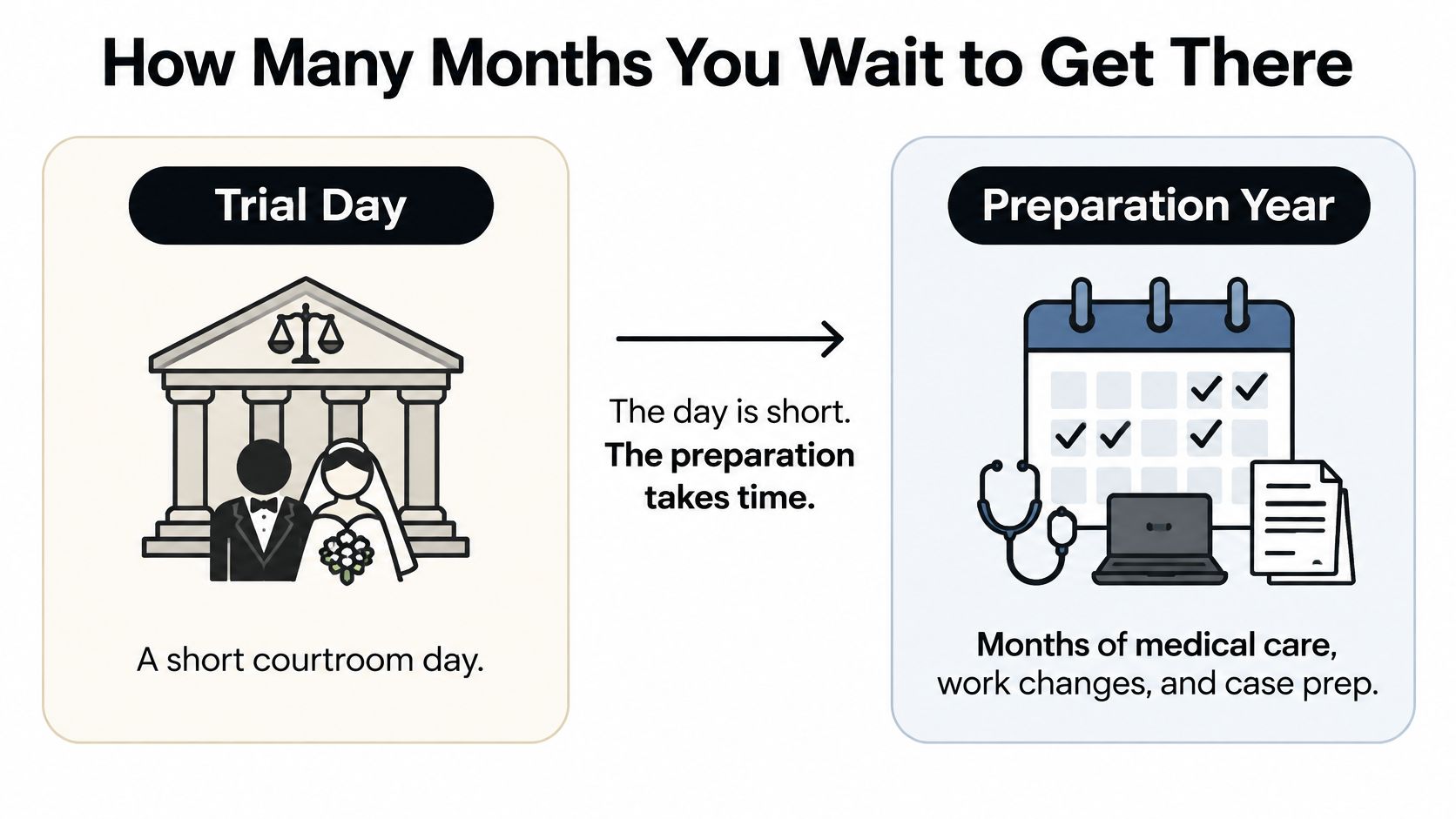
How Many Months You Wait to Get There
Say a café owner in Aurora gets rear-ended on Colfax in March. Her trial lasts less than a workweek. She waits more than three years to get those days in court.
That split confuses most injured Coloradans. There are two clocks running. One clock counts the years of preparation before trial. The other counts the days you spend in front of a jury.
The U.S. District Court for the District of Colorado's 2024 report lists 39 months on average from filing to civil trial, while 30 civil jury trials reaching verdict averaged 6 days. The court's district facts and figures for 2019 reported about 31 months from filing to civil jury trial, with trial length at about 5 days.
Months to trial versus days in court in Colorado federal court
| Measure | Figure | What it counts |
|---|---|---|
| 2024 filing to civil trial | 39 months average | Whole case until trial |
| 2024 tort cases to trial | 38 months, 12 cases | Tort cases only |
| 2024 insurance cases to trial | 34 months, 5 cases | Insurance cases only |
| 2024 civil jury trials to verdict | 6 days average, 5 most common | Courtroom only |
| 2019 filing to civil jury trial | 30.97 months average | Prep before trial |
| 2019 trial length | About 5 days | Courtroom only |
What these Colorado figures actually mean
These are federal court benchmarks. They do not set the schedule for every Colorado car accident lawsuit, and they do not measure Colorado state court automobile cases.
Categories change the picture. Tort is wider than car crashes. Insurance cases can turn on contract language instead of driver fault. Read neither line as a personal forecast for your collision.
Watch the starting line too. Filing to trial leaves out the months you spent in treatment or negotiation before the complaint was filed. When someone names a finish date, ask where the count began. That answer tells you whether you are hearing 20 months or 39 months.
Budget around the preparation period
Plan your household around the long clock. Reduced earnings, ongoing care, rides to appointments, and repeated requests for records fill those 30-plus months.
Plan time off around the short clock. Trial itself often runs about 5 or 6 days, so leave, childcare, and travel cluster in one tight window.
Ask your lawyer what must finish before the case is trial-ready and what dates the judge already set. Those two answers give you a clearer calendar than any average taped to the refrigerator.
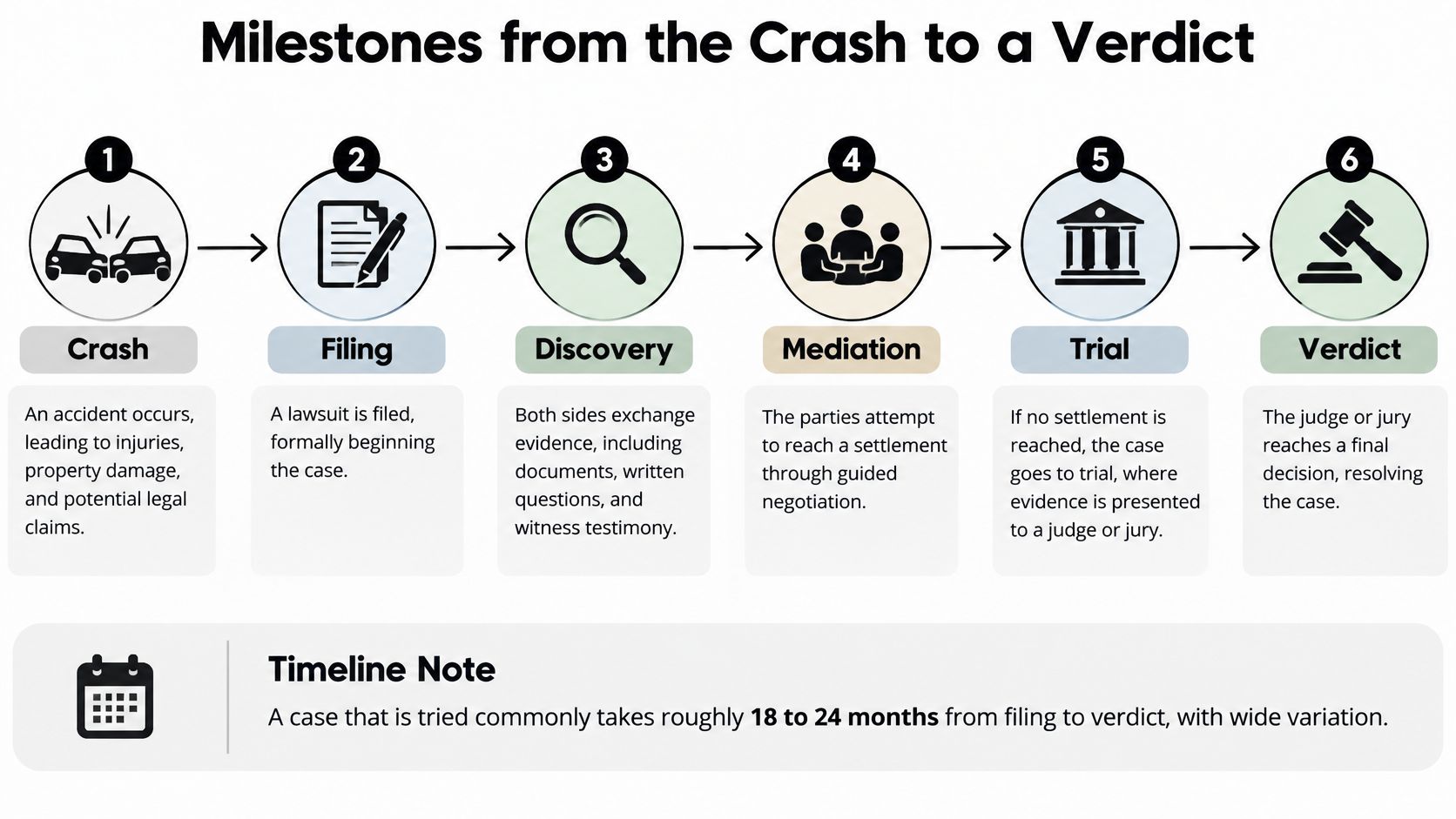
Milestones from the Crash to a Verdict
Say a café owner in Lakewood gets rear-ended on Colfax on March 4. Her car is drivable. Her neck is not. She wants one date for trial. She gets two clocks.
One clock counts courtroom days. The other counts months of waiting to get there.
The historical context helps separate them. In historical state-court cases, the Bureau of Justice Statistics study of tort trials reported a median of approximately 20 months from complaint filing to verdict or judgment for automobile-accident jury cases, compared with about 23 months for tort jury trials overall.
The gates your case moves through
A case moves like tickets in her kitchen. One order fires only after the last one clears. Ask what gate you are in, what closes it, and who acts next.
Investigation and treatment. Health care and evidence build side by side. At Nares Law Group LLC, we collect medical records, accident reports, witness statements, and expert opinions to establish liability and damages. This gate stays open while doctors define the injury and the file still has gaps.
Filing the complaint and receiving an answer. Filing starts the court case. The defendant receives service and responds under court rules. Your lawyer should name the deadline on your summons, not a number borrowed from another state.
Discovery. Both sides trade documents, send written questions, and record sworn testimony. Schedules collide here. Records departments run slow. Witness calendars fill. Learning what a deposition is in a lawsuit helps you treat that day as testimony under oath, with preparation and clear answers.
Expert disclosures. When fault, cause, or future care is contested, experts connect the crash to the harm. They review imaging, inspect vehicles, study treatment records, and write reports. The scheduling order sets the disclosure dates.
Motions. Lawyers ask the judge to decide legal disputes, limit evidence, or narrow claims. One ruling can change what still needs proof at trial.
Pretrial conference and trial setting. Lawyers list witnesses, exhibits, and exhibit objections, plus time estimates. The judge assigns the trial slot. Ask which dates are firm. Ask which ones can still move.
Verdict or an earlier resolution. A jury decides the admitted evidence if the case is tried. Many cases resolve by agreement before that day arrives, which stops the wait without any testimony.
Find your current gate
Our client-facing process uses Investigation, Treatment, Negotiation, Trial, and Settlement. Those words describe the work we guide Colorado families through while investigation or negotiation continues inside the court gates above.
Do not put a month count on each gate. Use a completion test instead.
A useful status question: What specific thing are we waiting for, and what happens after we receive it?
That answer tells you more than any calendar estimate. A missing MRI report. An expert draft. A ruling. A court date.
What Pushes a Case Off the Average
Say the other driver accepts responsibility for a rear-end collision. Your treatment records consistently document a soft-tissue injury, and the insurer doesn't dispute that the crash caused it.
That file may be ready for meaningful negotiation without extensive technical testimony. Change the facts, though, and the work changes: the driver denies hitting you, your symptoms persist, or a commercial vehicle becomes part of the liability investigation.
Complexity means additional evidence and additional decisions, not a lawyer choosing to move slowly.
| Case feature | Effect on the wait | Why |
|---|---|---|
| Clear fault and a modest documented injury | Often shorter | Less to investigate, and settlement is more likely |
| Disputed liability | Longer | More witnesses, depositions, and motions |
| Brain injury or disputed future care | Longer | Medical experts and extra examinations |
| Truck wreck or multiple defendants | Longer | More records and more parties on the calendar |
| Crowded docket or continuances | Longer even if the case is ready | The court, not the lawyers, holds the date |
| Settlement before the trial date | Wait ends without a verdict | The courtroom days never happen |
A case can become more complicated after the crash
A person may initially focus on a sore shoulder and a damaged car. Later, difficulty concentrating, headaches, or problems completing familiar tasks may lead to further medical evaluation.
That doesn't establish a diagnosis by itself. It does mean the legal team should work from the medical evidence as it develops, rather than assume that the earliest emergency record describes the full injury.
If physicians identify a brain injury, the dispute may include whether the crash caused it, how it affects work, and what care will be needed. Those are different questions from whether a bumper repair was necessary.
We have access to medical and accident reconstruction experts who can testify about the cause and impact of an injury. Their value is in explaining the evidence, not making a complicated claim fit an artificially short schedule.
Separate legal work from calendar problems
A missing medical opinion and an unavailable courtroom require different responses. The first may call for obtaining records or arranging an evaluation; the second may require revised planning under the court's orders.
You should be able to ask which kind of delay you're facing. A clear explanation won't remove the inconvenience, but it helps you avoid confusing necessary preparation with an unexplained stall.
Use the table as a self-check, not a scoring formula. When several lengthening factors apply together, plan for a less predictable path and ask which factor currently controls the next step.
Three Ways a Colorado Case Can Unfold
These are illustrations, not client histories or promises. Each begins with an injured person trying to keep ordinary life running while a claim develops.
The rear-end crash that resolves through negotiation
Say you're rear-ended while stopped in traffic. The other driver accepts fault, your doctors document your symptoms, and your employer provides records showing missed shifts.
You're juggling follow-up appointments and temporary work restrictions. Your lawyer gathers the treatment and wage evidence, presents the claim, and discusses an offer with you.
If the parties reach an acceptable agreement, no jury is selected. Your immediate decision concerns the settlement terms and whether the evidence adequately accounts for your losses, not how to prepare for cross-examination.
The left-turn collision with conflicting accounts
Now say you entered an intersection as another driver turned across your lane. You remember having the right of way; the other driver gives a different account.
You're trying to attend follow-up care while saving enough leave for required legal appointments. The lawyers obtain witness testimony, examine the available photographs, and prepare medical evidence. In a state-court lawsuit, the scheduling order sets the sequence for that work.
The parties might also use a neutral mediator to test whether agreement is possible. Learning how the mediation process works helps you distinguish a settlement discussion from a hearing where someone decides the case.
If negotiations don't resolve the dispute, your testimony becomes part of the trial preparation. You need an attendance plan, not an assumption that you'll be able to return to work between witnesses.
The truck crash with a brain injury
A truck collision leaves you struggling with concentration and unable to manage your former workload. Your family helps track appointments while the legal team evaluates crash evidence and medical opinions.
There may be commercial records to obtain, separate defendants to question, and expert opinions to reconcile. Your spouse may need to help with transportation and symptom history while also protecting time for a trial setting that could change.
The practical distinction is the workload. The rear-end example centers on documenting an agreed account, the intersection example requires resolving competing accounts, and the truck example adds technical and medical questions. Fault, injury, and the court calendar explain more than a single national average can.
Planning Clocks and Getting a Case Timeline
The most useful timeline is one you can use to make decisions. It should tell you what needs attention now, what you might need to attend personally, and what remains outside anyone's control.
Before you reorganize work or family plans, separate these common assumptions from what a trial setting means.
A trial date is a plan, not a guarantee
A scheduled date gives the parties a target. The case can still settle, and the court can postpone the proceeding.
A continuance doesn't, by itself, mean you've lost ground on fault or damages. It means you need to understand the reason, the new requirements, and the revised calendar. Don't assume every postponement is merely administrative, either; ask whether it changes the legal strategy or only the schedule.
Keep essential arrangements flexible where you can. Before making nonrefundable plans, confirm with your lawyer which appearances require you and whether the court has changed anything.
A short trial is not a short case
The courtroom presentation is the assembled version of work already completed. By the time a physician explains your limitations to a jury, the lawyers may have obtained records, reviewed opinions, taken testimony, and addressed objections about that evidence.
Your experience of the case includes that preparation. Counting only your attendance at trial leaves out the appointments, document requests, and decisions you've already managed.
The trial is an event inside a case, not the length of the case.
A federal average is not your claim's timer
The Colorado federal figures don't include Colorado state-court timing. They also don't establish which court can hear your particular claim.
A useful case review should address the realistic forum, the disputed issues, and the information still needed before offering a forecast. A responsible estimate includes uncertainty rather than concealing it behind a precise finish date.
There's also a separate issue: the deadline to preserve your claim. An expected litigation timeline doesn't tell you how long you can wait before taking legal action. The overview of personal injury time limits from ProPlaintiff.ai is useful background for understanding that distinction, but your lawyer needs to determine the deadlines that apply to your facts.
Settlement is a resolution, not a failed trial
Many claims resolve through negotiation rather than a verdict. The question is whether the proposed agreement makes sense in light of the evidence, available recovery, risks, and consequences for you.
You don't need to demand a trial to prove that your injury matters. You do need to understand what accepting a settlement means and what claims you're giving up.
A lawyer should help you evaluate that choice without treating either speed or a courtroom appearance as the goal by itself. The goal is an informed decision about your case.
Gather the facts that make an estimate useful
Write down the following before a case review:
- Treatment status. When did treatment begin, what care are you receiving, and are further evaluations or procedures being discussed?
- Fault status. Has the insurer accepted responsibility, denied it, or said it's still investigating? Save the actual correspondence.
- Complexity. Does the claim involve ongoing cognitive symptoms, a truck, several vehicles, multiple defendants, or disagreement about future care?
Bring the crash report, a simple treatment timeline, wage records, and insurance letters. Those documents help turn a general conversation about waiting into a discussion about the evidence and next steps.
At Nares Law Group LLC, our firm is led by an experienced trial attorney. A case review gives us an opportunity to discuss the likely court path and explain how we handle investigation, treatment, negotiation, trial, and settlement.
Schedule that review this week, rather than waiting until a trial notice becomes your first reason to ask how the process works. Leave with a clear understanding of the clock you need to plan around and the next task that moves your claim forward.
Nares Law Group LLC offers a free consultation for Colorado auto accident cases, including a discussion of the issues that can shape your case timeline. Visit Nares Law Group LLC to arrange a review, and bring your crash report, treatment timeline, and insurance letters so we can discuss what comes next.