You get a notice that your case is set for mediation, and your stomach drops a little. Most injured people hear that word and assume it means a showdown, a trap, or a sign that their case is about to spin out of control.
In reality, mediation is usually the opposite. It's a structured settlement process designed to help both sides talk seriously about resolving the case without asking a judge or jury to decide everything for them. If you're dealing with a Colorado car crash, a trucking collision, or a traumatic brain injury claim, mediation often becomes one of the most important days in the life of your case.
Clients often ask some version of the same question: what is the mediation process, really, and what will happen to me that day? That's the right question. Once you understand how mediation works, who's involved, and what decisions are yours, the process becomes much less intimidating.
Your Guide to the Mediation Process
A lot of clients arrive at mediation exhausted.
They've been to doctor visits. They've answered insurance questions. Some have sat through depositions. In a trucking case, they may already know there are multiple companies involved and a stack of records nobody outside the case would ever want to read. In a brain injury case, they may be struggling to explain symptoms that don't show up on an X-ray but still change daily life.
That's usually when mediation enters the picture.
Mediation isn't a random meeting someone scheduled to make your life harder. It's part of the larger path a personal injury claim often takes from investigation to negotiation and, if needed, trial. If you want a broader look at where this fits, the stages of a personal injury case can help place mediation in context.
Why it feels stressful
The stress usually comes from uncertainty, not from the process itself. Clients wonder:
- Will I have to speak in front of the other side?
- Will the mediator decide how much my case is worth?
- Am I being forced to settle?
- What if the insurance company says something insulting?
Those are normal concerns. They don't mean you're unprepared. They mean you care about the outcome.
Practical rule: Mediation works best when you treat it like a serious negotiation, not a test you can fail.
What most clients find surprising
Many people expect a courtroom atmosphere. Most mediations feel more like a guided settlement conference. There are conversations, pauses, strategy discussions, and rounds of negotiation. Your lawyer handles the legal framing. You stay involved in the decisions that matter most.
That last part matters. Mediation is one of the few points in litigation where you can directly shape the outcome instead of waiting for strangers to do it for you.
If you've been asking what is mediation process in plain English, here's the short answer: it's a private, structured effort to see whether your case can be resolved on terms you can live with.
What Mediation Is and What It Is Not
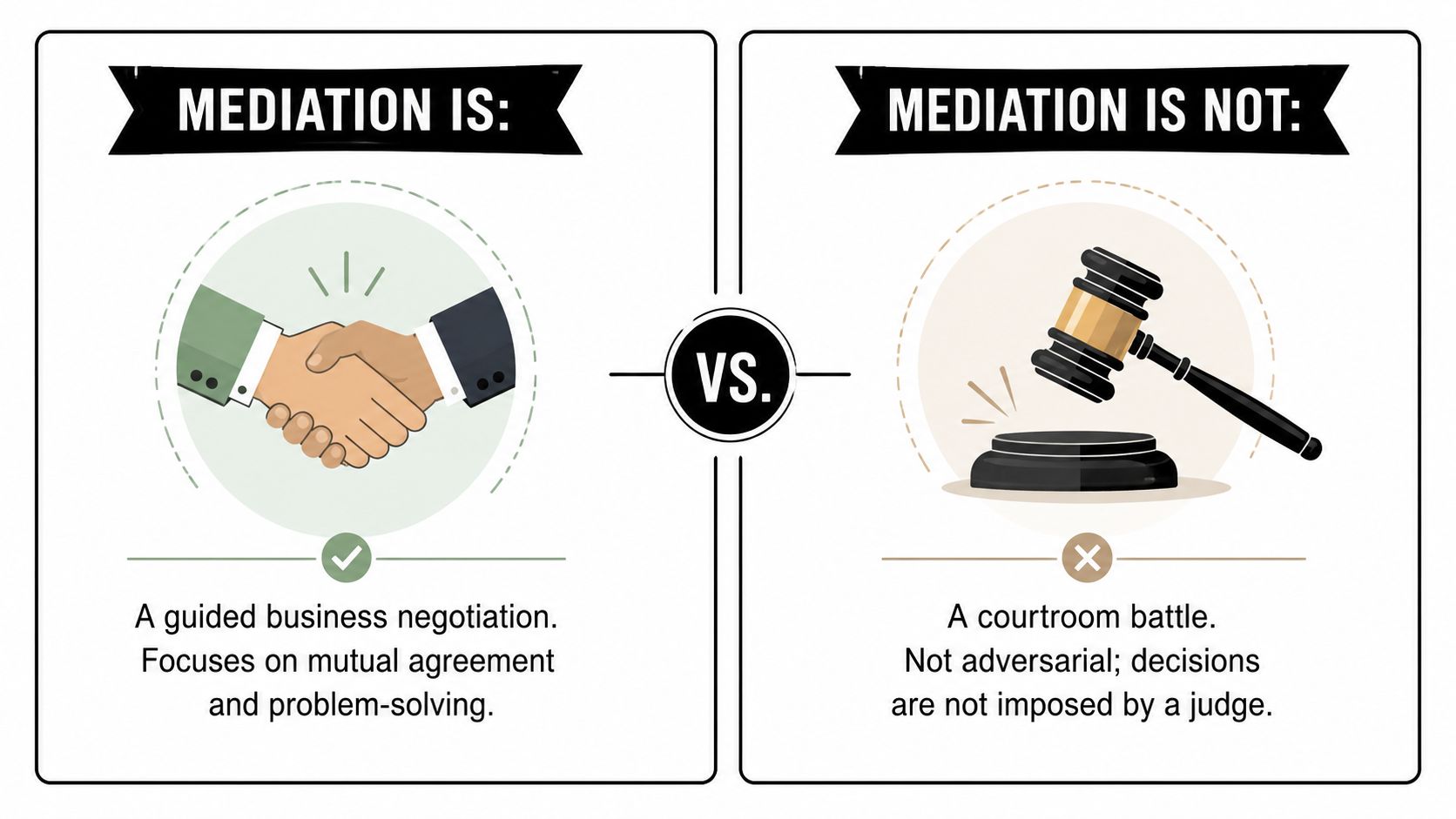
The cleanest way to understand mediation is this: it's a guided negotiation.
It is not a trial. It is not a hearing. It is not a day where a neutral person forces you to accept a number.
The simplest analogy
Think of mediation as a business meeting with structure and rules. Both sides have a dispute. Both sides want to avoid unnecessary risk if possible. A neutral mediator helps move the conversation from blame to bargaining.
In a trial, a judge or jury decides what happens.
In arbitration, a third party usually has decision-making authority.
In mediation, you keep decision control. As JAMS explains in its definition of mediation, the mediator can help frame issues, move between private sessions, and push for concessions, but the parties keep full authority to accept or reject any proposal.
What mediation is
A good mediation usually includes these features:
- Neutral guidance: The mediator isn't your judge and isn't your lawyer.
- Focused negotiation: The discussion centers on settlement options, risk, and practical solutions.
- Party control: No settlement happens unless the parties agree.
- A private setting: Most clients find it far less stressful than a public courtroom.
What mediation is not
It also helps to clear away common misconceptions.
| Common fear | What's actually true |
|---|---|
| The mediator will decide the case | The mediator facilitates, but doesn't impose a result |
| I have to settle if I attend | You can reject a proposal that doesn't work for you |
| It means my case is weak | Strong cases mediate too, because risk exists on both sides |
| It's just informal chatting | The process is structured and strategic |
Mediation is often where a claim becomes concrete. Positions get tested, assumptions get challenged, and real settlement authority shows up.
Why this matters in injury cases
In personal injury litigation, your losses don't fit neatly into one line item. You may be dealing with pain, work disruption, future treatment questions, family strain, and uncertainty about what recovery will look like. Mediation gives space to talk about solutions in a way a verdict form often can't.
So when someone asks what is mediation process, the most useful answer is not a dictionary definition. It's this: mediation is a structured negotiation where the mediator helps the parties communicate, but you remain the person with the power to say yes or no.
The People in the Room and Their Roles
One reason mediation feels mysterious is that people picture a crowded room full of strangers judging them. Usually, that's not what happens.
Most of the day is spent with a small group of people, each with a specific job. Once you know who they are, the room feels less intimidating.
The mediator
The mediator is the neutral guide. This person doesn't represent you and doesn't represent the insurance company. Their job is to help the conversation move, lower the temperature when needed, and test whether common ground exists.
A skilled mediator often does three things well:
- Listens for real priorities: not just opening demands
- Translates conflict into choices: risk, cost, timing, and practical terms
- Carries information carefully: especially during private caucuses
The mediator may ask hard questions. That doesn't mean they doubt you. It usually means they're pressure-testing the case the same way the other side will.
You
You are not a spectator.
You're the person who lived through the crash, the treatment, the disruption, and the uncertainty. In a trucking case, you may also be the person who can explain how one moment on the road changed work, sleep, family routines, and physical comfort. In a traumatic brain injury case, you may be the only one who can describe memory gaps, sensory overload, fatigue, or the frustration of not feeling like yourself.
Your role is not to perform. Your role is to help your legal team present the human reality of the case and to make decisions about settlement.
You don't need to know every legal argument. You do need to know your own story and your priorities.
Your attorney
Your lawyer is your advocate and advisor. During mediation, your attorney usually handles the legal analysis, the negotiation strategy, and the response to weak arguments from the defense.
That includes work such as:
- Explaining liability issues
- Organizing medical evidence
- Responding to defense themes
- Advising you on offers and counteroffers
A good attorney also helps regulate the pace. Mediation can be slow. Offers can feel disappointing. Emotions can spike. Your lawyer's role is to keep the process anchored to the evidence and your long-term interests.
The other side
In many injury cases, the other side includes defense counsel and an insurance representative with authority to negotiate. In a trucking claim, there may be more than one defendant or more than one insurer. That can make the mediation more layered because responsibility and payment may be split or contested.
That complexity doesn't mean the case can't settle. It just means the negotiation may involve more moving parts than a standard two-car crash case.
The Step-by-Step Flow of a Mediation Day
Most mediations follow a recognizable sequence. That predictability helps. When clients know what the day is likely to look like, they can focus on decisions instead of worrying about surprises.
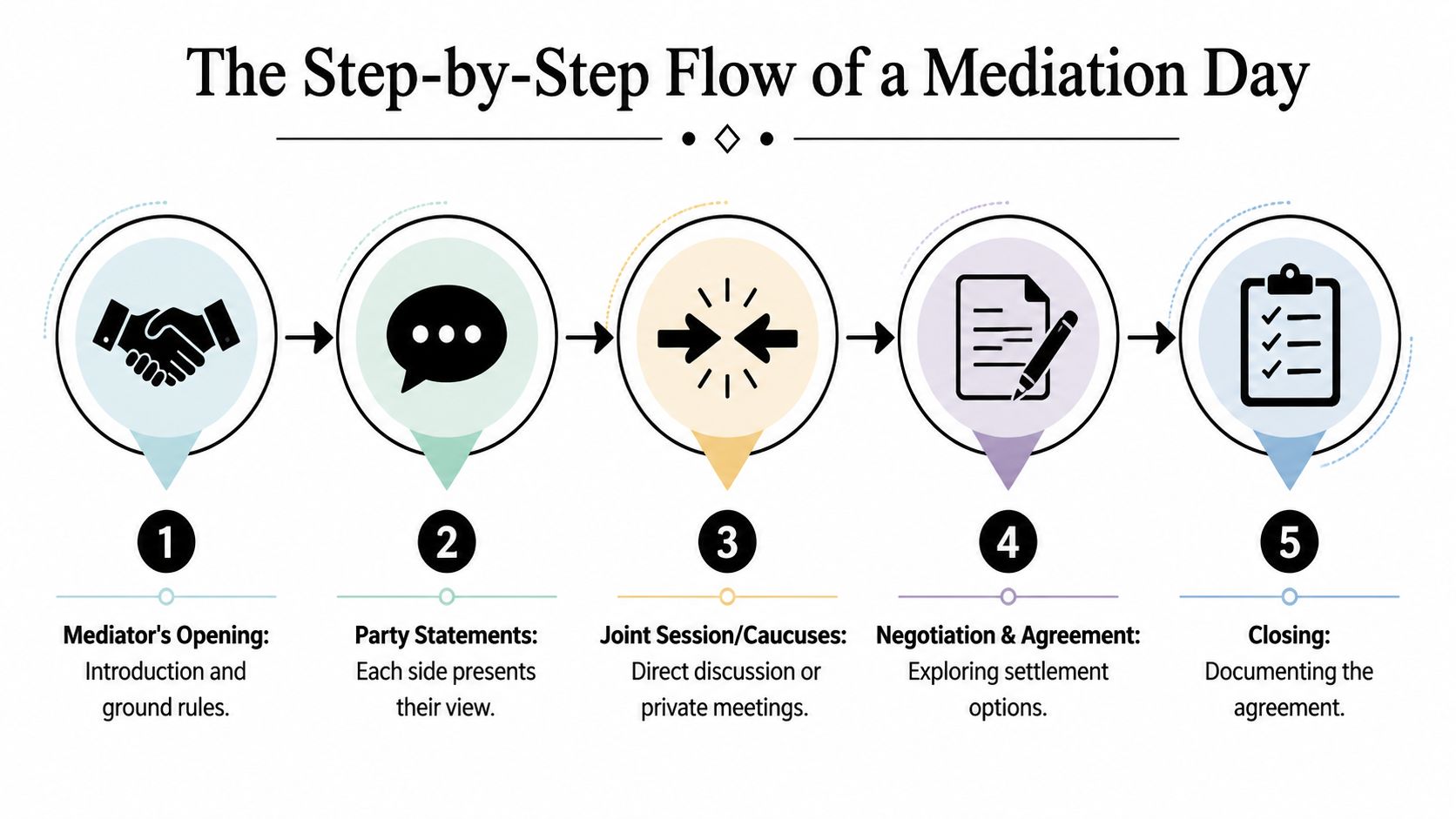
A well-known overview from Harvard's Program on Negotiation describes mediation as a structured process that commonly moves through planning, the mediator's introduction, opening remarks, joint discussion, private caucuses, and negotiation, ending either in settlement or impasse, as explained in Harvard's discussion of how mediation unfolds.
Early in the day, it helps to have a simple roadmap in mind.
Before the negotiation starts
A lot happens before anyone sits down. The lawyers usually prepare mediation statements, organize records, evaluate risks, and think through likely bargaining ranges. In a brain injury case, preparation may involve sorting out how to present symptoms that are real but not always visible. In a trucking case, it may mean untangling corporate roles and insurance layers.
Then the actual day begins.
The opening phase
The mediator usually starts by introducing the process, setting expectations, and explaining confidentiality and logistics. At this point, everyone becomes oriented.
Some mediations begin with all sides together. Others move quickly into separate rooms. Either format is normal.
Statements and early discussion
After introductions, each side may have a chance to present its view of the case. Sometimes that's done directly in a joint session. Sometimes the lawyers communicate those positions through the mediator.
This stage matters because it frames the dispute. In a trucking collision case, the defense may focus on fault, medical causation, or the severity of impact. In a traumatic brain injury claim, they may question whether ongoing cognitive issues are connected to the crash. Your team uses this phase to present a grounded account of liability, treatment, and damages.
Private caucuses
Private caucuses are often where important work happens. The mediator meets with each side separately and moves back and forth between rooms.
These meetings give people room to speak candidly. You can ask questions, vent concerns, and discuss options without performing for the other side. The mediator may test your assumptions and carry messages or offers across the hall.
A caucus is not a trap. It's a strategic workspace.
Negotiation
This is the stage commonly brought to mind when asking what is mediation process. Offers and counteroffers begin to move. Sometimes they move quickly. Often they don't.
A typical negotiation rhythm may include:
- An opening demand or offer
- A response shaped by legal risk
- Mediator feedback about gaps and obstacles
- Further movement as each side reassesses
- Discussion of non-monetary terms if needed
Progress rarely looks dramatic from the inside. It can feel slow, repetitive, and frustrating. That's normal.
Settlement negotiations often advance in small, deliberate steps. Patience is part of the process, not a sign that it's failing.
Closing the day
There are usually two possible endings.
If the parties reach agreement, the lawyers put the key terms in writing before anyone leaves. That written settlement matters. It turns a verbal understanding into an enforceable agreement.
If the parties don't reach agreement, the mediation ends in impasse. That can be disappointing, but it doesn't mean the day was wasted. Mediation often clarifies positions, exposes weaknesses, and sets up later negotiations.
Why Mediate Instead of Going to Trial
Clients sometimes worry that agreeing to mediation means backing down. Usually, it means doing the opposite. It means taking control of risk where you can.
Trial has an important place. Some cases need it. But trial also hands enormous power to strangers who only know your life through exhibits, testimony, and a limited amount of time in court.
A side-by-side reality check
Here's the practical comparison many clients need:
| Issue | Mediation | Trial |
|---|---|---|
| Who controls the result | The parties decide whether to settle | Judge or jury decides |
| Privacy | More private setting | Public courtroom process |
| Flexibility | Terms can be tailored | Outcome is constrained by legal rulings and verdict forms |
| Emotional strain | Usually lower | Often much higher |
| Certainty | If agreement is reached, the result is known that day | Outcome remains uncertain until verdict and possible post-trial issues |
Mediation also has a strong record as a dispute-resolution tool. An international civil-justice evidence review reported that 79% of participants said they would recommend mediation, attorneys reported high fairness and effectiveness ratings, and U.S. studies cited in that review found compliance with mediated agreements ranging from 62% to 90%, as summarized in the Scottish Government's international evidence review on mediation in civil justice. That same body of information also notes that mediation is often described as having a 70% to 80% success rate.
Why injured people often prefer it
For many clients, the benefits are practical rather than philosophical.
- You keep your voice: You aren't waiting for a verdict to define your future.
- You reduce uncertainty: A known settlement can be easier to evaluate than a risky trial.
- You can focus on recovery: Litigation takes energy. Mediation may create a path to closure sooner.
- You can make a business decision: Even strong cases carry trial risk.
If you want to understand what happens when a case doesn't settle and must be built for court, trial preparation in a personal injury case is worth reviewing.
When mediation may not work well
A balanced view matters. Mediation isn't magic.
It may be less productive when:
- A party refuses to negotiate seriously
- Key evidence is still missing
- The injuries or future needs aren't yet clear
- One side wants delay more than resolution
In those situations, mediation can still be useful as a checkpoint. But it may not be the moment when the case resolves.
Your Mediation Playbook How to Prepare
Preparation lowers stress. It also improves decision-making.
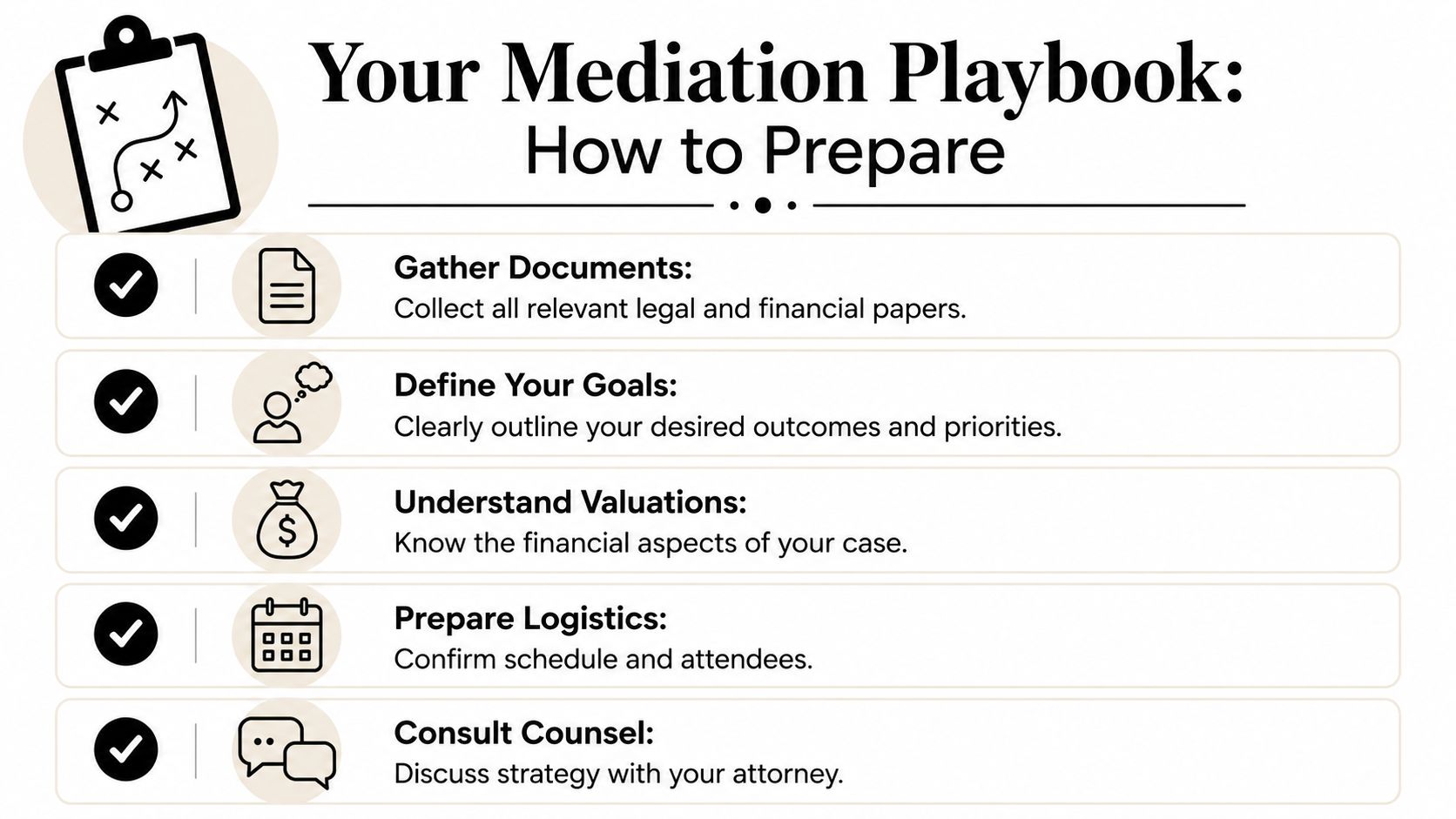
The clients who feel most grounded at mediation are rarely the ones who know every legal term. They're the ones who know the key facts of their own case, understand the major choices, and have talked through strategy with counsel before the day starts.
The core checklist
Use this as your working playbook.
- Review the story of the case: Know the basic timeline of the crash, treatment, symptoms, work impact, and current status.
- Understand the medical picture: Be ready to discuss the providers you've seen, what treatment helped, and what problems remain.
- Talk through strengths and weaknesses: Every case has both. You want to hear them from your lawyer before the defense raises them.
- Clarify your priorities: Some clients care most about total dollars. Others are also focused on timing, privacy, liens, or future care planning.
- Plan for a long day: Mediation often involves waiting, regrouping, and renewed discussion.
Know your numbers without becoming trapped by them
Clients often think preparation means memorizing one number and refusing to move from it. That's not strategy. That's rigidity.
A better approach is to understand categories such as:
- Medical expenses already incurred
- Work loss
- Ongoing symptoms and future care concerns
- How the injury changed daily function
In a traumatic brain injury case, future needs may be one of the hardest parts to value because cognitive fatigue, emotional changes, concentration problems, and support needs can affect life in ways that don't fit neatly on a bill. In a trucking case, the severity of injury may be obvious, but the defense may still dispute cause, scope, or duration.
If you want a practical overview of what happens after the parties agree, the settlement process in a personal injury case is a helpful next read.
Questions to ask your lawyer before mediation
Bring written questions. Stress makes memory worse, especially when you're in pain or overwhelmed.
Consider asking:
- What are the biggest strengths of my case right now?
- What arguments will the defense likely push hardest?
- Do you expect a joint session, private caucuses, or both?
- What range of outcomes should I realistically prepare for?
- If we don't settle, what happens next?
- What terms besides money should I pay attention to?
Write your questions down before mediation starts. People often remember concerns in the car ride home, not in the room.
Prepare your own short statement
You may never need to speak directly, but it helps to prepare a short explanation of how the injury affected your life. Keep it plain. Keep it honest.
For example, a trucking crash client might explain that driving now triggers panic, sleep is disrupted, and work tasks take longer because pain flares by midday. A brain injury client might say they can no longer manage noise, multitask, or trust their memory the way they once did.
That kind of statement often does more than polished rhetoric. It gives the case a human center.
A practical planning note
Some people benefit from outside organizational help while they're gathering records, tracking providers, or understanding service options after a serious injury. In that context, Nares Law Group LLC provides educational resources on case process and injury claims, which can be useful for clients trying to stay oriented while preparing for legal decisions.
Mediation in Colorado Trucking and Brain Injury Cases
Not all mediations feel the same. A straightforward crash claim is different from a Colorado trucking case with multiple defendants, and both are different from a traumatic brain injury claim where the biggest losses may be cognitive, emotional, and long-term.
That's why generic explanations often leave clients unsatisfied. They describe mediation in the abstract but skip the part people need, which is how the process works inside a complicated case.
Trucking cases bring extra layers
A trucking mediation may involve the driver, the motor carrier, other corporate entities, and multiple insurers. The discussion can include company conduct, recordkeeping, crash dynamics, and the extent of injury. That means the negotiation isn't just about one person's mistake. It may also involve who controlled what, who insured what, and who is trying to shift blame to someone else.
For clients, that can feel impersonal. It helps to remember that complexity is not the same as weakness. It means the case has more decision-makers in the chain.
Brain injury cases require careful communication
A traumatic brain injury case creates a different challenge. The client may look fine while struggling with memory lapses, overstimulation, headaches, mood changes, or reduced endurance. Mediation becomes a place where the legal team has to translate those invisible harms into a clear, credible picture of daily life and future need.
That's one reason preparation matters so much. The mediator and defense need to understand not only diagnosis labels but also how the injury changed work, relationships, independence, and routine.
Timing matters in Colorado cases
Many people assume mediation is always optional and always early. In litigation, that's often not how it works. As explained in this discussion of when mediation happens in the case timeline, mediation in civil cases is frequently required and often occurs after a lawsuit is filed and initial discovery is complete.
That timing matters. By then, the parties usually know more about treatment, depositions, liability disputes, and settlement advantage. In a trucking or brain injury case, that extra information can make the mediation much more meaningful.
Use practical resources, not just legal labels
Families dealing with serious injuries often need more than a legal definition. They need ways to organize information, compare options, and understand what kinds of help may exist around a claim. Resource hubs such as Algomizer personal injury services can be useful for people who want broader orientation while they sort through medical, insurance, and legal issues.
Mediation doesn't ask you to surrender control. In the right case, at the right time, it gives you a structured chance to use it.
If you're facing mediation after a Colorado car crash, truck wreck, or traumatic brain injury, Nares Law Group LLC helps injured clients understand the process, prepare for the negotiation, and make informed settlement decisions with confidence.