A functional capacity evaluation is a performance-based, objective assessment that measures an injured person's ability to safely do work-related physical tasks, like lifting, pushing, carrying, and pulling, and compares those results to the demands of the actual job. It is often used when a doctor, employer, insurer, or lawyer needs a clearer picture of what you can safely do right now.
You may be staring at a letter, a voicemail, or a claim note that says you need an FCE, and the wording feels cold and confusing. If you're hurt, out of work, and trying to protect both your health and your claim, that request can feel like a turning point. It is, because the results can affect treatment plans, work restrictions, disability decisions, and how everyone involved sees your recovery.
Understanding Functional Capacity Evaluation Basics
A worker gets a call saying, “You need an FCE before we decide next steps.” That person usually hears the phrase and immediately wonders whether it's a test, a doctor visit, or some kind of insurance hurdle. In plain English, it's a structured way to show what your body can safely handle in a work setting, not just what diagnosis appears in the chart.
A functional capacity evaluation looks at current function against job demands. That matters because pain, imaging results, and even a strong medical diagnosis don't always answer the practical question, “Can this person safely do the job today?” The FCE tries to turn that question into observable work performance.

Why the evaluation exists
The idea behind an FCE is simple. Instead of relying only on self-report, the evaluator watches you perform tasks that resemble work activity and records what happens. That can include whether you can sustain a posture, how your body responds to lifting, and whether a task stays safe over time.
Clinical reviews describe FCEs as tools used to evaluate whether an injured worker can work, guide treatment, and determine return-to-work readiness, which shows how central they've become in occupational rehabilitation (NIH review). If you want a plain-language overview before your appointment, Cartwright Fitness on FCE explained is a helpful background resource.
Practical rule: An FCE is about what you can safely do on the day of testing, not about whether you're “trying hard enough” or whether your injury is real.
The best way to think about it is this. A doctor diagnoses, a therapist treats, and an FCE helps answer the work question. That difference matters in injury claims because the report can shape restrictions, job placement, and the next round of negotiations.
Core Components of a Functional Capacity Evaluation
A Functional Capacity Evaluation usually starts with a bigger question than, “How much can you lift?” It asks how your body handles work-like demands, whether your performance stays safe, and what those findings may mean for treatment, work restrictions, and an injury claim. In a real dispute, that report can affect whether a carrier keeps authorizing care, whether an employer thinks you can return with limits, and how a lawyer frames the next step.
The main parts of the evaluation
A detailed FCE is built from several required elements, including worker information, musculoskeletal screen, capacity testing, cardiorespiratory endurance testing, consistency testing, and level-of-effort testing. You can picture them as separate checkpoints in the same review, each one answering a different question about your physical ability and the reliability of the results.
- Worker information: This is the intake piece. The evaluator learns about your job, your symptoms, and which tasks matter most in the workplace.
- Musculoskeletal screen: This checks the body itself, including areas that may react to loading or movement.
- Capacity testing: This is the center of the FCE, where you perform physical tasks tied to work demands.
- Cardiorespiratory endurance testing: This looks at whether you can tolerate sustained activity, not just short bursts.
- Consistency testing: This checks whether your performance stays stable across repeated tasks, much like a mechanic checking whether a car behaves the same on several drives.
- Level-of-effort testing: This helps the evaluator interpret how effort, pain, and performance fit together.
Johns Hopkins describes FCEs as a series of tests involving tasks such as pulling, pushing, lifting, and job-related activities, with the results recorded in a report to determine return-to-work readiness or restrictions (Johns Hopkins). That report is often what adjusters, employers, and attorneys read first. The details you remember from the testing room may matter less than how the evaluator describes them on paper.
What the tasks usually look like
The task list can include lifting, carrying, pushing, pulling, postural tolerance, and job-specific activities. The evaluator is not guessing from a diagnosis. They are watching actual movement and comparing it to the physical demands of a specific job.
That difference matters in an injury claim. Two people can have the same diagnosis and still produce very different FCE results because pain, endurance, movement quality, and work demands do not line up the same way in every case. The evaluation helps show what your body can do safely on that day, and that can shape treatment limits, return-to-work decisions, and later arguments over restrictions or benefits.
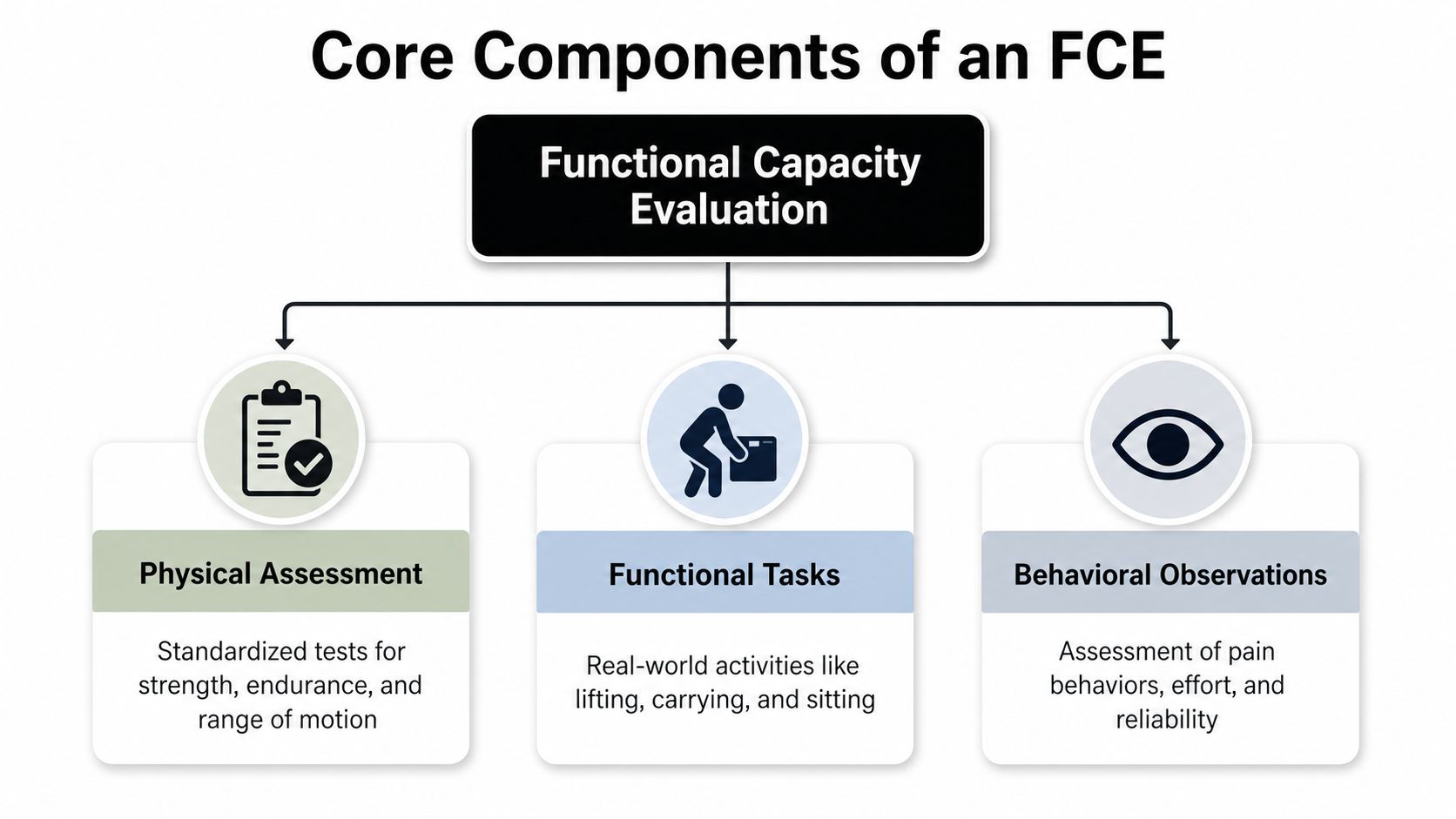
The practical takeaway is simple. An FCE is not just a fitness check, it is part medical review, part work simulation, and part documentation tool that can ripple through treatment planning and claim handling.
Types of Functional Capacity Evaluation Systems
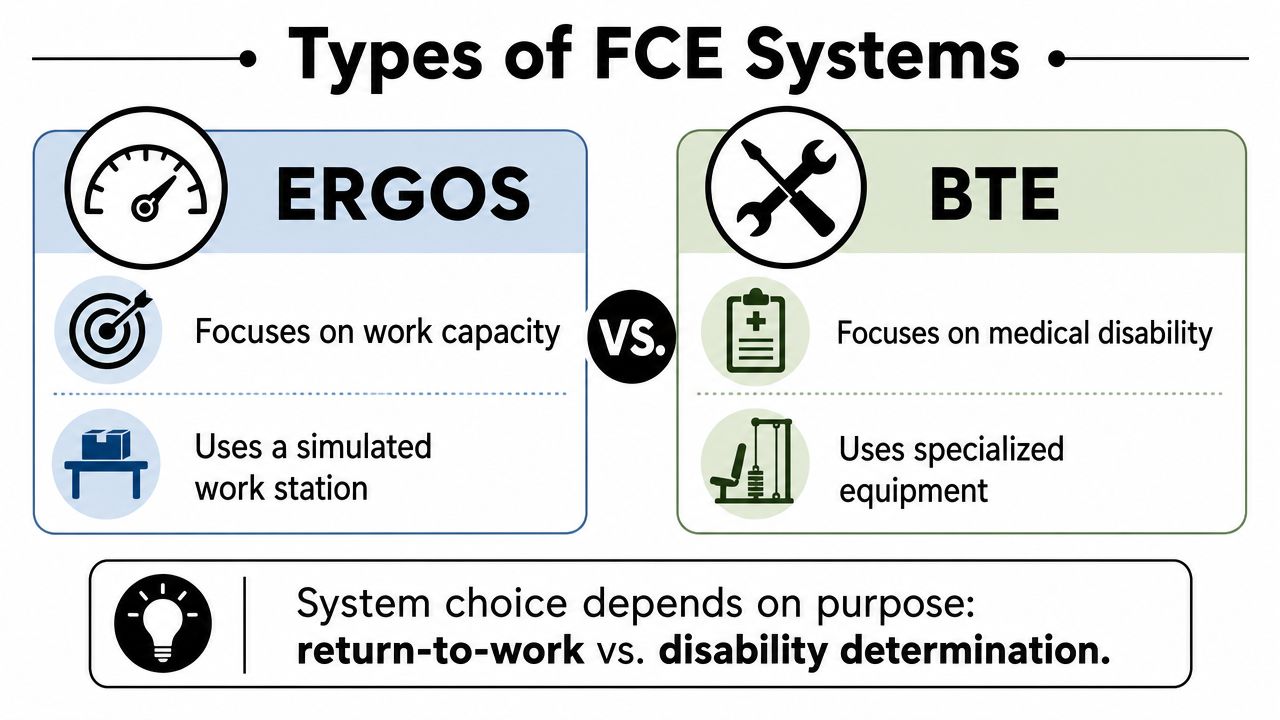
One reason people get confused is that an FCE isn't one uniform test. A clinical review says there are approximately 10 commonly used types of FCEs, including the Blankenship, Isernhagen Work System, Physical Work Performance Evaluation (Ergoscience), WEST-EPIC, Key, ARCON, and AssessAbility systems (NIH review). So if your friend describes a very different experience, that doesn't mean one of you had the wrong test.
Why there are multiple systems
These systems grew over time because clinicians were trying to solve the same problem in different ways, how to measure real-world physical ability in a repeatable format. Some systems lean more toward work capacity, while others are used more in disability settings. The underlying goal stays the same, compare observed performance against job demands.
That's why the experience can look different from case to case. One evaluator may use a simulated work station, while another may use specialized equipment and a different scoring method. The setting changes, but the core question does not, can this person safely do the work required?
Why the system name matters less than the purpose
The system chosen often depends on why the FCE is being done. Some evaluations are built to help with return-to-work planning. Others are used more often in disability determinations or legal disputes. That purpose affects how the evaluator structures the session, what tasks show up, and how the report is written.
The name of the system matters, but the report's purpose matters more.
If you're reviewing paperwork and see a system name you've never heard of, don't panic. The important questions are whether the evaluator is qualified, whether the job demands were understood, and whether the final report matches the actual issues in your case.
What to Expect Before During and After Your FCE
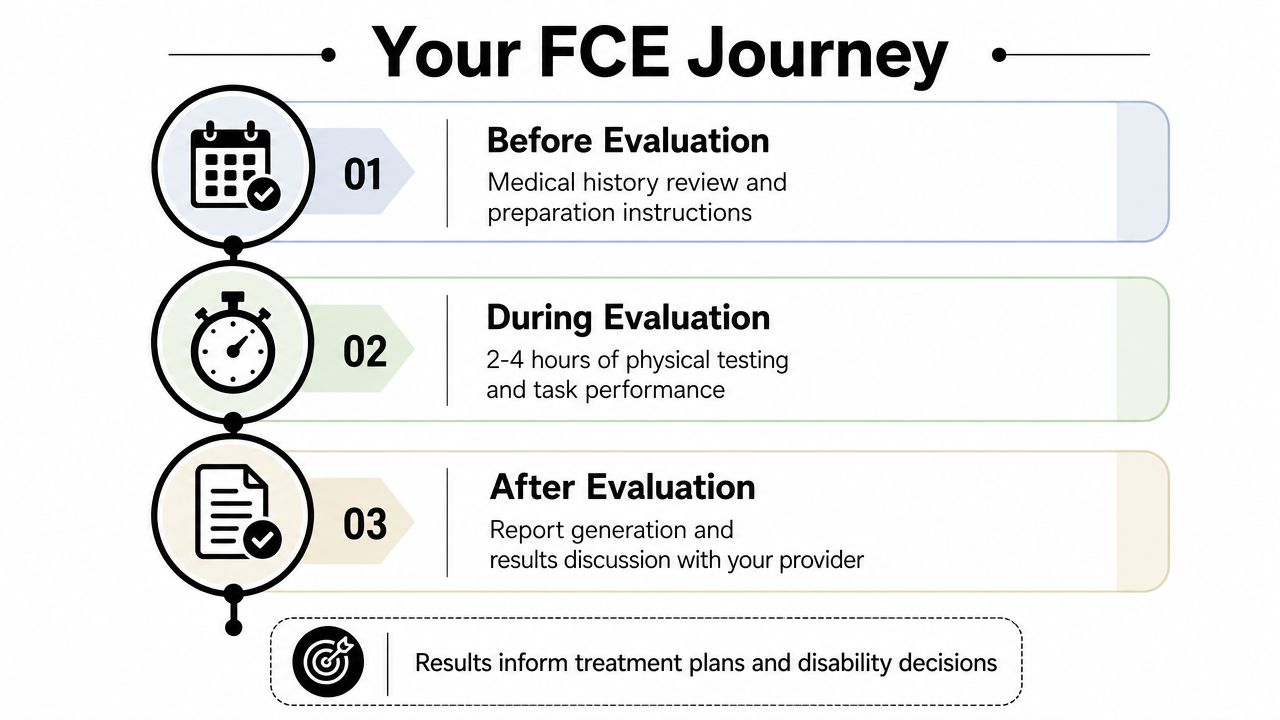
The first question many injured workers ask is simple. Will this feel like physical therapy, a medical exam, or a work test? The answer is that it includes pieces of all three. Before the testing begins, the evaluator usually gathers your history, reviews records, and performs a physical exam so the rest of the session has context. This helps show how your reported limits match your medical file and the demands tied to your job.
During the evaluation, the pace can feel demanding. A major clinical source describes a 6-to-8-hour evaluation, sometimes spread over two days, when the goal is to verify whether a worker can safely perform a specific job. That time is spent on a series of tasks, not a single lift or a quick checklist.
Before the testing starts
Expect questions about your job, your symptoms, and your medical history. Evaluators often review records first because the FCE is more useful when they understand the kind of work you do and the restrictions already in your file. If you also have an upcoming an independent medical examination, it helps to keep those two processes separate, since they serve different roles in a claim.
During the test battery
The session can include lifting, pushing, pulling, balance work, fine motor tasks, and cardiovascular tolerance testing. The evaluator may also track pain, effort, heart rate, and blood pressure for safety and interpretation. That monitoring matters because the point is not to push you until you fail, it is to find out what you can do safely and what starts to break down.
After the report is written
Once the testing is over, the findings are compiled into a report that usually addresses work capacity, restrictions, and accommodations. Those details can shape treatment planning, return-to-work discussions, insurance decisions, and the rest of the claim file. If you want to understand why paperwork carries so much weight, reviewing understanding medical necessity requirements can help explain how decision-makers read medical support and why the quality of documentation matters.
How FCE Results Affect Your Treatment and Injury Claim
A functional capacity evaluation can shift the direction of a case in a very direct way. If the testing shows steady tolerance across the tasks tied to your job, a doctor or employer may support fewer restrictions and a clearer return-to-work plan. If the evaluation shows pain flare-ups, uneven effort, or limited endurance, the next step may be modified duty, work conditioning, or continued treatment.
The report also matters because it becomes part of the evidence other people use to make decisions. In injury claims, insurers often rely on documents that appear objective when they decide disability benefits, claim posture, or settlement value. That is why the evaluation can feel less like a routine appointment and more like a record that follows you through the rest of the case.
Why the job description matters so much
The comparison standard is the demands of the job, so the report is more useful when it is matched with a detailed job analysis or occupational classification. Without that context, a restriction can sound vague and leave too much room for interpretation. With it, a clinician can say what is safe, what needs to change, and what may not be realistic.
An FCE is strongest when the evaluator understands the actual job, not just the job title.
That same idea carries through the claim file. Paperwork that supports treatment approval works best when it gives decision-makers a clear reason to agree, which is why the logic behind understanding medical necessity requirements matters beyond one form or one appointment.
Where legal and vocational professionals fit in
A vocational expert may help explain how work restrictions affect earning capacity or job options, especially when the injury lasts or the job is physically demanding. If that part of your case is already being reviewed, a vocational rehabilitation expert can translate work-function problems into legal and practical terms that are easier to use in a claim.
The point is simple. An FCE does not just describe how you felt that day. It can shape the treatment path, the employer's next move, and the insurer's view of the claim.
Common FCE Pitfalls and How an Attorney Can Help
People often assume an FCE is neutral just because it looks clinical. It can be objective, but it can still be mishandled. Problems come up when the test pushes past someone's actual capacity, when the conditions are inconsistent, when the evaluator isn't well qualified for the job at issue, or when the report ignores the actual physical demands of the work.
Another issue is selective use of the results. An insurer may focus on the parts of the report that suggest some capacity while giving less weight to the limitations, symptom provocation, or task failures. That can lead to premature return-to-work pressure or a lower settlement position than the facts support.
What to watch for
A careful review often looks at whether the evaluation matched the job, whether the testing was internally consistent, and whether the report explains limitations fairly. If the evaluator never had a clear job analysis, the final opinions can be less useful than they appear. If the evaluator didn't document the pattern of symptoms well, the report may oversimplify a complicated injury.
You also want to know whether the person writing the report had the right background for the kind of evaluation being done. Credentials matter because the final opinion can influence work status, benefits, and settlement strategy. If a report feels off, a lawyer can ask harder questions than an injured person usually can on their own.
How legal help changes the process
An experienced personal injury attorney can review the report for inconsistencies, compare it against medical records, and push for an independent medical opinion when needed. They can also make sure the evaluation is measured against the actual job, not a simplified title that leaves out lifting, climbing, sustained standing, or repetitive motions. In cases involving trucking or motor vehicle trauma, that distinction can be especially important because work capacity and earning capacity are often central issues.
Don't treat the FCE as the last word if the report doesn't match your symptoms, your job, or your medical history.
If you're sorting through records and preparing for a dispute, keeping documents organized can make a huge difference. A practical guide on medical record organization can help you think about how to keep the timeline, restrictions, and test results easier to review.
Protecting Your Rights After a Functional Capacity Evaluation
An FCE is not just another appointment. It can shape treatment, work status, and the financial side of a claim for a long time. The safest approach is to understand the purpose of the test, answer truthfully, and make sure the final report is reviewed with the same care as any other key medical document.
If you're in Colorado after a car crash, truck wreck, or traumatic injury, don't assume the first report tells the whole story. The details matter, especially when your future work ability is being measured against a job you may not yet be ready to resume.
A good next step is to gather your records, note any problems you noticed during testing, and get legal guidance before accepting a decision that feels rushed. If your FCE is part of a larger injury claim, a law firm that understands how these reports affect treatment and negotiations can help you protect your rights and keep the case focused on the facts that matter.
If you're facing an FCE and want help understanding how it fits into your injury claim, Nares Law Group LLC can review the medical and legal issues with you and help you plan your next step. Visit Nares Law Group LLC to connect with a team that represents injured people with care, clarity, and trial-tested advocacy.