You stopped at a red light. The tap from behind felt small. You stepped out, saw a scuff on the bumper, and told the other driver you were fine. The next morning your neck was stiff, your head ached, and checking a blind spot hurt.
That gap between a quiet bumper and a sore body is why inertia in car accidents matters. The car can change speed while your head and neck are still catching up. Feeling okay at the scene doesn't close the question of injury.
What follows walks the physics in plain steps. You'll see what inertia means, how a rear impact moves the torso and the head, why two belted people can be hurt differently, how crash evidence gets sorted, and which medical notes make the link visible.
Why Minor Crashes Can Still Cause Real Injuries
The morning after is often when the crash becomes real. You slept poorly. Your shoulders sat high. Coffee didn't loosen the tightness at the base of your skull. Nothing about the bumper photo matches how you feel, and that mismatch is what makes people doubt themselves.
Vehicle damage and occupant injury answer different questions. A bumper can absorb or hide energy while the seat, the belt, and the neck still have to manage your body. Low visible damage doesn't prove you were unhurt. People looking at a car crash involving low property damage run into the same puzzle. The photos look mild, and the symptoms don't.
Why symptoms can wait
Adrenaline at the scene can mask pain. Soft-tissue irritation and muscle guarding often build over hours, not seconds. A headache or a stiff neck that shows up later is common enough that it should be written down. It isn't proof that the crash "wasn't that bad."
Practical rule: Write down when you first noticed each symptom, even if that moment was the next day. Timing is part of the story, not a reason to dismiss it.
Keep these pieces in mind as you read:
- A plain definition of inertia: why your body doesn't stop when the car does.
- The motion sequence: how the seat and the neck share the load in a rear impact.
- Injury pathways: why wearing a belt doesn't end the analysis.
- Evidence types: what bumper photos, speed change, and body motion each can and can't show.
- Records: seating position, head restraint, belt use, impact direction, and how symptoms changed.
If an insurer later calls the crash minor, those details are the reply. They describe you, not just the bumper.
The Physics of Inertia in a Vehicle Collision
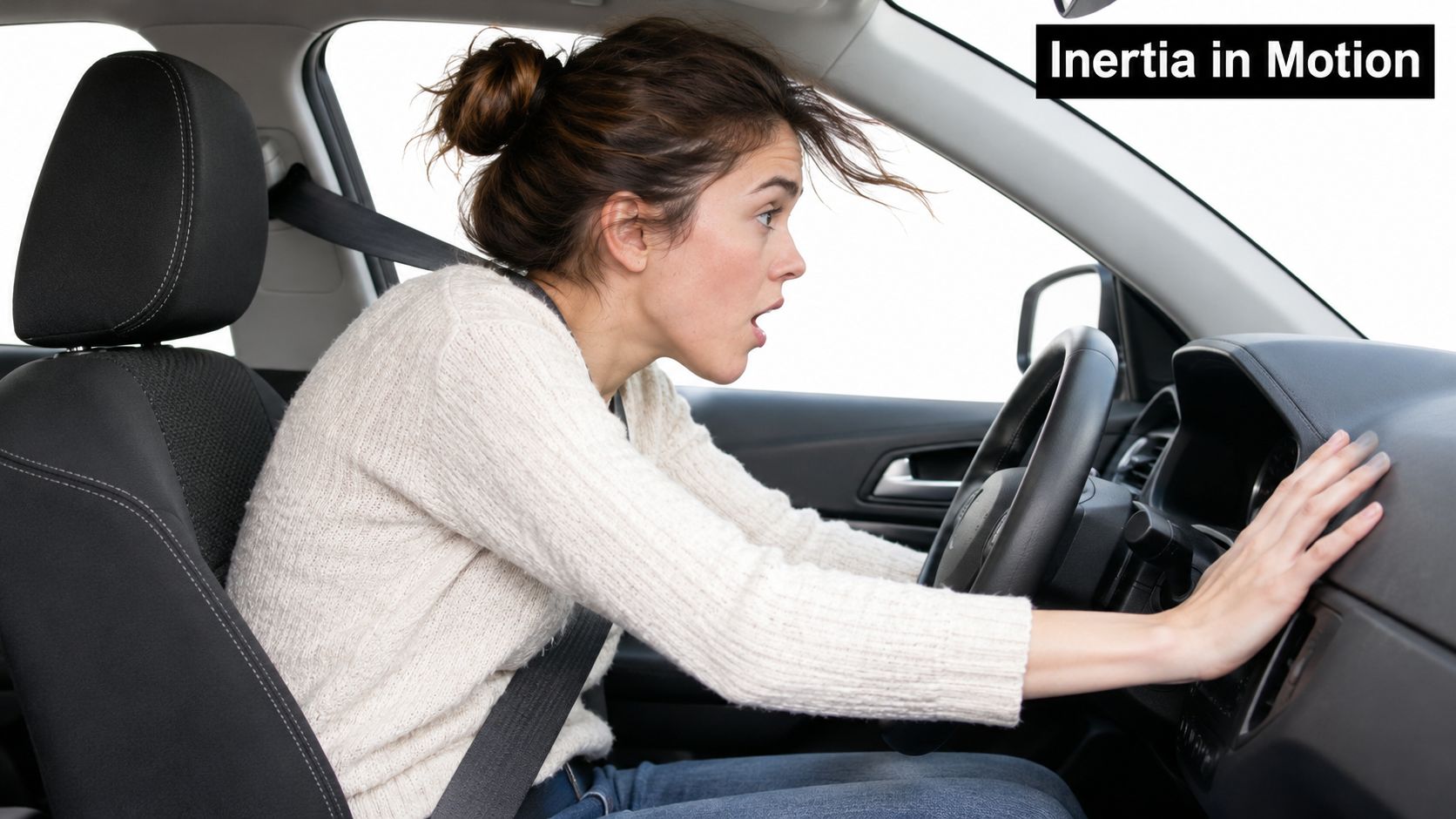
Inertia is the tendency of your body to keep doing what it's already doing until a force changes that. Sit in the passenger seat while someone brakes hard at a yellow light. The car slows. Your chest still wants to travel forward. The belt catches you. That small lurch is the same idea, at a gentler scale, as inertia in car accidents.
Car motion and body motion are not the same event
The vehicle can change speed in a fraction of a second. Your torso, head, and limbs change speed only when something pushes or pulls on them. That something might be the seatback, the belt, a head restraint, the steering wheel, or an interior surface. Until that force arrives, each body region keeps the motion it had.
Three ideas carry the rest of this guide:
- Speed change of the car: how quickly the vehicle's velocity changes.
- Force on the occupant: what slows or speeds each part of the body.
- Time: a shorter stop means a sharper push, which is why safety design tries to stretch that moment.
The same bump doesn't move every person the same way. Height, weight, how you were sitting, and which way the impact came from all change which part of you meets the seat or the belt first. Inertia isn't one single danger. It's a set of motions the body has to absorb, piece by piece.
Direction matters as much as size. A hard brake throws you forward. A rear hit shoves the seat into you from behind. A side impact loads you across the cabin. The vocabulary stays the same. What changes is which structure has to stop which body part.
A short clip makes that braking lurch easier to picture before a rear impact comes into view.
Your body doesn't decide to keep moving. Nothing has pushed it yet.
How the Crash Sequence Moves the Body
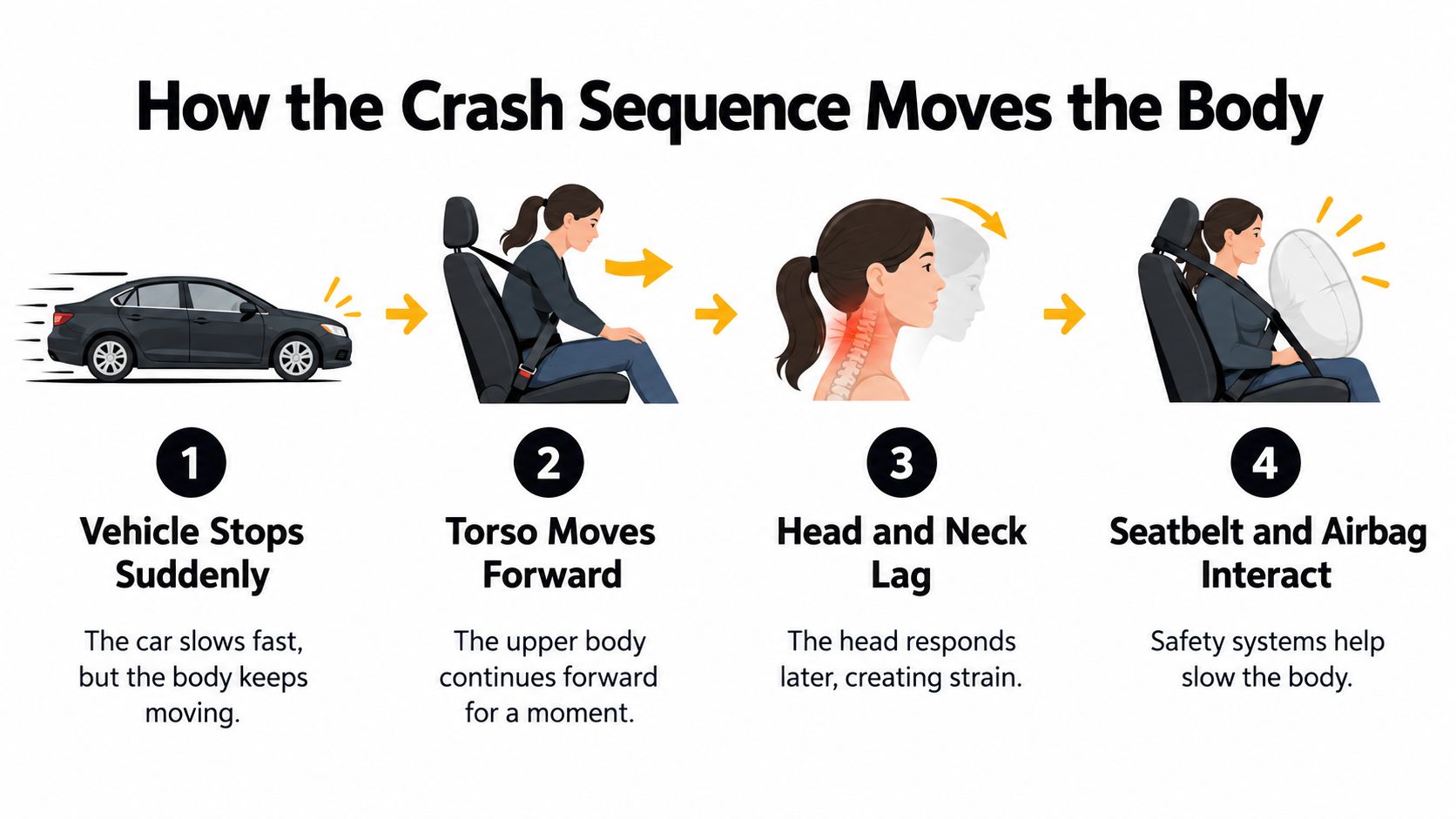
In a rear-end crash, the timing is easy to miss if you only picture "the body keeps moving." The struck vehicle is pushed forward first. Your torso is still sitting. The seatback comes into your back and shoulders and starts to deflect. Your head, freer to move than your chest, lags behind the torso for a moment because of head inertia and cervical-spine flexibility.
A peer-reviewed model validated with human test data reports that even low- to moderate-speed rear impacts are associated with cervicocranial biomechanics capable of producing head and neck injury. That finding is about occupant motion, not about how the bumper looks.
Rebound is a second loading event
The mechanism doesn't end at first contact. On rebound, the belt holds the torso while the head and neck keep traveling forward. That motion creates cervical flexion and loads the muscles that try to catch the head. People who later find relief for a stiff neck are often dealing with this second phase, not only the first shove into the seat.
What to picture, in order
- Vehicle accelerates forward. The car moves before you do.
- Torso loads the seatback. Your back presses in and the seat gives.
- Head lags. The neck bridges two speeds at once.
- Rebound flexes the neck. The belt stops the chest. The head is still going.
Low speed doesn't cancel that order. It can reduce the energy, and it can still be enough to strain joints, discs, and muscles. Pain the next day is a reason to get the neck examined, not a reason to wait it out in silence.
The head restraint's job is to meet the head sooner so the lag is smaller. If it sits low or far back, the head travels farther before it has support. That geometry is specific to you. It isn't visible in a bumper photo.
Secondary Impacts and Common Injury Mechanisms
The order of motion is one question. The injury pathway is another. Rear-impact research describes several distinct routes, including compartment collapse, contact with rigid interior structures, and thoracic loading from the seat. That rear-impact research also notes that thoracic loading is especially relevant for older occupants.
Three pathways, not one bruise
Contact with the cabin happens when the head or a limb meets glass, a pillar, the dashboard, or a window after the body has already started to move. The first push and the later strike can injure different tissues. A sore neck and a cut on the scalp can come from two moments in the same crash.
Compartment collapse is structural. If the occupant space deforms, the available room shrinks and the body meets hard surfaces sooner. You may never see that deformation from the curb.
Thoracic loading from the seat is easy to overlook in a rear impact. The seatback itself pushes on the chest and upper back. For an older occupant, that chest load can matter even when the face never hits anything.
Why two belted people don't match
A belt reduces forward ejection and spreads some of the stopping force. It doesn't delete inertia. Occupant motion still varies with height, weight, seating position, head-restraint design, seatback recliner stiffness, belt use, and vehicle motion. One person may load the head restraint cleanly. The person beside them may be turned, reclined, or sitting so the belt crosses the body differently.
A restraint can be working exactly as designed and an occupant can still be hurt, because protection systems manage motion. They don't make inertia disappear.
The same research describes NHTSA work evaluating human responses and injury risks for forward- and rear-facing reclined seating, including male and female body models and new advanced crash-test dummies. The lesson for today's cars is simpler. Upright, forward-facing assumptions don't cover every posture people use.
Belt fit, head-restraint height, and age-related vulnerability belong in the injury story. Preventing ejection isn't the same as eliminating injury risk.
How Crash Reconstruction Separates Damage From Injury Evidence
Insurers and reconstruction specialists are often answering a vehicle question while you're living a body question. Those aren't interchangeable.
| Evidence Type | What It Measures | What It Cannot Prove Alone |
|---|---|---|
| Vehicle damage | How much the bumper, panels, or structure deformed | Whether your neck or brain was injured |
| Delta-V | The change in the vehicle's speed | The exact motion of your head relative to your torso |
| Occupant acceleration | How the person's body was sped up or slowed | A diagnosis, or that every occupant felt the same load |
| Injury biomechanics | How tissues were loaded by that motion | Fault, or the dollar value of a claim |
A clean bumper photo is evidence of deformation, not a medical exam. Delta-V describes the vehicle's speed change. It still doesn't tell you how far your head lagged, or how stiff your seatback was. Occupant acceleration is closer to the body, and it still isn't a diagnosis. Injury biomechanics asks how tissues were loaded. It doesn't assign fault by itself.
What a minor-impact argument skips
A "minor impact" claim often treats damage, delta-V, and injury as one fact. They aren't. Occupant-specific factors change the load, including body size, seating position, head-restraint geometry, and seatback stiffness. An accident reconstruction specialist can separate those layers so a low repair estimate doesn't stand in for a medical opinion.
Liability and causation sit side by side
Fault asks who should have avoided the crash. Causation asks whether this crash explains these symptoms. Useful notes for both include:
- Where you sat, and whether the seat was reclined or turned.
- Direction of impact, not only "rear" if the hit was offset.
- Belt use, and where the head restraint was set.
- When symptoms started, and how they changed over the next days.
Photos of a scuffed bumper answer a body-shop question. They don't answer a neck question.
None of these records, by themselves, prove an injury. Together they stop the shortcut that says little paint damage means little harm.
Medical Records That Help Prove Inertia Injuries
The motion explains how a load can exist. Records show that it happened to you. A useful file connects the crash mechanism to symptoms, and it does that with more than one document.
What each record is good for
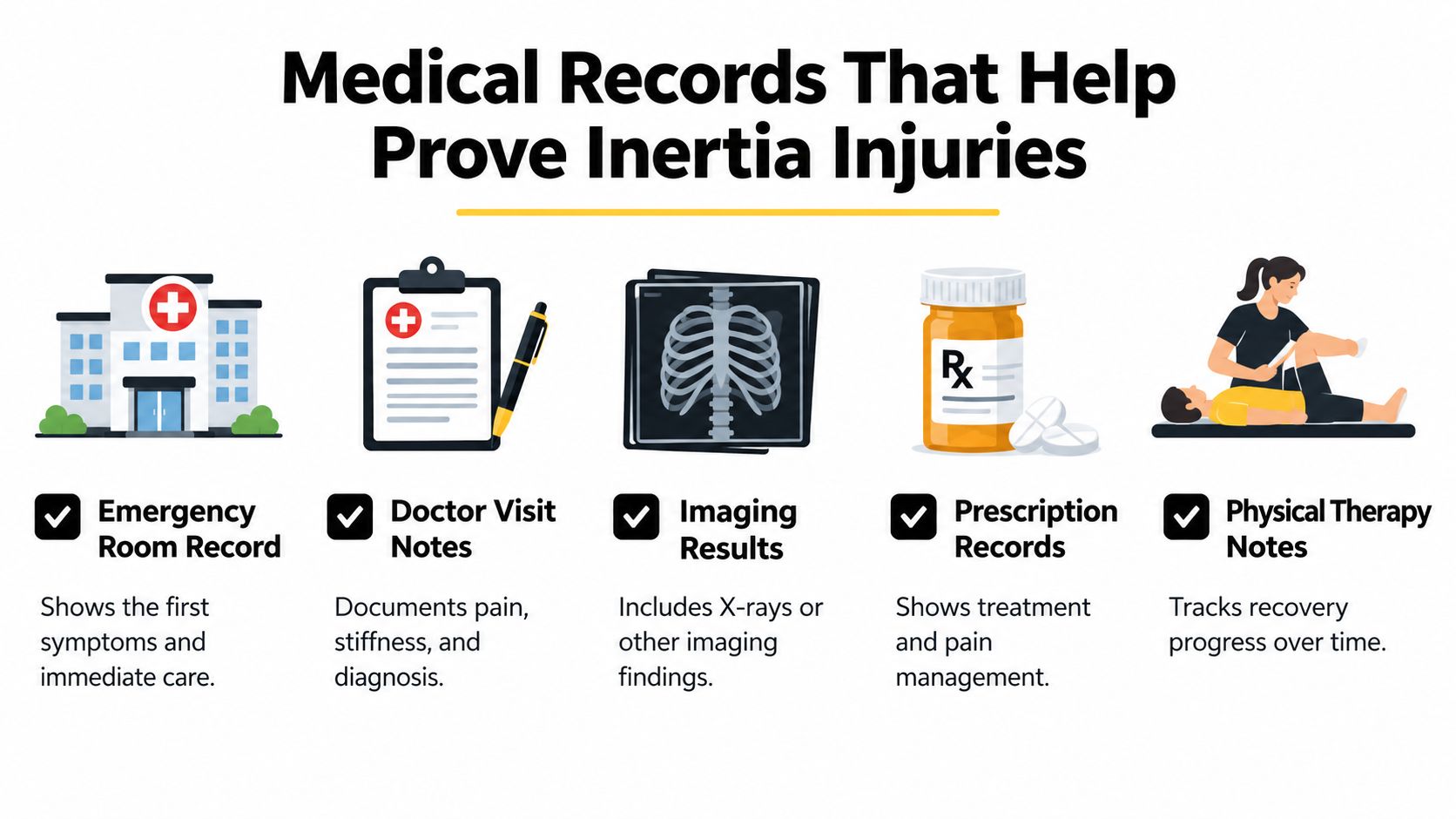
An emergency room record is the earliest clinical snapshot. It should say what hurt, what was examined, and what care you got that day. It's weak on the long-term course, and it's often written before stiffness fully shows up.
Treating physician notes carry the mechanism if someone asks the right questions. The strongest notes record seating position, head restraint, belt use, direction of impact, symptoms, and symptom progression. Delayed symptoms don't automatically disprove causation. A blank timeline does make that argument easier for someone else to make.
Imaging and neurological testing look for structural or nerve findings. A normal scan doesn't erase muscle, joint, or concussion symptoms. It does rule some emergencies in or out, which is a different job from explaining neck pain.
Therapy records show whether pain, motion, and headaches changed with care. They're often the clearest picture of recovery, or of a plateau that never quite lifted.
What to ask for and keep
- Position details: seat, belt, head restraint, and impact direction, written in the clinician's words.
- A symptom log: onset, what makes pain worse, and missed work or sleep.
- The actual images and reports, not only a short portal summary.
- One organized timeline: medical record organization keeps the ER note, follow-up, imaging, and therapy together so a gap isn't treated as "you got better."
You still choose your doctors and your treatment. The paperwork's job is narrower. It should let a reader who wasn't in the car see how you were positioned and how your symptoms moved after the crash.
Taking the Next Step After an Inertia Injury
The bumper can look ordinary and the injury can still be real. The physics explains that gap. It doesn't replace an exam, and it doesn't build the file by itself.
Early care is the strongest base. Get checked, follow the plan you and your clinician choose, and write a short symptom timeline while the days are still distinct.
What to bring to the first conversation
- The crash report, plus photos of both vehicles and the interior.
- Medical records you already have, even if they're incomplete.
- A written symptom timeline, from the scene through the days that followed.
- Notes on your seat, including belt use, head-restraint position, and which way the impact came.
Those items let someone test a minor-damage argument against your actual position in the seat. You don't have to calculate every force yourself.
Accountability and compensation can still be on the table when the repair bill was small. What changes the conversation is a clear record of how you were sitting, how symptoms started, and how treatment unfolded. If the other insurer has already called the crash too small to matter, that's a claims position, not a medical finding. A calm next step is a free consultation, with those documents in hand, before gaps harden into the only story on file.
Nares Law Group LLC is a Denver-based firm that investigates motor vehicle and truck crashes, coordinates medical treatment records, negotiates with insurers, and takes cases through trial when the claim needs it. If a low-damage crash left you with neck, head, or soft-tissue symptoms, the motion and the paperwork described here are the kind of detail that firm uses to answer a minor-impact denial. Visit Nares Law Group LLC to request a free consultation and talk through the records you already have.