After a serious crash, a crash victim doesn't remember events in a neat, reliable sequence. They remember noise. Glass. Airbags. A sudden turn of the wheel. Then they remember the insurance company asking for a statement as if the whole thing should already be obvious.
That gap between what you felt and what you can prove is where many injury claims get stuck.
An accident reconstruction specialist helps fill that gap with science. Not guesses. Not blame-shifting. Not a polished story from the other driver's insurer. Their job is to take the physical evidence a crash leaves behind and turn it into a clear explanation of how the collision happened, who had time to react, whether braking occurred, how severe the forces were, and whether the other side's version makes sense.
For injured people, that matters because insurance companies don't pay based on confusion. They pay when the facts corner them.
The Moments After a Crash Are a Blur
You may be in that position right now.
You know you were hit. You know you're hurting. But the details feel scrambled. Maybe the other driver said you “came out of nowhere.” Maybe the police report feels incomplete. Maybe the insurer is already hinting that fault is “still under investigation.”
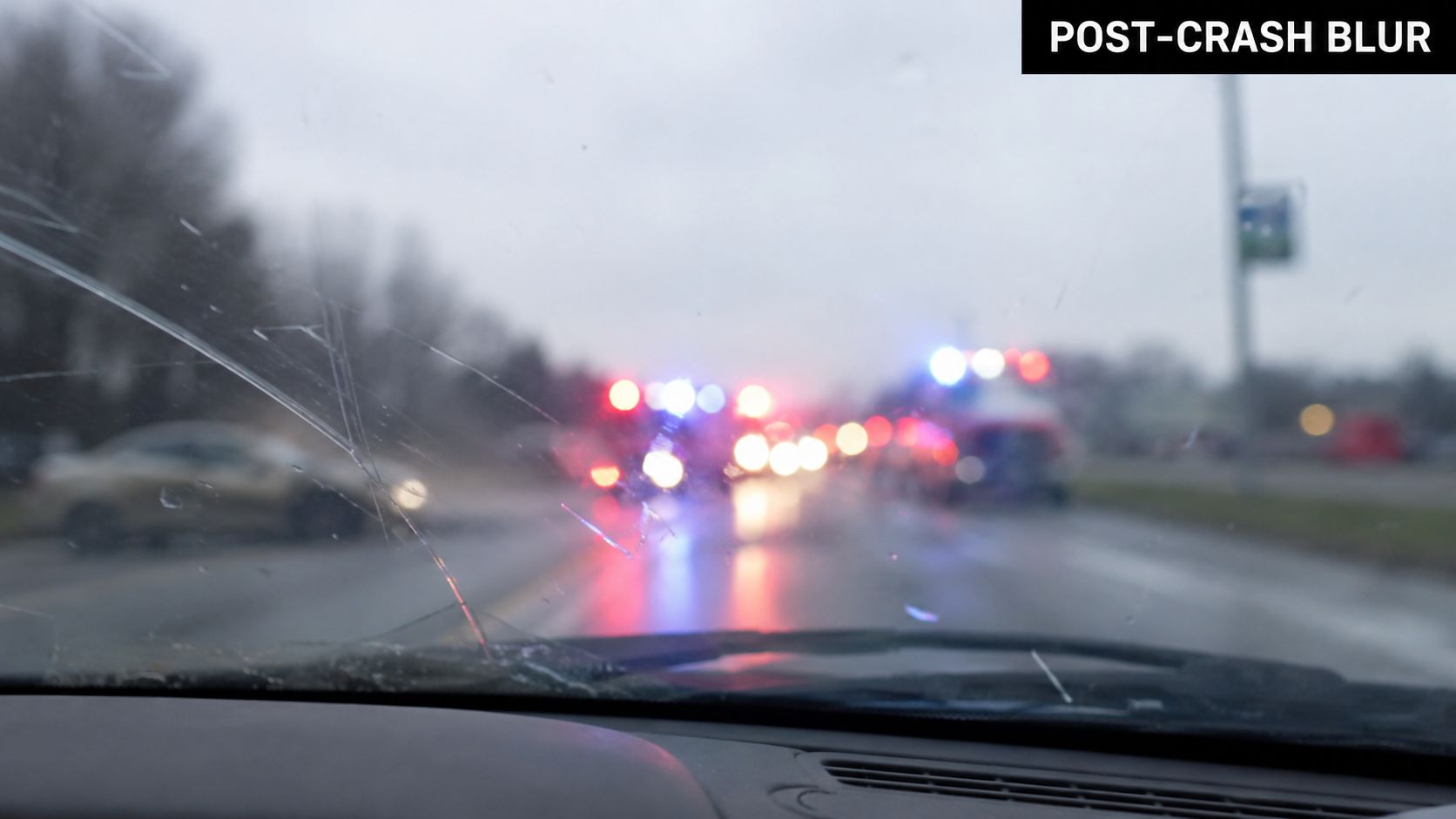
That's normal after a violent event. Human memory doesn't work like a dashboard camera. It captures fragments. It fills gaps. It gets shaken by pain, fear, and adrenaline.
What the crash leaves behind
A crash scene, though, tells its own story. Tire marks, debris, vehicle damage, roadway gouges, airbag modules, and electronic vehicle data can show things people often can't remember accurately. Physical evidence doesn't get nervous in a recorded statement. It doesn't try to protect itself from liability.
That's why an accident reconstruction specialist matters in a personal injury case. This person isn't there to dramatize the collision. They're there to answer the questions that move a claim:
- Who was where
- Who moved first
- Whether someone braked
- How fast the vehicles were traveling
- Whether the claimed version of events fits the evidence
When memories blur, measurements become the most trustworthy witness.
If you've already looked at the officer's narrative and found it confusing, it helps to understand how to read a police accident report before you assume it answers every liability question. Police reports matter, but they're often the starting point, not the final word.
Why this creates leverage
Insurance companies often do well in gray areas. If fault looks uncertain, they can delay, dispute, or discount. A reconstruction specialist can change that by replacing a vague disagreement with a technical explanation the defense has to confront.
That shift is powerful. Once the evidence shows a likely impact angle, pre-impact movement, or braking pattern, the case stops sounding like a debate and starts looking like proof.
Rebuilding the Truth from Physical Evidence
An accident reconstruction case works a lot like putting together a puzzle after someone scattered pieces across a highway. The picture is already there. The specialist's job is to find the pieces that remain, determine which ones fit, and explain why the finished image is reliable.
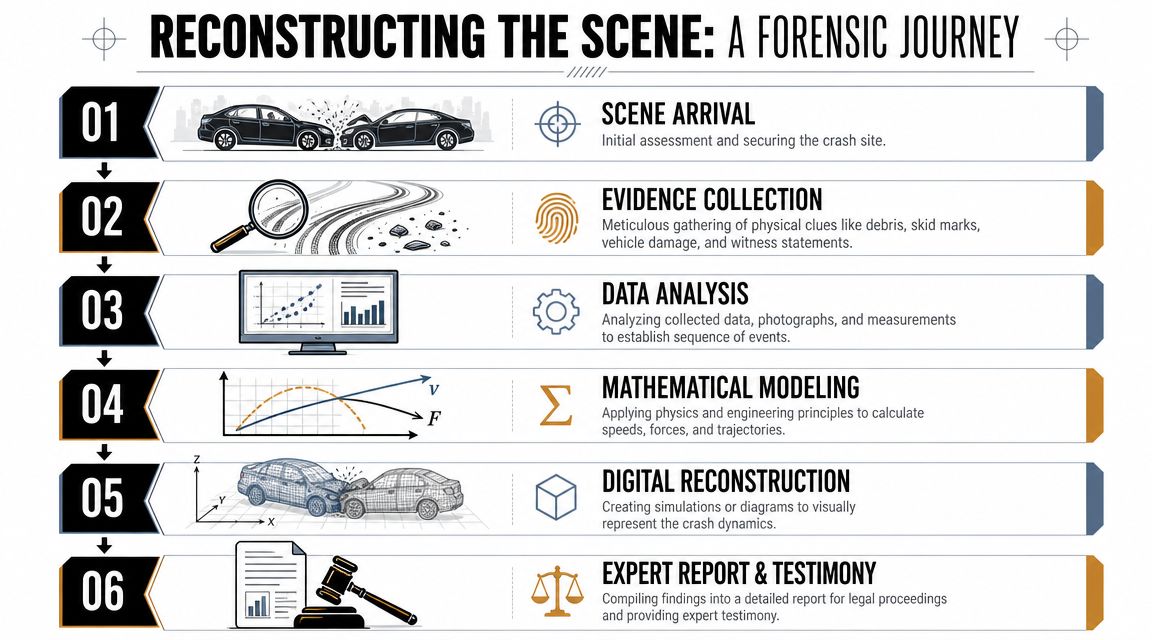
A long-established description of this field explains that accident reconstruction is usually built around a three-phase workflow: investigation, analysis, and presentation. In the investigation phase, specialists collect scene measurements, tire marks, vehicle damage patterns, witness statements, and data such as Event Data Recorder information. In the analysis phase, they use physics, vehicle dynamics, and computer modeling to estimate speed, impact angles, and trajectories. In the presentation phase, they turn those findings into reports, diagrams, and testimony that legal audiences can understand, as described in EBSCO's overview of vehicular accident reconstruction.
Investigation means gathering the puzzle pieces
At this stage, the specialist wants the raw materials of truth.
That can include photographs, scene measurements, debris location, roadway markings, vehicle resting positions, witness accounts, surveillance footage, and electronic downloads from the vehicles. If a car recorded crash data, that information can function a bit like an onboard memory of what the vehicle was doing just before impact. If you want a simple explanation of how recorders capture critical data, Dronedesk's flight recorder guide offers a useful comparison point.
The key idea is simple. A specialist doesn't start by picking a side. They start by preserving evidence.
Analysis means translating clues into movement
People often get intimidated by the word “physics.” It sounds abstract. In practice, it isn't.
Physics in accident reconstruction means using measurable facts to answer practical questions. If one vehicle has crush damage in a certain area and the other has matching contact points, that helps show how the vehicles met. If tire marks appear in a certain path, that may help show braking or steering input. If the vehicles ended up in particular positions, that can help explain direction and force.
A specialist may apply concepts like momentum and energy the same way a coach studies replay footage. The point isn't the equation itself. The point is what it reveals about speed, direction, timing, and force.
For injury claims, that analysis often connects directly to the mechanism of injury because how a body moved inside the vehicle can matter when the insurer argues your injuries “shouldn't be that serious.”
Here's a short visual explanation before the modeling stage goes further:
Presentation is where science becomes legal leverage
The best reconstruction doesn't stay buried in technical notes.
It gets turned into diagrams, timelines, image overlays, and testimony that a jury, mediator, adjuster, or defense lawyer can follow. That matters because a correct opinion is only useful if someone can explain it clearly enough to survive attack and persuade decision-makers.
Practical rule: A reconstruction that can't be explained clearly often won't create pressure in settlement negotiations.
From Skid Marks to Digital Simulations
Older crash investigation methods still matter. The difference today is that specialists can combine them with digital tools that preserve and visualize the scene much more clearly.
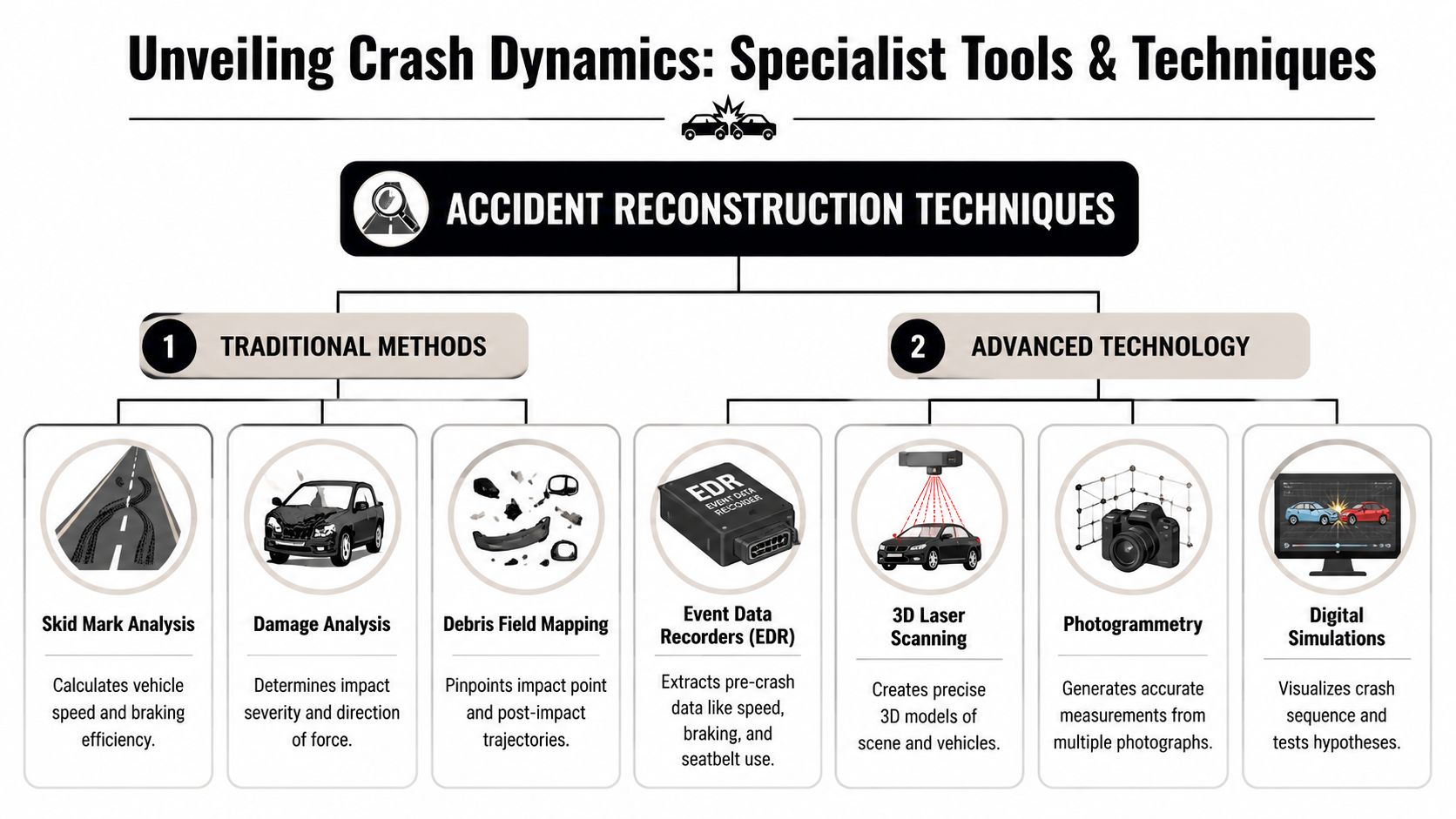
Recent industry material notes the growing role of 3D laser scanning, computer simulations, and Event Data Recorders, along with photogrammetry and computer-based analysis, to recreate collisions more precisely and present them more clearly to juries, as discussed in Smith McBroom's explanation of crash reconstruction tools.
What scene evidence can show
Scene evidence is what the roadway and surroundings reveal.
A skid mark, for example, doesn't automatically answer every question. But it may help show that a driver braked, when braking likely began, and whether the path of the vehicle changed before impact. Debris fields can help narrow the likely impact area. Road gouges and scrape marks may help identify where metal contacted pavement and how vehicles moved after collision.
Traditional evidence often helps answer questions like these:
- Did the driver try to stop
- Where did the impact most likely happen
- Did the vehicle continue straight, rotate, or get pushed sideways
- Was the crash sequence consistent with the other side's story
What vehicle evidence can show
Vehicle evidence is often even more persuasive because it can be measured closely after the fact.
Damage patterns can reveal direction of force. Crush depth can help assess impact severity. Electronic downloads can sometimes show pre-impact speed, braking input, throttle position, and other recorded data points. In plain English, this is often what people mean when they say a car's “black box.”
Photogrammetry gives specialists another strong tool. Think of it as building a precise digital model from multiple photographs. If people took photos from different angles, a specialist may be able to turn those images into usable measurements and spatial relationships. That can be invaluable when the physical scene has already been cleared.
Why insurers struggle more against this kind of proof
An insurance adjuster can argue with a witness who says, “I think he was speeding.”
It's harder to dismiss a reconstruction that combines scene measurements, damage patterns, a digital model, and recorded vehicle data into one consistent explanation. The stronger the objective evidence, the less room there is for creative denial.
A useful way to think about the tools is this:
| Evidence type | What it helps answer |
|---|---|
| Skid or yaw marks | Whether braking or steering occurred before impact |
| Vehicle crush | How and where force entered the vehicle |
| Debris mapping | Likely point of impact and post-crash motion |
| EDR data | What the vehicle was doing just before impact |
| 3D scanning and photogrammetry | Accurate scene layout and spatial relationships |
| Digital simulation | Whether the full sequence makes physical sense |
The goal of technology isn't to make the case look flashy. It's to make the case harder to deny.
Credentials That Matter in the Courtroom
Not every engineer is a strong accident reconstruction witness. Not every person who can run software can withstand cross-examination. And not every impressive resume translates into persuasive testimony.
That distinction matters because the defense won't just challenge the conclusion. They'll challenge the person giving it.
A reliable reconstruction expert needs technical skill, but that isn't enough by itself. As J.S. Held's discussion of accident reconstruction explains, effective reconstruction also requires report writing, courtroom explanation, and testimony support. The same source notes that in Georgia, a formal specialist certification pathway requires 228 hours of training across multiple traffic investigation and reconstruction courses, along with a competency exam that includes cognitive and practical components.
What qualifications actually matter
You're looking for someone who can collect defensible data, analyze it properly, and explain it without losing the room.
Here's a practical checklist.
| Credential / Qualification | Why It Matters |
|---|---|
| Reconstruction-specific training | Shows the expert studied crash investigation methods, not just general engineering concepts |
| Experience with vehicle data and scene documentation | Matters when the case involves EDR downloads, mapped scenes, or digital evidence |
| Report-writing ability | A weak report gives the defense room to attack methodology and conclusions |
| Testimony experience | The expert has to explain technical points clearly under cross-examination |
| Familiarity with the crash type | Trucking, motorcycle, pedestrian, and multi-vehicle crashes raise different technical issues |
Questions worth asking before relying on an expert
You don't need to interview an expert like a scientist. You need to think like a client whose case may depend on whether a jury finds this person credible.
Consider asking:
- What kinds of crashes do you reconstruct most often? A trucking collision isn't the same as a low-speed parking lot impact.
- How do you preserve and review digital evidence? That includes EDR data, video, and scene imagery.
- Have you testified before? Courtroom clarity matters.
- Can you explain your method in plain language? If they can't explain it to you, they may not explain it well to a jury.
- What additional evidence would make your opinion stronger? Good experts know the limits of the record.
If your case involves a commercial vehicle, it also helps to understand how expert witnesses function in trucking accident trials because those cases often involve more records, more defendants, and more aggressive defense strategies.
Why courtroom communication counts so much
A specialist may have the right conclusion and still hurt a case if they present it poorly.
Jurors and adjusters usually aren't deciding who can recite formulas. They're deciding who made the most reliable, understandable, and disciplined use of the evidence. The expert who can walk people from raw facts to logical conclusion often gives the legal team far more settlement advantage.
The Right Time to Bring in an Expert
The best reconstruction work often depends on what gets preserved in the first hours and days after a crash. Once that window closes, the case may still be workable, but the specialist has less to work with.
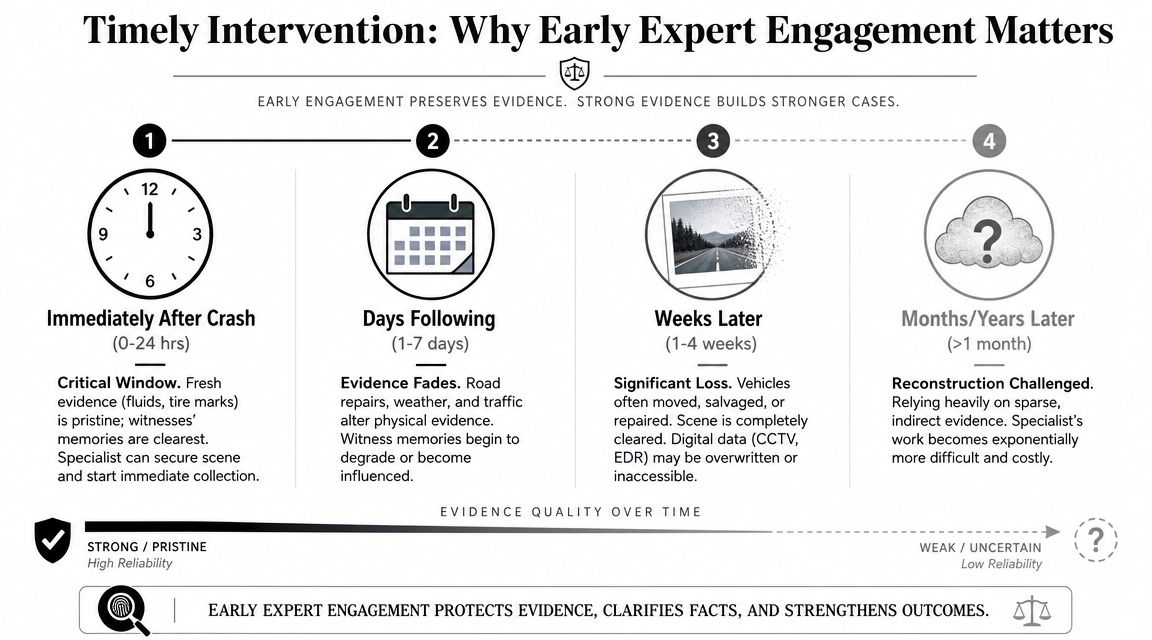
That's why timing matters so much. Expert Institute's discussion of accident reconstruction notes that reconstruction quality depends heavily on early evidence preservation, including scene data, vehicle data, photographs, video, and witness statements, because tire marks, vehicle positions, and other transient evidence can disappear quickly.
What counts as perishable evidence
“Perishable evidence” sounds technical, but the idea is simple. Some proof fades fast.
Rain can wash away markings. Traffic can scatter debris. Vehicles can be repaired, salvaged, or moved. Nearby businesses may overwrite surveillance footage. People who meant well can forget details or merge their memory with what they later heard from others.
Here are common examples:
- Roadway marks: Tire marks and gouges may fade or be altered.
- Vehicle condition: Crush patterns are harder to evaluate after repairs or salvage handling.
- Video footage: Cameras may not keep recordings for long.
- Electronic data: Access becomes harder if the vehicle is gone or systems change.
- Witness recollection: People usually become less precise with time.
A late reconstruction can still help, but an early reconstruction can preserve evidence that no one can recreate later.
How this works in a personal injury case
Most injured people aren't the ones personally hiring a scanner operator, downloading vehicle data, or coordinating inspections. Their legal team usually handles that process, identifies what evidence should be preserved, and determines whether a reconstruction specialist is needed based on disputed liability, serious injury, or conflicting versions of events.
In some cases, a firm may also retain outside specialists as part of the litigation strategy. For example, Nares Law Group LLC handles investigation in motor vehicle and truck injury matters and can retain accident reconstruction support when the facts and the severity of the case call for it.
Why waiting can cost leverage
The defense doesn't need to prove your version is impossible. They often only need enough uncertainty to reduce pressure.
If key evidence disappears before anyone documents it, the insurer gets more room to argue. They can say the impact point is unclear, the speed estimate is speculative, or the damage pattern can't be interpreted confidently. Early expert involvement shrinks that room.
That's especially important in serious Colorado crash cases, where the practical battle often starts long before trial. It starts when one side can show it preserved the proof and the other side didn't.
How Reconstruction Changes Case Outcomes
An accident reconstruction specialist changes a case when the evidence answers a disputed question the insurance company wanted to keep muddy.
The strongest work doesn't just describe the collision. It ties physical facts to legal fault.
A rigorous reconstruction can apply physics-based calculations to estimate impact speed, delta-V, and pre-impact driver actions. It can also use measurable crush depth, energy absorption, skid marks, and roadway friction to evaluate impact severity and whether a specific maneuver was a probable causal factor, as explained in Rimkus's discussion of accident reconstruction experts.
When an intersection case stops being a tie
Consider a common dispute. Two drivers enter an intersection. Each says the other caused the crash. The police officer arrives after the impact and has no independent view of the light cycle.
Without more, the insurer may treat the case like a coin toss.
A reconstruction specialist can review vehicle damage, final rest positions, scene measurements, and any available electronic data to test whether one vehicle was accelerating, braking, or entering at an angle consistent with a late attempt to beat the light. If that analysis aligns with surveillance footage or witness timing, the case often stops looking “disputed” and starts looking provable.
When a trucking defense loses room to shift blame
Truck cases often produce more finger-pointing.
The driver may blame traffic. The company may blame the passenger car. A maintenance contractor may point elsewhere. A reconstruction specialist can sort out sequence and causation by evaluating impact order, vehicle motion, and whether the truck's movement fits the explanation being offered.
That matters because in a truck case, the legal fight often isn't just about who hit whom. It's about whether speed, lane movement, braking behavior, or another driving choice created the chain of events.
When injury causation gets challenged
Insurers sometimes accept that a crash happened while minimizing what it did to the human body.
It is in such circumstances that reconstruction can become especially valuable. If the defense claims the impact was “minor,” a specialist may use vehicle deformation, scene evidence, and force analysis to evaluate impact severity. That doesn't replace medical testimony, but it can support the argument that the collision involved meaningful forces and that the claimed injury mechanism is consistent with the crash.
Scientific reconstruction often gives the medical story a factual backbone.
Why this improves settlement posture
Most cases resolve before a jury ever hears from the expert. That doesn't make the reconstruction less important. It often makes it more important.
Once the insurer sees that your legal team can present a disciplined, evidence-based explanation of liability and force, the cost of denial goes up. The adjuster has to consider depositions, motions, trial risk, and the possibility that a jury will find your version better supported than their own.
That's the true advantage. Not theater. Not bigger words. A narrower path for the insurer to argue around the evidence.
Protecting Your Rights with Scientific Proof
After a crash, you may feel like the truth should be obvious. In many cases, it isn't. The scene gets cleared. People disagree. Insurance companies look for uncertainty and use it.
An accident reconstruction specialist helps turn uncertainty into something firmer. Measured evidence. Defensible analysis. Clear explanation. In a personal injury claim, that can be the difference between a case that gets discounted and a case the other side has to take seriously.
This kind of work matters most when fault is disputed, injuries are serious, multiple vehicles are involved, or the insurer is already trying to minimize what happened. In those cases, science can level the field. It can show how the crash unfolded, why a driver's actions mattered, and why your account fits the physical proof.
You shouldn't have to piece that together alone while you're trying to heal.
If you were hurt in a crash and the facts are being disputed, Nares Law Group LLC can evaluate whether expert reconstruction, vehicle data analysis, or other technical evidence may help support your claim. A free consultation can help you understand what evidence may still be preserved, what questions need answers, and what steps make sense now.