You may be reading this with an ice pack on your shoulder, your phone buzzing, and a knot in your stomach. The crash happened fast. The aftermath feels slow, messy, and strangely administrative. One person asks for a statement. Another wants paperwork. Meanwhile, your body hurts in places you didn't notice at first.
That's where many people in Denver first start searching for injury lawyers denver. Not because they want a courtroom fight, but because they want someone to explain what happens next, what matters, and what mistakes can damage a valid claim.
A good injury lawyer doesn't just file papers. They create order when your life feels disordered. They help protect evidence, handle insurer pressure, coordinate the legal side of your recovery, and give you enough breathing room to focus on getting through the week.
After the Crash The First 24 Hours
You get home from the hospital or the roadside, sit down for the first time, and serious confusion starts. Your neck is tightening. Your family wants updates. Your phone lights up with calls from insurance. In that moment, the first 24 hours can shape the rest of your claim and, just as important, your peace of mind.
In Denver, many injured people feel pressure to sound calm and cooperative right away. That pressure is understandable. Colorado crashes often set off a fast chain of calls, forms, and questions before you have had time to understand what hurts, what was damaged, or what you may need next. The legal process can feel cold at first. The reason for these early steps is human. They help connect your injury, your treatment, and the crash before the facts start to blur.
Medical care comes first. Your body is giving you the first set of facts, even if those facts are incomplete. Pain, dizziness, numbness, headaches, and back strain do not always show up on a schedule. Adrenaline can hide injuries for hours. If you are unsure what early treatment can look like, this guide on how to get prompt care after a car crash explains why quick evaluation matters.
The next risk is silence mixed with paperwork. Insurance adjusters often sound polite because this is routine for them. It is not routine for you. Insurance negotiation works like a high-stakes chess game. A friendly opening move can still be designed to limit what the insurer pays later.
Here are the mistakes that tend to happen in the first day:
- Waiting too long to get checked out: Gaps in treatment can make a real injury look minor or unrelated.
- Letting evidence fade: Scene photos, damaged property, road conditions, and witness contact details are easiest to collect early.
- Giving a recorded statement before you understand your injuries: A rushed answer can be compared against your medical records later.
- Assuming soreness will pass: Some injuries become clearer only after sleep, swelling, or the return of normal movement.
One simple rule helps: do not treat the first day like the day you must prove everything. Treat it like the day you preserve what happened.
That means saving photos, keeping discharge papers, writing down what you remember, and noting new symptoms as they appear. It also means being careful with insurance conversations. If you are already getting calls, this plain-language guide on how to deal with insurance after a car accident can help you avoid common early mistakes.
Colorado law does impose deadlines, but the larger problem in the first 24 hours is practical, not abstract. Evidence disappears. Memories soften. Security footage can be lost. The earlier you protect the story of what happened, the easier it is to show what this crash has cost you in real life, not just on paper.
What a Denver Injury Lawyer Actually Does for You
A lot of injured people picture a lawyer in a courtroom making arguments to a jury. In Denver injury cases, that usually comes much later, if it happens at all. The work that changes your daily life starts earlier and feels more practical. A lawyer often works like a general contractor for the legal side of your recovery, keeping the claim organized so missed paperwork, bad statements, or pressure from insurance do not derail the help you need.
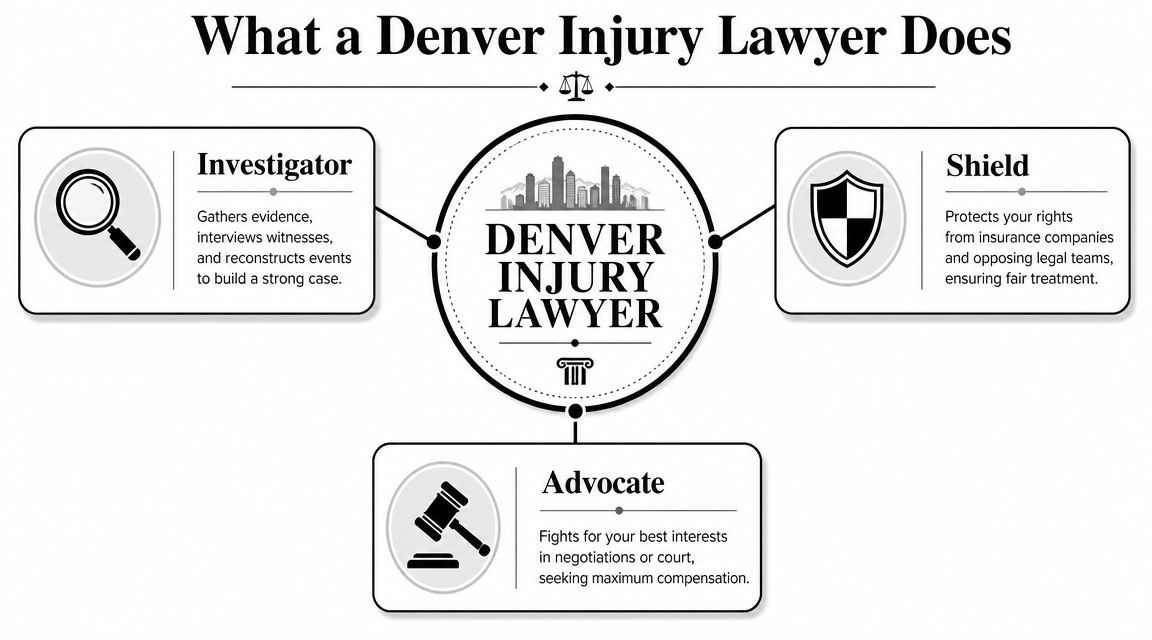
Investigator
An insurance adjuster usually asks, “What can we confirm right now?” A Denver injury lawyer asks a harder question. “What will we need to prove months from now, after memories fade and treatment records grow?”
That difference shapes the whole case.
Your lawyer gathers the pieces that make your story credible and complete. That can include the police report, photos from the scene, witness statements, medical records, billing records, wage loss documents, repair estimates, and video footage if any exists. In a truck crash, the work may expand to driver logs, company safety records, black box data, and federal rule violations. In a brain injury case, it may involve records from the ER, neurologists, therapists, and the people who see how your concentration, sleep, or mood changed after the accident.
This is about more than collecting paper. It is about preserving context. A chart may show a diagnosis, but a good case also explains why that diagnosis now affects your job, your parenting, your commute through Denver traffic, or your ability to sleep through the night.
Shield
After an accident, insurance contact can feel relentless. Calls come while you are in pain, on medication, trying to schedule appointments, or figuring out how to get your car repaired. One job of a lawyer is to absorb that pressure.
Once counsel is involved, key claim communications usually go through the lawyer instead of landing directly on you. That matters because early conversations can shape the entire claim. A rushed answer, a casual “I'm doing okay,” or an incomplete description of symptoms can later be treated like a firm statement about your condition.
A short explainer can help make that role concrete:
The shield role also has a human side. Many injured people in Colorado are trying to do three jobs at once. Heal, keep life running, and defend a claim they do not fully understand. A lawyer takes one of those jobs off your plate.
Advocate
Advocacy in an injury case is not just asking for a larger check. It is building a clear, documented explanation of what the accident has cost you.
Some losses are straightforward, like medical bills or missed paychecks. Others are harder to show and easier for insurers to minimize. Ongoing pain. Limited mobility. Follow-up treatment. The way a shoulder injury changes a construction job, or the way a concussion affects screen time, driving, and patience with your kids. Those losses are real even when they do not fit neatly into a single invoice.
Insurance negotiation works like a high-stakes chess game. The insurer studies the proof, the gaps, the timing of treatment, and whether stress might push you to settle early. Your lawyer's job is to plan several moves ahead, organize the record, answer weak points before they become problems, and push for a result that reflects the full impact of the injury.
That preparation also includes deciding whether a case should settle or be prepared for litigation. Denver injury practice covers everything from relatively modest claims to severe, life-altering injuries. A lawyer's value is not just filing forms. It is judgment. Knowing when an offer is reasonable, when more evidence is needed, and when the other side is betting that you are too tired to keep going.
If you want a practical breakdown of those day-to-day tasks, this guide on what a car accident lawyer does explains the process in plain language.
Colorado Legal Deadlines and Rules You Cannot Ignore
The legal clock starts running while your life still feels upside down. You are trying to get to appointments, sleep through the pain, keep work informed, and make sense of insurance calls. Colorado law does not pause for that confusion, which is why deadlines matter so much after an accident.

The filing deadline depends on the kind of case
Colorado does not use one deadline for every injury claim. In general, many personal injury cases must be filed within two years. Many motor vehicle cases, including car, truck, and motorcycle crashes, often have a three-year deadline. If you want a Colorado-specific explanation, this guide on the statute of limitations for personal injury in Colorado gives a useful overview.
That difference matters more than people expect.
A slip and fall in a Denver grocery store and a rear-end crash on I-25 can both leave someone in pain, missing work, and arguing with an insurer. But the legal timeline may not be the same. Treat the deadline like a fuse, not a calendar reminder. Once it burns out, the claim can disappear even if the injury is real and the other side was clearly at fault.
Waiting hurts cases long before the deadline arrives
The statute of limitations is only the outer wall. Cases often weaken much earlier.
Security footage can be erased. Witnesses forget details. Vehicle damage gets repaired. Medical records become harder to line up into a clear story. Even your symptoms can be misunderstood if there are long gaps in treatment, especially with conditions that flare up over time. That includes many of the pain conditions treated after a crash, such as neck pain, back pain, nerve issues, and headaches that do not always show their full impact on day one.
A Denver injury case is partly about law and partly about timing. The sooner the facts are gathered, the easier it is to show what happened and why it still affects your daily life.
Colorado fault rules can change what you recover
Deadlines are only one part of the picture. Fault can become the next source of confusion.
Colorado uses a comparative fault rule. In plain English, that means the other side may argue that you share some of the blame. Insurance adjusters often press that point early because it can reduce what they pay or discourage you from continuing. A crash is rarely as simple as one sentence on a claim form. A driver may have been distracted. Another may have changed lanes carelessly. A pedestrian may have crossed outside the crosswalk while a driver still failed to watch the road.
That is why local advice matters. Colorado rules shape how fault is evaluated, and small facts can carry a lot of weight.
| Situation | Why it matters |
|---|---|
| You wait too long to collect records | Video, witness memories, and other proof may fade or disappear |
| You assume every injury claim follows the same deadline | You can miscalculate how long you really have to file |
| You accept the insurer's version of fault too quickly | You may give up value in a case that is still legally strong |
The practical takeaway is simple. Act early, even if you are still unsure whether you will file a lawsuit. Early action gives your lawyer room to protect the claim, gather proof, and explain the process in a way that supports both your recovery and your peace of mind.
Common Injury Cases Handled in the Denver Area
An injury claim in Denver often begins with a very ordinary moment. You are driving home on Colorado Boulevard, heading to work near the Tech Center, or shopping on a weekend. Then one careless act changes the rhythm of daily life. The case file may later be labeled "auto," "truck," or "wrongful death," but people live these cases as pain, missed paychecks, sleepless nights, and hard conversations at the kitchen table.
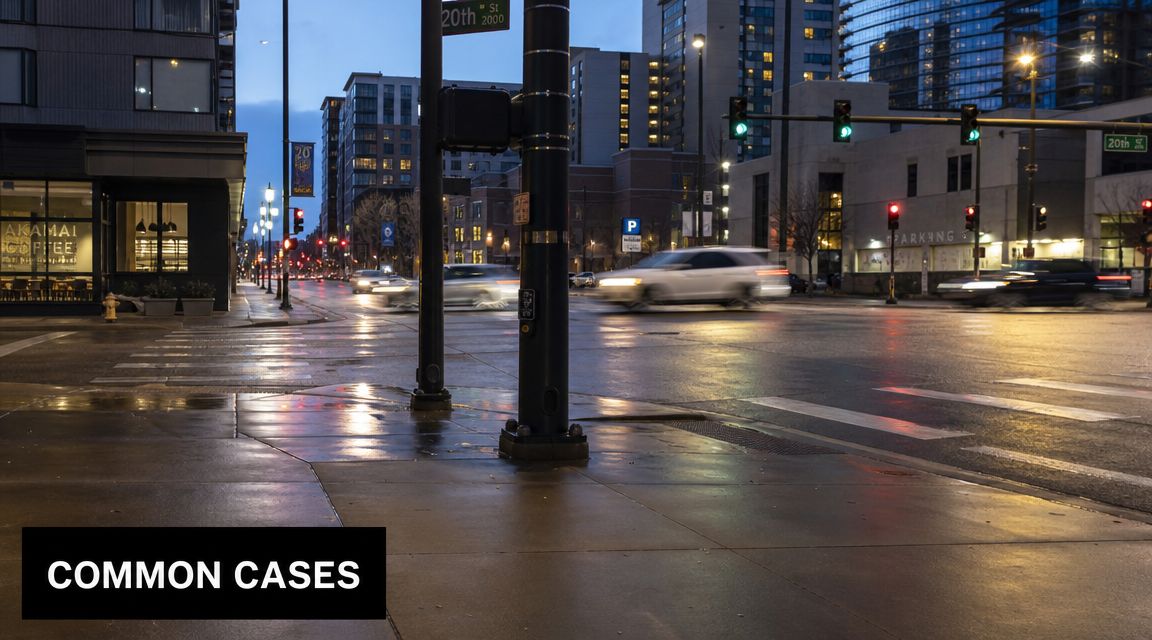
Motor vehicle accidents
Car accident cases are some of the most common injury claims in the Denver area. A rear-end crash at a stoplight may look minor on paper, especially if the vehicles are still drivable. The harder part is often showing what happened after the scene cleared. Neck pain shows up the next morning. Sitting through a full workday becomes difficult. Driving your kids to school starts to hurt.
That is why these cases are rarely just about the police report. A lawyer often has to connect the crash to the disruption that followed, using medical records, treatment notes, wage loss documents, and your own account of how life changed. Insurance negotiation works like a high-stakes chess game. Every move needs support.
Commercial truck wrecks
Truck collisions are a different category altogether. On roads like I-25 and I-70, a crash involving a commercial vehicle can pull in several layers of responsibility at once. The driver may matter, but so may the trucking company, the maintenance history, the cargo loading, and the safety rules that apply to commercial carriers.
These cases also tend to feel more intimidating for injured people. The other side may have rapid-response investigators and insurers working early to shape the story. As discussed in this overview of Denver brain injury litigation, serious truck wrecks and brain injury claims often require specialized proof. In practical terms, that means the case may depend on records and technical evidence that do not exist in a typical fender bender.
Traumatic brain injuries
Brain injuries confuse families because the injury may be serious even when nothing looks dramatic from the outside. A person may be walking, talking, and trying to act normal while dealing with headaches, memory lapses, light sensitivity, fatigue, irritability, or trouble focusing at work.
That gap between appearance and reality creates legal problems. Adjusters, employers, and even friends may expect a quick recovery because they cannot see the symptoms. The proof usually develops over time through follow-up care, symptom tracking, and doctors who can explain why a concussion or other brain injury keeps affecting daily life weeks later.
Some injuries are obvious on day one. Brain injuries often become clearer as the days pass.
If you are trying to understand the medical side of lingering symptoms, a plain-language guide to pain conditions treated can help you put words to what your body may be experiencing after trauma.
Wrongful death
Wrongful death cases carry a legal task and a human one at the same time. A family is grieving, yet bills still arrive, work still demands attention, and someone still has to answer the phone, gather records, and make decisions. The law asks for proof. Grief rarely arrives in an orderly way.
In Denver wrongful death cases, a lawyer often serves as both investigator and buffer. That matters. Families usually need space to mourn without being forced to revisit every detail again and again for insurers or defense lawyers. The case is about financial loss, but it is also about accountability, a clear record of what happened, and some measure of steadiness during a time of great instability.
How to Hire the Right Injury Lawyer for Your Case
By the time you start looking for a lawyer, you may still be in pain, missing work, and fielding calls from an insurance company that sounds calm but is measuring every word. Choosing counsel in that moment can feel like making a major medical decision while you are still in the waiting room.
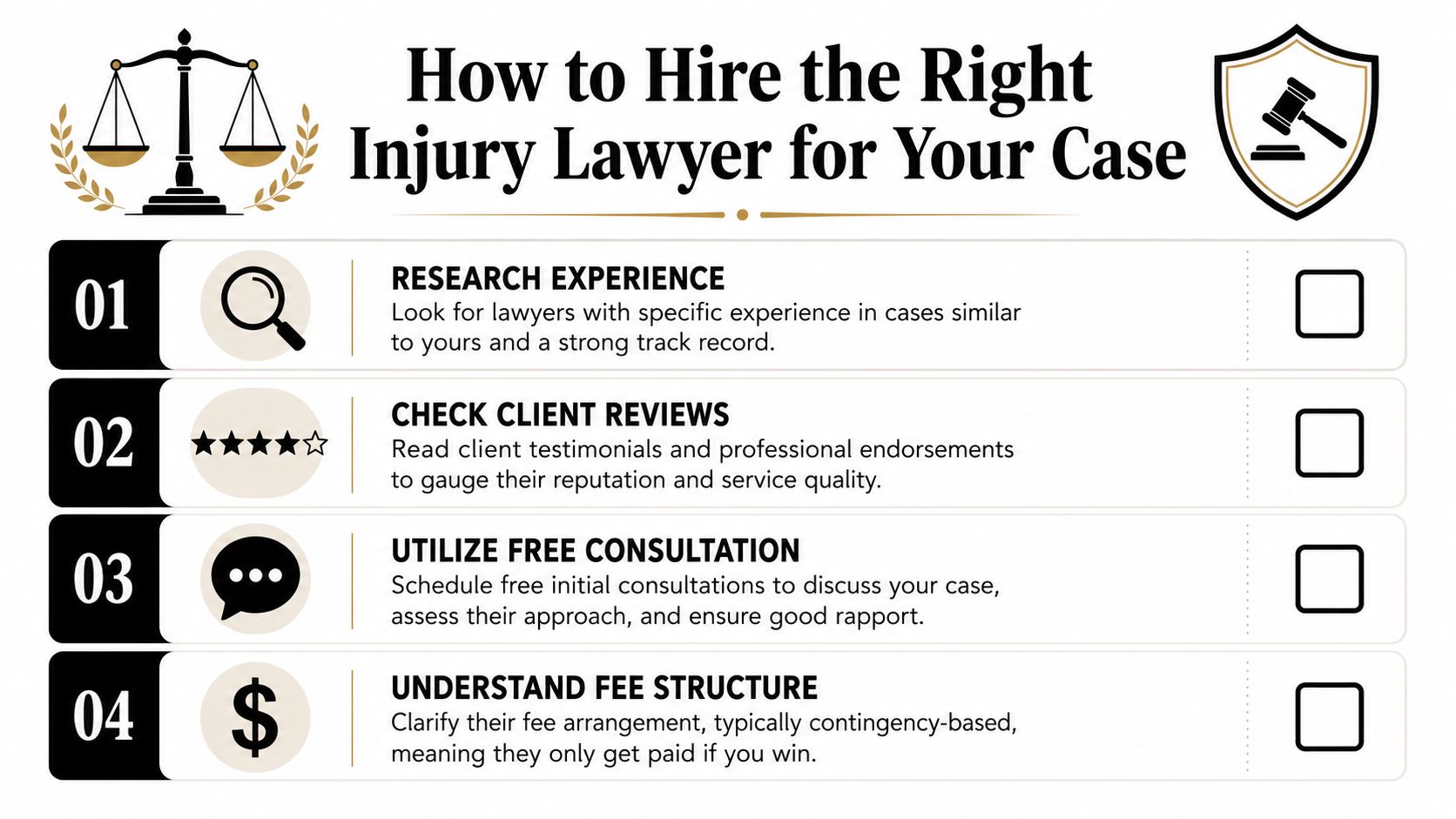
A better frame helps. Hiring an injury lawyer works like hiring a guide for a hard mountain route. You are not looking for the person with the loudest voice. You are looking for someone who knows the terrain in Colorado, explains the risks clearly, and keeps you from taking costly wrong turns.
Start with money, because confusion here causes problems later
Many Denver injury lawyers use a contingency fee. That usually means you do not pay attorney fees up front, and the lawyer is paid from a settlement or verdict if money is recovered. Ask for the fee agreement in writing. Then ask someone to walk you through it line by line.
Focus on three parts:
- The fee percentage
- Case costs, such as records, filing fees, or expert reviews
- What happens if the case does not recover money
People sometimes avoid these questions because they do not want to seem difficult. Ask anyway. Clear money terms often tell you a lot about how a firm communicates under pressure.
Use the consultation to test clarity
A consultation is less about getting a fast prediction and more about seeing how the lawyer thinks. Insurance negotiation works like a high-stakes chess game. A good lawyer should be able to explain the next few moves, not just promise a win.
Bring a short list of questions that reveal how the case will be handled:
- Who will work on my case day to day? The attorney you meet may not be the person returning calls later.
- How often will I get updates, and from whom? You need a process, not a vague promise.
- What should I gather now? Good answers usually mention medical records, crash reports, photos, wage loss information, and insurance details.
- Have you handled injuries like mine before? A lawyer who understands concussions, spinal injuries, or soft tissue claims will often know where proof problems tend to show up.
- What could make this case harder? Honest answers matter more than polished ones.
One more question helps many injured people: How do you help clients who are still treating? In real life, recovery and legal work happen at the same time. If you are still sorting out pain, missed work, and physical limitations, even basic tasks can feel heavier than they should. For some people, that includes understanding the pace of healing itself. A plain-language guide to rehab steps for muscle tears can help you see why recovery often comes in stages, not all at once.
Watch how the lawyer explains risk
A strong consultation usually leaves you more grounded. You should come away with a clearer sense of the process, the likely pressure points, and what needs to happen next.
Be careful with lawyers who jump straight to dollar amounts or guarantee outcomes. Early in a case, no careful attorney knows the final value. What they can do is explain how claims are built, how medical proof develops, and why representation often changes the result. As noted earlier, injured people who hire attorneys tend to recover more on average. The reason is not magic. It is preparation, documentation, and negotiation.
Compare firms with a simple scorecard
You do not need a perfect formula. You need a way to compare answers without getting distracted by marketing.
| Question | What a strong answer sounds like |
|---|---|
| Experience | Specific work with your type of crash or injury |
| Communication | A clear plan for calls, emails, and updates |
| Case strategy | A practical approach to records, evidence, and insurer contact |
| Local knowledge | Familiarity with Colorado procedures, deadlines, and Denver-area claims |
| Personal fit | You feel heard, respected, and not rushed |
That last category matters more than people expect.
After an accident, your lawyer often becomes the person standing between you and a process that can feel cold, repetitive, and draining. In Denver, where one case may involve local providers, Colorado insurance rules, and months of treatment follow-up, good legal help should reduce chaos, not add to it. A brief factual example is Nares Law Group LLC, a Denver firm that handles motor vehicle crashes, truck wrecks, traumatic brain injuries, and wrongful death cases, and offers free consultations for injury-related claims.
Take the First Step Toward Clarity and Recovery
After an accident, legal help can sound like one more burden. In reality, the right help often removes burdens. It gives structure to the paperwork, puts boundaries around insurance communications, and creates a plan for proving what happened to you.
That matters emotionally as much as legally. People heal better when they understand the process, know who is handling what, and stop feeling like every unanswered call could cost them something.
Recovery also takes time. Physical healing rarely follows a straight line, especially when pain, mobility limits, or soft tissue injuries linger. If you're working through the physical side of recovery, this practical guide on rehab steps for muscle tears can help you understand why progress often happens in stages.
You don't need to have every record gathered or every question perfectly phrased before talking to a lawyer. You just need to start before confusion hardens into delay.
If you need answers about a crash, truck wreck, brain injury, or wrongful death claim in Colorado, Nares Law Group LLC offers a free consultation. A conversation can help you understand your options, protect key evidence, and decide on the next step with more clarity and less stress.