In Colorado, the law sets a strict deadline for filing a personal injury lawsuit. This is called the statute of limitations. Think of it as a legal countdown clock that starts the moment you get hurt. Missing that deadline usually means losing your right to seek compensation, no matter how strong your case is.
The deadlines are different depending on how you were injured. For most motor vehicle accidents, you have three years. For almost everything else, like a slip and fall, the window is shorter—only two years. Understanding this distinction is absolutely critical.
Understanding Colorado's Legal Countdown Clock
Imagine a "shot clock" for your legal rights. That’s the best way to think about the statute of limitations. The moment an injury happens, the clock starts ticking. Once it runs out, your opportunity to file a lawsuit and hold the responsible party accountable is gone for good.
These deadlines aren't arbitrary. They exist to make sure legal claims are handled while evidence is still fresh. Memories fade, witnesses move, and physical evidence can be lost or destroyed over time. The law tries to strike a balance, giving you enough time to act while also preventing defendants from living under the indefinite threat of a lawsuit years after an incident.
Different Clocks for Different Injuries
The single most important detail is that not all injury claims have the same deadline. Colorado law draws a clear line between injuries caused by motor vehicles and other types of harm. It's a difference that can make or break your case.
Here’s a quick breakdown:
- Motor Vehicle Accidents: You have three years from the date of the crash to file a lawsuit. This includes crashes involving cars, trucks, and motorcycles, and applies whether you were a driver, passenger, pedestrian, or cyclist.
- General Personal Injury: You have two years from the date of the incident. This is a broad category covering things like slip and falls, dog bites, or injuries from a defective product.
- Wrongful Death Claims: When an injury is fatal, the surviving family has two years from the date of death to bring a claim.
To make these timelines clearer, here is a quick-reference table summarizing the most common deadlines.
Colorado Personal Injury Filing Deadlines At A Glance
| Type of Injury Claim | Statute of Limitations (Time Limit to File) | Relevant Colorado Statute |
|---|---|---|
| Motor Vehicle Accidents | 3 Years from the date of the accident | C.R.S. § 13-80-101(1)(n) |
| General Personal Injury (e.g., slip and fall) | 2 Years from the date of the injury | C.R.S. § 13-80-102(1)(a) |
| Wrongful Death | 2 Years from the date of death | C.R.S. § 13-21-204 |
| Claims Against Government Entities | 182 Days to provide formal notice of the claim | C.R.S. § 24-10-109 |
This table is a starting point, but remember that every case is unique. Exceptions can and do apply, which is why you can't afford to wait.
The statute of limitations is a strict, unforgiving deadline. If you miss it—even by a single day—the court will almost certainly throw out your case. It doesn't matter how severe your injuries are or how clear the fault is.
Let’s put this into a real-world context. If you were rear-ended on January 1, 2024, your deadline to file a lawsuit is January 1, 2027. But if you slipped on an icy sidewalk on that exact same day, your deadline would be a full year sooner: January 1, 2026. Knowing which clock applies to you is the first step in protecting your rights.
You can learn more about the steps involved by reading our guide on filing a suit in a personal injury case.
Key Deadlines For Common Colorado Injury Claims
Think of a statute of limitations as a legal countdown clock. Once you're injured, that clock starts ticking, and you only have a certain amount of time to file a lawsuit. In Colorado, however, there isn’t just one clock. The deadline you face depends entirely on how you were injured.
Getting this right is one of the most critical first steps in any claim. The state legislature set different timelines for different types of cases, and knowing which one applies to you is essential for protecting your right to seek compensation.
Let’s break down the most common deadlines you need to know.
The Three-Year Rule for Motor Vehicle Accidents
If you were hurt in a crash involving a car, truck, motorcycle, or any other motor vehicle, Colorado law gives you a three-year statute of limitations. This is a specific and important exception to the state's general rule for injuries.
This three-year window applies to just about everyone involved in the incident:
- Drivers and passengers
- Pedestrians or bicyclists hit by a vehicle
- Anyone filing a claim for property damage to their car
The clock starts ticking on the day of the wreck. This longer timeframe is a recognition that injuries from a car accident—like whiplash or even a traumatic brain injury—don’t always reveal their full severity right away. You can learn more in our detailed guide on the statute of limitations for a car accident.
The Two-Year Rule for General Personal Injury
For most other injury claims, the deadline is shorter. Colorado has a two-year statute of limitations for what we call general personal injuries.
This two-year clock covers a huge range of incidents that don't involve a motor vehicle. Some of the most common examples include:
- Premises Liability: Cases like a slip and fall in a grocery store or tripping over a broken sidewalk.
- Dog Bites: When you’re injured by someone else's dog.
- Product Liability: Harm caused by a defective or dangerous product you used.
Because the evidence in these cases can sometimes be more straightforward, the law provides a two-year window to take legal action.
This decision tree helps simplify that first, crucial question for determining your deadline.
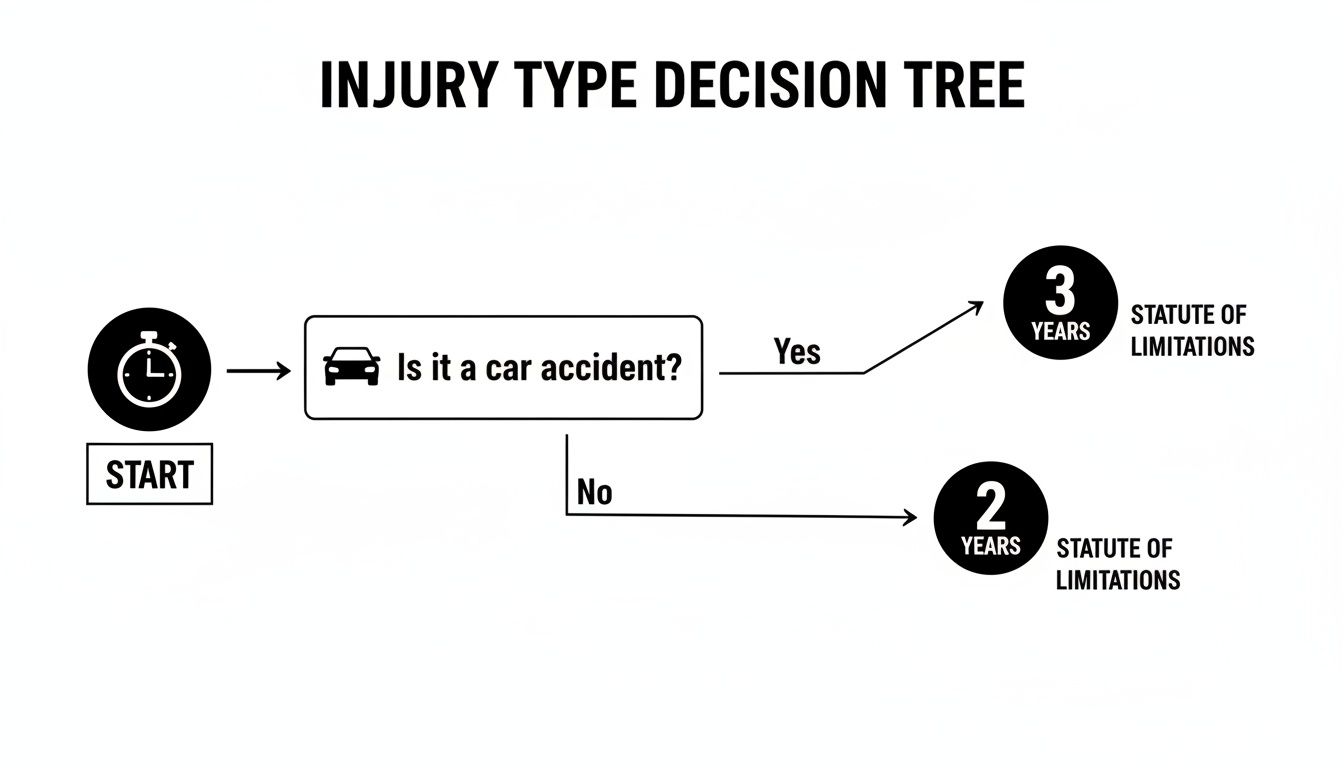
As the graphic shows, your path starts by figuring out whether a motor vehicle was involved. That single fact changes everything.
Wrongful Death Claims
When an injury tragically leads to someone’s death, the case becomes a wrongful death claim. For these devastating situations, surviving family members have two years to file a lawsuit.
It's important to note that this clock starts on the date of the person's death, which might be different from the date of the accident that caused the fatal injury.
The Strictest Deadline: Claims Against the Government
The rulebook changes completely when the person or entity at fault is a government agency. This could be a city bus, a state-owned vehicle, or an injury on public property. Under the Colorado Governmental Immunity Act (CGIA), you are up against an incredibly short and unforgiving timeline.
You must file a formal, written "notice of claim" with the correct government body within just 182 days of your injury.
Miss this 182-day notice deadline, and your claim is almost certainly barred forever. It doesn't matter if the regular statute of limitations is two or three years; failing to file this initial notice is a fatal mistake. It is one of the most common and heartbreaking traps for people trying to handle these claims on their own.
Colorado's statute of limitations for motor vehicle accidents stands at three years from the date of the crash, representing a critical deadline that applies to drivers, passengers, pedestrians, bicyclists, and property damage claims tied to vehicle use. This three-year window is significantly longer than the state's general two-year statute of limitations for other personal injury claims, such as slip-and-fall incidents or premises liability cases. You can discover more insights about these crucial distinctions on personalinjuryincolorado.com.
When Does The Countdown Clock Actually Start?

Most people think the legal clock starts ticking the moment an accident happens. In many cases, it does. But what if you were hurt and had no way of knowing it at the time? The law accounts for this.
Colorado law recognizes something called the discovery rule. It’s a critical exception built on a simple idea of fairness: the deadline to file a claim shouldn’t start until you actually discover—or reasonably could have discovered—that you were injured.
Think of it like this: the shot clock in a game doesn't start until you know you're in the game. Some injuries don't show up right away. The discovery rule acknowledges that reality.
The Discovery Rule in Action
Let's look at a real-world example. Imagine a construction worker is exposed to a chemical spill on a job site. He feels fine, washes up, and goes home, not thinking much of it. The incident is forgotten.
Two years later, he starts having serious trouble breathing. After a long series of tests, his doctors connect his respiratory disease directly back to that chemical exposure from two years ago.
Without the discovery rule, his claim would be dead on arrival. The two-year deadline would have passed. But because of this rule, the clock didn’t start on the day of the spill. It started on the day he discovered the link between his illness and the exposure.
The discovery rule shifts the starting line. It says the statute of limitations begins not on the date of the negligent act, but on the date the injury was known or should have been known by a reasonable person.
This is a game-changer in cases where the harm isn't obvious from day one, such as:
- Medical Malpractice: A surgeon leaves a sponge inside a patient during surgery. It causes no issues until a year later when it’s found on an X-ray for an unrelated problem.
- Traumatic Brain Injuries (TBI): A person involved in a "minor" car accident seems fine, but six months later starts experiencing debilitating memory loss and cognitive problems.
- Pharmaceutical Injuries: A patient takes a medication for years, only for studies to later reveal it causes long-term kidney damage.
In all these situations, the injured person couldn't have known the true harm right away. The discovery rule gives them a fair shot at justice.
Proving a Later Discovery Date
This rule is a vital protection, but it isn’t automatic. The responsibility falls on you, the injured person, to prove to the court that you couldn't have reasonably found the injury any sooner. This is often where the real fight begins.
You can bet the at-fault party’s insurance company will push back hard. They will argue you should have known earlier. They might claim you ignored symptoms or should have seen a doctor sooner, insisting a "reasonable person" would have connected the dots much faster.
Successfully using the discovery rule means building a strong, evidence-based case. It requires a thorough investigation that often includes:
- Gathering Medical Records: Creating a clear timeline that shows when your symptoms first appeared and when you finally received a diagnosis.
- Hiring Expert Witnesses: Bringing in medical specialists who can explain to a court why an injury was "latent" and why the symptoms wouldn't have been obvious.
- Presenting Personal Testimony: Clearly documenting your experience and showing that you acted reasonably with the information you had at the time.
Navigating the complexities of the discovery rule is not something you should ever try to do on your own. Proving when you "should have known" about your injury is a tough legal battle that demands skill and experience. You need a personal injury attorney who can build the powerful argument needed to protect your claim and make sure the clock starts on the right day.
Exceptions That Can Pause Or Extend Your Filing Deadline
While Colorado's legal deadlines are strict, they aren't heartless. The law recognizes that life gets in the way. Sometimes, a person is simply not in a position to file a lawsuit within the standard two or three-year window, and it wouldn’t be fair to penalize them for it.
In these specific situations, the law allows the countdown clock to be paused. This is a legal concept called tolling. The easiest way to think of it is hitting the pause button on your legal deadline. The clock stops ticking until a certain condition is met, and only then does it start back up.
Tolling is a critical protection. It ensures that people don't lose their only chance at justice because of circumstances completely outside their control. But these exceptions are not automatic—you have to prove one applies to your case, which requires a strong legal argument.
When the Injured Person Is a Child
One of the most common and important exceptions involves injuries to minors. When a child under 18 is hurt, the law gives them extra protection.
The statute of limitations clock doesn't have to start right away. Instead, it can be "tolled," or paused, until the child's 18th birthday. Think about it: if a 12-year-old is injured in a bike accident caused by a negligent driver, the three-year deadline for motor vehicle accidents doesn't necessarily run out when they turn 15. The clock can be paused until they turn 18, and then they have the standard amount of time to file their own claim as a legal adult.
This rule exists for a simple reason: children can't file lawsuits for themselves. While a parent can and often should file a claim on their child's behalf, this tolling rule acts as a failsafe. It protects the child’s right to seek justice even if an adult doesn't, or can't, act for them.
When an Injury Causes Mental Incapacity
Another key exception is for an injured person who is considered "mentally incapacitated." This isn't about feeling stressed or overwhelmed after an accident. It’s a high legal standard referring to a severe condition that prevents someone from managing their own affairs or understanding their rights.
This could include situations like:
- A traumatic brain injury (TBI) that leaves the person in a coma or with severe cognitive deficits.
- A pre-existing condition, like advanced dementia, that makes it impossible for them to comprehend the legal process.
- A severe psychological condition directly caused by the trauma, leaving them unable to function.
In these tragic cases, the statute of limitations is tolled. The clock won't even start to run until the person's mental capacity is restored. If the incapacity is permanent, a court-appointed guardian may be the one to pursue the claim on their behalf.
Important Note: Proving mental incapacity is a significant legal challenge. It almost always requires extensive medical records and testimony from expert witnesses to convince a judge that the person was truly unable to pursue their rights.
When the At-Fault Person Leaves Colorado
So, what happens if the person who hurt you packs up and leaves the state, maybe hoping you'll just give up? The law has an answer for that. You can’t just run from responsibility.
If the at-fault party leaves Colorado after causing your injury, the statute of limitations clock is tolled for the entire time they are gone. The countdown only restarts once they move back.
For example, imagine you have a two-year deadline for a slip and fall. One year after your injury, the negligent property owner moves to another state. At that point, your deadline clock pauses with one year remaining. If they return to Colorado four years later, the clock starts ticking again, and you still have that one year left to file your lawsuit.
This rule ensures defendants can't escape accountability just by crossing state lines. As you can see, applying these tolling rules to a statute of limitations personal injury colorado calculation adds another layer of complexity, making experienced legal guidance essential.
What Happens If You Miss The Filing Deadline
Think of the statute of limitations for a personal injury in Colorado not as a suggestion, but as a locked door. Missing this deadline isn't a small mistake you can fix later. It’s a critical error that almost always means losing your right to seek justice, permanently.
Once that door slams shut, your claim becomes what lawyers call statute-barred. If you try to file a lawsuit after the fact, the other side’s attorney will immediately ask the judge to throw out your case. By law, the judge almost always has to agree.
The result is final. You are blocked forever from recovering a single dollar from the person who hurt you or their insurance company. It doesn’t matter how clear their fault was or how devastating your injuries are.
The Insurance Company Is Watching The Clock
You have to understand—the insurance adjuster knows this deadline. They have it marked on their calendar. In many cases, they will use that clock against you.
An adjuster might intentionally drag their feet, hoping to run out the clock on your right to sue. It often looks like this:
- They make a ridiculously low offer and then slow-walk negotiations.
- They keep asking for more and more documents, creating endless, frustrating delays.
- They simply stop returning your calls as the deadline gets closer.
Their goal is to push you past that filing date. The second that happens, their legal duty to pay you evaporates. You lose all your leverage, and they can deny your claim without any fear of you taking them to court.
The consequences for missing the statute of limitations are absolute. The courthouse doors are closed to you. Your legal claim is extinguished forever. It’s a harsh reality, but it’s why acting quickly after an injury is so vital.
The Finality of a Missed Deadline
Let me be perfectly clear: there are no do-overs. It doesn't matter if you were still getting medical treatment, thought you were negotiating in good faith, or just didn't know the rules. Unless a very specific, rare exception applies, the court will not hear your case.
This finality is exactly why you cannot afford to wait. The countdown on a statute of limitations personal injury Colorado claim starts the moment you are hurt. The only way to protect yourself is to act decisively and long before that deadline is even on the horizon.
Speaking with an experienced personal injury attorney is the single most important step you can take to make sure your rights are preserved. Don’t let a simple calendar mistake cost you the compensation you need to heal and rebuild your life.
How To Protect Your Rights And Preserve Your Claim

Knowing the rules of the statute of limitations personal injury colorado is one thing. Acting on them is another. After an injury, it’s natural to feel overwhelmed, but there are a few simple steps you must take to keep that countdown clock from running out on your right to compensation.
The single most critical action you can take is to speak with an experienced personal injury attorney. That first conversation costs nothing, but it's the definitive move to protect your claim and stop the clock from working against you.
Taking Control of the Clock
Once you partner with a firm like Nares Law Group, that heavy burden is no longer yours to carry alone. A dedicated legal team takes over immediately, managing every detail so you can focus on what really matters—your health and your family.
Here’s what that looks like in practice:
- Immediate Investigation: Your attorney will dispatch investigators to gather the evidence that wins cases. This means securing accident reports, tracking down and interviewing witnesses, and preserving physical proof before it can be lost or destroyed. Time is never on your side when it comes to evidence.
- Stopping Insurer Tactics: The legal team becomes a shield. They will handle every phone call, email, and letter from the insurance companies. This stops adjusters from pressuring you into a lowball settlement or tricking you into a recorded statement that could damage your case later.
- Properly Filing Your Claim: Most importantly, your attorney makes sure every deadline is met. Whether it’s filing the initial notice for a government claim or formally filing your lawsuit before the statute of limitations expires, nothing gets missed.
By taking these steps, a law firm builds a protective barrier around you and your claim, ensuring that while you heal, your rights are being aggressively defended.
Understanding What You’re Fighting For
While taking swift action is crucial, it’s also important to understand the compensation you’re entitled to. In Colorado, personal injury damages are split into two main buckets—economic and non-economic. Understanding the difference is key to seeing why a timely claim is so vital.
Economic damages are the straightforward, calculable losses. This includes:
- All medical bills, both past and future
- Lost wages and income from missed work
- Reduced future earning capacity if you can't return to your old job
- Property damage, like your vehicle
Non-economic damages cover the intangible, human losses—things like pain, suffering, emotional distress, and loss of enjoyment of life. These are often subject to legal caps. In fact, as of January 1, 2026, new statutory caps will apply to many personal injury claims, with amounts adjusted by the Colorado Department of Labor and Employment.
But here’s the crucial part: those caps do not apply to your economic losses. The fact that your most significant financial burdens—your medical bills and lost income—are not capped makes it even more important to act. Filing a timely claim is the only way to recover the full financial cost of your injury.
Don’t let a legal technicality stop you from getting the resources you need to rebuild your life. An attorney will work to maximize your recovery in every category, giving you the financial stability to move forward. To get a clearer picture of what this looks like, check out our guide on how to file a personal injury claim. Consulting a lawyer is the best way to safeguard your future.
Answering Your Questions About Colorado's Injury Deadlines
After an injury, the legal questions can feel just as overwhelming as the physical recovery. Most people have the same worries and wonder about the same things. Here are some straight answers to the questions we hear most often.
What if I Settle With the Insurance Company and My Injuries Get Worse?
This is a scenario we see all too often, and it’s one of the biggest risks of dealing with an insurer alone. When you accept a settlement, you sign a release. That document closes your claim for good.
It doesn’t matter if you later find out you need a major surgery or that a “minor” injury is actually a permanent disability. You can’t go back and ask for more money. The case is over. That’s why we never let a client settle until they’ve reached what’s called Maximum Medical Improvement (MMI)—the point where their doctor confirms they are as healed as they are going to get. Only then can we accurately calculate the full cost of your future needs.
Does the Deadline to Sue Still Apply if I'm Negotiating With Insurance?
Yes. This is a critical point that many people miss. The statute of limitations is the hard deadline for filing a lawsuit, not just for talking to an adjuster. The insurance company knows this perfectly well.
It’s not uncommon for adjusters to drag out negotiations, offering just enough to keep you on the phone. They might sound helpful, but their goal is often to run out the clock.
Once the deadline to file a lawsuit passes, your leverage disappears. Without the ability to take them to court, the insurance company has no reason to offer you a fair settlement. Your claim becomes practically worthless.
Should I Wait to See How Bad My Injuries Are Before Calling a Lawyer?
No. In fact, this is one of the most dangerous mistakes you can make after an accident. Waiting creates problems that can’t always be fixed.
Evidence disappears. Surveillance footage gets erased. Witnesses move or their memories fade. And if your claim is against a city or state entity, you could miss the extremely short 182-day notice deadline and lose your right to a claim before you even realize it exists.
Contacting an attorney right away isn’t about rushing to sue. It’s about protecting your options. A quick, early conversation ensures every deadline is tracked and that crucial evidence is preserved. It lets you build your claim on a solid foundation from day one, so you can focus on healing without worrying about the legal clock.
If you have more questions or you're worried about a deadline in your own injury case, don't wait. The team at Nares Law Group is here to give you clear answers and protect your rights. Contact us for a free, no-obligation consultation to understand your options and secure your future.