You’re driving home through Denver traffic, your hands still tight on the wheel, when another car cuts across your lane and everything compresses into noise, glass, and adrenaline. A few minutes later, the questions start arriving faster than the tow truck. Should you talk to the other driver’s insurer? Do you need imaging even if you walked away? How do you pay bills if you can’t work for a while? And when does calling a lawyer stop feeling dramatic and start feeling necessary?
That moment is when many individuals begin looking for a denver auto accident attorney. Not because they want a lawsuit, but because they want control. They want someone to explain what happens next, what mistakes to avoid, and how to protect their recovery while life feels unstable.
The Moments After a Crash and Your First Big Decision
A crash on I-25, Speer Boulevard, or a neighborhood arterial often leaves people functioning on autopilot. You exchange information, call family, answer a few questions, and tell yourself you’ll sort it out tomorrow. Then tomorrow arrives with neck pain, a damaged car, missed work, and an insurance call that sounds friendly but moves very fast.

You’re not overreacting if the situation feels bigger than it first looked. Denver recorded 15,701 motor vehicle crashes in 2024, resulting in over 5,500 injuries and 63 traffic fatalities, according to Denver car accident statistics. A serious collision is common enough that the system has routines for it, but personal enough that your case can still turn on details no one else sees.
What to do before the insurance calls shape the story
The first big decision isn’t whether to sue. It’s whether to get organized early.
A lawyer’s help starts long before a courtroom becomes relevant. The job at the beginning is preserving facts, protecting your medical narrative, and preventing an avoidable statement from becoming the insurance company’s favorite paragraph in your file. If you need a practical checklist for the immediate aftermath, this guide on post-accident procedures for drivers is useful because it focuses on the concrete steps people miss when they’re shaken up.
Practical rule: The first version of the story tends to stick. Get the facts documented before assumptions harden into “disputes.”
Why calling a lawyer is often a recovery decision
Clients often think hiring counsel means escalating conflict. Usually it means the opposite. It creates one place for documents, one point of contact for insurers, and one plan for medical records, bills, wage loss proof, and vehicle evidence.
A good attorney also slows things down in the right way. Fast settlements often feel attractive when the car is in the shop and money is tight. But quick money can cost a lot if your symptoms worsen, your treatment expands, or the at-fault driver’s insurance turns out not to be enough. That last problem, the underinsured driver problem, is where many Denver cases get financially difficult.
Your Advocate Beyond the Courtroom
Often, a lawyer is pictured standing up in court. In an auto case, that’s only one small part of the work. A better analogy is this. Your attorney is the general contractor for your recovery.
You focus on healing. Your lawyer coordinates the moving parts that have to come together if the claim is going to reflect what the crash cost you.
The investigator
Police reports matter, but they aren’t the whole case. Officers arrive after the impact. They may not see the full angle of visibility, the sequence of lane changes, the timing of symptoms, or the witness who left before they arrived.
A strong attorney looks for the pieces that don’t make it into the initial report, such as:
- Vehicle evidence: damage patterns, crash photos, repair records, and onboard data when available.
- Scene evidence: road layout, signage, skid marks, debris fields, and nearby cameras.
- Medical linkage: records that connect the collision mechanism to the injuries being treated.
- Witness development: follow-up conversations that clarify what each person observed.
That work matters because the insurance company doesn’t pay based on sympathy. It pays based on what can be shown.
The buffer
Insurance adjusters aren’t your doctors, and they aren’t neutral historians. Their job is to evaluate exposure and resolve claims. Sometimes that leads to fair outcomes. Sometimes it leads to narrow questions designed to lock you into an incomplete description before treatment is finished.
A denver auto accident attorney steps in as the communication buffer. That reduces the chance that a bad day, a rushed call, or an offhand comment gets used to minimize the claim. It also lets you stop treating every voicemail like a legal risk.
When a client is trying to heal, the case moves better when one trained person handles the paper trail and the pressure.
The strategist and advisor
The strongest claims aren’t just piles of records. They tell a coherent story. How the crash happened. Why liability points where it does. What treatment was necessary. What work was missed. What future problems are likely to remain.
That strategy also includes practical guidance. Which providers need records requests. How to document lost wages. Whether property damage evidence may support the injury claim. Whether experts may be needed later. In that role, firms such as Nares Law Group’s Denver personal injury team handle the coordination side of a case so the client isn’t forced to become their own claims manager while recovering.
What doesn’t work is fragmented handling. One office deals with the car, another with the medical bills, and the client is left forwarding emails between everyone. Cases get undervalued that way because no one is building the full picture.
Navigating Colorado's Fault Rules and Deadlines
Colorado law shapes the value of your case before negotiations even begin. If you don’t understand the timing rules and fault rules, it’s easy to misread your strength.
The filing clock keeps running
Think of the statute of limitations like a clock that begins its countdown. It doesn’t announce itself, and it doesn’t pause because treatment is ongoing or the insurer says negotiations are continuing.
Colorado generally gives three years for personal injury cases and two years for wrongful death actions, according to Denver car accident lawyer statistics. That sounds like plenty of time until records are delayed, fault gets contested, or your injuries take months to fully understand. Waiting too long narrows your options.
The fault pie matters more than most people expect
Colorado uses modified comparative negligence. You can recover damages only if your share of fault is less than 50%, and a plaintiff found 40% at fault on a $100,000 claim would receive $60,000, as explained in this discussion of Colorado comparative negligence and liability assessment.
That’s the fault pie. Every percentage point matters.
If the insurer can push more blame onto you by arguing speed, distraction, lane position, or failure to react, the value of the claim drops. If it can push fault high enough, recovery can be barred. That’s why liability work is not a formality. It’s often the economic center of the case.
For a plain-language look at this issue, is Colorado a no-fault state is a useful place to clear up a common misunderstanding. Colorado is fault-based, which means who caused the crash directly affects who pays.
Damages are broader than most people think
People usually think of damages as medical bills and car repairs. The law recognizes more categories than that.
- Economic damages: out-of-pocket losses such as treatment costs, wage loss, and other documented financial harm.
- Non-economic damages: the human cost, including pain, disruption, and the loss of normal daily function.
- Physical impairment impacts: lasting limitations that continue after the initial treatment period.
If your vehicle lost market value even after repairs, that can become part of the broader financial picture. This Colorado drivers' diminished value guide helps explain that separate issue for people whose cars don’t fully recover in value after a crash.
A short video can also help make these rules easier to absorb when you’re already overloaded with paperwork and appointments.
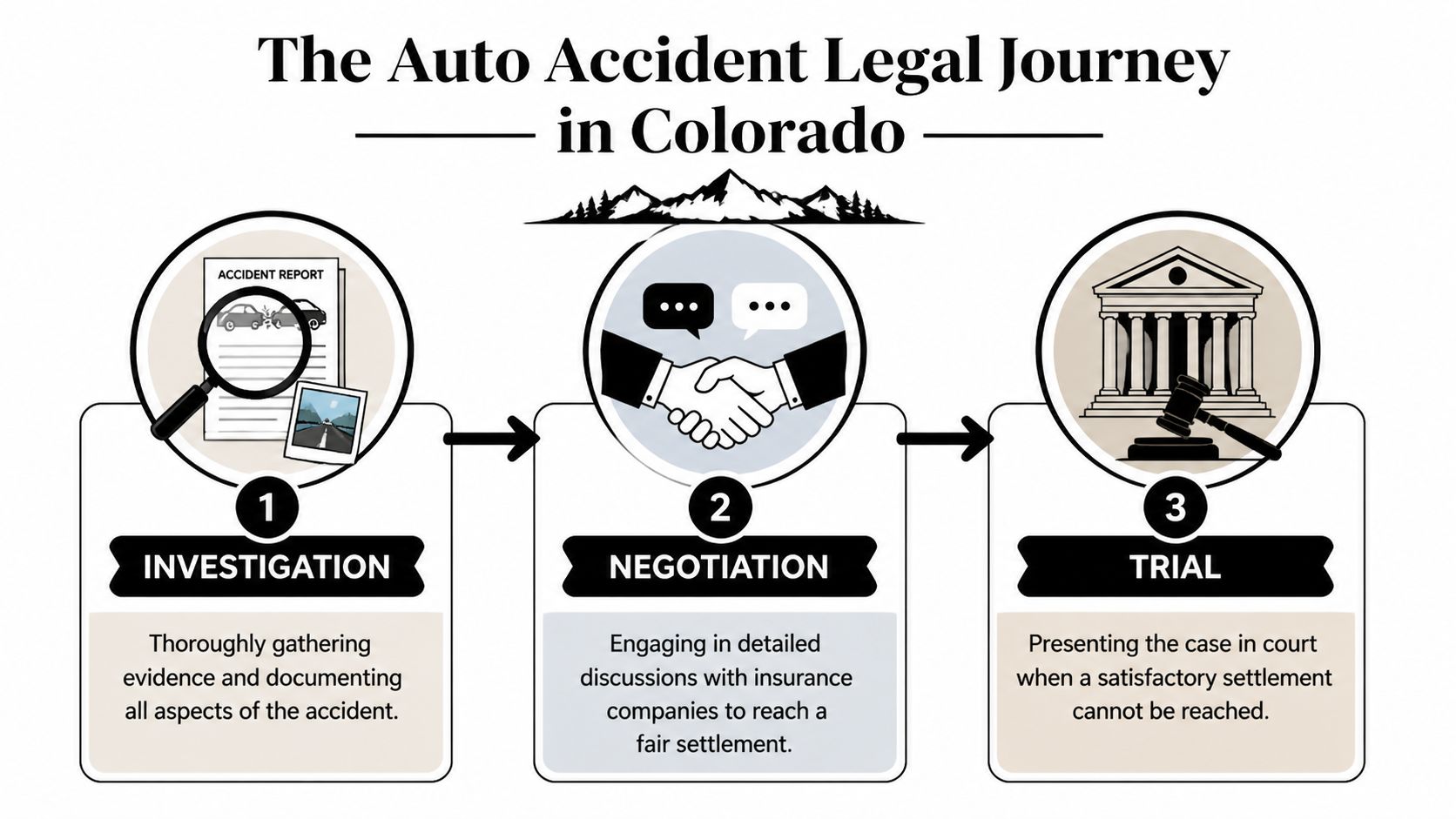
The Path to Compensation Investigation Negotiation and Trial
Most auto claims follow a sequence. The quality of each stage affects the next one. Weak investigation produces weak negotiation. Strong preparation creates pressure the insurer has to respect.
Investigation builds the foundation
The case starts with collecting evidence before it disappears or gets harder to interpret. That usually includes the crash report, photographs, witness contacts, medical records, billing records, employment information, and property damage material.
This part is less dramatic than trial, but it’s where good cases are built. If the vehicle damage tells an important story, don’t assume the repair estimate captures it all. Sometimes prior or hidden damage creates confusion, which is why tools that help identify hidden car damage can be useful when the condition and history of a vehicle become disputed.
Negotiation is not just back-and-forth
Once treatment has developed enough to understand the injuries, the attorney usually prepares a demand package. That package isn’t a stack of bills with a number on top. It should connect liability, treatment, losses, and future consequences into one persuasive presentation.
Then the negotiation begins. The insurer responds. The attorney counters. Additional records may be requested. Liability arguments may tighten. The adjuster may test whether your side is impatient, underprepared, or unwilling to file suit.
What doesn’t work is bluffing. Insurance companies see that every day. They can usually tell when a lawyer is making trial noises without building a trial-ready file.
A fair settlement often comes from the work the insurer never wants to see completed, depositions prepared, experts retained, and a case developed as though a jury may decide it.
Trial readiness changes leverage
Often, real value materializes. The point of preparing for trial isn’t that every case should be tried. The point is that preparation changes the bargaining range.
One documented example shows why. In a trucking collision case, an insurer’s initial offer of $2 million was followed by a $26.6 million jury verdict, a 1,230% increase, as described in this discussion of trial readiness in car accident cases. That result doesn’t mean every case explodes in value at trial. It does show that credible trial risk can force a very different conversation.
What clients should expect during the process
The process becomes easier to handle when you know what your job is and what your lawyer’s job is.
- Your job is treatment and documentation. Keep appointments, follow medical advice, and preserve records.
- Your lawyer’s job is proof and pressure. Build the file, answer the insurer, evaluate offers, and prepare for litigation if needed.
- Both jobs matter. A well-prepared legal claim still suffers if treatment is inconsistent or losses aren’t documented.
Some cases settle before suit. Some settle after filing. A smaller group goes much deeper into litigation. The timeline depends on medical clarity, disputed fault, policy limits, and whether the defense believes your lawyer will do the hard work required to try the case.
The Unseen Risk Closing the Insurance Coverage Gap
Many law firm pages stop after saying uninsured and underinsured motorist coverage exists. That’s not enough. The core problem isn’t the definition. It’s the gap between what the at-fault driver carries and what your injuries cost.
A common Denver example is a working driver hit by someone with minimal coverage. The injured person needs imaging, follow-up care, physical therapy, and time off work. The bills start stacking up long before the body has given a final answer about recovery. Then everyone learns the at-fault policy may not go far enough.
Why this risk is bigger than many people realize
In Colorado, about 13% of drivers were uninsured in 2024, and the cost of a moderate injury can easily exceed $20,000, according to this explanation of uninsured car accident risks in Denver. That combination creates a serious exposure for injured drivers, especially when treatment stretches beyond the first round of bills.
The mistake I see most often is assuming “the other driver’s insurance” is the whole case. Sometimes it is. Sometimes it is nowhere close.
How a UIM claim actually feels in practice
People are often surprised to learn that after being hit by someone else, they may need to make a claim under their own policy. That feels backward. You paid premiums to protect yourself, and now your own carrier may scrutinize the claim like an opposing insurer.
That’s where legal guidance matters. A lawyer can review the policy language, identify available coverage, organize proof of damages, and handle the negotiations so your UIM claim is presented with the same care as the liability claim. If you want a clearer overview of how that works, this page on uninsured motorist coverage in Colorado is a practical starting point.
Don’t treat UIM coverage like a technical add-on. In the wrong crash, it becomes the bridge between a partial recovery and a financial mess.
What works better than generic advice
Generic advice says “make sure you have coverage.” Practical advice asks harder questions.
- How exposed are you if the at-fault driver has low limits?
- Could your household absorb treatment costs and lost income during a coverage fight?
- Are you relying on your car for gig work, commuting, or family care responsibilities?
Those aren’t abstract planning questions. They shape how much risk a family carries after a collision. A denver auto accident attorney who understands coverage gaps can help both with the current claim and with smarter policy planning after the case closes.
Choosing Your Denver Auto Accident Attorney A Practical Checklist
The fee question usually comes first, and it should. Most Denver auto accident attorneys work on a contingency fee, typically 33% to 40% of the final recovery, and only get paid if they win, according to Denver attorney market and fee information. That structure matters because injured people often can’t absorb hourly legal fees while also handling treatment, repair issues, and lost work.
Denver’s legal market is active because crash volume keeps demand high. That means you have options, but it also means you need a way to separate polished marketing from actual case handling.
What to ask in the consultation
Don’t use the consultation just to tell your story. Use it to interview the lawyer.
| Question Category | Specific Question to Ask | Why This Matters |
|---|---|---|
| Case handling | Will you personally handle my case, or will it move immediately to staff? | You need to know who will make strategy decisions and answer hard questions. |
| Trial posture | How do you prepare a case if the insurer refuses to be reasonable? | Some firms negotiate well but rarely build a file that creates real trial pressure. |
| Communication | How often will I receive updates, and who returns calls or emails? | Uncertainty is easier to manage when expectations are clear. |
| Medical proof | How do you document injuries like mine and connect them to the crash? | Injury claims rise or fall on medical causation and consistent proof. |
| Coverage issues | How do you evaluate uninsured or underinsured motorist coverage? | Coverage gaps can change the value of the case more than fault disputes do. |
| Fee clarity | What costs are separate from the contingency fee? | You should understand how litigation expenses are handled before signing. |
Green flags and warning signs
A useful consultation should leave you calmer, not more confused.
Look for these green flags:
- Specific answers: The attorney explains process, evidence, and likely pressure points in plain language.
- Realistic expectations: They don’t promise results. They explain trade-offs.
- Coverage awareness: They ask about all available policies, not just the other driver’s.
- Treatment focus: They care whether your medical picture is still developing.
Be cautious if you hear any of the following:
- Rush pressure: pushing you to sign before your questions are answered.
- No discussion of fault issues: especially in a state where comparative fault can dramatically change value.
- Little interest in your insurance: a sign they may miss UIM exposure.
- Pure settlement talk: with no explanation of how the case would be prepared if negotiations fail.
The right lawyer should sound organized, candid, and unafraid to discuss both strengths and weaknesses.
Taking the First Step Toward Your Recovery
After a serious crash, individuals don’t need more noise. They need a clear path. They need to know how Colorado fault rules affect their claim, what deadlines matter, how the case is built, and why underinsured driver issues can turn a manageable claim into a financial strain.
That’s why hiring a denver auto accident attorney isn’t just a legal decision. It’s a recovery decision. The right lawyer protects evidence, manages insurer contact, develops the damages story carefully, and watches for the coverage gaps many people don’t discover until too late.
You don’t have to make every major decision on day one. You do need to avoid preventable mistakes while the facts are still fresh. Getting legal guidance early can help you understand what your case may involve, what documents to gather, and what pressure points may affect compensation later.
A consultation should give you clarity. You should leave with a better understanding of fault, deadlines, insurance issues, and the likely next steps, even if you’re not ready to hire anyone that day. That kind of conversation can replace panic with a plan.
If you were hurt in a crash and need straight answers about liability, insurance, medical documentation, or underinsured motorist issues, Nares Law Group LLC offers free consultations for injured people in Denver and across Colorado. A good first call should help you understand your options, protect your rights, and decide what to do next with more confidence.