A crash in Aurora can turn an ordinary commute into a blur of noise, paperwork, pain, and fear. One moment you're watching brake lights on I-225 or merging onto E-470. The next, you're trying to answer questions you never expected to face. Is everyone okay. Do you need an ambulance. Should you talk to the insurance adjuster. Why do you feel shaken, dizzy, or strangely numb.
Individuals don't need legal jargon in that moment. They need calm, plain guidance. They need to know what matters first, what can wait, and when an aurora auto accident attorney becomes part of protecting their recovery.
This guide is written for that exact moment. It focuses on two problems many crash victims in Aurora don't see coming until they're deep in the claims process. First, the uninsured or underinsured driver problem, especially on busy corridors where hit-and-runs and inadequate coverage can complicate recovery. Second, the long-term effects of traumatic brain injuries, which often don't show up clearly on the outside but can change work, memory, sleep, and family life in ways insurance companies tend to minimize.
The Moments After a Crash on an Aurora Road
Traffic is heavy. The road is slick. Someone changes lanes too fast, or doesn't stop in time, and the impact comes before your brain can catch up. Your hands shake when you reach for your phone. You hear sirens, other drivers, maybe a child crying in the back seat. You look at the damage and think, "How bad is this going to get?"
That's the part people remember most clearly. What they often don't realize is that the first hours after a crash can shape the legal claim almost as much as the collision itself. The photos you take, the symptoms you mention, the treatment you accept, and the statements you make can all matter later.

If you're in that early window, this practical guide to the initial phase of personal injury claims helps explain what usually happens before the legal process starts to feel organized. One of the most useful early documents is the police report, and learning how to read a police accident report can help you catch mistakes or missing details before they snowball.
Why your fear isn't an overreaction
Aurora drivers aren't imagining that the roads feel more dangerous. Aurora, Colorado saw fatal traffic accidents rise from 31 in 2019 to 56 deaths in 2025, and the city moved from rank #64 in 2024 to rank #4 in 2025 among Colorado cities for fatal crashes related to bad driving behaviors, with 11.02 fatal crashes per 100,000 residents according to Ramos Law's Aurora crash overview.
That statistic matters for a simple reason. It tells you your crash wasn't some bizarre fluke in an otherwise low-risk environment. Aurora has become a place where serious collisions happen often enough that families need a real roadmap after impact.
Practical rule: If you feel overwhelmed after a crash, that's normal. Your job is not to solve the whole claim at the roadside. Your job is to protect your health, preserve what you can, and avoid making rushed decisions.
The first questions people usually ask
In the first day or two, most injured people circle around the same worries:
- "What if I feel worse tomorrow?" That's common, especially with neck injuries, concussions, and adrenaline-heavy crashes.
- "Should I talk to the insurer right away?" You may need to report the crash, but you don't need to guess about your injuries or accept blame to sound cooperative.
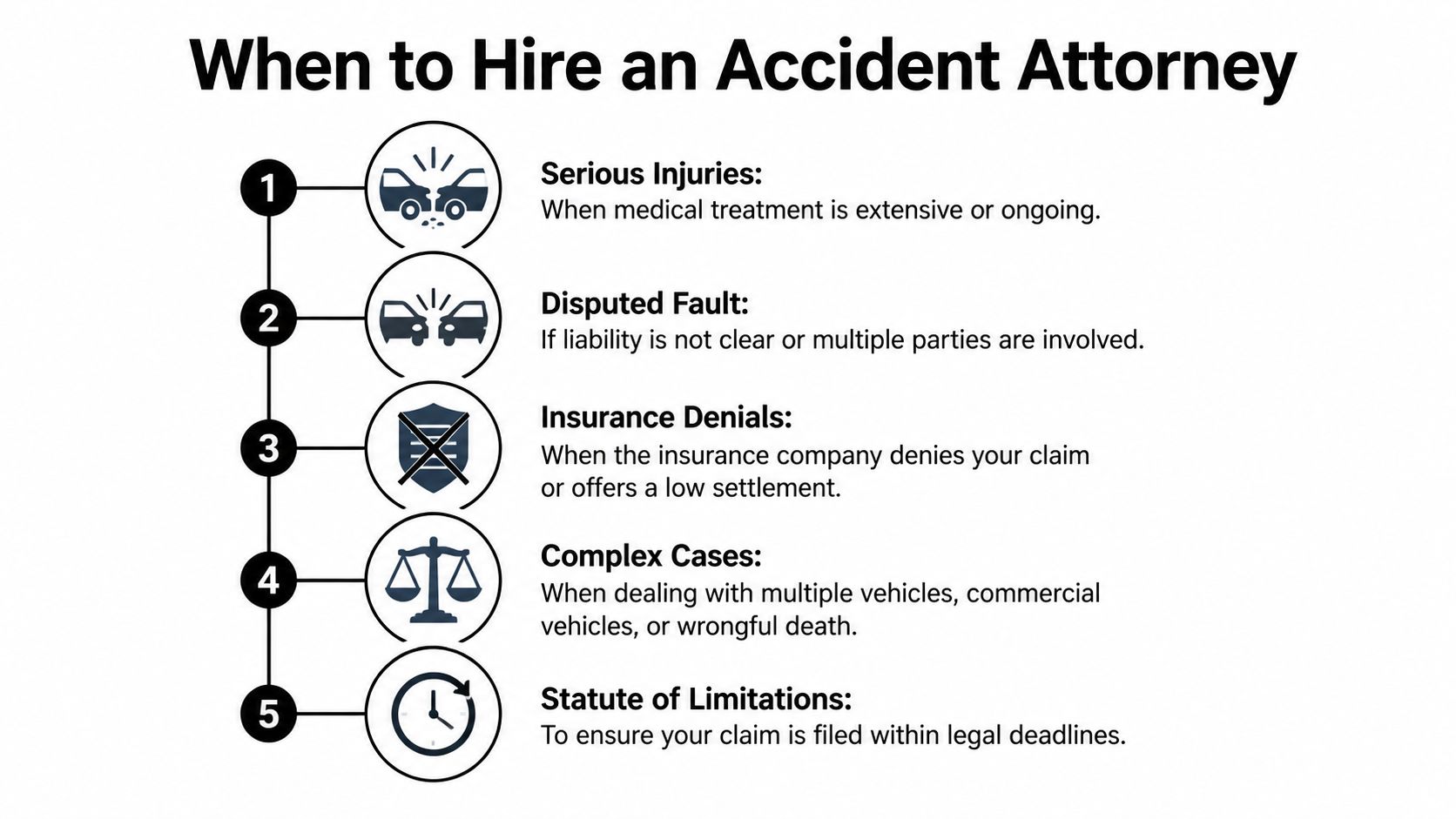
- "Do I really need a lawyer?" Not always. But if the crash involves significant injuries, fault disputes, commercial vehicles, or insurance gaps, waiting can cost you evidence and bargaining power.
An aurora auto accident attorney doesn't erase the stress. What they can do is turn a chaotic sequence of events into an organized process, one step at a time.
What an Aurora Auto Accident Attorney Really Does
Many envision a lawyer arguing in court. That's only one piece of the job, and in many cases it isn't even the first or most important one. A better analogy is this. An aurora auto accident attorney is the project manager for your recovery.
After a serious crash, your life can split into several tracks at once. Medical care. Insurance calls. car repairs. Missed work. Bills. Records. Deadlines. A lawyer's role is to keep those tracks from colliding.
The investigator role
The first job is finding out what happened, and proving it with something stronger than memory. Crash scenes change fast. Vehicles get repaired. Skid marks fade. Witnesses stop answering unknown numbers. Digital evidence can disappear.
A lawyer starts gathering the building blocks of liability:
- Scene evidence such as photos, vehicle damage, roadway conditions, and debris patterns
- Official records including the police report and any supplemental investigation
- Witness information while memories are still fresh
- Insurance details from all involved drivers and, in some cases, additional policies that may apply
Legal help becomes less about arguing and more about assembling a reliable record.
The medical coordinator role
People often assume a lawyer gives medical advice. They shouldn't. What they do is help make sure the legal case reflects the medical reality.
That matters because many injuries aren't simple. A person may start with headaches, confusion, light sensitivity, or back pain and not realize how disruptive those symptoms will become. A lawyer helps track treatment, gather records, and understand how providers are documenting the injury. That can prevent a claim from being valued as a short-term inconvenience when it is a long recovery.
The strongest claims don't just show that you were hurt. They show how the injury changed your daily life, your work, and your future care needs.
The financial negotiator role
Insurance companies speak the language of files, categories, and risk. Injured people speak the language of pain, uncertainty, and practical loss. Someone has to translate.
A lawyer does that by organizing bills, wage loss information, treatment records, and evidence of ongoing limitations into a demand the insurer can evaluate. If you want a broader overview of how injury cases are handled in Colorado, this page on a Denver personal injury attorney gives helpful context for what representation usually includes.
The legal advocate role
Some cases settle through negotiation. Others don't. If fault is disputed, coverage is limited, or the insurer refuses to value the case fairly, the attorney becomes the person who pushes the claim into litigation and prepares it for trial.
That doesn't mean every case ends in a courtroom. It means the other side knows someone is preserving evidence, understanding damages, meeting deadlines, and preparing as if the case might need to be proved to a jury.
Here's the key point. A lawyer isn't there just to file papers. They're there to create order. When the client is trying to sleep, heal, get to appointments, and keep the household moving, that order matters.
Deciding When You Need to Hire an Attorney
Some crashes are straightforward. The damage is minor, medical care is brief, and the insurance process stays relatively smooth. Many aren't. The danger is that people often wait until a claim is already tangled before they ask for help.
If you're trying to decide whether you need an aurora auto accident attorney, don't ask whether the crash felt serious in the moment. Ask whether the claim has signs of becoming complicated.
Situations where waiting can hurt your case
A few fact patterns should make you pick up the phone quickly.
- You may have a brain injury. If you have headaches, dizziness, memory problems, sleep disruption, sensitivity to light, nausea, confusion, or personality changes after a crash, don't dismiss that as just stress.
- The other driver fled or may not have enough coverage. A hit-and-run or thin insurance policy changes the path of the claim.
- A commercial truck or company vehicle was involved. These cases often involve more records, more insurers, and faster defense response.
- Fault is disputed. If the other driver is blaming you, or the police report doesn't clearly support your account, delay gives the other side room to define the story first.
- You can't tell what your recovery will look like. That uncertainty is exactly why early legal guidance matters.
The uninsured driver problem in Colorado
One of the least understood reasons to hire counsel early is the uninsured or underinsured driver issue. The Colorado Division of Insurance reported that approximately 13.5% of drivers were uninsured in 2024, an 11.6% increase from the previous year. For accidents on corridors like I-225, that raises the chance that the at-fault driver may not have adequate coverage, making a UM/UIM claim important according to LMOC Law's discussion of uninsured accidents.
That catches many families off guard. They assume, understandably, that if another driver caused the crash, that driver's insurance will pay. Sometimes it doesn't. Sometimes the person has no policy. Sometimes the policy limits are too low to cover serious injuries. Sometimes a hit-and-run leaves you without an identified at-fault driver at all.
UM/UIM claims can feel upside down because you're often dealing with your own insurer while still having to prove the value of your losses. People expect support and find themselves in another negotiation.
If the crash involved a hit-and-run, sparse insurance information, or a driver who seemed evasive about coverage, treat that as a legal issue early, not a paperwork detail for later.
A simple way to think about timing
Hiring a lawyer isn't only about filing a lawsuit. It's often about early protection. Much like boarding up windows before a storm gets worse, not after the rain is already inside.
A consultation can help answer questions like these:
- Is there enough insurance to cover the harm done?
- Do your symptoms suggest a more serious injury than the ER recognized at first?
- Are there vehicles, records, or electronic data that need to be preserved now?
- Has the insurer already started shaping the case in a way that hurts you?
If any of those questions makes you pause, that pause is meaningful. It's often the point when legal help becomes less of a luxury and more of a safeguard.
The Essential Evidence That Builds Your Claim
A strong claim isn't built on emotion alone, even when the injury is devastating. It's built on evidence that shows what happened, who caused it, and how the crash changed your life. In serious cases, your attorney becomes something close to an evidence-management engineer, making sure the important pieces don't disappear before anyone understands their value.
Why early evidence matters so much
Some evidence is obvious. Photos of the vehicles. The police report. Your medical records. Other evidence is technical and highly perishable.
One example is the Event Data Recorder, often called the vehicle's black box. Attorneys often issue a preservation letter within 72 hours of a crash to secure a vehicle's Event Data Recorder data. The EDR captures pre-crash speed, braking, and other metrics in 300-millisecond windows, and that objective data can be highly valuable in proving fault under Colorado's comparative fault rules according to Lampert & Walsh's explanation of post-crash evidence preservation.
That may sound technical, but the idea is simple. If two drivers tell different stories about speed, braking, or impact sequence, the car itself may hold part of the answer.
What evidence actually helps
Think of the claim like a puzzle. No single piece tells the whole story. Several pieces together do.
| Document/Evidence Type | Why It's Important | Where to Get It |
|---|---|---|
| Photos of vehicles and scene | Shows damage patterns, lane position, weather, debris, and visible injuries | Your phone, passenger phones, nearby businesses if footage exists |
| Police report | Gives the basic incident record, involved parties, diagram, and officer observations | Law enforcement agency handling the crash |
| Medical records | Connects the crash to diagnosis, symptoms, treatment, and restrictions | Hospitals, urgent care, specialists, therapists |
| Bills and receipts | Documents out-of-pocket losses and treatment costs | Medical providers, pharmacy, transportation records |
| Witness statements | Helps confirm how the collision happened | Witnesses directly, or through your attorney's investigator |
| Employment records | Supports missed work, wage loss, or job disruption | Employer, payroll department, tax or benefit records |
| Vehicle repair or total loss records | Helps show severity of impact and property damage timeline | Body shop, insurer, vehicle appraiser |
| EDR or black box data | Provides objective pre-crash driving data when available | Vehicle download arranged through legal and technical channels |
| Communication from insurers | Shows claim positions, denials, requests, and settlement offers | Your email, claim portal, letters, voicemail logs |
| Symptom journal | Captures daily pain, sleep issues, headaches, cognitive problems, and limitations | Created by you or a family member consistently over time |
The evidence people forget
The overlooked evidence is often the evidence that explains life after the wreck.
- A daily symptom log can show that headaches weren't occasional. They were constant enough to affect work and parenting.
- Calendar notes can show just how many appointments, school pickups missed, or social events abandoned followed the crash.
- Messages from family members may help document mood changes, memory issues, and the invisible fallout of a concussion.
- Photos over time can capture bruising, swelling, mobility devices, or home modifications that don't appear in the initial ER file.
Keep records as if you may need to explain your recovery to a stranger months from now. Because you probably will.
Why comparative fault changes the evidence strategy
Colorado comparative fault rules can make evidence collection more than a formality. If the insurer argues that you were partly responsible, each detail starts to matter more. Lane placement, braking, visibility, seat belt use, vehicle data, and witness recollections can all shape how fault is assigned.
That doesn't mean every case becomes a technical battle. It means your story is stronger when it rests on records, timestamps, and objective data instead of memory alone.
A good evidence file tells a simple story clearly. Who caused the crash. What it did to your body. What it cost you. What you still need.
Understanding Your Compensation and Attorney Fees
After the medical emergency settles, the financial panic usually begins. Bills arrive before healing does. Paychecks may shrink or stop. Insurance language gets abstract at the exact moment your life feels painfully concrete.
Compensation is supposed to account for those losses. But a fair claim value doesn't come from adding up the emergency room charges and calling it done.

Economic losses and non-economic harm
Lawyers usually divide compensation into two broad categories.
Economic damages are the financial losses you can point to on paper. Medical bills, rehabilitation expenses, lost income, reduced earning capacity, and other measurable costs fit here.
Non-economic damages are harder to put in a spreadsheet but no less real. Pain. Disruption. Anxiety. Loss of enjoyment of life. Changes in relationships. The daily frustration of no longer feeling like yourself.
People often understand the first category and underestimate the second. That's especially true when the injury doesn't look dramatic from the outside.
Why future costs matter
The most expensive part of an injury may not be the first month. It may be the years that follow. A skilled attorney creates a detailed damages matrix, using vocational experts and life-care planners to quantify future losses. In a moderate-severe TBI case, that model can project lifetime costs exceeding $1–3 million, which can anchor settlement negotiations at a much higher value than an insurer's initial position according to Ben Crump Law's Aurora injury discussion.
That kind of modeling matters because insurers often look for shortcuts. If they can frame the injury as temporary, they can frame the payment as limited. A detailed damages analysis forces attention onto what the recovery may require over time.
A demand package is one of the tools used in that process. If you want a plain-English explanation of how that document is built and why wording matters, this auto accident demand letter guide is a useful companion read.
How contingency fees usually work
Most injury firms handle car crash cases on a contingency fee. In plain language, that means the attorney's fee is tied to the recovery in the case rather than an upfront hourly bill. People often find that structure easier to manage because they're already dealing with medical and household pressure.
If you want a focused explanation of common fee structures and how percentages are discussed in practice, this page on what percentage do personal injury lawyers take lays out the basics clearly.
Here's the simplest way to understand contingency representation:
- You don't pay to start the case in the way you would with hourly billing.
- The lawyer's payment is generally tied to whether money is recovered.
- Case expenses and fee terms should be explained in writing before you sign anything.
Ask for the fee agreement in plain English. If you can't explain it back in one minute, ask more questions.
A short explainer can also help if you're sorting through the money side of a case:
The gap between an offer and a fair result
The first settlement offer often reflects what the insurer can close the file for, not what your life now requires. That's why timing matters. Settle too soon and you may sign away the right to pursue future losses before you even know what those losses are.
A careful attorney looks at the full arc of harm, not just the stack of current bills. That difference can be life-changing in brain injury, trucking, and long recovery cases.
How Nares Law Group Guides Families to Recovery
Families dealing with serious crashes don't only need a case strategy. They need a way through the day-to-day confusion that follows an injury. That's especially true when the injury is neurological and the symptoms are inconsistent, subtle, or dismissed.
A person with a traumatic brain injury may look fine at a grocery store and still be unable to manage a full workday, remember appointments, tolerate noise, or regulate emotion at home. Those are hard injuries to explain. They're even harder to value without a deliberate plan.

The invisible injury problem
Aurora families facing highway crashes need to understand one uncomfortable truth. The legal system often responds more quickly to visible injuries than invisible ones. That doesn't make brain injuries less serious. It means they often require stronger proof and closer care coordination.
Traumatic brain injuries from high-speed crashes on Aurora highways like E-470 rose 18% from 2024-2025. These injuries are often undercompensated by 35% without expert economic analysis according to Eddington Law's Aurora injury page.
That helps explain why some people feel gaslit by the claims process. They know they're different after the crash. They know work is harder, home life is strained, and concentration is slipping. Yet the insurer keeps treating the case like a routine soft-tissue claim.
What family-centered legal guidance looks like
The legal side of a TBI case often needs to do more than collect records. It needs to connect medical care, daily function, and long-term losses in a way that makes sense to an adjuster, mediator, or jury.
That can include:
- Care coordination support so treatment records don't stay fragmented across emergency care, primary care, neurology, therapy, and rehabilitation
- Function-based documentation that shows not only diagnosis, but also how symptoms affect parenting, employment, driving, sleep, and social life
- Economic analysis that puts numbers around future care needs and reduced earning ability when appropriate
- Trial-ready framing if the insurer refuses to recognize the seriousness of a so-called invisible injury
Nares Law Group LLC handles motor vehicle crashes, truck wrecks, traumatic brain injuries, wrongful death claims, and related post-accident coordination for Colorado families. That includes helping clients understand treatment documentation, insurer pressure, and the practical steps needed to move a case forward while recovery is still unfolding.
A brain injury case often succeeds or fails on whether the legal team can translate hidden symptoms into visible evidence.
Why this matters beyond the claim
Families often tell the same story in different words. The crash didn't just create medical bills. It changed the rhythm of the house. One parent became forgetful. A teen became withdrawn. A spouse became exhausted from carrying extra responsibilities. Those losses are real, even if they're hard to chart on an X-ray.
That is why compassionate representation matters most in the cases that look confusing from the outside. A good lawyer doesn't only ask, "What did the crash cost?" They also ask, "What did the crash interrupt, and what will it take to rebuild?"
Frequently Asked Questions About Aurora Accident Claims
How long do I have to file a car accident claim in Colorado
For many Colorado car crash cases, the filing deadline is three years from the date of the accident. That's a legal deadline, not a suggestion, and missing it can destroy an otherwise valid claim. Because evidence can fade long before the deadline arrives, it's wise to get legal advice much earlier than that.
What if I was partly at fault
Colorado uses modified comparative negligence in car accident cases. In plain terms, partial fault can reduce what you recover, and too much assigned fault can block recovery. That's one reason evidence matters so much. The more clearly the crash can be reconstructed, the harder it is for an insurer to inflate your share of blame.
What should I do if the insurance company calls me
Stay calm. Be polite. Keep your answers short. Confirm basic facts if needed, but don't guess about injuries, don't minimize your symptoms, and don't agree to a recorded statement without understanding the consequences.
A useful script is simple:
- Confirm the crash happened
- Say you're still receiving medical evaluation or treatment
- Decline to discuss fault or the full extent of injuries until you have more information
- Ask for requests in writing when possible
If you're overwhelmed, that's a sign to get counsel involved sooner rather than later.
How long will my case take
There's no honest one-size-fits-all answer. A case may move faster when injuries are clear, treatment is complete, fault is uncontested, and insurance coverage is straightforward. It may take longer when brain injuries evolve over time, multiple vehicles are involved, commercial policies apply, or the insurer disputes value.
The best frame is this. A case should usually settle when your medical picture is developed enough to understand the actual harm, not merely when you're tired of dealing with it.
Do I need a lawyer for a UM or UIM claim with my own insurer
Often, yes. People assume their own insurer will automatically treat them fairly because they've paid premiums for years. But a UM/UIM claim is still a claim for money, and the insurer still evaluates exposure, causation, and value. If the crash involved a hit-and-run, a low-policy driver, or serious injuries, legal guidance can help keep the process from being treated like a routine file.
What if I think I have a concussion but the ER sent me home
That happens. Emergency care focuses on urgent stabilization, not always the full long-term picture. If you continue having headaches, dizziness, memory trouble, fatigue, mood changes, or sensory sensitivity, follow up promptly with appropriate medical providers and document those symptoms carefully. In legal terms, early follow-up helps connect the injury to the crash before insurers try to label the symptoms as unrelated.
If you or someone you love is trying to make sense of a crash, an insurance dispute, or the lingering effects of a brain injury, Nares Law Group LLC offers free consultations for Colorado accident cases. You can use that conversation to get clear on your next steps, understand what evidence matters, and decide whether legal help makes sense for your situation.