A deposition in a lawsuit is a formal, out-of-court interview where a person gives sworn testimony about a case. In most personal injury cases, that testimony happens under oath, is recorded by a court reporter, and under federal rules is generally capped at 7 hours in one day.
If you've just learned that you have to give a deposition, you're probably not treating it like a simple interview. It can feel more like a threat printed on legal paper. You may be dealing with pain, doctor visits, missed work, insurance calls, and fear about saying the wrong thing.
That reaction is normal.
For injured people, especially after a car crash, truck wreck, brain injury, or the loss of a loved one, a deposition can sound harsher than it usually is. The legal words don't help. Neither does the idea of being questioned by the other side's lawyer.
What helps is knowing what this process is, why it matters, who will be there, what the day looks like, and how to prepare in a way that protects both your case and your peace of mind.
Your Guide to Navigating a Deposition
The notice often arrives on an ordinary day. You're sorting mail, checking email, or trying to keep up with appointments, and suddenly there's a document telling you to appear for a deposition. Many people read it and immediately wonder three things: Am I in trouble? Is this like testifying in court? What if I freeze up?
A deposition is formal, but it isn't a courtroom showdown. It's a structured question-and-answer session that usually takes place in a conference room or by secure video, with lawyers present and a court reporter creating the official record. If you're the injured person in a personal injury case, the other side wants to hear your account, evaluate how you present, and learn what evidence supports your claim.

A useful way to think about it is this. A deposition is less like an attack and more like a recorded mapmaking session. Everyone is trying to pin down who saw what, when events happened, what injuries followed, and where the disagreements really are. In truck cases, that process can become especially detailed, as explained in this discussion of depositions in truck wreck litigation.
Depositions feel intimidating mostly because they're unfamiliar. Once you know the rules of the room, the process becomes far more manageable.
The hardest part for many injured clients isn't the legal standard. It's the emotional weight. If you're still in pain, still grieving, or dealing with memory problems after a traumatic brain injury, talking under oath can feel exhausting before it even starts. That's why good preparation isn't just about facts. It's also about pacing, confidence, and knowing you're allowed to slow down.
The Purpose of a Deposition in Your Personal Injury Case
A few months after a crash, many injured clients sit down in my office and ask the same worried question: "Why do they need to question me for hours when the medical records already show I was hurt?" That reaction makes sense. If you are dealing with pain, headaches, poor sleep, or memory trouble after a traumatic brain injury, a deposition can feel like one more burden you did not ask for.
The short answer is that your case cannot be judged fairly from papers alone. A personal injury claim is built during the discovery stage in a personal injury case, where both sides gather testimony, records, and other evidence. A deposition is one of the main ways lawyers test whether the facts line up, where the disputes really are, and what still needs proof.
A deposition works like a careful inspection after a house fire. Photos help. Repair bills help. But sooner or later, someone has to walk room by room and document what was damaged, what was already there, and what happened first. Your sworn testimony serves that same purpose in a lawsuit.
Creating a clear record of what happened
One purpose of a deposition is to turn a stressful, often chaotic event into a clear record. That includes your account of the incident, the symptoms that followed, the treatment you received, and the ways your daily life changed after the injury.
That matters more than many people realize.
Medical records usually tell part of the story, not the whole story. They may show that you reported headaches, dizziness, neck pain, or trouble concentrating. They may not show what it feels like to forget appointments, lose patience with your children because of pain, or need to lie down in a dark room halfway through the day. For a client with a brain injury, those details are often central to the case.
Lawyers also use depositions to identify the pressure points in a claim, including:
- how the event unfolded, step by step
- which injuries are tied to the incident
- which witnesses, providers, or experts have relevant information
- what the defense admits, disputes, or tries to minimize
As the testimony becomes clearer, the case often becomes clearer too. Some issues narrow. Some weak arguments fall away. Some facts become harder for the other side to avoid.
Preserving testimony while memories and witnesses are still available
A deposition also preserves testimony for later use. That can matter if a witness's memory fades, if someone moves away, or if a serious medical condition makes future testimony uncertain. In limited situations, Federal Rule of Civil Procedure 27 allows testimony to be preserved even before a lawsuit is formally filed if waiting could cause a loss of important evidence. Esquire Solutions explains several deposition purposes, including preserving testimony and supporting pretrial motions.
For injured plaintiffs, this is not just a procedural point. It is often a human one. Recovery changes people over time. A person in the early months after a major collision may speak differently, remember details differently, or present symptoms differently than they will a year later. Preserving testimony helps keep an honest snapshot of what was true at that stage.
Measuring consistency, credibility, and case value
Depositions also let attorneys evaluate how a witness answers questions under pressure. The words matter, but so does the way the testimony comes across. Is the witness careful? Do they stay within what they know? Do they admit uncertainty when memory is fuzzy instead of guessing?
Those questions affect settlement value and trial strategy. If your account is steady, grounded, and consistent with the medical evidence, that often strengthens your position. If the defendant changes their version of events, minimizes obvious facts, or makes admissions that help prove fault, that can shift the case in a meaningful way.
For clients with TBIs, this part can feel unfairly personal. You may worry that fatigue, slower recall, or trouble finding the right word will be mistaken for dishonesty. Good lawyers prepare for that. A deposition is not an intelligence test. It is a sworn question-and-answer session, and truthful answers remain truthful even when they come more slowly.
Practical point: The goal is not to sound polished. The goal is to give accurate testimony the defense cannot easily twist.
Why this matters to you
From your side of the table, the purpose of a deposition is simple. It gives your experience a place in the official record. It lets your lawyer pin down the other side's story. It can expose gaps, excuses, and shifting explanations before trial.
It also gives the case a human voice.
That is especially important in serious injury claims. Bills and charts can show treatment. They cannot fully show what it is like to live with pain, sensory overload, memory lapses, fear of driving, or the frustration of not feeling like yourself anymore. Your deposition helps connect the legal claim to the actual life it disrupted.
Done well, it does not just gather facts. It helps the case reflect the truth.
Who Is in the Room During a Deposition
One reason people dread depositions is that they picture a crowded courtroom. That's usually not what happens. Most depositions involve a small group in a controlled setting.
Once you know who each person is, the room becomes less mysterious.
The people you should expect
At the center is you, the deponent. That means the person giving sworn testimony. If you're the injured plaintiff, you'll answer questions about the incident, your injuries, your treatment, and how your life has changed.
Your attorney is there too. Your lawyer prepares you beforehand, objects when necessary, and helps make sure the process follows the rules. That doesn't mean your lawyer answers for you. It means you are not facing the process alone.
The opposing attorney asks most of the questions. In a personal injury case, that lawyer often represents the defendant or the defendant's insurance interests. Their job is to gather information, test your recollection, and look for weaknesses they can use later.
A certified court reporter attends to create a verbatim transcript. In some cases, a videographer may also record the deposition. Sometimes a party representative, such as an insurance or corporate representative, may be present depending on the case.
Deposition participants and their roles
| Participant | Role and Responsibilities |
|---|---|
| You, the deponent | Answer questions under oath based on your personal knowledge |
| Your attorney | Prepares you, protects the record, objects to improper questions, and advises you on procedure |
| Opposing attorney | Asks questions to gather facts, assess credibility, and evaluate claims or defenses |
| Court reporter | Administers the oath and creates the official transcript of the testimony |
| Videographer | Records the deposition if video testimony is being preserved |
| Party representative | Observes on behalf of a defendant, insurer, or organization involved in the case |
What usually is not in the room
There's usually no judge and no jury. That surprises many people. A deposition is formal because you're under oath, but it doesn't usually have the public pressure of a courtroom.
That difference matters emotionally. The setting is professional, but it's often quieter and more controlled than people expect. If you're anxious, it can help to know that the room is designed for recording testimony, not for dramatic confrontation.
If the room feels serious, that's because the testimony matters. It does not mean the process is hostile by default.
For clients with pain, fatigue, or concentration issues, knowing who will be present can lower stress. Predictability helps. When the cast of characters is clear, the unknown loses some of its power.
The Deposition Process Step by Step
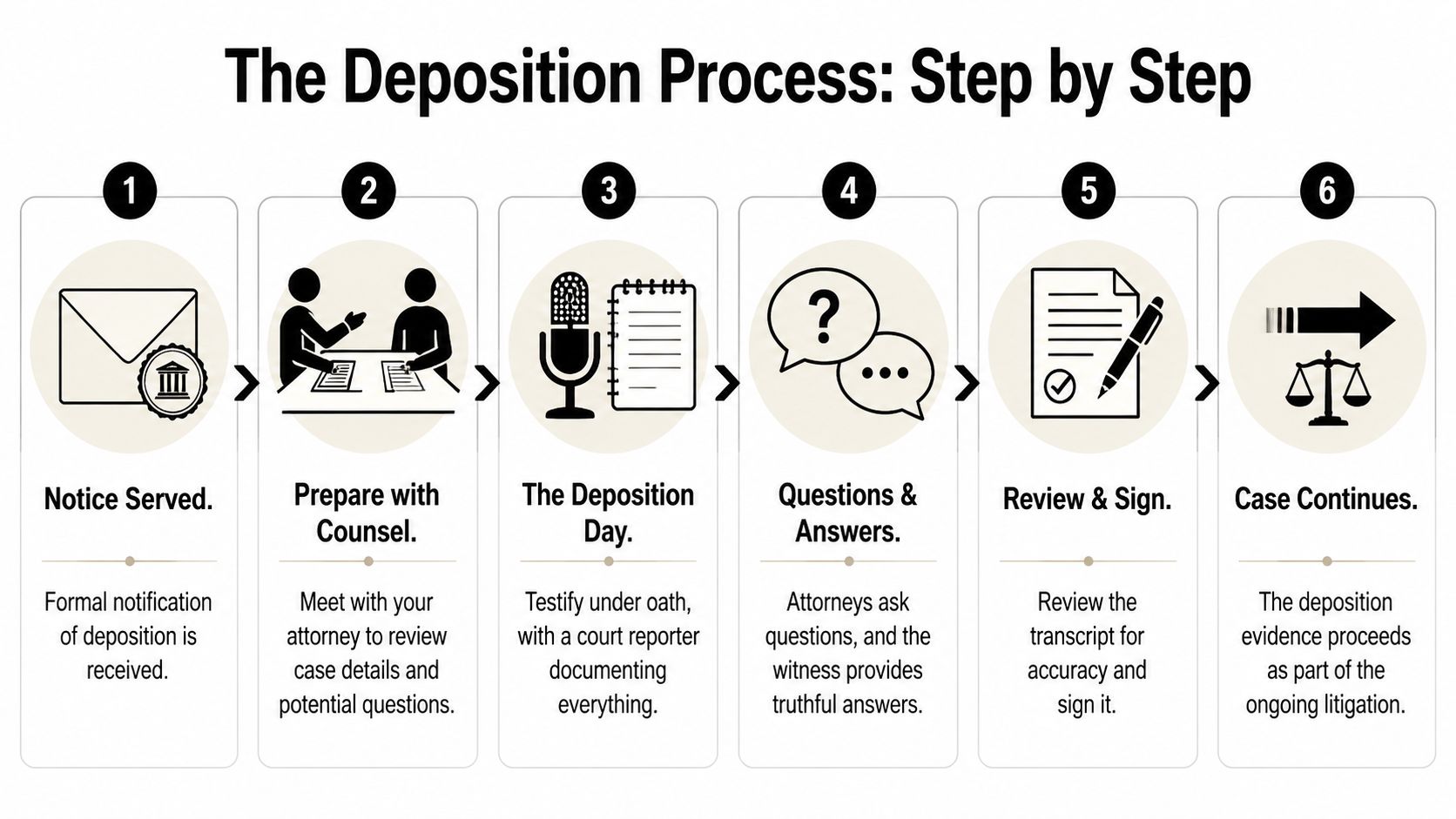
The day often starts with a knot in your stomach. You show up knowing you will be asked personal questions under oath, and if you are dealing with pain, headaches, memory gaps, or the aftereffects of a traumatic brain injury, that can feel especially heavy. It helps to know that a deposition follows a set sequence. Once you know the order of the day, the process usually feels less unpredictable.
How the day usually begins
First, you receive a formal notice with the date, time, and place of the deposition. Sometimes it also lists documents to bring.
Before the deposition, you meet with your attorney to prepare. That meeting matters for more than legal strategy. It gives you a chance to talk through weak spots, clear up confusion, and make a plan for fatigue, pain, or concentration problems. For clients with a TBI, this preparation is often as much about pacing and clarity as it is about facts.
When the deposition starts, the court reporter puts you under oath. The rule is simple. You must tell the truth, just as you would in a courtroom.
How the questions usually unfold
After the oath, the opposing lawyer begins asking questions. Some are open-ended, such as asking you to describe the crash in your own words. Others are narrow and detailed, such as where your vehicle was positioned, what you saw first, or what happened in the seconds before impact.
That shift can feel unsettling if you are not expecting it.
A deposition works a lot like a recorded interview with legal consequences. The attorney is listening to your overall account, but is also testing detail, sequence, and consistency. In a trucking case, the questions may turn technical. You might hear about braking, weather, vehicle placement, company procedures, or Hours-of-Service logs. Those topics are not asked to confuse you. They are part of how lawyers pin down facts.
If you have memory or processing problems, slow the pace. Ask for the question to be repeated. Answer only the question asked. If you do not know, say you do not know. If you do not remember, say you do not remember.
Those are honest answers.
What happens if there is an objection
Clients are often surprised when their lawyer objects and the questioning keeps going. That is normal in many depositions.
Here is the practical version:
- Some objections are made to preserve a legal issue for later.
- Many questions still must be answered after the objection.
- Your attorney may tell you not to answer if a question calls for privileged information or crosses a legal boundary.
- You can ask for clarification if a question is confusing, compound, or misleading.
- You can request a break if you are in pain, overwhelmed, or having trouble concentrating.
This part matters for injured clients who are trying hard to be cooperative. You do not need to answer quickly to be a good witness. Careful testimony is stronger testimony.
How long it can last
Under Federal Rule of Civil Procedure 30(d)(1), a deposition is generally limited to 7 hours in one day. That limit gives structure to the process and helps prevent questioning from becoming endless.
For someone managing chronic pain, dizziness, migraines, or cognitive fatigue, that boundary matters in a very real way. Even so, seven hours is a long day. Depositions include pauses, and your attorney can address reasonable needs for breaks or other accommodations. If your symptoms flare as the day goes on, speak up. Silence helps no one.
How the deposition ends
Once the questioning is finished, the court reporter prepares a transcript. That transcript is the official written record of everything said.
You may later have a chance to review it and note corrections on an errata sheet under rules such as FRCP 30(e). The correction process is for fixing reporting or transcription errors, not rewriting testimony because an answer came out awkwardly. That is an important distinction, especially for plaintiffs who leave the deposition replaying every answer in their head.
Many injured clients worry afterward that one imperfect phrase ruined the case. Usually, that fear is stronger than the actual situation. A deposition is not about sounding polished. It is about giving truthful testimony, with your limitations and symptoms described accurately.
A calmer way to view the process
A deposition is usually methodical, not theatrical. The lawyer asks. You listen. You answer truthfully. Your attorney watches for problems. The court reporter creates the record.
That structure helps more than people expect. When you know what is coming, the day becomes easier to handle, one question at a time.
How Deposition Testimony Is Used After the Fact
Once the deposition is over, many clients feel relief followed by a new question. What happens to all of that testimony now?
The answer is that the transcript becomes a working tool. Lawyers study it, compare it to records and other testimony, and use it to shape the next stage of the case.
Settlement pressure and negotiation leverage
A deposition can move settlement discussions in a very concrete way. If an injured plaintiff presents as careful, honest, and credible, that can increase pressure on the defense. If a defendant or company witness makes damaging admissions, that can have the same effect.
Insurance companies don't just evaluate medical bills and documents. They evaluate how the testimony will look if the case keeps moving. A solid deposition can make trial risk feel more real to the other side.
Motions and case-shaping arguments
Deposition testimony also appears in motions. Lawyers cite the transcript to support arguments about what facts are undisputed, what claims should continue, and what defenses don't hold up.
In practical terms, this means your deposition can help defeat a weak attack on your case or expose a factual gap in the defense's position. The transcript gives the court sworn language to work with instead of competing informal stories.
Trial use and impeachment
If a case goes to trial, a deposition transcript may be used in more than one way.
- If a witness becomes unavailable: Preserved testimony may be used because the sworn statement already exists.
- If someone changes their story: The prior deposition answer can be used to impeach them, meaning to show the jury that their testimony has shifted.
- If a detail is disputed: Lawyers may use the transcript to pin down exact wording rather than rely on memory.
This is one reason consistency matters so much. A deposition is not a rehearsal with no consequences. It is part of the evidence.
Your transcript becomes a measuring stick. Later testimony is often compared against it line by line.
The rule-backed seriousness of participation
The rules also give depositions force. Federal procedure generally limits them to 7 hours in a single day, which protects against abuse, and failing to appear for a properly noticed deposition can lead to severe consequences, including dismissal of a case for a plaintiff or default judgment against a defendant. The same source explains that over 95% of civil cases settle before trial, which is one reason parties take depositions seriously as part of the discovery process, according to U.S. Legal Support's guide to deposition rules and consequences.
That rule structure matters because it answers a common fear. A deposition is not just some optional meeting the other side scheduled to intimidate you. It is a formal part of litigation with legal consequences and strategic weight.
Why this matters emotionally, not just legally
Clients often assume the important part is getting through the day. That's understandable. But the larger importance is that the deposition keeps working after you've gone home.
It influences negotiations. It influences motion practice. It may influence trial. If your testimony is careful and truthful, it can support your case long after the deposition room is empty.
How to Prepare for Your Deposition as an Injured Client
The most common advice people hear is simple. Tell the truth.
That's correct, but it's not enough.
Injured clients need more than a moral instruction. They need a method. If you're in pain, overwhelmed, taking medication, grieving a death, or living with the effects of a traumatic brain injury, the challenge isn't honesty. The challenge is answering carefully under pressure.

Thoughtful preparation can make that pressure manageable. It can also become part of broader trial preparation in a personal injury case, since depositions often shape everything that follows.
Start with the right mental frame
A deposition is not a memory contest. It's not a performance review. It's not a trap you escape by sounding polished.
It's a sworn conversation where accuracy matters more than speed.
That means your job is to answer from your own knowledge, not to fill every silence or guess at every missing detail. If you don't know, say so. If you don't remember, say that. If a date or distance would be speculation, don't supply one just to be helpful.
Core habits that protect you
These habits sound simple, but they prevent many avoidable problems:
- Listen to the whole question: Don't start answering before the attorney finishes speaking.
- Pause before you respond: A short pause gives you time to think and gives your attorney time to object if needed.
- Answer only the question asked: If the lawyer asks what color the light was, don't volunteer what the other driver said later at the scene unless asked.
- Use plain language: You don't need legal phrases. Clear, ordinary speech is better.
- Don't guess: Estimated answers can become fixed testimony.
- Say when you don't remember: Honest uncertainty is better than confident inaccuracy.
One helpful habit: wait a beat, then answer in the shortest truthful way.
Special preparation for clients with traumatic brain injuries
Generic advice often fails in such situations. Clients with brain injuries may struggle with recall, concentration, fatigue, or word-finding. That doesn't make their testimony weak. It means preparation has to account for the injury itself.
According to this discussion of deposition preparation for brain-injured plaintiffs, 70% of moderate-to-severe TBI survivors face long-term memory issues, and a 2023 study found that mock deposition simulations improved testimony accuracy by 40% for brain-injured litigants.
That matters because defense lawyers may push pace, repetition, or detail in ways that expose cognitive strain. Good preparation for a TBI client should be trauma-informed and practical.
Consider asking your attorney about:
- Mock questioning sessions: Practice helps you experience the rhythm of deposition questions before the actual deposition.
- Shorter prep meetings: Concentration may be better in smaller sessions than in one long review.
- Symptom planning: Discuss headaches, fatigue, light sensitivity, word-finding issues, or memory limits ahead of time.
- Break strategy: Build in a plan for when you need to pause.
- Record review methods: Timelines, treatment summaries, and event sequencing can help refresh memory without encouraging guessing.
Here is a short video that can help reinforce the basics before your meeting with counsel.
Sample questions you may hear
The exact questions depend on the case, but many personal injury depositions cover similar territory.
About the crash or incident
- Where were you going that day?
- What do you remember before the collision?
- When did you first see the other vehicle?
- Did you hear braking, a horn, or impact noise?
- What happened immediately after the crash?
About your injuries and treatment
- What symptoms did you notice first?
- When did you first seek medical care?
- Which doctors or therapists have treated you?
- What treatment have you had so far?
- What symptoms are still affecting you today?
About daily life and losses
- How has the injury affected your work?
- What activities can you no longer do, or can only do with difficulty?
- How has your sleep changed?
- Has your mood, concentration, or memory changed since the incident?
- What does a typical difficult day look like now?
What to do the day before and the morning of
Preparation isn't only verbal. Physical and mental pacing matter too.
| Time | Helpful focus |
|---|---|
| The day before | Review key facts with counsel, gather medications or comfort items, and avoid cramming |
| The night before | Prioritize rest if possible and reduce extra stressors |
| The morning of | Eat if you're able, allow extra time, and arrive without rushing |
| During the deposition | Ask for clarification when needed and request breaks before fatigue overwhelms you |
A final reassurance
Many injured clients worry that emotion will hurt their case. Usually, what matters is whether you're truthful and understandable. If talking about the event makes you upset, that doesn't automatically damage your credibility. It may merely reflect what you've lived through.
The better goal isn't to appear untouched. It's to be steady, honest, and prepared enough that the facts come through clearly.
Colorado Deposition Rules and Your Next Steps
If your case is in Colorado, your deposition will usually be governed by the Colorado Rules of Civil Procedure, including the rules that address oral depositions and discovery practice. The exact mechanics can vary by court order, local practice, and the facts of your case, but the underlying structure is familiar. Notice is given, testimony is taken under oath, objections are made on the record, and the transcript becomes part of the case file.
For clients, the practical takeaway is reassuring. The process is rule-based. It is not improvised. There are limits on scope, standards for conduct, and procedures your attorney should know well.
What Colorado clients should keep in mind
A Colorado deposition in a motor vehicle, trucking, brain injury, or wrongful death case will still feel formal. But the same core truths apply:
- You don't need to memorize legal rules: Your attorney handles procedure.
- You do need to prepare carefully: Especially if your injury affects memory, stamina, or concentration.
- You should expect professionalism: The setting may be tense, but it is not supposed to be chaotic.
- Your words matter beyond that day: The transcript can influence settlement, motions, and trial strategy.
That last point is often the most important. Clients sometimes think the deposition is just one stressful appointment to survive. In reality, it's one of the moments when your case takes on sharper shape.
If you're feeling anxious, that's normal
Colorado clients dealing with crash injuries often arrive at this stage already carrying a lot. They may be juggling rehabilitation, family responsibilities, employment issues, transportation challenges, and calls from insurers. A deposition adds another demand at a time when life already feels unstable.
That doesn't mean you're unready. It means you need support and preparation that fit your actual condition.
The strongest deposition testimony usually comes from a person who understands the process, not from a person who tries to sound perfect.
Your next practical steps
If a deposition is coming up, these are the right next moves:
- Schedule dedicated prep time with your attorney
- Review the timeline of the incident and your treatment
- Flag any memory gaps, pain issues, or cognitive symptoms early
- Ask what documents or topics are likely to come up
- Make a plan for breaks, medications, transportation, and timing

A deposition is serious, but it doesn't have to stay mysterious. Once you understand what it is, why it happens, who will be there, and how to prepare, the process becomes more manageable. And when you're prepared in a way that respects both the law and your injury, you're in a far better position to protect your case.
If you've been hurt in a crash, are dealing with the effects of a traumatic brain injury, or are facing the stress of a wrongful death or trucking case, Nares Law Group LLC can help you understand what comes next. The firm offers compassionate, trial-tested guidance for injured people and families who need clarity, strong advocacy, and a path forward. Reach out for a free consultation if you want help preparing for a deposition and protecting your rights through every stage of the case.