Your hands tighten on the wheel. The car feels light, then wrong. You turn, but the front end keeps moving straight, or the rear starts to come around, and for a second it feels like the road has stopped listening.
That moment scares people because it happens fast. It also tricks people into doing exactly the wrong thing. They slam the brakes. They jerk the wheel. They stare at the ditch, the guardrail, or the car ahead.
What to do if your car skids is less about bravado and more about a few calm, correct inputs. The right reaction can keep a slide from becoming a crash. The right actions afterward can also protect your health and your legal rights if the skid led to an impact, a rollover, or symptoms that show up later.
That Heart-Stopping Moment Your Car Loses Grip
It often starts in a way that feels ordinary. You're on the highway before sunrise. The road looked wet, not icy. You change lanes, or ease into a curve, and suddenly the tires stop biting. The steering goes vague. The vehicle drifts wider than you intended. Panic shows up before thought does.
That reaction is human. It doesn't mean you're a bad driver. It means you've hit one of the most dangerous moments a driver can face on a winter road, especially in places where weather changes fast and elevation makes conditions unpredictable. Drivers in Colorado know that one stretch of pavement can be dry, and the next can be polished with ice. If you're driving in those conditions, these winter travel tips for handling icy roads are worth reviewing before the next storm.
The risk isn't theoretical. Skids are tied to about 22% of all vehicle crashes, or over 1.2 million incidents annually, linked to slippery road conditions, according to AAA's discussion of NHTSA skid data.
Practical rule: The first battle in a skid is against panic. If you stay smooth for the next few seconds, you give the tires a chance to work again.
Many drivers search for what to do if your car skids after a close call. Some are reading after a crash, with a sore neck, a pounding headache, or questions about what they should have done differently. Both situations matter. The seconds during the slide matter. So do the minutes after you stop, and the days after, when pain, confusion, and insurance pressure can set in.
The Moments That Matter Reacting During a Skid
The worst move in a skid is a sudden one. Tires only have so much grip. When you overload them with hard braking, sharp steering, or abrupt throttle, they give up even more traction.
Start with your eyes, then your hands
Look where you want the car to go. Not at the snowbank. Not at oncoming traffic. Not at the object you're afraid of hitting.
Your hands usually follow your eyes. If you lock onto the hazard, you often steer toward it without meaning to. If you look at the open lane or safe path, your steering correction gets cleaner and smaller.
Ease off the accelerator
In many skids, the first useful input is less pedal, not more. If the tires are already struggling for grip, asking them to keep accelerating only makes the slide harder to manage.
For an understeer skid, where the front tires lose grip and the vehicle keeps pushing forward instead of turning, lifting off the accelerator completely is the first step. According to CarParts.com's summary of the driving guidance, trained drivers recover from understeer on ice 92% of the time, compared with 65% for untrained drivers, and ABS-equipped vehicles boost that to 97%.
Know which skid you're in
Drivers often hear "steer into the skid" and apply it to everything. That's too simplistic. It helps in one type of slide, but not all of them.
| Skid type | What it feels like | What usually helps |
|---|---|---|
| Understeer | You turn the wheel, but the car keeps going straighter than you want | Ease off the gas. Reduce steering demand slightly. Let the front tires regain grip. |
| Oversteer | The rear of the car starts to swing out | Steer in the direction the rear is sliding. Stay smooth. Unwind the wheel as the car straightens. |
If the front end won't turn
Understeer feels like the car is plowing ahead. A common example is entering a snowy curve too fast and realizing the nose of the vehicle won't follow the wheel.
Do this:
- Come off the gas: Let the front tires stop fighting acceleration and cornering at the same time.
- Soften the steering input: If you've cranked in too much wheel, the front tires may just scrub and slide. A slight unwind can help them roll and grip again.
- Wait for traction to return: The urge to add more steering is strong. Resist it. More wheel doesn't help if the tires can't bite.
What doesn't work is trying to force the car around the corner. Tires can't turn if they aren't gripping.
After you've seen the mechanics once, it helps to watch the movement in real time:
If the rear end steps out
Oversteer feels different. The back of the car starts rotating, and you sense the vehicle trying to swap ends.
In that moment:
- Stay off sudden braking
- Turn the wheel in the direction the rear is sliding
- Straighten the wheel as the car comes back in line
If the rear slides right, steer right. If it slides left, steer left. The correction should be real, but not wild. Overcorrection can send the car snapping the other direction.
Smooth beats fast. Fast panic inputs often create the second skid that causes the crash.
Braking with ABS and without it
A lot of drivers still don't know how their braking system changes skid recovery.
If your car has ABS, press the brake firmly if you need to slow or stop, and keep pressure on it. The pulsing or vibration is the system working. Don't pump the brakes.
If your car doesn't have ABS, hard braking can lock the wheels and take away steering control. In a skid, that usually makes things worse. Ease off enough to let the tires rotate and regain grip.
What works versus what fails
A skid is a trade-off problem. Every input asks the tire to do something. Too much steering plus too much braking plus too much throttle is a losing equation on ice or wet pavement.
Here are the common failures:
- Slamming the brakes: This can worsen the loss of traction.
- Jerking the wheel: Sharp steering loads the tires too aggressively.
- Staring at the hazard: Your hands tend to follow your eyes.
- Trying to fix it all at once: One good correction works better than three panicked ones.
What usually works is simpler. Look up. Lift off. Steer smoothly. Let the tires recover.
Control Regained Your First Actions on the Road
When the car straightens out, many drivers make a second mistake. They act like the danger is over. It might not be. Traffic may be closing behind you. Your pulse is up. A tire may be damaged. You may be injured and not know it yet.
Settle the vehicle before making any big move
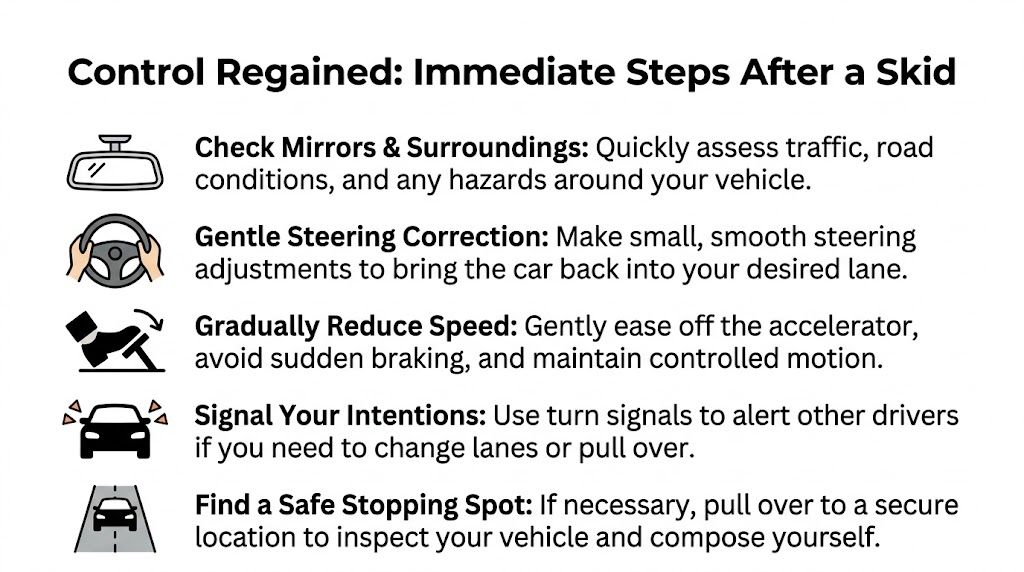
The first priority is controlled movement, not a dramatic exit to the shoulder. Keep both hands on the wheel. Reduce speed gradually. Signal if you need to move over. Then find a place where you can stop without creating a new hazard.
If another vehicle was involved, or if the skid turned into a collision, what you say in those first minutes matters. This guide on what to say to police after a car accident can help you avoid saying too much while still giving clear, useful information.
Use a simple roadside order
When adrenaline is high, a short checklist helps.
- Get visible: Turn on your hazard lights if you're stopped in a risky area or moving unusually slowly.
- Pick a safe spot: Shoulder, parking lot, frontage road, or any area away from moving traffic.
- Take a breath: A few slow breaths can keep you from jumping back into traffic too soon.
- Check passengers: Ask direct questions. "Are you hurt?" "Did you hit your head?" "Do you feel dizzy?"
- Assess the car: Look at tires, wheel position, body damage, leaking fluid, and whether the car tracks straight.
Decide whether the car should keep moving
A vehicle that still starts and rolls isn't always safe to drive. If a tire hit a curb, a wheel bent, or the steering feels off-center, don't assume it's fine. If airbags deployed, if you smell fluid or smoke, or if the car won't track properly, stop there and arrange help.
Pulling over isn't weakness. It's what keeps a near-miss from becoming a second incident.
A lot of people minimize what just happened. They tell themselves they got lucky, so they should just keep going. Sometimes that's true. Sometimes it's the reason they miss a concussion, ignore a neck injury, or drive a damaged vehicle back into traffic.
Preventing the Next Skid Proactive Driving and Maintenance
Most skid advice starts after the tires have already let go. That's late. The strongest safety decision happens before the slide ever starts.
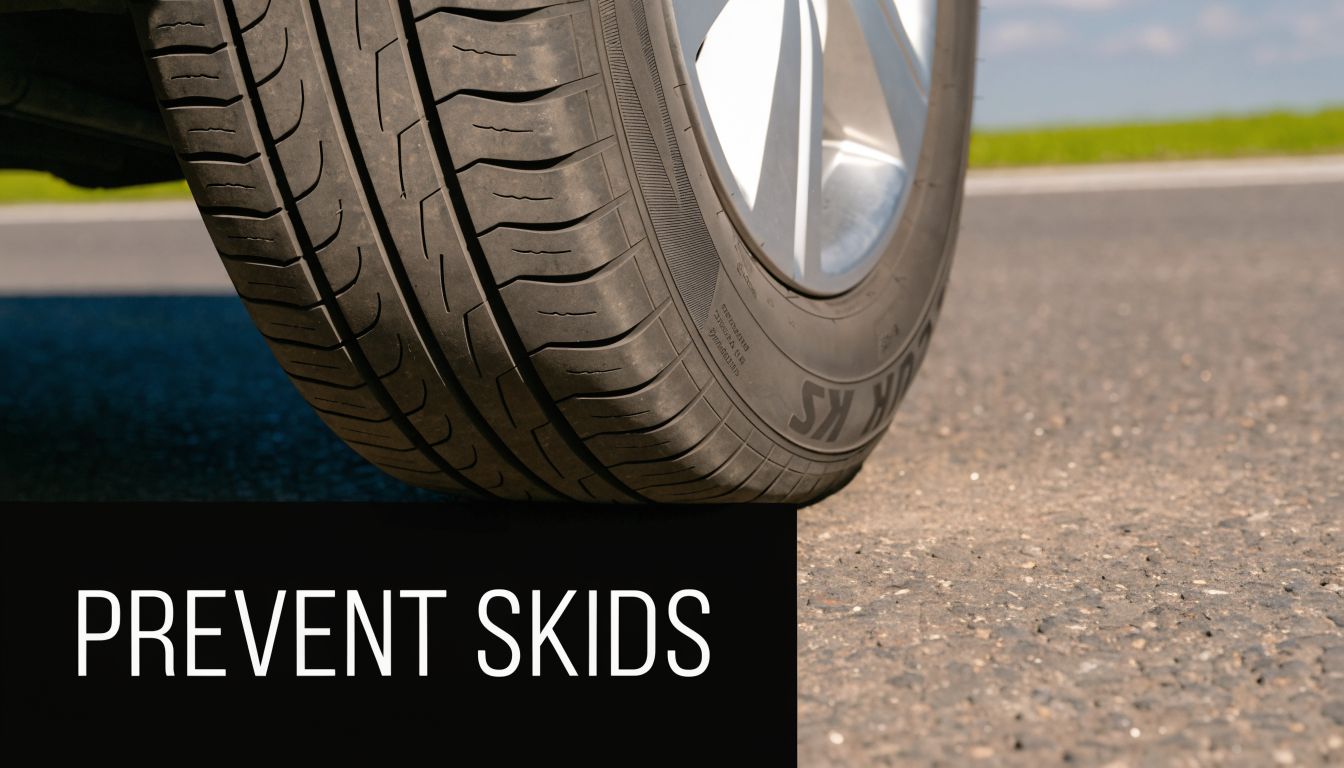
Tires decide more than drivers want to admit
People like to talk about all-wheel drive, traction control, or driver confidence. Tires still do the actual work of gripping the road. If they're worn, underinflated, or wrong for the season, you start every trip with less margin.
If you drive in snow country, tire maintenance isn't a side chore. It's a primary control measure. Issues tied to poor upkeep don't just affect skids. They can shape legal responsibility after a crash too, especially when a vehicle wasn't roadworthy. That's one reason inadequate vehicle maintenance matters far beyond the repair bill.
Slow down before the car forces you to
Drivers often skid because they were moving at a speed the road couldn't support, not because they were doing anything reckless in the ordinary sense. The posted limit may be legal in dry conditions and still be far too fast for sleet, slush, shaded curves, bridge decks, or packed snow.
Use these habits consistently:
- Brake early: Finish most of your slowing before the turn, hill, or merge.
- Leave more space: Extra following distance buys time for gentle inputs.
- Read the road: Dark glossy patches, shaded lanes, overpasses, and intersections deserve suspicion.
- Keep inputs small: Steering, throttle, and braking should all be gradual when grip is uncertain.
Prevention is a chain, not one trick
Skids rarely come from one cause. A slightly fast approach, tired tires, a wet painted line, and a quick steering correction can combine into one bad second.
A better routine looks like this:
| Habit | Why it matters |
|---|---|
| Check tires regularly | Good tread and proper inflation support grip and predictable handling |
| Adjust for conditions | Snow, ice, rain, and cold pavement reduce your margin for error |
| Drive smoothly | Small inputs keep the tires within their available traction |
| Respect transition zones | Bridges, ramps, mountain shade, and early morning roads often change first |
The strongest drivers aren't the ones who can "save" a dramatic slide. They're the ones who rarely put the car in that position.
After the Skid Protecting Your Health and Your Rights
A skid can end without visible vehicle damage and still leave real injuries behind. That is where many people get hurt twice. First by the event itself. Then by waiting too long to document what happened or get medical care.
Don't trust adrenaline to tell you the truth
After a skid, spin, or impact, people often say, "I'm okay." Sometimes they are. Sometimes they're running on shock.
Motor vehicle crashes are a leading cause of traumatic brain injuries, with the CDC reporting around 17,000 such injuries annually in the U.S. Overcorrection during a skid can lead to spins or rollovers, where rotational forces raise TBI risk, which is why this discussion of skid-related injury risks stresses prompt medical evaluation and legal consultation.
That matters because brain injuries don't always announce themselves dramatically. A person may feel foggy, nauseated, dizzy, unusually tired, sensitive to light, or just "off." Neck pain, back pain, headache, shoulder pain, and hand numbness can also arrive later.
Get checked, even if the crash seems minor
You don't need to be bleeding or unconscious to need care. If your body was whipped, rotated, or struck, a same-day evaluation creates two things that matter. Medical protection and a clear record.
Seek medical attention promptly if you notice:
- Head symptoms: Headache, dizziness, confusion, blurred vision, nausea, memory gaps
- Neck and spine symptoms: Stiffness, shooting pain, reduced range of motion, tingling
- Behavior changes: Irritability, unusual fatigue, trouble concentrating, feeling slowed down
- Delayed pain: Soreness that worsens after the adrenaline fades
If you hit your head, lost awareness, or can't remember parts of the event, treat that as a medical issue first and an insurance issue second.
Preserve the evidence while it's fresh
If you're physically able, document the scene before weather, traffic, or towing erase the details. In skid cases, road condition evidence can matter a lot. Ice melts. Slush gets pushed aside. A dangerous patch that was obvious in the moment can disappear quickly.
Capture what you can:
- Wide shots of the area: Lane position, curve, intersection, shoulder, guardrails, traffic controls
- Close photos of the road: Ice, slush, standing water, packed snow, debris
- Vehicle images: All sides, wheel position, tires, interior damage, deployed airbags
- Visible injuries: Bruising, cuts, swelling, seat belt marks
- Context notes: Time, weather, lighting, direction of travel, what you felt in the car
If there were witnesses, get names and contact details. If police responded, get the report information. Keep towing, medical, repair, rental, and pharmacy records together.
Be careful with early insurance statements
It's common to report the event, often under the impression that it's the only thing to do. Reporting matters. So does restraint. In the first day or two, you may not know the full extent of your injuries or vehicle damage.
A safer approach is to stick to facts:
- State what happened clearly: Road condition, direction of travel, skid, impact, and where the vehicle came to rest
- Avoid guessing: Don't speculate about speed, fault, or injuries you haven't had evaluated
- Don't minimize symptoms: "I'm fine" can come back to haunt you if symptoms appear later
- Keep your records: Save claim numbers, emails, photos, and adjuster communications
Know when legal help becomes necessary
Not every skid requires an attorney. Some do, and waiting can make things harder.
Consider legal guidance if any of these apply:
| Situation | Why it matters |
|---|---|
| You have injuries | Medical bills, treatment coordination, and lost income can grow fast |
| A rollover or spin occurred | These events raise the risk of serious injury, especially head and spine trauma |
| Liability is disputed | Bad weather doesn't automatically end the fault analysis |
| An insurer questions your injuries | Delayed symptoms are common, but insurers may still challenge them |
| A commercial vehicle was involved | Evidence can disappear quickly, and the stakes are often higher |
The legal side of a skid case is often about proof. Proof of conditions. Proof of injury. Proof that your symptoms began with this event, even if they worsened over time. Good records give that proof shape.
People often focus on surviving the slide itself. That's only the first half of the problem. The second half is making sure a frightening roadside event doesn't become a medical and financial mess because no one documented it, treated it, or took it seriously.
Conclusion A Path Forward After a Skid
A skid feels chaotic, but your response doesn't have to be. When the tires lose grip, the basics matter most. Look where you want to go. Ease off the inputs that are making the slide worse. Use smooth steering. Let the vehicle regain traction instead of forcing it.
After control returns, slow the situation down. Pull over safely. Check yourself and your passengers. Make an honest decision about whether the car and the people in it are okay.
Then protect what comes next. Prevention starts with tires, speed, and smooth habits. Recovery after an incident means medical attention when symptoms show up, careful documentation, and caution with insurance communications.
That's the effective path forward after a skid. React. Secure. Protect. If you know what to do if your car skids, you give yourself a better chance not only to avoid a crash, but to handle the aftermath with clarity if one happens.
If a skid led to a crash, injury, or confusing insurance questions, Nares Law Group LLC can help you understand your options. The firm represents injured people in Colorado motor vehicle cases, including traumatic brain injury claims, and offers free consultations for families who need clear guidance after a frightening event on the road.