A lot of people reach this question in the same moment. The crash was serious. The injuries are real. The medical care keeps growing, the income loss is mounting, and then someone says the at-fault driver or trucking company only has a policy that won't come close to covering what happened.
That's where people start to feel trapped.
If you're dealing with a catastrophic car or truck wreck, the first insurance policy you hear about usually isn't the whole story. In severe injury cases, there may be another layer above the basic policy. That layer is often excess liability insurance, and finding it can make the difference between a limited recovery and a claim that fully reflects the harm done.
When a Car Crash Exceeds Insurance Limits
A highway crash can change a family's finances in a day. One violent impact leads to surgery, rehabilitation, time away from work, and uncertainty about whether life will ever look the same again. Then the insurance adjuster starts talking about “limits,” as if your losses should somehow shrink to fit the policy.
They don't.
In major injury cases, especially truck crashes and high-speed collisions, the primary liability policy may be only the first layer. That's one reason the excess liability insurance market keeps growing. One market study says the global market grew from USD 15.89 billion in 2025 to USD 17.05 billion in 2026, reflecting sustained demand for higher limits as large claims, litigation costs, and layered insurance structures expand, according to this excess liability insurance market report.
What this looks like in real life
A driver gets hit by a commercial vehicle on the interstate. The injuries include a brain injury, orthopedic trauma, and months of follow-up care. The trucking company's basic policy is identified early, and everyone involved realizes the same thing. That policy may pay something, but it may not be enough.
That's when lawyers start asking better questions.
Not just, “What's the policy limit?” but “What other policies sit above it?” and “Who else in the transportation chain may have liability coverage?” If you're already sorting through your own coverage, this guide on understanding uninsured driver situations in the UK is also useful because it shows how quickly compensation issues become more complex when the obvious policy isn't enough.
The problem is often bigger than one policy
Many injured people also need to evaluate their own protection while the claim against the at-fault party develops. If that issue applies to you, it helps to understand a Colorado underinsured motorist claim and how your own policy may fit into the larger recovery picture.
Practical rule: In a catastrophic crash case, never assume the first declarations page is the full insurance picture.
Excess liability insurance matters because severe cases often outgrow the first available layer. When that happens, the legal work shifts from proving fault to identifying every source of coverage that could pay for care, lost earnings, and the long aftermath of a life-changing injury.
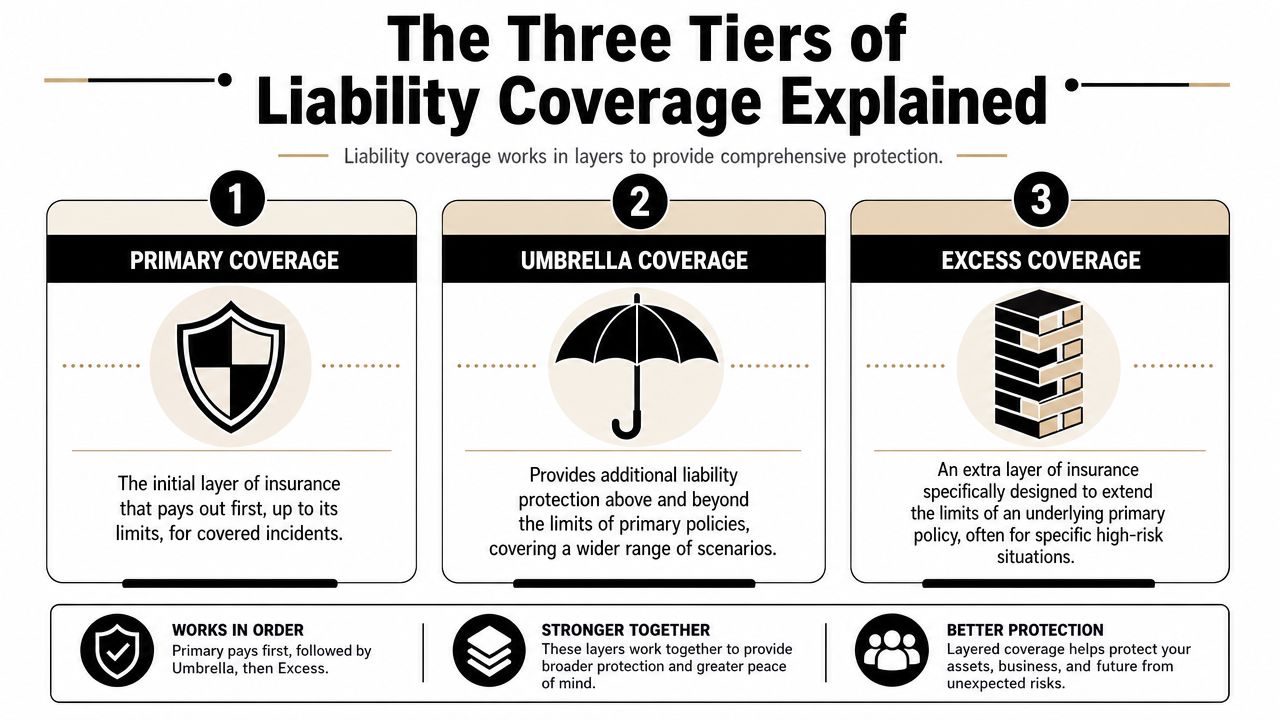
The Three Tiers of Liability Coverage Explained
A serious injury claim can involve more than one insurance layer, and each layer has a different job. For an injured person, that distinction affects how much money may be available for surgery, future care, lost income, and the long recovery that follows a major crash.
A clear way to understand the layers
Primary coverage is the first policy in line. In a car or truck case, it is usually the driver's or company's main liability policy, the policy that responds first if the claim is covered.
Umbrella coverage sits above one or more underlying policies. It often provides extra limits, and in some situations it can cover losses more broadly than the underlying policy language.
Excess coverage also sits above an underlying policy, but it is usually more tied to that policy's terms. It commonly adds another layer of dollars without adding new types of protection.
A good way to picture it is a stack of buckets catching the same leak. The first bucket fills first. If the loss is larger, the next bucket matters. But an excess bucket usually has to be placed over the right bucket below it. If it is attached to a different policy, or if the underlying requirements were not met, the injured person may face a coverage fight instead of a straightforward payment.
One phrase matters here: follow-form. In many claims, a follow-form excess policy tracks the same basic coverage terms, exclusions, and conditions as the underlying policy it sits over. The International Risk Management Institute explains that follow-form excess liability generally incorporates the provisions of the underlying policy except where the excess policy says otherwise, which is the key reason lawyers ask for both policies, not just the declarations page, in a discussion of follow form excess liability.
Primary vs. Umbrella vs. Excess Insurance
| Coverage Type | Role | Scope of Coverage | When It Applies |
|---|---|---|---|
| Primary | First line of payment | Covers the claim if it fits the policy | Applies first |
| Umbrella | Additional protection above underlying policies | May extend beyond underlying coverage in some situations | Applies after underlying limits or under umbrella terms |
| Excess | Added limit over a scheduled underlying policy | Usually follows the underlying policy rather than broadening it | Applies only after the listed underlying policy is exhausted |
Excess coverage is extra limit connected to specific underlying insurance, not a general pool of money available for any large claim.
Why this difference matters in an injury case
This issue comes up often in severe wrecks, especially in commercial cases. If you are dealing with a trucking collision, a lawyer handling an 18-wheeler accident claim will usually want the full policy stack early, because the label on the policy does not answer the critical question. The crucial question is whether that policy responds to this loss.
That is where injured people and their attorneys can get tripped up. A defense lawyer may mention an excess policy, but the useful follow-up questions are more specific. What underlying policy is scheduled? Does the excess form follow the same terms? Was the required underlying insurance in force? Is the type of loss in your case covered under the underlying form in the first place?
Those details affect recovery in a very practical way. An excess layer may provide substantial additional funds, or it may not apply at all if the policy structure does not line up with the crash, the insured party, and the underlying coverage. For a catastrophically injured person, that difference can shape the entire path of the claim.
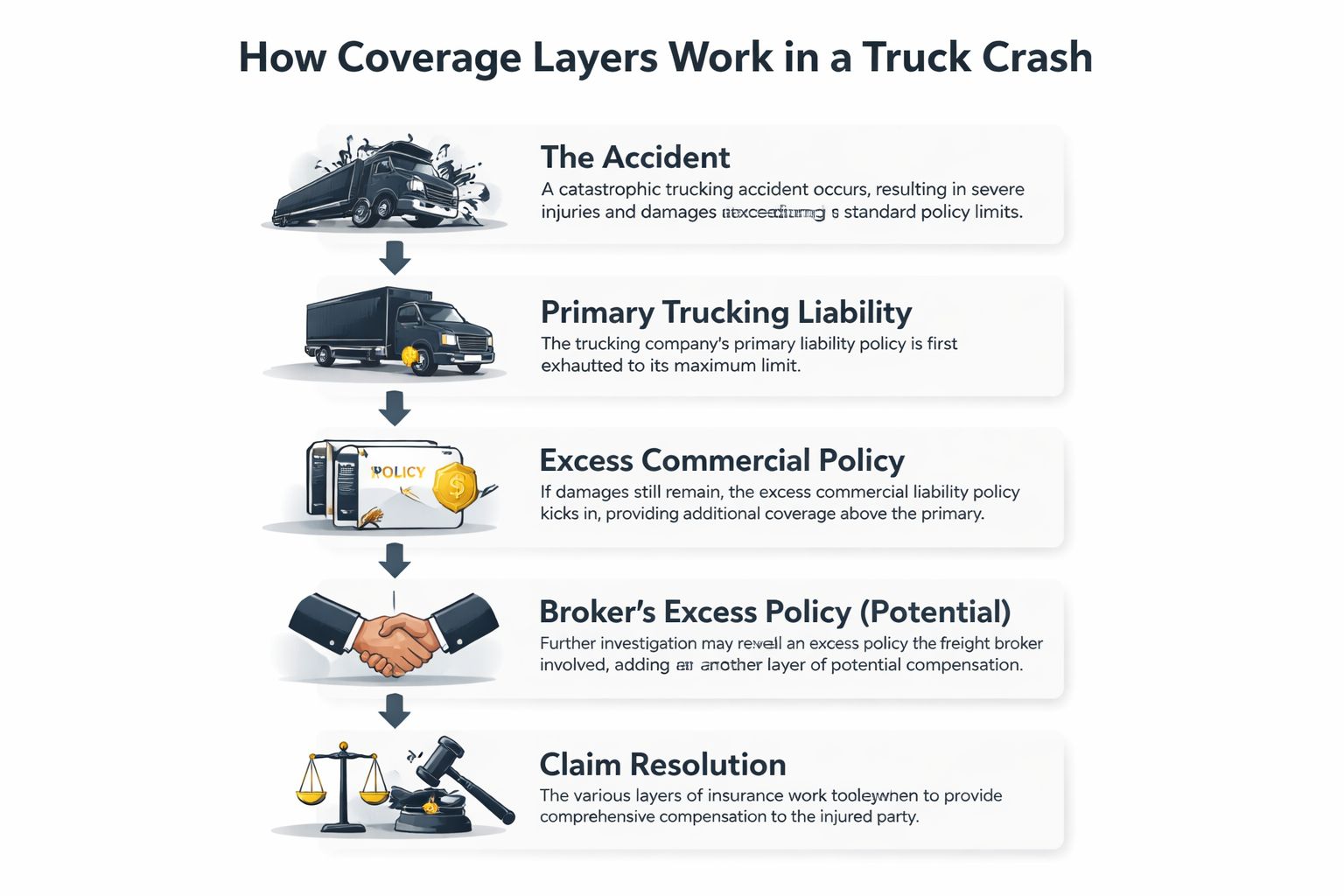
How Coverage Layers Work in a Truck Crash
A serious truck crash can create losses that outrun the first insurance policy long before the injured person understands how many policies may exist. That is why lawyers in catastrophic trucking cases trace the coverage stack early, the same way a contractor checks each floor of a building before deciding how much weight it can hold.
A step-by-step crash example
A tractor-trailer rear-ends a family vehicle on a Colorado highway. One occupant suffers a traumatic brain injury. Another has multiple fractures and faces a long recovery. The trucking company carries a primary commercial auto policy with a $1 million per-occurrence limit.
At first, that number may sound large. Then the true cost of the harm starts to come into focus. Surgeries, rehabilitation, lost income, future treatment, home modifications, and long-term care can push the claim far past the first layer of insurance.
Here is how the layering works in plain terms. The primary policy pays first, up to its limit. If the claim value and covered damages go beyond that amount, the excess policy may begin paying the portion above the primary limit, subject to its own terms and any conditions tied to the underlying policy.
That means the excess layer does not step in just because the injuries are severe. It steps in after the underlying layer has been paid out or otherwise exhausted in the way the policy requires.
A federal guide for motor carriers explains the basic structure of primary and excess liability coverage in commercial trucking through the FMCSA insurance filing forms overview. In practice, the same idea applies to a lawsuit after a wreck. One layer sits on top of another, and each layer has to be examined in order.
Where lawyers look after the primary policy
In a major truck case, the first declarations page is often only the starting point.
An attorney may investigate several paths at once:
- The motor carrier's excess or umbrella liability policies
- A separate policy carried by the trailer owner, broker, shipper, or another company involved in the trip
- Additional insured endorsements created by transportation contracts
- Leased vehicle agreements and indemnity provisions that point to another insurer
- Whether the crash involved multiple covered vehicles, drivers, or insured entities under related policies
For an injured person, this work matters because severe trucking injuries often leave a gap between the harm done and the first policy's limit. A lawyer handling a serious 18-wheeler accident claim will usually treat insurance investigation as part of case investigation, not as an afterthought.
That approach matters for recovery. If counsel stops at the primary policy, a family may be told there is not enough insurance when more coverage exists higher in the stack or with another responsible company.
In a catastrophic trucking case, coverage analysis helps answer a practical question: where can the money come from to pay for the care, income loss, and long-term support this injury will require?
For injured families, coverage layers are not an insurance theory problem. They are the map to whether a life-changing injury will be met with token funds or with insurance that more closely matches the scale of the loss.
Why Excess Coverage Transforms Your Injury Claim
When a case has only a small primary policy, the fight often becomes cramped and defensive. The insurer knows the available money is limited. The conversation shifts toward rationing, not accountability.
Excess coverage changes that.

It changes the negotiating landscape
An excess policy doesn't guarantee fairness. But it can change the posture of the case in an important way. Instead of negotiating in the shadow of an obviously inadequate primary policy, the parties are dealing with a broader pool of indemnity for catastrophic harm.
That matters most when the injury has long-term consequences. Lifelong care needs, reduced earning ability, cognitive changes after brain trauma, and major pain-related limitations don't disappear just because the first policy is small. If excess coverage exists, there may be a realistic path to compensation that reflects the actual scale of the loss.
Why insurers care so much about these layers now
Insurers have been responding to severe verdict trends in the liability market. One industry analysis reported 135 nuclear verdicts in 2024, up 52% from 2023, with total case value reaching USD 31.3 billion, according to this industry guide on excess liability insurance.
That matters for plaintiffs because it explains why excess layers have become so central in large-loss cases. Insurers know a serious crash can move far beyond a standard limit. They also know policy wording, attachment points, and defense strategy can decide whether the higher layer comes into play.
What this means for your recovery
If excess coverage is available, your claim may be able to account for losses that otherwise get squeezed out of the discussion:
- Future medical care when treatment won't end with the first round of bills.
- Lost earning capacity if the injury changes your ability to return to the same work.
- Human damages such as pain, disability, and loss of normal life that often become central in catastrophic cases.
- Wrongful death damages when a family's financial and emotional losses extend far beyond immediate expenses.
Case reality: The existence of excess liability insurance often determines whether a catastrophic injury claim is treated like a bookkeeping problem or a full accountability case.
For an injured person, that distinction is everything. It can mean access to treatment, stability for a family, and enough financial support to rebuild around permanent harm instead of being forced to absorb it alone.
How to Find Hidden Insurance After an Accident
Insurance isn't usually handed over in full at the start of a case. In serious crashes, finding every applicable policy takes deliberate legal work. That's especially true in trucking, fleet, and commercial cases, where the liable party may have layered coverage, contractual relationships, and multiple insurers.

Why commercial vehicle cases deserve extra scrutiny
Some categories of defendants are more likely to buy higher layers. An insurance marketplace explains that insurers price excess layers based on risk profile, and classes such as automobiles and trucking attract higher premiums but are also more likely to carry excess coverage to protect against a single catastrophic judgment that could threaten solvency, according to this commercial excess liability overview.
That means a major truck or fleet crash should prompt an immediate coverage investigation. If the exposure is large, there may be more than one layer to find.
A practical roadmap for uncovering coverage
In Colorado litigation, attorneys typically use formal discovery tools and early case investigation together. The goal isn't just to ask whether insurance exists. It's to force disclosure of the policies that matter and the documents that prove how those policies connect.
Here are the core steps:
Send preservation demands early
A spoliation letter can demand preservation of insurance documents, contracts, broker communications, trip records, and electronically stored information. In trucking cases, early preservation matters because records can disappear, systems can overwrite data, and witnesses can scatter.Demand the full policy, not just the declarations page
A declarations page is useful, but it's not enough. You need the endorsements, schedules, exclusions, and underlying insurance references. In excess cases, the schedule of underlying insurance can be the most important page in the file.Use targeted written discovery
Good interrogatories and requests for production should ask for every liability policy, every excess or umbrella layer, every renewal in effect on the date of loss, and every contract that required one party to carry insurance for another.Look beyond the obvious defendant
In a trucking claim, the driver and motor carrier may not be the only insureds with relevant coverage. Brokers, contractors, vehicle owners, and other entities may have their own policies or may appear in indemnity agreements.Match the policy to the accident facts
Don't stop at finding a policy number. Confirm whether the vehicle, the driver, the trip, and the alleged conduct fit the coverage grant.
Documents that often matter most
Some of the most useful records include:
- Declarations pages showing the policy period and limit structure
- Schedules of underlying insurance identifying what the excess layer sits over
- Endorsements that modify who is insured or what risks are covered
- Broker communications that may reveal placement details
- Service contracts and transportation agreements that allocate insurance obligations
If you're trying to understand how a higher layer may apply above a basic policy, this explanation of umbrella policy coverage is a helpful companion because it shows why the wording and structure matter as much as the limit itself.
Don't assume “no additional insurance” means none exists. Sometimes it means no one has asked the right questions yet, or asked for the right documents.
Why timing matters
The worst time to investigate excess liability insurance is late in the case. By then, positions harden, deadlines tighten, and settlement opportunities may have already been shaped by incomplete information.
For injured clients, this part often feels invisible because it happens in letters, disclosures, subpoenas, and document review. But it's some of the most important work in a catastrophic claim. The money that pays for future care is often found in the policy layer that wasn't obvious at the beginning.
Common Gaps and Misconceptions to Avoid
The biggest misunderstanding is thinking excess liability insurance automatically pays once the at-fault driver's basic policy runs out. Sometimes it does. Sometimes it doesn't. The answer depends on the policy structure, the underlying coverage, and the order in which other benefits apply.
Your own UIM coverage may come first
This surprises many injured people. In a serious crash, your own underinsured motorist coverage may pay before the at-fault party's excess layer responds. Chubb makes that point clearly in this explanation of why excess liability coverage is important.
That means your lawyer may need to pursue two parallel tracks at once. One is the liability case against the negligent driver or company. The other is a claim under your own policy.
A higher layer on the at-fault side doesn't always move to the front of the line. Policy order matters.
Excess isn't a blank check
Even when an excess policy exists, several problems can block recovery:
- The wrong underlying policy is scheduled and the loss doesn't attach the way everyone assumed.
- The primary policy wasn't maintained properly, which can create a gap.
- The loss falls outside the underlying terms because excess usually follows form rather than broadens it.
- Defense arguments focus on exclusions or wording differences that seem minor until a large claim reaches the excess layer.
“More insurance” can still leave real holes
Clients often hear that there is “another policy above the first one” and understandably feel relieved. But layered insurance is conditional by design. If the policy stack is mismatched, exhausted in an unexpected way, or tied to the wrong underlying form, there can still be uncovered loss.
That's why experienced lawyers read the full policy language instead of relying on summary descriptions. In catastrophic cases, one overlooked endorsement can matter as much as the limit itself.
Securing Your Future After a Catastrophic Injury
After a devastating crash, excess liability insurance can sound like a technical detail. It isn't. It may be the part of the case that determines whether compensation stops at an inadequate primary limit or extends far enough to address the actual damage.
The key ideas are straightforward. Primary insurance pays first. Excess liability insurance may provide another layer above it. That layer usually follows the underlying policy, which means the wording, schedule, and attachment point all matter. In truck and severe auto cases, finding those layers takes active investigation, not assumptions.
For injured people, this issue is about more than insurance mechanics. It's about whether future treatment gets funded, whether lost earning power is recognized, and whether a family has room to rebuild after a life-changing injury.
If you suspect the policy first disclosed in your case isn't the whole picture, you're probably asking the right question. The next step is making sure someone has the experience and persistence to find the answer.
If you or your family is dealing with a catastrophic car or truck crash, Nares Law Group LLC can help evaluate all available insurance coverage, investigate excess and umbrella layers, and fight for the full compensation your case deserves.