A lot of people learn they have an underinsured motorist problem at the worst possible moment. The crash has already happened. The ambulance bill is on the way. Work has been missed. Then someone tells them the driver who caused all of this carried insurance, but not enough to cover what the collision cost.
That feels backwards, and it is. You expect the at-fault driver's insurance to solve the financial part of the case. Instead, you find out there's a second insurance fight ahead of you, this time with your own carrier. If you're in Colorado, that issue deserves immediate attention because underinsurance is not some rare edge case here.
The Unexpected Bill After the Crash
The first wave after a crash is usually physical. Pain, appointments, medication, sleep problems, transportation problems, and a dozen interruptions to ordinary life. The second wave is financial. That's where many people first hear the phrase underinsured motorist claim.
A common sequence looks like this. You get rear-ended or hit in an intersection. The other driver admits fault, or the police report points clearly in that direction. At first, that brings some relief. Then your injuries turn out to be more serious than you hoped. Imaging leads to more treatment. Time off work keeps growing. The other driver's insurance company finally discloses the liability limits, and the amount available doesn't come close to matching the harm.
That gap is exactly why UIM coverage exists.
When “insured” still isn't enough
Many injured drivers assume the problem is only uninsured motorists. In practice, a lot of people are hit by drivers who are technically insured but functionally unable to pay for the damage they caused because their policy limits are too low for a serious injury claim.
You can do everything right after a crash and still face unpaid losses if the at-fault driver bought minimal coverage.
That problem has become more common. According to the Insurance Research Council, UIM claim frequency reached 0.17 claims per 100 insured vehicles in 2023, and its growth since 2020 has been double that of bodily injury claim frequency in this industry summary of uninsured and underinsured trends.
What this means for you right now
If you're reading this while bills are piling up, the important point is simple. A UIM claim is not a side issue. It may be the only realistic path to recovering the part of your losses that the at-fault driver's insurance can't cover.
That includes more than the obvious invoices sitting on your kitchen table. In a serious case, the pressure often comes from a combination of losses:
- Medical treatment: Emergency care, follow-up visits, therapy, specialists, prescriptions, and future care.
- Lost income: Missed work, reduced hours, lost opportunities, and disrupted self-employment income.
- Human impact: Pain, limitations, interrupted routines, and the strain injuries put on a family.
If that sounds like your situation, you're not overreacting. You're dealing with the exact problem UIM coverage was designed to address.
Understanding Your UIM Safety Net
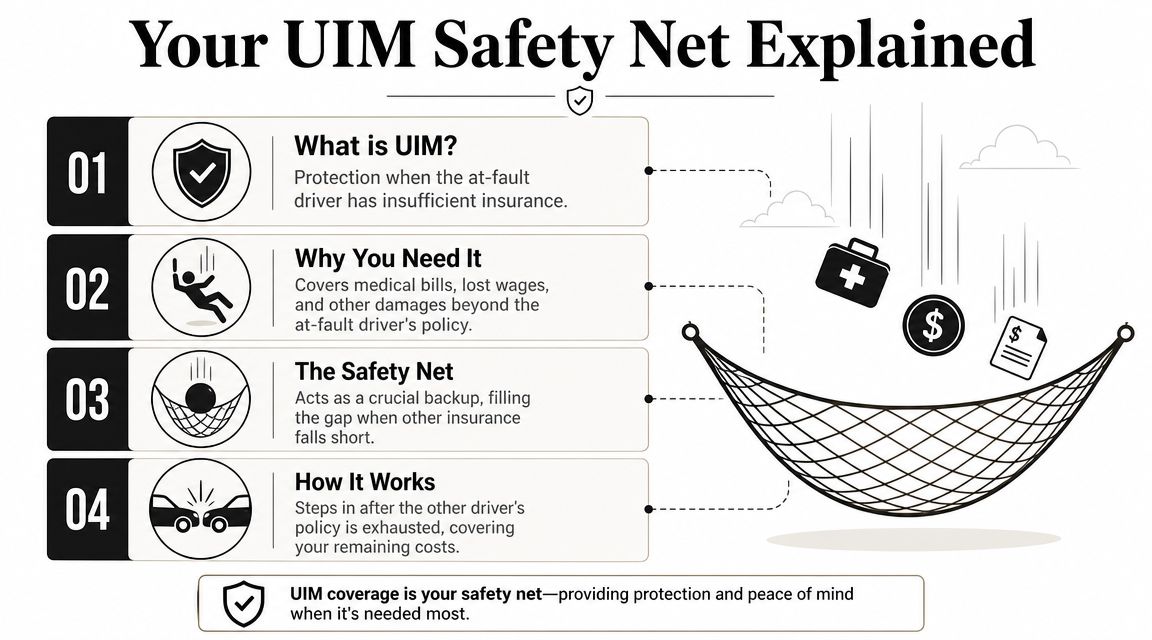
Think of underinsured motorist coverage as a safety net under the at-fault driver's policy. If the other driver's insurance falls short, your UIM coverage may catch the remaining loss, up to your policy limits and subject to Colorado law and your policy language.
What UIM actually does
The clearest way to understand it is this. Standard UIM coverage is a gap-filling mechanism. If your damages exceed the at-fault driver's coverage, you can recover the excess amount up to your own UIM policy limit. The insurer pays only the uncompensated portion of damages after the other policy is exhausted, as explained by Maryland's insurance regulator in its UIM coverage guide.
That “gap-filling” language matters because many people assume their own carrier adds another full layer of money on top of the at-fault driver's payment. Sometimes policy language and state law create more complicated outcomes. The first question is always what your policy says, and the second is how Colorado applies it.
UIM and UM are not the same thing
People often use UM and UIM as if they mean the same thing. They don't.
| Scenario | Uninsured Motorist (UM) Coverage | Underinsured Motorist (UIM) Coverage |
|---|---|---|
| The at-fault driver has no applicable bodily injury coverage | May apply | Usually not the main issue |
| The at-fault driver has coverage, but the limits are too low | Usually not the main issue | May apply |
| You make the claim under your own policy | Yes | Yes |
| The core problem | No insurance available from the other driver | Not enough insurance available from the other driver |
Here's the practical distinction. UM deals with absence. UIM deals with inadequacy.
The most important misunderstanding
A UIM claim is still an injury claim. Your carrier doesn't just ask whether the other driver had low limits. It looks closely at fault, medical causation, treatment, wage loss, and how much of your damages sit above the other driver's policy.
That means the file has to prove two things at once:
- The at-fault driver caused the crash
- Your damages exceed the amount available from that driver's policy
Practical rule: Don't think of a UIM claim as “extra paperwork.” Think of it as a second liability and damages presentation built on the same crash.
If you want another plain-English look at what this process feels like from the claimant's side, this guide on recovering from an underinsured driver is a useful companion read.
Colorado UIM Rules You Must Know
Colorado drivers need to pay closer attention to UIM than drivers in many other states. The reason is simple. The underinsured driver problem is unusually severe here.
According to the Insurance Research Council, Colorado had the highest estimated rate of underinsured drivers in the nation in 2022, at 40.9%, compared to the national average of 15.7%, as reported in this IRC release on rising underinsured-driver rates.
Start with your declarations page
Before anyone can evaluate a Colorado underinsured motorist claim, they need the policy declarations page. That page usually shows the bodily injury liability limits you purchased and the UM/UIM limits that may apply.
You should also understand the underlying liability framework for Colorado drivers. A plain-language overview of those baseline requirements is available in this summary of Colorado car insurance requirements. In real cases, low liability limits are often the reason UIM becomes necessary so quickly.
Mandatory offer, stacking, and offsets
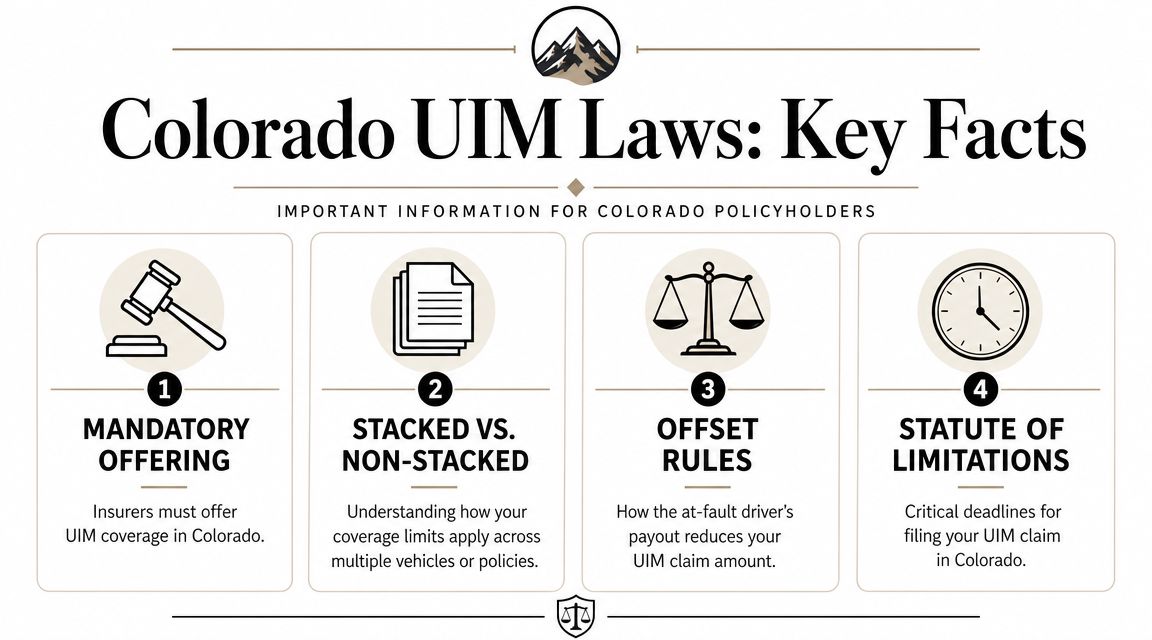
Colorado is important for another reason. Insurers must offer UM/UIM coverage, but policyholders can reject it. Many people don't realize what they selected years earlier until after a collision.
Stacking is another issue that can change the value of a case. In plain terms, “stacking” asks whether multiple coverages can be combined across vehicles or policies. The answer depends on the policy language and the facts. It is not something to assume either way from memory or from what a call-center representative says over the phone.
Offset rules matter too. In a UIM setting, the amount paid from the at-fault driver's policy can affect what remains available under your own coverage. That sounds technical, but its practical effect is straightforward. The math of the policy can become just as important as the medicine.
Deadlines matter more than people think
Colorado UIM claims also come with timing issues. There may be statutory deadlines, policy notice requirements, and consent issues that have to be handled correctly before the underlying liability case is wrapped up.
That is why a Colorado UIM case should never be treated like an ordinary property damage claim. It is a coverage case, a liability case, and a damages case all at once.
How to File Your Colorado UIM Claim
The hardest part for most injured people is not understanding the basic concept. It's knowing what to do next, and in what order. A Colorado underinsured motorist claim is procedural. Sequence matters.
A simple visual helps:
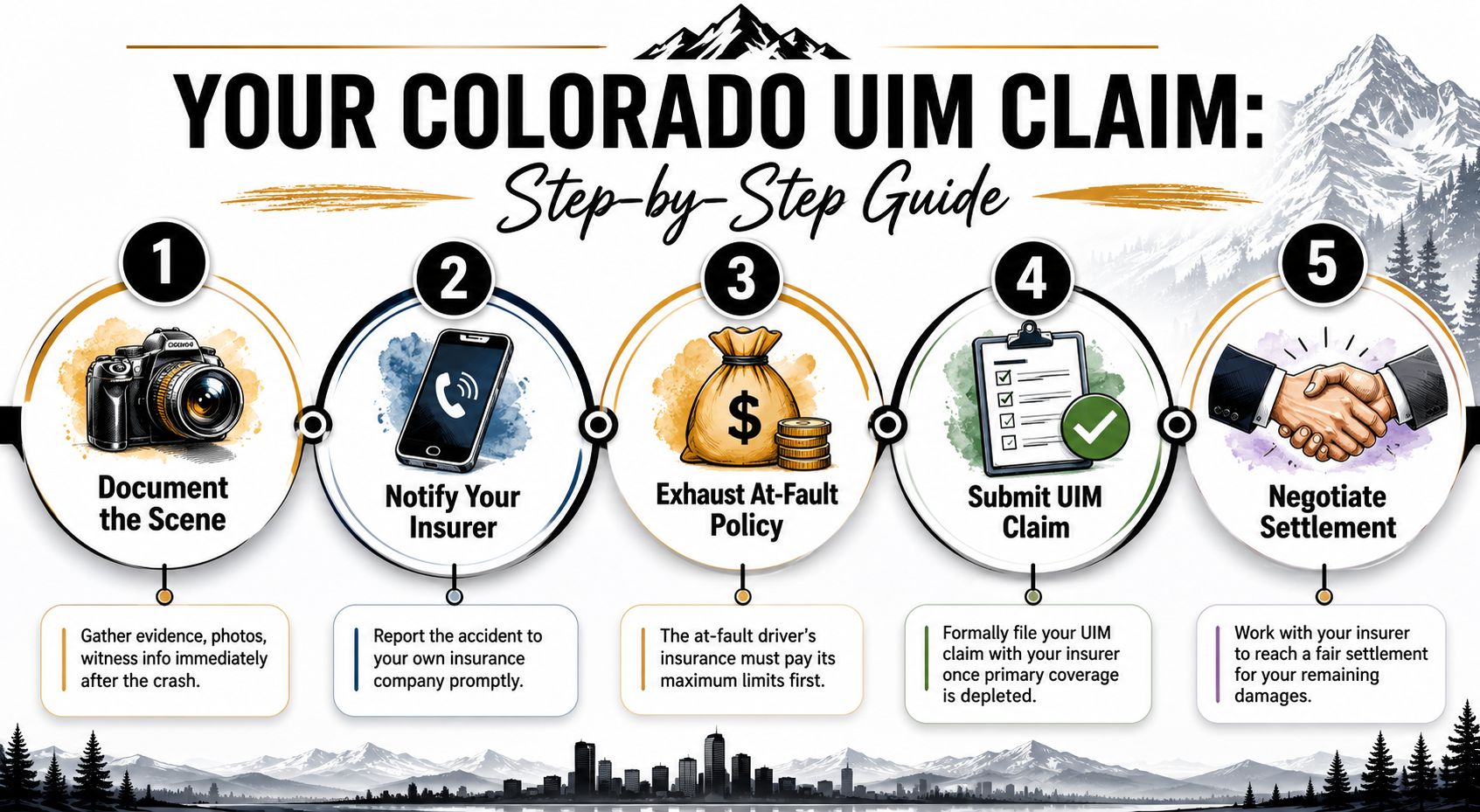
Step one through step three
Start with the basics, but do them carefully.
Document the crash early
Keep photos, the crash report, witness names, vehicle information, insurance details, and every communication from the other carrier. Save everything in one folder. If your injuries make organization difficult, ask a family member to help.Notify your own insurer promptly
Don't wait until the at-fault carrier tenders limits. Your own insurer should receive notice that a UIM claim may be implicated. Many people are surprised to learn that late notice creates arguments the carrier may later try to use.Build the damages file while you treat
UIM value usually turns on the excess damages layer, not just the fact that the other driver had low limits. That means your file should clearly show medical causation, wage loss, future treatment needs, and any lasting impairment.
A practical resource for the broader insurance side of the aftermath is this guide on how to deal with insurance after a car accident. The same disciplined record-keeping that helps with the liability claim helps with the UIM claim.
The procedural bottleneck most people don't expect
A UIM claim usually doesn't mature the same way a routine first-party claim does. You generally must first resolve the claim against the at-fault driver, then present the policy-limits offer and related proof to your own UIM carrier.
According to a Maryland practice guide, UIM claims are procedurally slower than other claims because you must first resolve the claim against the at-fault driver. Only after submitting proof of their policy-limits offer does your UIM insurer's 60-day decision window typically begin, preserving their right to seek reimbursement from the at-fault party, as explained in this overview of filing an uninsured or underinsured motorist claim.
If you settle the liability claim without handling the UIM consent issue correctly, you can create a second problem on top of the first one.
That is one reason these cases often feel slower than clients expect. The legal logic makes sense to insurers. It feels maddening when you're injured and trying to move on.
For a video overview of how this process unfolds, this walkthrough can help orient you before the paperwork starts.
What to include in the claim package
A strong Colorado underinsured motorist claim package usually includes more than bills and records. It should tell a coherent story.
- Liability proof: Police report, scene photos, witness statements, and any available video.
- Medical proof: Records that connect the crash to the injuries, explain treatment, and address future care.
- Economic proof: Wage verification, disability notes, tax records if self-employed, and out-of-pocket costs.
- Human proof: A clear explanation of what changed in your daily life, your work, your sleep, your mobility, and your relationships.
Some people handle the early notice and document gathering themselves, then hire counsel when valuation and consent-to-settle issues arise. Others want representation from the start. Firms that handle motor vehicle injury cases, including Nares Law Group LLC, can review the available coverage, coordinate the claim sequence, and help avoid notice and settlement mistakes.
Negotiating a Fair UIM Settlement
A UIM claim is unusual because you're pursuing benefits under your own policy, but the negotiation can still become adversarial. Your insurer may accept that coverage exists and still dispute what the case is worth.
That usually happens in predictable ways. The adjuster focuses on a treatment gap. A preexisting condition suddenly becomes central. Future care is called speculative. Wage loss is treated as incomplete. None of that means the claim is weak. It means the file has to be organized for persuasion, not just submission.
What works in negotiation
The best UIM demands are disciplined. They don't overwhelm the adjuster with a pile of unsorted records. They walk through liability, injuries, treatment, prognosis, economic loss, and the reason the damages exceed the at-fault driver's limits.
A strong package usually does three things well:
- It connects the dots: It explains why the crash caused the injuries being claimed.
- It addresses soft spots directly: If there was a prior injury, treatment gap, or delayed complaint, the demand deals with it rather than hiding it.
- It shows the excess layer clearly: The carrier needs to see why the unpaid portion of the claim belongs in the UIM lane.
What hurts your position
The biggest mistake is treating the liability settlement like a separate matter. In a UIM case, that step can affect everything.
Before signing anything, read the release carefully and make sure your UIM carrier's rights have been handled correctly. If you want a plain-language explanation of what those documents do, this overview of a settlement agreement is worth reading.
Your own insurer may sound cooperative early on and become much more skeptical once actual payment is on the table.
Another mistake is arguing only from bills. Bills matter, but serious claims are often won or lost on narrative. Why did treatment continue? Why couldn't you work? Why is future care medically reasonable? Why do the limitations matter in daily life? Those answers drive settlement value.
Common Pitfalls and When to Call an Attorney
Most self-inflicted damage in an underinsured motorist claim doesn't come from one dramatic error. It comes from a series of small missteps. A recorded statement given too casually. A release signed too soon. A gap in treatment left unexplained. An assumption that your own insurer will “take care of you” because you've paid premiums for years.

Mistakes that cost people leverage
Watch for these pressure points:
- Giving broad authorizations: If the insurer asks for unrestricted access to years of records, slow down and understand what you're signing.
- Underestimating future harm: A claim can look manageable early, then become much more serious as treatment develops.
- Accepting “routine” explanations: If the adjuster says something is standard, that doesn't mean it's correct for your case.
- Missing the policy layer: People often focus so heavily on fault that they don't analyze all available coverage.
- Waiting too long to get help: Delay makes records harder to gather and strategy harder to fix.
The premium increase fear
This is one of the most common private worries clients have, and many people are embarrassed to ask it directly. They shouldn't be.
A neutral source notes that in many jurisdictions, insurers are legally prohibited from raising premiums, canceling coverage, or refusing renewal solely because an insured person made a claim against their UIM coverage, as they are not the at-fault party, as discussed in this article about whether an uninsured motorist claim can affect your insurance rates.
That doesn't mean every premium issue in every state works exactly the same way. It does mean the fear many people have is often broader than the law allows. If rate consequences are keeping you from using coverage you paid for, get the specific answer for your policy and jurisdiction before you decide not to proceed.
When legal help usually makes sense
Call an attorney quickly if any of these are true:
- Serious injury is involved: Surgery, head injury, permanent symptoms, or future treatment needs change the stakes.
- Liability is disputed: Even a good UIM policy doesn't help much if fault isn't proved.
- Consent issues are unclear: Settling with the at-fault driver without handling the UIM procedure correctly can create real problems.
- The carrier is delaying or lowballing: If the process stalls, strategy matters.
- A claim has been denied: If that happens, practical guidance on how to appeal a denied insurance claim can help you understand the dispute process alongside legal advice.
Your Colorado UIM Claim Checklist
When people are hurt, clarity helps more than theory. Use this checklist to get control of the claim.
Your next moves
- Find your declarations page: Confirm whether UM/UIM coverage exists and what limits appear on the policy.
- Report the crash to your own insurer: Give prompt written notice that a UIM claim may arise.
- Keep the liability claim documents together: Save the at-fault driver's policy information, claim number, and any limits-related communications.
- Track treatment in real time: Keep a running log of providers, appointments, diagnoses, medication, and restrictions.
- Document wage loss carefully: Save pay stubs, employer letters, disability paperwork, and notes about missed work.
- Preserve evidence of daily impact: A short journal can help show pain levels, mobility problems, sleep disruption, and missed family activities.
- Do not sign away rights casually: Review any release or settlement paperwork before agreeing to it.
- Ask about consent before accepting limits: This issue can matter in UIM cases even when the liability offer seems straightforward.
- Look for all possible policies: Household policies and multi-vehicle issues can affect available coverage.
- Get advice early if the case is complex: Serious injuries and disputed value rarely get easier to fix later.
A Colorado underinsured motorist claim is manageable when the sequence is handled correctly. The biggest advantage you can give yourself is early organization. The second is getting a clear answer on coverage before assumptions harden into mistakes.
If you're dealing with a Colorado underinsured motorist claim and need a clear review of your coverage, deadlines, and settlement options, Nares Law Group LLC offers consultations for injured drivers and families. A focused case review can help you determine what insurance applies, what steps have to happen next, and what not to sign before your rights are protected.