A lot of Colorado drivers learn about insurance at the worst possible moment. You're standing on the shoulder after a crash, your heart is racing, and you assume the other driver's insurance will take care of the mess. Then you find out they only carried the legal minimum. Suddenly, "insured" doesn't sound nearly as reassuring as it did an hour earlier.
That confusion is understandable. The average driver doesn't spend their weekends reading policy declarations or decoding liability limits. They buy what keeps the car legal, keep the ID card in the glove box, and move on with life. After a wreck, that shortcut can become a very expensive problem.
Colorado's insurance rules are simple on paper and much harsher in real life. The law sets a floor. It doesn't promise enough money to cover a serious injury, a totaled newer vehicle, missed work, or the ripple effects that follow a violent collision. In practice, that's the gap that hurts people twice. First in the crash, then in the bills.
As a practical matter, this is what people need to understand about car insurance requirements in Colorado: legal coverage and adequate protection are not the same thing. If you were injured and you're trying to figure out why the numbers don't work, or you're reviewing your own policy before something goes wrong, the answer usually starts there.
If you're also trying to understand fault, deadlines, and your rights after a wreck, Nares Law Group's guide to Colorado car accident laws is a useful companion to the insurance issues discussed here.
Introduction
A common scene plays out the same way across Denver, Aurora, Boulder, and the mountain corridors. Two drivers exchange information after what looked like a straightforward crash. One person says, "Don't worry, I have insurance." The injured driver goes home believing the claim process may be annoying, but the bills will get paid.
That confidence often fades when the claim gets evaluated. The at-fault driver may be compliant with Colorado law and still carry too little insurance to cover what the crash caused. That's not a loophole. That's how the system is built.
Insurance compliance answers one question. Can this driver legally be on the road? It doesn't answer the harder question, which is whether there's enough coverage to protect the people harmed in a serious collision.
Often, many families get blindsided. They assume "minimum coverage" means "minimum acceptable protection." It doesn't. It means minimum legal eligibility to drive.
The difference matters most when injuries aren't minor. A trip to the emergency room, imaging, follow-up care, physical therapy, lost income, and vehicle damage can pile up fast. If the policy on the other side is thin, the unpaid balance doesn't disappear just because the crash wasn't your fault.
The Bare Minimum Colorado's Mandatory Liability Insurance
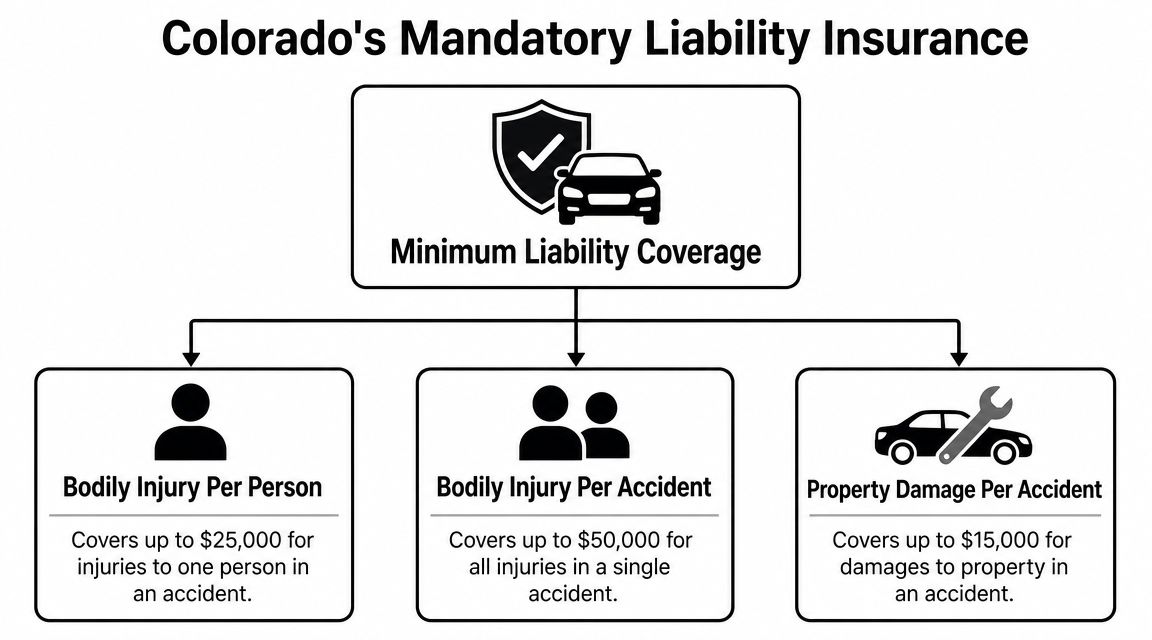
Colorado law requires drivers to carry liability insurance at the 25/50/15 level. That means $25,000 for one injured person, $50,000 total for all injured people in one crash, and $15,000 for property damage. Proof of insurance is also part of staying legal on the road, including registration and traffic stops, as summarized by Bankrate's overview of Colorado car insurance laws.
What 25 50 15 actually means
Liability insurance works like money set aside for the damage you cause to other people, up to a fixed cap.
Here is what those three numbers control:
- $25,000 bodily injury per person is the most the policy will pay for one injured person's medical bills, pain and suffering, and other injury-related losses.
- $50,000 bodily injury per accident is the total available for everyone injured in the same crash.
- $15,000 property damage per accident is the cap for vehicle repairs, replacement value, or other damaged property.
Those limits are the stopping point, not a promise that all harm will be covered. If two people are badly hurt, the total available can run out fast. If a newer vehicle is totaled, the property damage limit may fall short on its own.
What minimum liability does not do
Minimum liability coverage does not serve as broad protection for your own losses after every wreck. If you cause the crash, it generally does not pay to fix your own car or cover your own injuries unless you bought other types of coverage.
That distinction causes a lot of confusion. Drivers hear "full coverage" in casual conversation and assume any insurance card means they are financially protected from every direction. Policies do not work that way. Liability coverage is about your legal responsibility to other people.
A simple way to read it is this: your policy has separate buckets of money, and each bucket has a hard lid. Once that bucket is empty, the remaining bills do not disappear.
For many drivers, the best place to start is the declarations page. It shows what is required, what is optional, and where the dangerous gaps are. For a plain-English explanation of fault-based exposure and required coverage, Nares Law Group's page on Colorado liability insurance requirements is a useful baseline.
The Risks of Non-Compliance Penalties for No Insurance
Some insurance problems don't begin with a crash. They begin at registration, renewal, or after a quiet policy lapse that the driver doesn't notice until the state does.
Colorado county guidance says vehicles must be insured before registration, and insurers report new policies and cancellations to the state monthly. That reporting system can flag a lapse for non-compliance and trigger registration holds and related consequences, as explained by Boulder County's auto insurance requirements guidance.

The real-world problem isn't always intentional driving without insurance
A lot of drivers hear "no insurance" and picture someone knowingly ignoring the law. Sometimes that's true. Often, the mess is more ordinary.
A payment fails. A renewal notice goes to an old email address. The VIN on the proof document doesn't match what the county clerk needs. A driver moves to Colorado and assumes an old document will keep working without issue. Then registration hits a wall.
That matters because compliance in Colorado is operational, not just theoretical. You need coverage in force, and you need proof that lines up with the specific vehicle.
What counts as proof
Colorado county guidance recognizes several forms of acceptable proof tied to the vehicle and showing the right details. Drivers often use one of the following:
- Insurance card if it shows the needed policy information.
- Declaration page when a more complete record is needed.
- Binder or insurer letter if the policy is new and the standard card hasn't arrived yet.
- Vehicle-specific information including the VIN and effective dates, which helps avoid rejection during registration review.
The practical takeaway is simple. A policy that exists somewhere in an insurer's system isn't enough if your paperwork doesn't match the car you're trying to register.
Keep your proof of insurance where you can access it quickly, but also review it like a clerk would. Check the VIN, the dates, and the vehicle listed. Administrative mistakes can create the same immediate headache as an actual lapse.
Why this matters after a crash
When insurance is inactive, mismatched, or under review, everything gets harder. Registration problems can overlap with claims problems. Drivers discover they are non-compliant when they're already dealing with injuries, towing, transportation, and calls from adjusters.
This is one reason people searching for car insurance requirements in Colorado need more than the headline minimums. The legal limit matters, but so do the mechanics of staying continuously compliant.
Why the State Minimum Is Not Enough After a Crash
Being legal on the road and being financially protected after a wreck are two different things. Colorado's minimum liability limits satisfy the first question. They often fail the second.
The most important gap shows up when real losses meet a small policy. The Colorado legislative content on mandatory automobile insurance notes that many explanations of 25/50/15 don't grapple with the financial reality that the average cost of a hospital stay for a car accident injury can easily exceed $60,000, and totaling a new car can cost over $40,000, both of which can outrun minimum coverage by a wide margin, according to Colorado's mandatory automobile insurance materials.
A minimum policy can disappear quickly
Take bodily injury first. If one person suffers significant injuries, the per-person liability limit may be exhausted long before treatment is finished. If multiple people are hurt, the per-accident cap creates another bottleneck. That can leave each injured person competing against a limited pool of funds.
Property damage creates the same problem in a different form. Many drivers still assume vehicle damage claims are modest because they remember what cars cost years ago. A newer SUV, truck, or electric vehicle can turn that assumption into a nasty surprise.
A minimum policy is like bringing a small bucket to a house fire. Technically, you brought water. Practically, it may not touch the real problem.
What this looks like in an injury claim
Here is the painful math in plain English. The at-fault driver can carry the minimum required coverage and still leave an injured person facing unpaid medical bills, uncovered wage loss, or a vehicle loss beyond available property limits.
That doesn't always mean the victim did anything wrong. It means the legal minimum was never designed to guarantee whole recovery in a serious crash.
This is also why claim value and collectible insurance are not the same thing. A case can be worth more than the available liability policy. If the at-fault driver has limited assets, collecting beyond insurance may be difficult.
Colorado minimum vs recommended car insurance coverage
| Coverage Type | State Minimum Required | Recommended Protection |
|---|---|---|
| Bodily injury liability | 25/50 structure required under Colorado law | Higher liability limits if available in your budget |
| Property damage liability | $15,000 per accident minimum | Higher property damage limits for newer vehicles and multi-car collisions |
| UM/UIM | Not required to purchase, but insurers must offer it | Strongly consider keeping it to protect yourself from underinsured drivers |
| MedPay | Not required to purchase, but insurers must offer it | Consider it for immediate medical bill help after a crash |
| Collision and comprehensive | Not required by the state | Useful if you need protection for your own vehicle damage |
When someone is already in the claim process, small mistakes can make the shortfall worse. Good documentation, a clear treatment record, and organized loss evidence can help you maximize your car accident payout when liability coverage is limited and every dollar matters.
Building Your Financial Shield Recommended Coverage Options
Colorado follows an at-fault system, which means the driver who caused the crash is financially responsible for the losses. Colorado also requires insurers to offer Uninsured/Underinsured Motorist coverage and Medical Payments coverage, even though drivers can reject them in writing, as explained in Help In Colorado's overview of state insurance requirements.
That detail matters more than commonly understood. You can't control whether the person who hits you bought a bare-bones policy. You can control whether your own policy includes tools that step in when the other side falls short.
UM UIM protects you from somebody else's bad policy
Uninsured/Underinsured Motorist coverage, often shortened to UM/UIM, is the part of your policy that can help when the at-fault driver has no insurance or not enough insurance.
That makes it one of the most important protections in a state where many drivers buy only what is needed to stay legal. If the other driver's liability limit runs out before your losses are covered, UM/UIM can become the bridge between a paper claim and actual financial recovery.
A helpful way to think about it is this: liability coverage protects other people from your mistakes. UM/UIM protects you from theirs.
If you want a deeper explanation of how these claims work in Colorado, Nares Law Group has a focused resource on uninsured motorist coverage in Colorado.
MedPay helps with the early cash-flow problem
Medical Payments coverage, usually called MedPay, serves a different purpose. It can help pay medical expenses after a crash regardless of fault.
That matters in the first days and weeks after a collision, when treatment starts before the liability claim is resolved. People often need care long before the at-fault insurer admits responsibility or offers a fair settlement. MedPay can soften that pressure.
Consider what it solves in practice:
- Immediate treatment pressure because clinics and hospitals don't wait for liability negotiations to finish.
- Gap coverage when health insurance leaves deductibles, co-pays, or treatment access issues.
- Family stability because early medical bills can disrupt rent, groceries, and other basics even in households with decent income.
The best optional coverage is often the coverage that helps before the argument is over. UM/UIM and MedPay do that in different ways.
What works and what doesn't
What works is reading your policy before a crash, not after one. What works is asking your agent to explain exactly what you rejected, what you kept, and whether your current limits reflect the actual cost of a modern wreck.
What doesn't work is assuming the other driver's insurance will be enough because the state allowed that person to register a vehicle. Those are different issues. A legally compliant driver can still be a financial disaster for the person they injure.
For drivers reviewing coverage choices and for injured people already dealing with a thin liability policy, firms such as Nares Law Group LLC handle crash claims, insurance investigation, medical treatment coordination, negotiation, and litigation when needed.
What to Do After Being Injured in a Colorado Crash
A crash can leave two problems on your doorstep at the same time. One is physical. The other is financial, and it often starts before anyone agrees who caused the collision.
The first hours matter because insurance companies build cases from early records, early statements, and early gaps. A serious injury claim can weaken fast when there is no prompt medical evaluation, no scene documentation, or no clear record of what the crash disrupted.
Start with your health. Get checked out after a significant collision, even when the pain feels manageable at first. Adrenaline can cover symptoms, and some injuries show up hours or days later.
The first moves that usually help
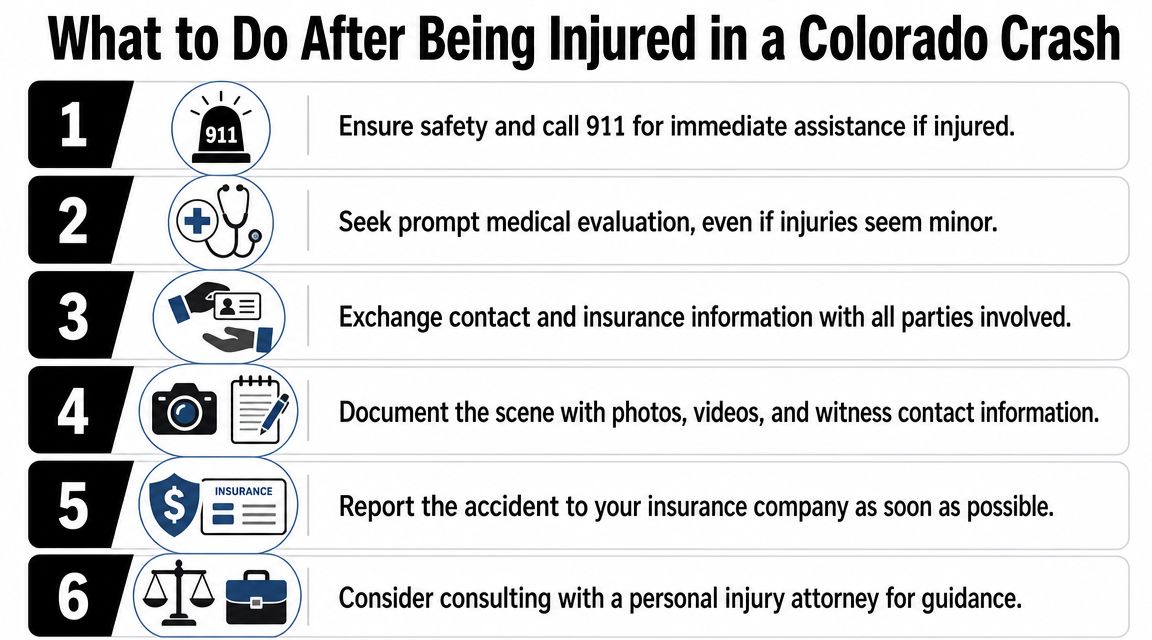
A practical checklist helps keep small mistakes from becoming expensive ones:
- Get to safety first. Move out of traffic if you can do so without making an injury worse, and call 911 when needed.
- Seek medical evaluation. Early records help connect the crash to your symptoms before an insurer argues something else caused them.
- Exchange information carefully. Collect names, insurance details, plate numbers, and vehicle information from each driver.
- Document the scene. Photograph vehicle damage, road conditions, debris, weather, skid marks, and visible injuries.
- Identify witnesses. Get names and contact information before people leave.
- Notify your insurer. Your own policy may provide MedPay, UM/UIM, or collision coverage even when another driver caused the wreck.
A short video overview can help reinforce the basics:
Be careful with early insurance conversations
The other driver's adjuster may call quickly and sound organized, polite, and ready to help. The job is still to limit what the company pays.
Give basic facts. Avoid guesses about speed, fault, prior health issues, or how long recovery will take. In my experience, people get into trouble when they try to be agreeable before they know the full extent of their injuries.
Keep records in one place. Save medical bills, prescription receipts, repair estimates, rental car costs, wage loss documents, and notes about how the injury affects daily life. A claim with thin documentation often gets treated like a small inconvenience, even when the injury is anything but small.
Be cautious with forms and quick money. A broad medical release or an early settlement can close off parts of the claim before you know whether the at-fault driver's policy is already too small for the harm done.
After a serious crash, the legal minimum can look adequate on paper and completely inadequate in real life.
When legal help becomes useful
Legal help often becomes useful well before a lawsuit is filed. The work usually starts with preserving evidence, identifying every insurance policy that may apply, organizing medical proof, and measuring the gap between available coverage and the actual losses.
That gap is the part many injured people do not see coming. A driver can be fully legal under Colorado insurance rules and still carry nowhere near enough liability coverage to pay for emergency care, follow-up treatment, lost income, and the human cost of a lasting injury. When that happens, the case turns into a coverage problem as much as a fault problem.
For injured people in Colorado who need to understand what insurance may apply, what a claim may be worth, or why the other driver's policy falls short, Nares Law Group LLC offers free consultations for accident victims and families seeking clear guidance on the next step.