Represented car accident claimants recover roughly 3.5 times more compensation on average, and even after contingency fees, they typically net about 3 times more than people who handle claims alone. For a serious injury claim, that makes hiring an attorney financially worthwhile far more often than it doesn't.
The important qualification is that not every crash is a legal case worth outsourcing. A minor property-damage collision with no injury, clear fault, and a fair insurance offer may not justify attorney involvement. But once medical treatment, lost income, disputed liability, future care, or permanent harm enters the picture, you're no longer just filing paperwork. You're negotiating over money that may need to support you for years.
The question isn't, “Will a lawyer ask for more?” The better question is, will professional claim building increase your net recovery enough to justify the fee? For moderate and serious injury cases, the available claim data strongly points to yes.
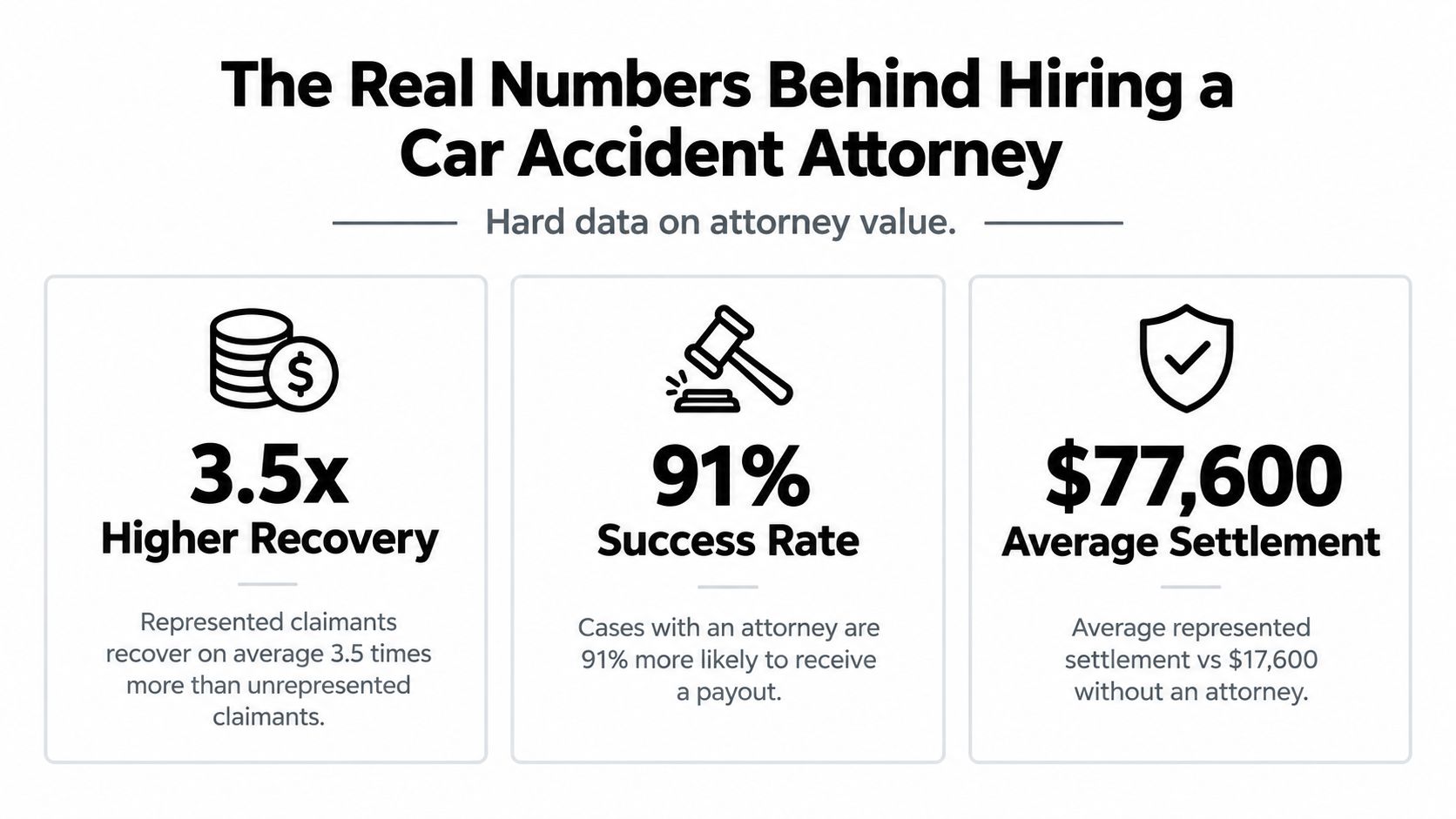
The Real Numbers Behind Hiring a Car Accident Attorney
The clearest historical claim data gives a direct answer to the question, is it worth getting an attorney for a car accident? Represented auto-injury claimants recovered about 3.5 times more than unrepresented claimants, and roughly 85% of bodily-injury payout dollars went to people with attorneys, according to a summary of Insurance Research Council closed-claim data from Insurance Research.
Another summary reports average recoveries of approximately $77,600 with legal representation, compared with $17,600 without it, a difference of roughly 4.4 times in gross recovery. Other summaries using the same underlying claim data describe the gap as approximately 3.4 to 3.5 times higher, so the exact multiplier varies by presentation, but the direction is consistent: represented claimants generally recover substantially more. See the historical car accident settlement statistics for the reported figures.
Why the courtroom usually isn't the point
Most car accident cases don't depend on winning a trial. Department of Justice-related summaries commonly report that approximately 90% to 95% of personal injury cases settle before trial, while one federal-court summary says only about 4% of personal injury claims reach trial, according to personal injury settlement statistics.
That changes how you should evaluate a lawyer's value. The attorney's advantage often comes from gathering medical proof, identifying all responsible parties, calculating future losses, and making the insurer believe that an inadequate offer won't end the dispute. A lawyer doesn't need to stand before a jury to make a meaningful difference.
For a real claimant, the practical calculation is straightforward:
- Without counsel: You may receive the insurer's initial valuation, which can focus on bills already incurred.
- With counsel: The claim can include documented treatment, lost wages, future care, reduced earning capacity, pain-related harm, and liability evidence.
- After fees: The attorney takes a percentage of the recovery, but that percentage applies to a potentially much larger settlement.
You can review how settlement valuation works in greater detail through this guide to car accident settlement payouts. The point isn't that every attorney will produce the same result. It is that serious claims often contain value that an insurer won't volunteer and an unrepresented claimant may not know how to prove.
Outcomes With and Without Legal Representation
Handling a claim alone can look efficient at the beginning. You call the adjuster, provide the police report, submit medical bills, and wait for an offer. The problem appears later, when the insurer asks you to resolve the claim before doctors can determine whether treatment has ended or whether your injuries will affect work and daily life.
The historical data shows a major difference in whether claimants receive compensation at all. A survey summary reports that 91% of claimants with a lawyer received compensation, compared with 51% without one, according to personal injury claim outcome data. That doesn't mean an attorney guarantees payment. It does show how much representation correlates with a claim being documented, pursued, and resolved successfully.
| Metric | With Attorney | Without Attorney |
|---|---|---|
| Average recovery pattern | Approximately 3.5 times higher on average, based on represented auto-injury claim data | Lower average recovery |
| Reported average settlement | About $77,600 in one summary | About $17,600 in the same summary |
| Claimants receiving compensation | 91% in the cited survey summary | 51% in the cited survey summary |
| Share of bodily-injury payout dollars | Approximately 85% went to represented claimants | A smaller share went to unrepresented claimants |
| Documentation | Organized medical, wage, liability, and future-loss evidence | Often limited to readily available records |
| Negotiation position | Lawyer manages communications and challenges valuation | Claimant negotiates directly with a professional adjuster |
| Risk of early closure | Counsel can advise against settling before the medical picture is clear | Claimant may accept an offer before future harm is known |
Gross recovery is not the whole story
A large settlement number can mislead if liens and fees consume most of it. The opposite is also true. A smaller gross settlement can leave a claimant worse off if it fails to cover outstanding medical obligations, ongoing treatment, lost income, and the consequences of permanent impairment.
Attorney involvement tends to improve the quality of loss documentation and the quantification of damages. That matters because insurers can discount soft-tissue injuries, delayed symptoms, and disputed causation when the records don't establish a consistent connection between the crash and the medical condition.
The insurer has already assigned a professional to protect its financial position. Your decision is whether you want to negotiate against that professional without one of your own.
A self-managed claim can make sense when the injury is minor, treatment is complete, fault is accepted, and the offer covers the actual loss. It becomes a poor financial strategy when you are being asked to release unknown future claims for a payment based only on what has happened so far.
When Hiring a Lawyer Actually Pays Off
The strongest reason to hire counsel isn't the mere existence of a crash. It's the presence of complexity, serious damages, or problems. Research on road-traffic injury compensation claims found that people use lawyers more often as injuries become more severe and when recovery outcomes turn negative, such as delayed return to work, persistent symptoms, or complications in the claim process. The analysis is available in this peer-reviewed discussion of lawyer use in injury compensation claims.
Use these triggers as practical triage rules.
Serious or evolving injuries
Hire an attorney when the collision involves hospitalization, surgery, fractures, disc injuries, traumatic brain injury symptoms, or treatment that may continue. You should also get legal advice when whiplash or other symptoms appear after the crash rather than immediately.
Insurers often treat soft-tissue and delayed-onset complaints skeptically. Consistent medical records, diagnostic evidence, specialist opinions, and a clear treatment timeline can make the difference between a documented injury and an adjuster's unsupported assumption that you're fine.
Fault is disputed
If the other driver denies responsibility, the police report is unclear, or the insurer blames you, representation becomes valuable quickly. A lawyer can preserve photographs, witness accounts, vehicle evidence, roadway information, and other proof before it disappears or memories become less reliable.
Disputed liability also raises the value of early advice. A careless statement to an adjuster can become part of the insurer's argument that you caused or worsened the crash.
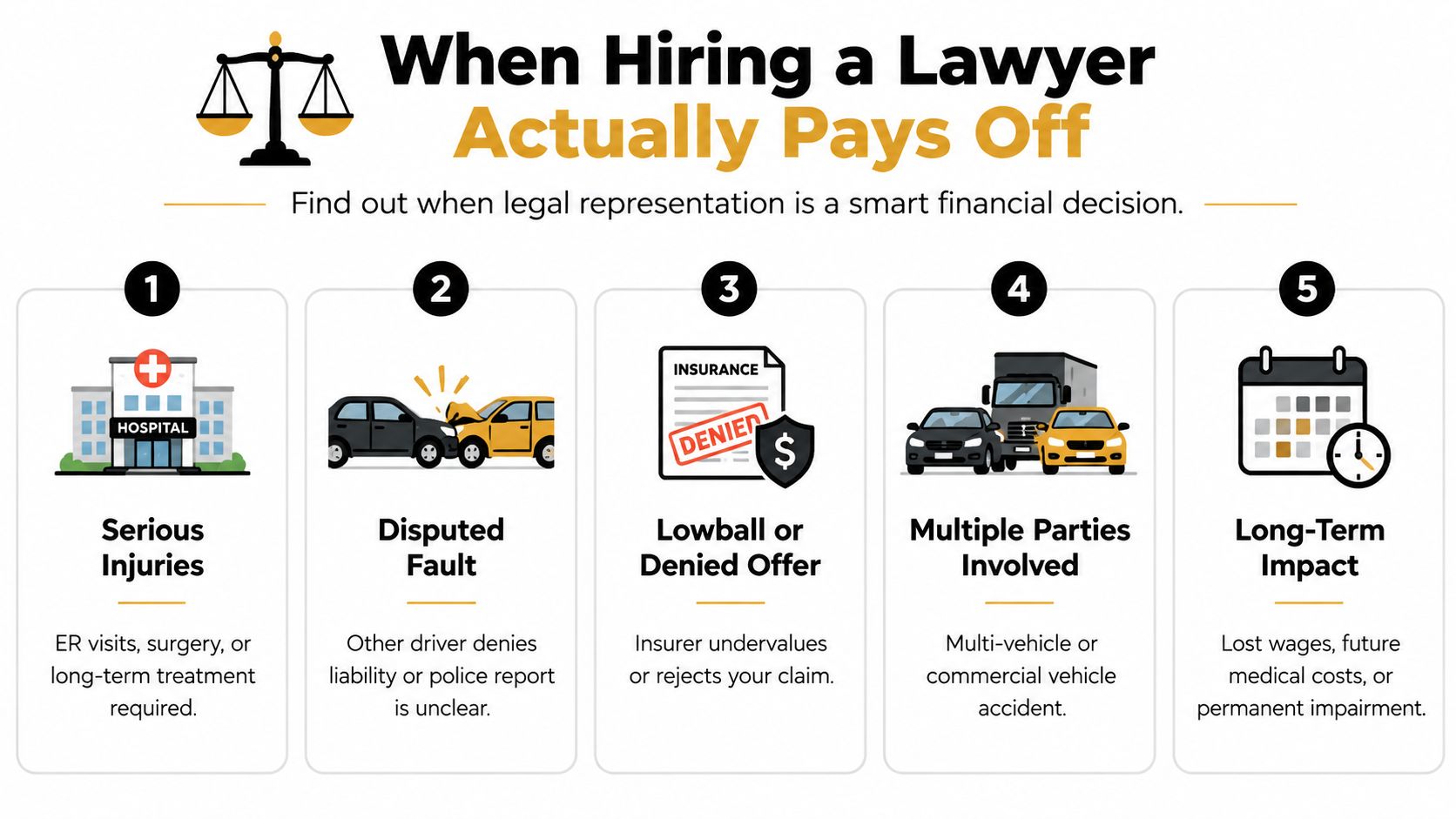
The financial exposure is substantial
A medical-bill threshold is only a screening device, not a legal rule. Recent consumer guidance identifies medical bills above $10,000 as a practical point at which people should seriously consider counsel, particularly when treatment is ongoing or the injury affects work. The same logic applies when you face lost wages, future medical costs, permanent impairment, or reduced earning capacity.
Commercial vehicles and multi-vehicle crashes deserve immediate attention because several insurers, employers, drivers, and theories of responsibility may be involved. More parties means more opportunities for each participant to shift blame.
The offer is low or denied
A denied claim isn't necessarily a failed claim. It may reflect missing documentation, a liability dispute, an insurer's position on causation, or an attempt to see whether you'll stop pursuing the matter. A lawyer can identify the reason for the denial, obtain supporting evidence, and decide whether negotiation or litigation is appropriate.
For a minor crash, an attorney may add little value if the insurer's offer is fair and no injury exists. For anything involving bodily injury or a meaningful dispute, waiting until the claim has deteriorated can make the case harder to build.
What a Car Accident Attorney Actually Does for You
A lawyer's work starts long before a demand letter. Consider a collision where the other driver admits hitting you, but your back pain continues, your medical bills are increasing, and you can't perform your usual job. The admission may establish a useful fact, but it doesn't calculate the value of your injury or prove what the condition will cost in the future.
Investigation comes first
Counsel typically obtains the crash report, photographs, witness information, available video, insurance details, and vehicle evidence. If the facts are contested, the attorney may consult accident reconstruction or medical professionals to connect the mechanics of the collision to the claimed injuries.
That investigation can uncover issues a quick insurance submission misses. A witness may clarify the light sequence. Vehicle damage may support the force of impact. A record may show that the other driver's account changed after the crash.
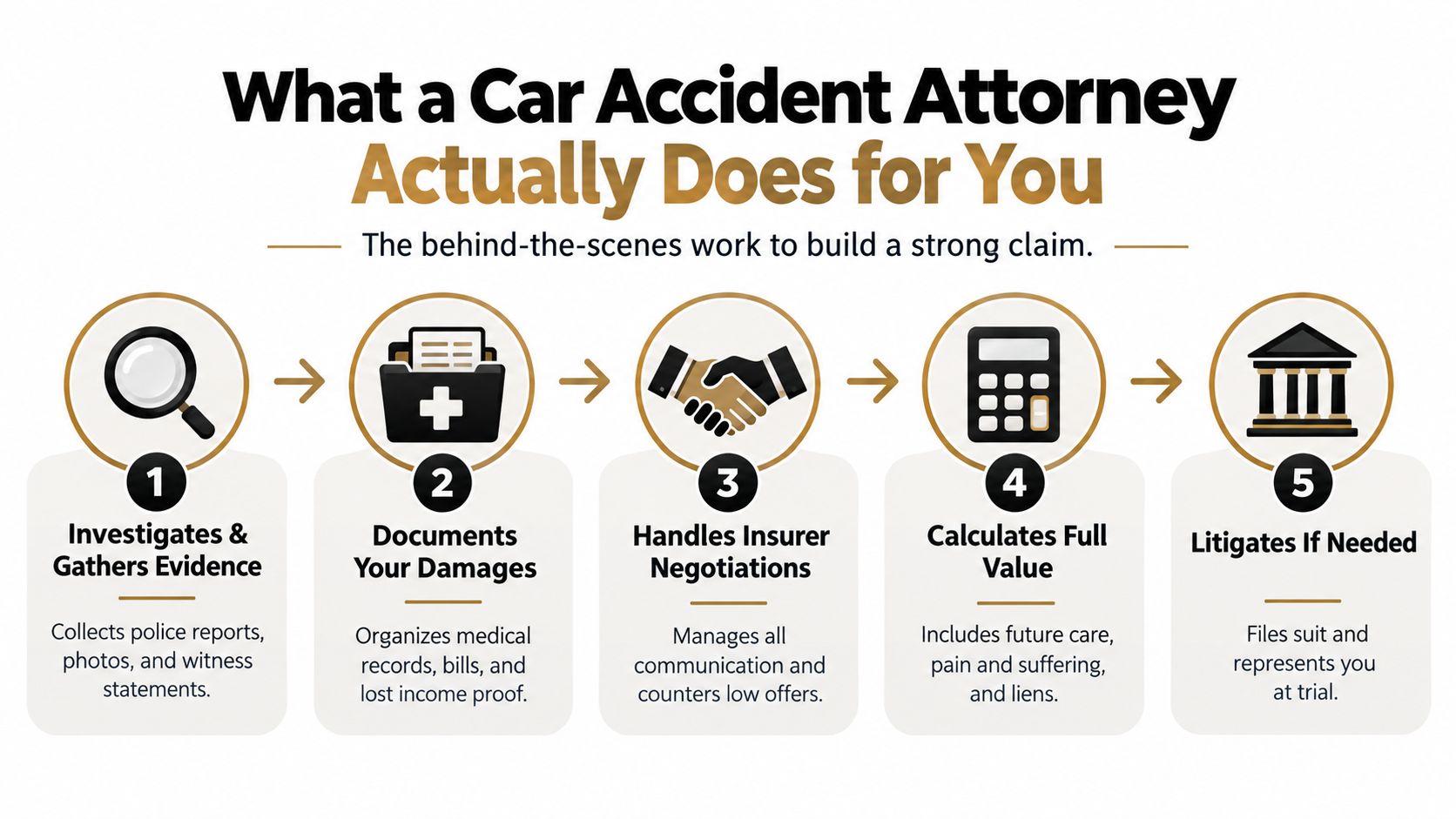
Damages need a complete record
An attorney organizes medical records and bills, tracks treatment, requests wage documentation, and evaluates whether the injury could affect future employment or daily activities. The lawyer also distinguishes between expenses already incurred and losses that may continue after settlement.
That distinction is critical. Signing a release generally ends the claim, so accepting payment before the medical picture is developed can transfer future financial risk from the insurer to you.
Negotiation is evidence applied strategically
A demand package isn't just a larger number. It should explain liability, treatment, prognosis, income loss, non-economic harm, and the reason the proposed amount follows from the evidence. Counsel also manages insurer communications, responds to requests, and challenges tactics designed to narrow the claim.
Attorney involvement is associated with more complete documentation and better loss quantification. Those improvements can raise the insurer's settlement anchor because the carrier faces a better-supported claim and a credible escalation path if negotiations fail.
Watch this brief overview of the attorney's role before deciding whether you can manage the process alone:
Trial preparation matters even when no trial occurs. A lawyer who is prepared to file suit can evaluate deadlines, procedural requirements, witnesses, experts, and litigation risk instead of treating the first offer as the finish line.
Understanding Attorney Fees and Your Net Recovery
The fee objection is reasonable. A contingency fee reduces the gross settlement, and medical providers or insurers may assert liens that must be addressed before you receive the remaining funds. But comparing your net recovery to the gross amount you might obtain alone is the wrong analysis.
Contingency fees are commonly structured as a percentage of the recovery, with summaries often describing typical rates between 33% and 40%. The exact percentage, litigation-stage adjustment, responsibility for case costs, and treatment of medical liens must appear in the written agreement. Review the mechanics in this explanation of car accident lawyer fees.
Use a net-recovery worksheet
Ask the attorney to show the expected distribution in plain language:
- Gross settlement: The total amount paid to resolve the claim.
- Attorney fee: The agreed percentage or amount.
- Case costs: Investigation, records, filing, expert, and litigation expenses, if applicable.
- Medical liens and balances: Amounts owed to providers, health plans, or other lienholders.
- Client net: What remains for you.
The historical summaries cited earlier report that represented claimants can still net approximately 3 times more after typical contingency fees than unrepresented claimants. That figure isn't a promise for your case, but it answers the common assumption that a fee automatically leaves you worse off. If representation produces a substantially larger gross recovery and reduces liens through negotiation, the amount in your pocket can still be higher.
When the math may not favor counsel
A minor property-damage-only crash may not justify a contingency arrangement. If no one is injured, fault is accepted, repairs are straightforward, and the insurer pays a fair amount, you may be able to resolve the matter directly.
Don't make that decision based on the fee percentage alone. Ask whether the firm expects a meaningful dispute, whether it will negotiate medical balances, who pays case costs if the claim fails, and whether the fee changes if a lawsuit is filed.
Ask for the net number, not just the settlement number. A responsible lawyer should explain where every major deduction goes.
A free consultation can help you test the economics before signing. You should leave knowing the likely issues, the fee terms, the risks of waiting, and whether the attorney believes the expected benefit justifies representation.
How to Choose the Right Car Accident Attorney
Contact several attorneys if your claim is serious enough to require representation. You aren't shopping for the most aggressive advertisement. You're looking for a lawyer who has handled the same kind of liability and injury problems, explains the fee agreement clearly, and can communicate with you throughout the case.
Questions worth asking at the first meeting
Ask who will personally handle the case, whether the firm has experience with disputed-fault claims, how it evaluates future medical needs, and what evidence it expects to collect. Ask whether the lawyer has trial experience and what would cause the firm to recommend settlement rather than litigation.
You should also ask for a written explanation of:
- The contingency fee: Find out the percentage before and after litigation, if it changes.
- Case expenses: Confirm which costs the firm advances and which costs come from the recovery.
- Medical liens: Ask whether the firm negotiates balances and how lien payments affect your net.
- Communication: Establish who answers questions and how often you'll receive updates.
- Decision authority: Confirm that you, not the firm, decide whether to accept a settlement.
For a broader framework, review these lawyer selection criteria before your consultations.
Red flags should end the conversation
Walk away from any lawyer who guarantees a specific settlement, pressures you to sign immediately, or refuses to explain the fee agreement. Be cautious if you can't speak with an attorney, if staff give vague answers about case strategy, or if the firm makes promises that depend on facts nobody has investigated.
Early contact is common in the legal market. A 2025 survey summary reported that 38% of accident survivors were contacted by attorneys within 24 hours, and 92% were contacted at some point, according to the survey summary on post-crash attorney contact. Those figures don't establish that you need the first lawyer who calls. They reinforce a practical point: early intervention matters, but you should choose counsel rather than respond to pressure.
Preserve your own records while you compare firms. Save photographs, medical bills, wage information, insurer messages, and the written fee proposals you receive. A good attorney will welcome informed questions.
Colorado-Specific Considerations and Next Steps
Colorado claimants need to act within the state's procedural rules, not just negotiate with an insurance adjuster. Personal injury lawsuits are typically subject to a two-year limitations period from the accident date, and Colorado's modified comparative negligence rules can reduce recovery when the injured person shares responsibility. Confirm how those rules apply to your facts with a Colorado attorney.
Insurance requirements and coverage disputes can also affect the practical value of a claim. The available policy may be limited, multiple people may seek payment, or another party's insurer may contest responsibility. A review of Colorado car accident laws can help you identify the issues to raise during a consultation, but general information can't replace case-specific advice.
Use this decision rule:
- Minor damage, no injury, clear fault, fair offer: Handling the claim yourself may be reasonable.
- Serious injury, ongoing treatment, disputed fault, commercial vehicle, or long-term losses: Speak with an attorney promptly.
- Denied claim, low offer, growing medical debt, or uncertain future care: Don't sign a release until counsel reviews the numbers.
- Any concern about a deadline: Get legal advice immediately.
Nares Law Group LLC offers free consultations for Colorado motor vehicle injury claims, including case review, insurer negotiations, medical treatment coordination, and litigation when necessary. If your crash involves serious injuries, disputed liability, or losses that extend beyond immediate bills, visit Nares Law Group LLC to request a consultation and discuss your options.