Your car is repaired, the paint matches, and it drives the way it did before the crash. Then a dealer pulls the vehicle history, sees the collision, and offers far less than you'd get for the same car with a clean record. That gap confuses a lot of owners, mostly because the repair bill and the value loss look like the same loss. They aren't, and treating them as one number is where most claims go wrong.
What Car Accident Value Loss Means and Its Types
A 2022 SUV comes back from the body shop with its front end repaired. It drives straight, the panels line up, and nothing rattles. Yet a dealer offers less than for the same SUV with no accident on record. The difference raises a practical question: what part of that lower offer can the owner prove?
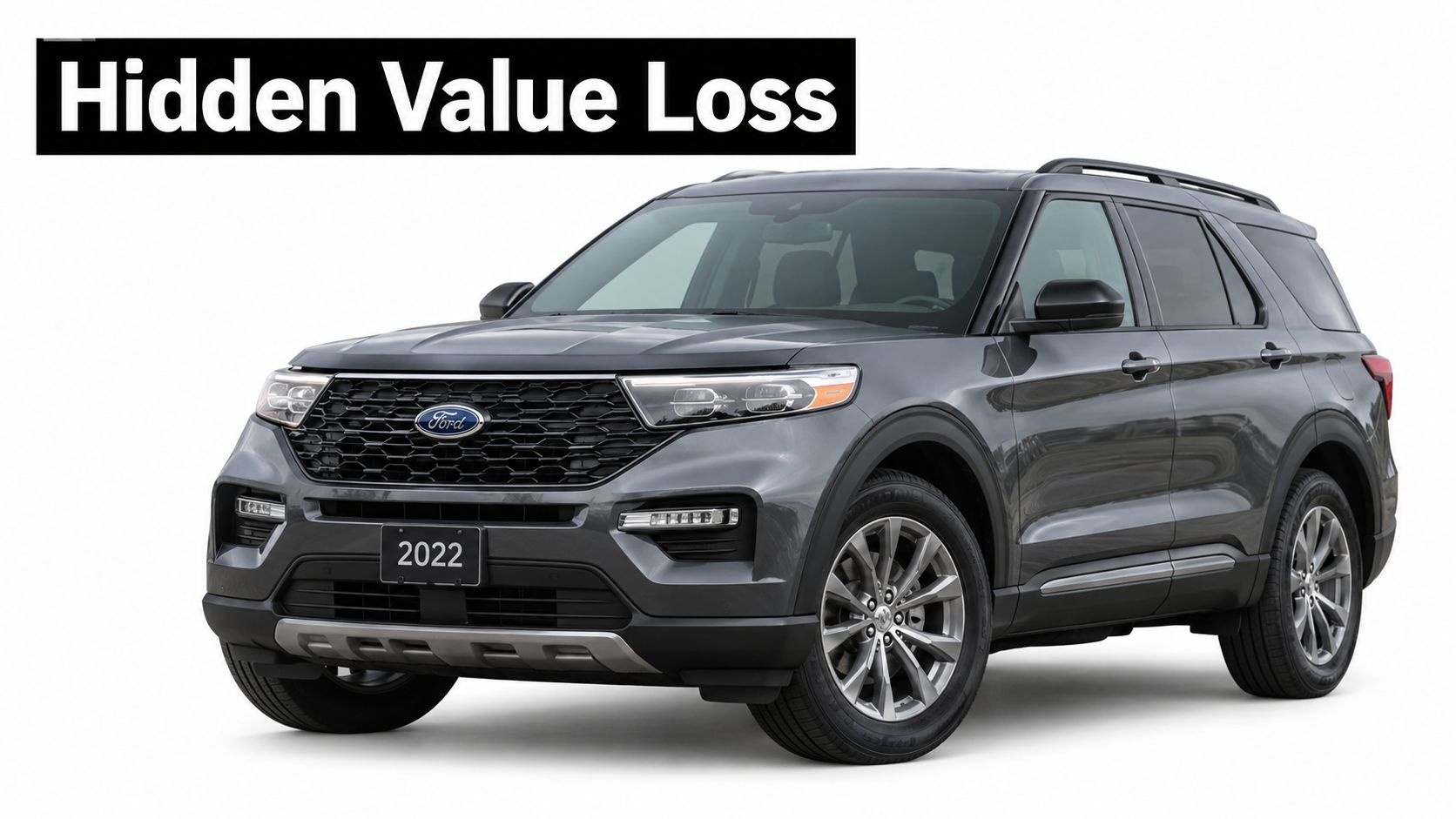
Car accident value loss, commonly called diminished value, means the reduction in a vehicle's market value after a crash, compared with its value just before the crash. A completed repair can restore how the car looks and drives without restoring what buyers are willing to pay. Buyers may see the accident record as a risk, even when the work was done correctly.
A repaired house with a disclosed foundation repair offers a useful comparison. The repair may be sound, but some buyers may still bid less because the history is part of the property's record. For cars, services such as CARFAX and AutoCheck can keep reported collision damage visible to future buyers and dealers. The record helps explain why the market gap may remain after repairs.
Four Numbers Owners Often Confuse
These figures describe different parts of the loss. Keeping them separate makes it easier to identify what a claim is asking the insurer to address.
- Repair cost: the shop's charge for parts and labor. It measures the work, not the vehicle's post-repair market value.
- Ordinary depreciation: the value a car loses over time through age and mileage, whether or not it has been in a crash.
- Total loss payout: when repair costs exceed the vehicle's value, the insurer generally pays based on pre-crash value minus salvage value. The vehicle is not returned as a repaired car with an accident record.
- Value loss: the difference in market value that remains after a repair, if buyers would pay less for the repaired vehicle than for a comparable one without the accident history.
The size of a possible gap depends on the vehicle's value. As a simple arithmetic example, a 20% reduction on a $50,000 vehicle is $10,000, while the same percentage on a $15,000 vehicle is $3,000. Those calculations illustrate how the same percentage produces different dollar amounts; they do not establish what any particular car lost. Newer and luxury vehicles may have more value at stake, but the claim still needs evidence of an actual market difference.
Five Ways the Loss Can Appear
| Type | What it measures | When it applies | Typical size |
|---|---|---|---|
| Immediate market loss | The potential drop in value after a reported collision | After the crash, including before repairs | Market summaries describe a broad range of about 10% to 30% of pre-crash value. |
| Inherent diminished value | The stigma that remains after a complete, correct repair | Accident history remains documented | Depends on comparable market evidence. |
| Repair-related loss | Value affected by poor or incomplete work, such as mismatched paint or alignment problems | When an inspection finds repair defects | Depends on the defect and cost to correct it. |
| Structural or airbag-related loss | Additional concern associated with frame damage or deployed restraints | When structural or safety-system repairs were needed | Depends on the damage and market response. |
| Total-loss payout, not diminished value | The pre-crash value minus salvage value | When repair costs exceed the vehicle's value | Based on the vehicle's pre-crash value and salvage value. |
The most disputed category is inherent diminished value. It concerns the market penalty that remains after proper repairs, not a problem with the body shop's work. Guidance on how accident history affects resale channels explains that accident history can affect private-party offers, trade-in negotiations, and eligibility for some certified pre-owned programs. A reported percentage alone cannot show how much a specific vehicle lost. The useful question is whether comparable vehicles with and without accident histories show a price gap.
For a negligence claim, property damage is generally assessed through the before-and-after difference in fair market value. Repair costs and loss of use are related issues, but they are distinct from the value difference. A paid repair bill therefore does not, by itself, establish that the vehicle's market value returned to its pre-crash level.
Self-check: A value loss question may be worth examining if the collision was reported, the vehicle was repaired and returned to you, and its documented history now shows the accident.
The core of the claim is proof, not a fixed percentage. Identify whether you are claiming lasting stigma, repair-related loss, or both, then compare the vehicle with similar cars whose accident histories differ. A number is persuasive only to the extent that the market evidence supports it.
How to Calculate Value Loss With Four Methods
No single method settles a claim on its own. The strongest files run at least two methods and check whether they land near each other.
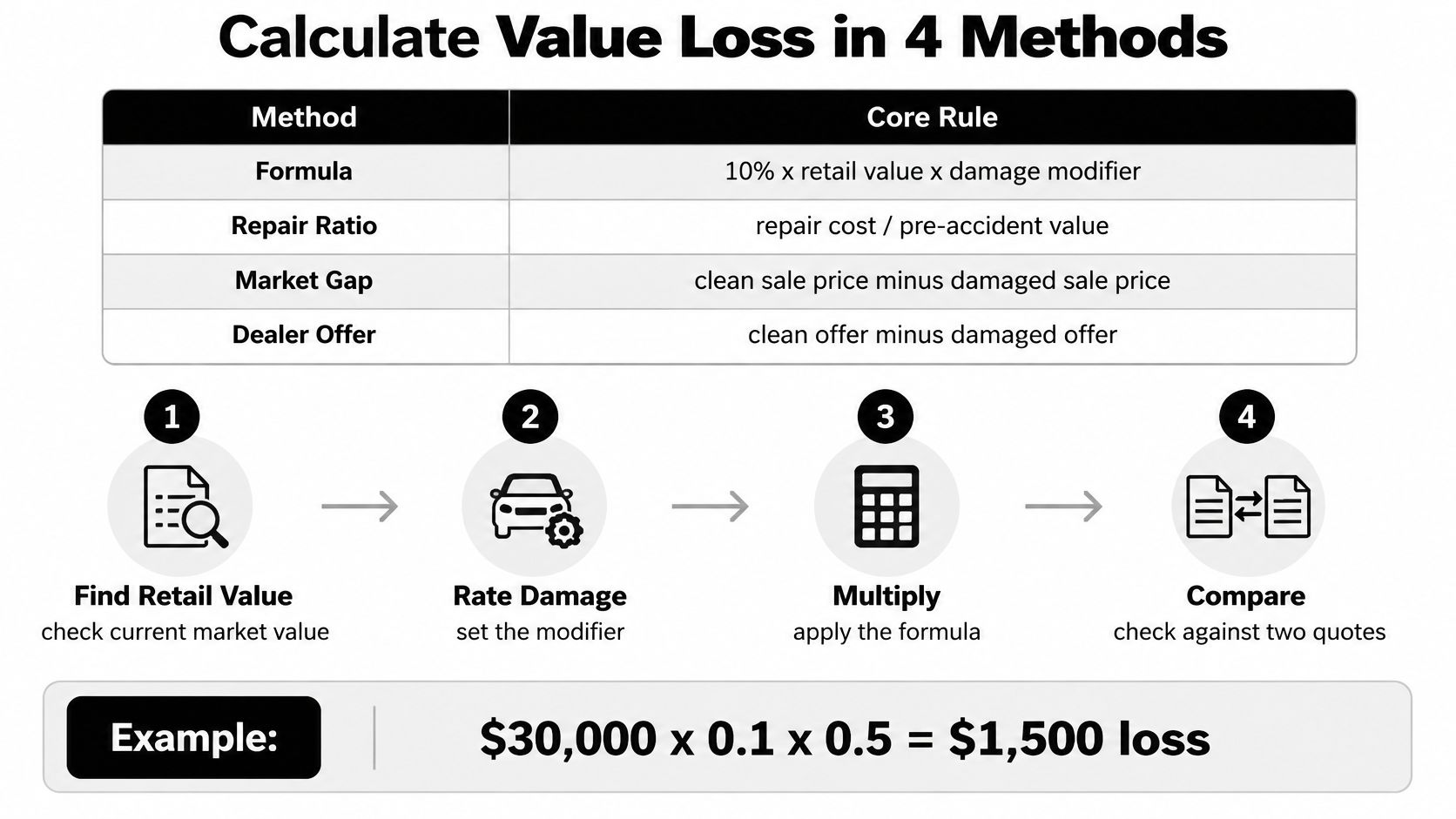
| Method | How it works | Best use | Worked example |
|---|---|---|---|
| Formula (17c and NAIC style) | 0.1 x retail value x damage modifier x mileage modifier | Fast first estimate before negotiating | $6,000 on the SUV below |
| Comparable-sales gap | Average clean-history price minus average accident-history price | Strongest proof when three or more comparables exist | $6,000 on the same SUV |
| Percentage rule of thumb | Broad percentage of pre-crash value | Quick sanity check only | Wide range, use with caution |
| Dealer buy-bid or appraisal | Written offers for your car compared with a clean equivalent | Trade-in or private sale disputes | Depends on the written bids you collect |
Running the Same SUV Through Two Methods
Step 1, establish pre-accident value. Use dated valuations for your exact year, trim, options, and mileage, not a generic listing you found today. In our example, the SUV was worth $50,000 before the crash.
Step 2, run the formula. The commonly cited 17c approach starts with 10% of pre-accident value, then applies a damage modifier and a mileage modifier, a structure that appraiser guidance on the 17c and NAIC formulation describes as 0.1 x NADA retail value x damage modifier x mileage modifier. For our SUV: 0.1 x $50,000 = $5,000. Multiply by a 1.5 structural damage modifier and you get $7,500. Multiply by a 0.8 mileage modifier and the estimate is $6,000.
Step 3, run the comparable-sales gap. Find at least three clean-history versions and three accident-history versions of the same model, trim, year, and mileage band in your market. Say the clean group averages $48,000 and the accident group averages $42,000. The gap is $6,000.
Step 4, reconcile. Here both methods agree, which makes the number easier to defend. When they disagree, don't average them blindly. Check whether your comparables match on trim and mileage, whether the damage modifier reflects structural work, and whether one group of listings is stale.
Why the Second Method Usually Wins Arguments
The formula captures a real relationship. Structural damage and deployed restraints scare buyers more than a repaired cosmetic panel, and higher mileage leaves less baseline value to lose. But a formula can't see your local market. Comparable sales can, because they show what buyers have paid for cars like yours, with and without the record you're stuck with.
A formula gives you a starting point for the conversation. Comparable market evidence is what turns that starting point into a claim someone else has to answer.
Use the percentage rule only to catch absurd results. If your formula output implies a loss far outside what comparable vehicles show, something in your inputs is wrong. Fix the inputs rather than defending the output.
First-Party and Third-Party Claims Compared
One rule covers most cases: the at-fault driver's insurer is usually the one that owes value loss. Your own policy is built mainly to pay for repairs.
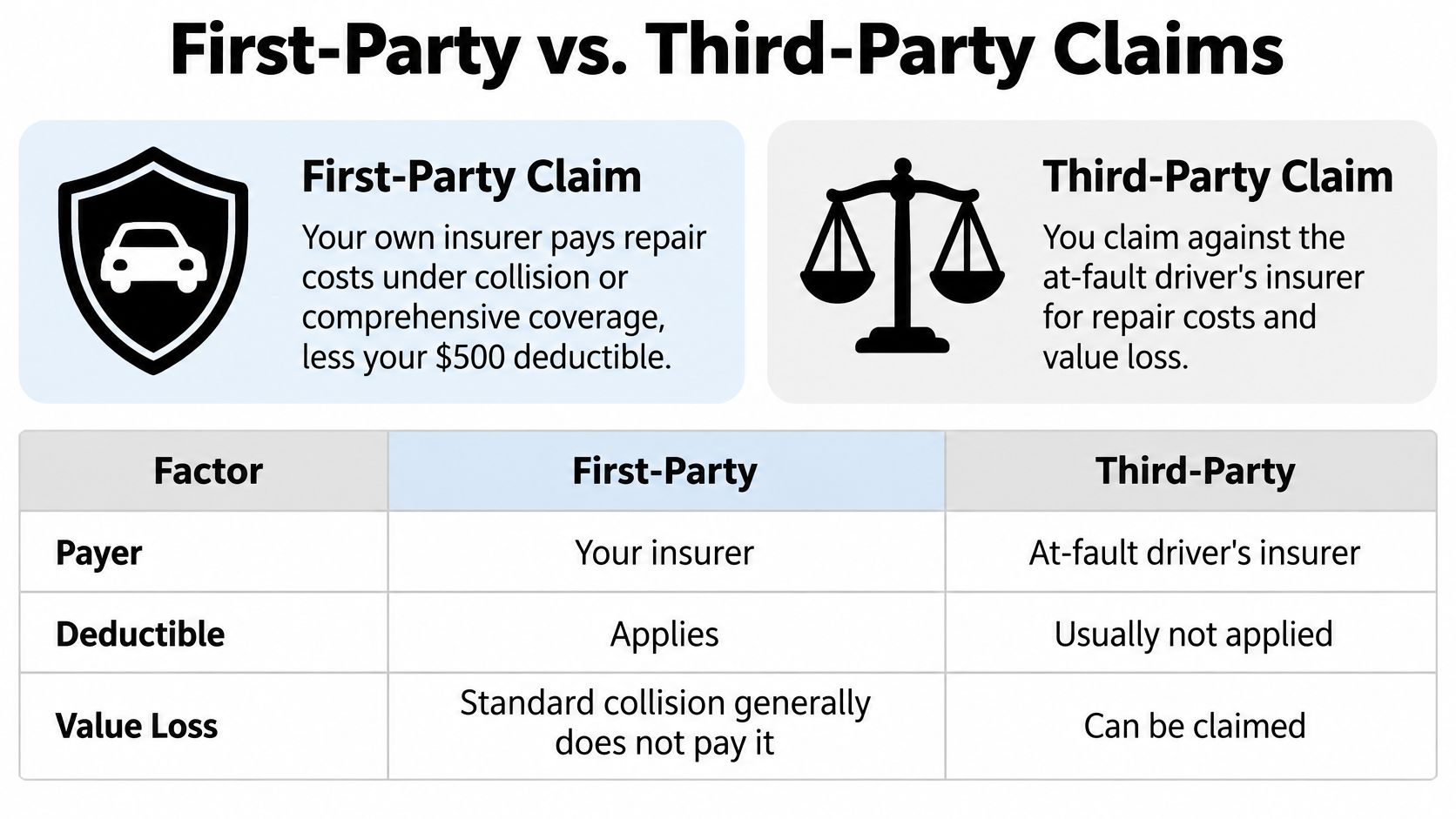
| Factor | First-party claim (your insurer) | Third-party claim (at-fault insurer) |
|---|---|---|
| Who you claim against | Your own insurer under collision or comprehensive | The at-fault driver's liability insurer |
| Value loss coverage | Generally not included in standard collision coverage, so check the policy | Available as damages when the other driver is at fault |
| Deductible | Applies to repair payments | None charged to you for the claim |
| Control of the repair | Insurer may direct the shop | You choose the shop and document the repair |
| Typical pressure point | Deductible and coverage limits | Adjuster disputes the lasting loss |
| When a lawyer is useful | Coverage denial or a disputed total loss | Offer rejected or liability disputed |
A first-party claim runs through your collision or full coverage. It pays repair costs less your deductible, and it's usually faster because there's no adversary arguing fault. The trade-off is that standard collision coverage generally doesn't pay diminished value, so reading your actual policy wording comes before assuming anything.
A third-party claim runs against the at-fault driver's liability insurer. This is the normal route for car accident value loss, because the loss flows from the other driver's negligence. The trade-off is control: their adjuster frames the early conversation and often opens with a formula-based figure or a denial that repairs made you whole.
The Third-Party Sequence in Order
- Report the claim and get the claim number and adjuster's name.
- Send the pre-loss valuation and repair records once repairs are complete.
- Receive the offer and ask for it in writing with the method behind it.
- Counter with comparable evidence rather than a bare percentage.
- Escalate to a written demand if the gap stays large.
- File suit if the offer remains unreasonable and your deadline allows.
Where it's practical, document the vehicle's value before repairs begin, and on the third-party route pick the shop yourself. Whoever holds the repair file holds half the evidence, and you'd rather that be you.
Evidence to Gather Before You File
A repair invoice proves what was fixed. A value claim has to prove something different: what the market now pays for your car. Build the file to answer both questions, because NAIC guidance on documenting diminished value ties a defensible claim to preserving the repair estimate, parts and alignment records, photographs, vehicle-history report, and comparable listings or sales.
The Checklist and What Each Item Proves
- Dated pre-accident valuation: fixes the starting number before anyone argues about it later.
- Complete repair estimate and final invoice: shows the full scope, including supplements the shop added mid-repair.
- Parts and alignment records: reveal whether structural components were repaired or replaced.
- Calibration records for cameras and sensors: prove safety systems were restored, which matters when an adjuster questions repair quality.
- Photographs before and after repair: document severity and finished condition in a way estimates can't.
- Police report and crash details: anchor fault, date, and impact description.
- Vehicle-history report showing the collision: proves the disclosure that creates the market penalty.
- Comparable listings or sales, clean and accident history: prove the price gap itself.
- Dealer buy-bids or an independent appraisal: give you a written market opinion tied to your specific car.
How the Pieces Connect
Think in three links. The crash records prove the physical event. The repair file proves scope and quality, including whether airbags deployed or structure was involved. The comparables and bids prove the market consequence. A file missing the third link invites the response that your loss is speculation.
Two habits protect the file while you build it. First, ask the shop for its complete file, not just the final bill, and keep the damaged parts or at least photographs of them until the claim resolves. Second, save the date on every comparable listing you capture. Listings disappear, and a screenshot with a date can still be checked months later.
The gap invoices can't show: a technically perfect repair can still carry a disclosed-history penalty, because the buyer is discounting the record, not the workmanship.
That gap is exactly why market evidence isn't optional decoration. It's the only part of your file that measures the loss you're claiming.
Colorado Rules, Deadlines and Limitations
Suppose your repaired car looks and drives like it did before the crash, but buyers offer less after seeing its accident history. Colorado law sets no percentage or formula for that difference. The Colorado Division of Insurance says no Colorado insurance law specifically addresses diminished value, as explained in Colorado's official auto insurance guidance. Your claim depends on evidence that the vehicle's market value fell, rather than a fixed calculation. For background on fault and claims in the state, see this overview of Colorado car accident laws.
Colorado is an at-fault state, so a diminished-value claim generally goes to the negligent driver's liability insurer. Fault allocation can affect whether you recover and how much. Under modified comparative negligence, you may recover if your fault is not greater than the defendant's fault. If you share fault, your recovery is reduced by your share. If your fault is greater than the defendant's, you cannot recover under this rule. With multiple parties, compare the claimant's fault with the defendant or defendants' fault as the applicable rule requires, rather than treating 50% as an automatic cutoff in every case.
An insurer may dispute your share of responsibility because it changes the amount recoverable. A recorded statement can affect how fault is assessed, so understand what you are being asked before agreeing to one.
General Time Limits to Calendar
| Claim type | General time limit | Governing rule | What it means for you |
|---|---|---|---|
| Negligence claim for property damage | Generally 2 years from the crash | Colorado tort limitation statute | Calendar the crash date as your deadline |
| Personal injury claim | Generally 2 years from the crash | Colorado tort limitation statute | Run it alongside any value loss claim |
| Breach of contract (policy dispute) | Generally 3 years | Colorado contract limitation statute | Applies to disputes over policy terms |
| Wrongful death | Generally 2 years | Colorado wrongful death provisions | Surviving family members should act early |
| Diminished value specific statute | None exists | Colorado Division of Insurance guidance | Proof rests on market evidence |
These are general time frames, not personal legal advice. Exceptions and the discovery rule may affect when a deadline begins, and settlement discussions do not pause the clock. An insurer may continue negotiating while the filing deadline approaches. Use the crash date as a cautious starting point, then confirm the applicable deadline with a lawyer.
The legal framework supplies no automatic dollar amount for value loss. For example, a repair invoice can establish what work was done, but it does not by itself show how much less a buyer would pay for the repaired car. The claim is strongest when the evidence supports a specific market gap for that vehicle. A percentage alone cannot establish the loss, just as a repair bill cannot prove what the car would sell for. If comparable market evidence does not support the amount claimed, there is no statutory formula to fill that gap.
Demand Letter Template for Diminished Value
A demand letter works when an adjuster can verify every number in it without calling you. Keep it factual, attach the proof, and send it in writing rather than relying on a phone conversation. If you want a fuller walkthrough of demand structure, this guide to a settlement demand letter covers the general format.
The Eight Parts in Order
- Identify the claim. Your name, claim number, date of loss, and the vehicle by year, make, model, and mileage.
- State liability briefly. Name the at-fault driver and cite the police report number. One or two sentences is enough.
- Give the pre-accident value. State the amount, the valuation source, and its date.
- Describe the repair scope. Mention structural or airbag work specifically, since those drive buyer discounts.
- Present the comparable evidence. Summarize the clean-history and accident-history groups and the gap between them.
- State the demand. Give the exact amount and show the reasoning in one short paragraph.
- Set a response deadline. Thirty days is a reasonable, professional window.
- List enclosures. Valuation, repair file, photographs, history report, and comparables.
A Sample Valuation Paragraph
Adapt this sentence pattern with your own figures and attachments:
The vehicle was worth [amount] before the collision according to the attached dated valuation, and comparable accident-history vehicles sell for [amount] less according to the attached listings, which supports a diminished value claim of [demand amount].
Use bracketed placeholders only while drafting. Replace every one before sending, and check that each number matches an enclosure. An adjuster who finds one unsupported figure tends to discount the rest.
Keep the tone flat and specific. Describe your next step if the deadline passes, but don't threaten anything you won't do. Send the letter so you can prove receipt, keep a complete copy with attachments, and note the response date on the same calendar that holds your filing deadline.
Common Questions About Value Loss Claims
1. Can I claim value loss on a leased car? Usually the lessor owns the vehicle, so who can claim and who can sign a release depends on your lease terms. Read the lease before filing anything, and expect the lessor to be involved in the decision.
2. What if I already sold or traded the car? A completed sale narrows your proof but doesn't erase it. Keep the sale contract, written trade-in offers, and any dated pre-sale valuation, because those documents become your market evidence of what the car brought.
3. Will a third-party claim raise my premium? It shouldn't affect your own rates, because the at-fault driver's insurer pays. A first-party claim under your own policy can affect your rates, so ask your insurer before you open one.
4. How long does a value claim take? A straightforward claim with a cooperative adjuster can settle in weeks. A disputed valuation can run for months, which is why the filing deadline belongs on your calendar from the start rather than after negotiation stalls.
5. Does a vehicle-history report show my dollar loss? No. It shows the collision record and nothing about price. The dollar figure has to come from your valuation and comparable evidence.
6. Does value loss change a total-loss payment? No. A total-loss payout is built on pre-crash value minus salvage, and it doesn't add a separate payment for post-repair stigma because the vehicle isn't repaired and returned.
Decide Whether to Hire a Lawyer Before You Settle
Some value loss claims settle fine without counsel. Others stall because the dispute isn't really about arithmetic. It's about proof, bargaining power, and time.

Signs Counsel Is Worth Considering
- The insurer disputes the lasting loss or insists the repair made you whole.
- Structural damage or airbag deployment is involved, or repair quality is hard to verify.
- An injury is part of the same crash, so property and injury claims interact.
- A commercial or truck vehicle is involved, which adds parties and coverage layers.
- The offer sits well below your comparables and the adjuster won't explain the gap.
- Your filing deadline is within 90 days and nothing is resolved.
Self-representation is more reasonable when the loss is small, the adjuster is engaging with your evidence, and your comparable set is clean and well documented. In that posture, a firm written demand may finish the job. If you're weighing the costs and benefits, this breakdown of whether an attorney is worth it after a car accident walks through the trade-offs.
A short video walkthrough can also help you hear how these claim issues get framed before you decide:
What a lawyer adds is mostly infrastructure: access to valuation experts, a file organized to a proof standard, and the credible ability to file suit before the deadline. Nares Law Group LLC, a Denver personal injury firm licensed in Colorado, offers free consultations for motor vehicle, truck, and brain injury cases and can review your valuation and deadline in a single meeting.
Your Next Actions in Order
- Calendar the deadline from your crash date today.
- Assemble the evidence package before negotiating further.
- Request the adjuster's position in writing, including the method used.
- Book a free consultation if any criterion above fits your situation.
- Don't sign a release until the value question is settled, because a signed release usually ends it.
If an adjuster is treating your repaired car's lost value as zero, you don't have to accept that framing or work out the proof alone. Nares Law Group LLC helps Colorado crash victims value the full property loss, protect their deadlines, and negotiate from documented evidence. Reach out for a free consultation and bring your repair file and valuations so the conversation starts with your actual numbers.