You're home from the ER. The CT scan was normal, the discharge paper says concussion, and you're supposed to rest. Three days later you can't follow a recipe, light hurts, you lose words mid-sentence, and your spouse says you snapped at the kids over nothing. Work is calling. The other driver's insurer is calling faster. That's where most families I meet are stuck, not at the crash scene. Traumatic brain injury law is built for that gap between a normal scan and a life that isn't working normally anymore.
What a Traumatic Brain Injury Claim Actually Is
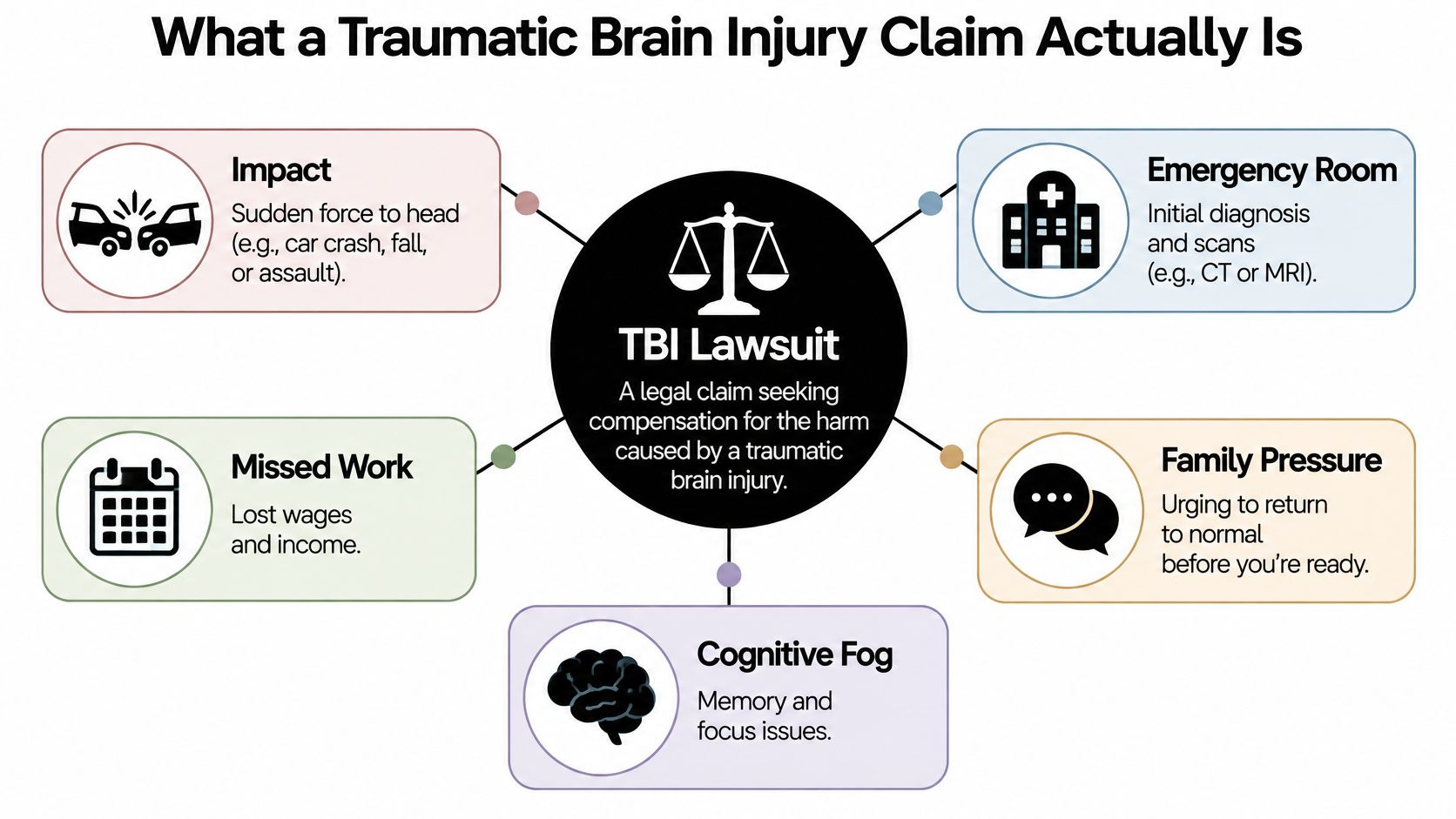
A truck runs a red light on a Colorado highway. Your head snaps forward, maybe hits the headrest, maybe doesn't hit anything at all. At the ER you're dizzy and confused, you answer questions slowly, and you're sent home once bleeding is ruled out. In the next 72 hours, headaches build, sleep fragments, and simple emails take an hour.
That sequence is a claim in embryo. It isn't just a medical bill. It's a legal argument that someone's carelessness caused a brain injury, and that injury caused specific losses you can prove. The medical labels matter, but they don't decide the case by themselves.
Mild, Moderate, and Severe Don't Mean What You Think
Mild TBI often means brief confusion or loss of consciousness and normal initial imaging. Moderate TBI usually involves longer unconsciousness, clearer cognitive and speech problems, and sometimes visible trauma on imaging. Severe TBI can involve coma, bleeding, swelling, surgery, and permanent deficits. The word mild describes the initial presentation, not your next six months at work or at home.
The scale of harm explains why courts take these cases seriously when proof is built correctly. Federal data recorded about 214,110 TBI-related hospitalizations in 2020, and the CDC reported more than 69,000 TBI-related deaths in 2021. Those numbers don't prove your case. They show why a claim must connect event, injury, and consequence with records, not assumptions.
Federal policy followed the same recognition. The Traumatic Brain Injury Act of 1996 established a federal framework for prevention, research, surveillance, and access to services, and later amendments expanded rehabilitation research. It wasn't a compensation statute. It helped move TBI into public health and disability policy, which is why modern claims look beyond the ER to cognition, rehabilitation, future care, and lost earning capacity.
If that arc sounds like yours, impact, discharge, fog, missed work, family pressure to be fine, you're in the right place. The questions from here are fault, proof, and value.
The Legal Elements You Have to Prove
Every Colorado negligence claim asks four questions. If you can't answer one, the other three don't save it. Learn them now, because an adjuster and a jury will use the same list.

Think of a shopper pushing a cart around a blind corner in a grocery aisle. She owes other shoppers reasonable care to slow down and look. A driver owes you the same basic duty, scaled up for speed and weight.
The Four Questions in Order
- Duty: Did the other person or company owe you reasonable care? Drivers, trucking companies, property owners, and employers usually do, though the source of the duty differs.
- Breach: Did they fall below that standard? Running a light, texting, sending a fatigued truck driver out, or leaving ice on an entryway are breaches you prove with reports, video, logs, and witnesses.
- Causation: Did that breach cause the brain injury? You need a medically plausible chain from force to symptoms to limitations, not just timing.
- Damages: What did you lose in dollars, function, and quality of life? Bills alone rarely capture a brain injury.
Take a car striking a pedestrian in a crosswalk. Duty is clear. Breach may be failure to yield. Causation turns on ER notes, symptom onset, and treating opinions. Damages turn on work records, cognitive testing, and what family members observed changing at home.
Trucking and premises cases shift the evidence, not the framework. Trucking adds company policies, maintenance, and driver qualification files. Premises adds notice, meaning whether the owner knew or should have known about the hazard.
Pre-existing depression, prior concussion, or migraine history doesn't kill a claim. It changes the causation work. Your lawyer has to separate what existed before from what this event aggravated or made worse, with records from before and after.
You control some of this proof. You control consistent symptom reporting, follow-up care, and preserving photos and messages. You don't control the truck's data or the store's video, and that evidence disappears fast. That's a reason to get counsel involved early, not after you've tried to assemble it alone.
Damages You Can Recover After a Brain Injury
Don't price a brain injury off the emergency bill. That's the cheapest chapter. A serious claim separates immediate costs, future needs, and human losses, then attaches evidence a jury can award.
Economic damages are the losses with receipts and projections. They include past medical care, rehabilitation, medication, future treatment, lost wages, and reduced earning capacity. Non-economic damages cover pain, cognitive loss, emotional distress, and loss of enjoyment of life. Wrongful death claims, brought by surviving family in fatal cases, address funeral costs, lost financial support, and the family's loss.
Damage Categories in a Colorado TBI Claim
| Category | What It Covers | Typical Evidence |
|---|---|---|
| Past and future medical | ER, neurology, therapy, rehabilitation, future care | Bills, treatment plans, life-care plan |
| Lost earnings | Missed work, reduced hours, lower-level job | Payroll, tax records, vocational opinion |
| Non-economic loss | Pain, fog, mood change, lost enjoyment | Symptom log, family testimony, testing |
| Household and care help | Caregiving, chores you can't do | Calendars, caregiver records, receipts |
Consider a rehabilitation nurse in her mid-thirties who can't track medication orders safely after a crash. Her ER bill is minor next to retraining, years of reduced earnings, cognitive therapy, and supervision needs at home. A life-care planner maps future care. A vocational expert explains what jobs remain realistic. An economist converts those opinions into present value. Without that team, the future gets guessed at, and guessed-at damages get cut.
Returning to work complicates valuation, and insurers exploit it. A 2025 systematic review found moderate evidence that return-to-work outcomes improve when vocational services are combined with cognitive, mental-health, and multidisciplinary care. Returning at fewer hours, with accommodations, slower output, or constant fatigue isn't full economic recovery. Document the accommodations. Document the mistakes, the extra time, the demotion risk.
Colorado also applies modified comparative fault. If you're partly at fault, your recovery is reduced by your share, and if your fault reaches the legal cutoff, you may recover nothing. That makes early fault evidence valuable. It isn't a distraction from damages. It directly changes what damages you keep.
How Lawyers Prove a Mild Brain Injury
A normal MRI is the defense's opening line, and it should be their weakest one. Mild TBI is proved by convergence: symptoms reported close to the crash, changes other people can name, work or school records that show the cost, and testing that fits the person's history rather than a number pulled from thin air.
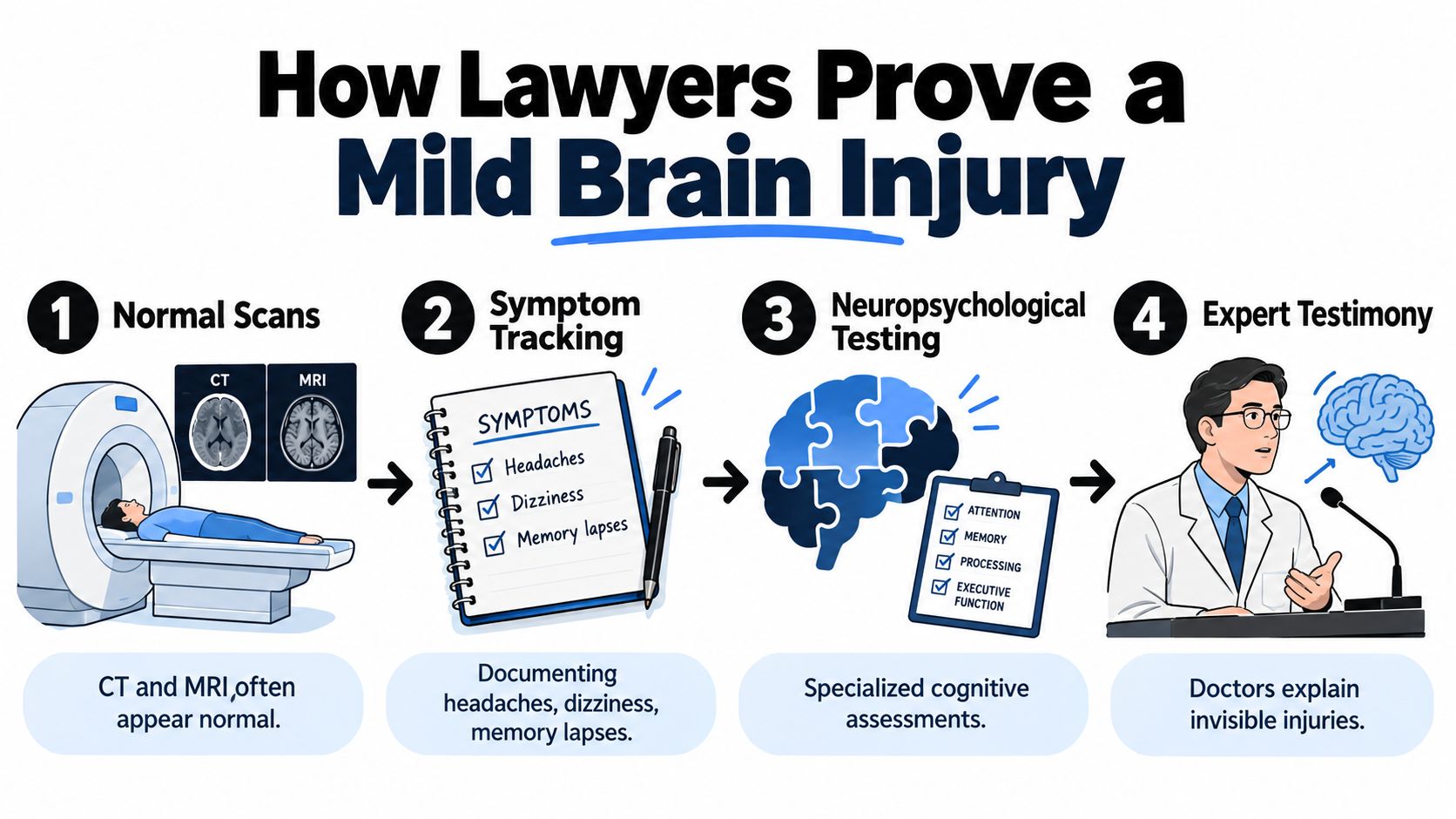
Conventional CT and MRI rarely show objective abnormalities in mild cases, so diagnosis often rests on history and symptoms such as confusion, dizziness, headache, fatigue, and memory trouble. Newer blood-based biomarkers are not yet sufficiently validated for routine clinical, legal, or policy use. That is why I build the file like a timeline: ER and primary-care notes within days, a dated symptom log for sleep, headaches, word-finding, missed tasks and fatigue, spouse and coworker accounts of specific before-and-after changes, then performance proof such as reviews, errors, reduced hours, accommodations, or failed retraining.
Testing helps when it is disciplined. Families should understand what cognitive testing for TBI actually measures before agreeing to any evaluation, because raw scores mean little without effort, education, language, and prior ability. A neuropsychologist who can say "this profile fits the person and the mechanism" carries weight. A screening printout does not.
Advanced imaging needs the same restraint. DTI can show group-level patterns, but available reviews report no sufficiently validated DTI method for determining mild TBI in a single patient. Functional imaging has similar limits: current literature does not show consistent relationships between SPECT findings and neuropsychological testing, behavior, or structural imaging. Used carefully, these studies corroborate a clinical story. Offered alone, they invite a reliability fight you do not need.
The strongest mild-TBI file usually looks ordinary to Colorado jurors: consistent complaints, consistent treatment, consistent work impact. Treating providers matter more than a hired opinion with no history. Go to follow-up. Report mood and sleep. If a symptom improves, say what improved and what remains. Gaps get explained by records. Silence gets explained by the defense.
Colorado Deadlines and Statutes of Limitation
A family calls a lawyer at month twenty-two. Records are organized, symptoms are documented, everyone is ready to fight. The answer they get: the deadline passed four months ago, and no judge weighs how badly you're hurt if you file late.
Deadlines end good cases.
Colorado generally gives you two years for personal injury and wrongful death claims. Treat that as the outer wall, not a planning target. Evidence, witnesses, and insurance positions harden long before year two. Read Colorado's personal injury statute of limitations rules and then confirm your specific date in writing, because the clocks below run faster than the headline number.
Where the Two-Year Answer Misleads
| Shorter clock | What trips families up |
|---|---|
| Government claims | A city vehicle, public school, or government entity triggers written notice deadlines far shorter than the lawsuit deadline. Miss notice and the claim dies before suit is ever filed. |
| Policy notice | Your own insurance may require prompt notice for medical payments or uninsured motorist coverage. You can lose a coverage fight on notice while the court clock stays open. |
| Wrongful death standing | Who may file, and when, can shift during the claim period. No relative should assume they can sign at any time. |
The discovery rule covers injuries that aren't immediately known. In some circumstances, the clock starts when you knew or reasonably should have known of the injury and its likely cause, not on the crash date alone. Don't build your case on that argument if you can avoid it. Late-emerging cognitive symptoms help explain delay, but once symptoms are clear, every month you wait weakens the explanation.
Tolling pauses the clock for minors and people under certain legal disabilities. The rules are technical, and they don't apply the same way to every claim or every defendant. A parent's claim for medical expenses can run on a different schedule than a child's claim.
Once the deadline passes, the case is usually gone for good. Insurers know this. Friendly delays, requests for more records, and slow negotiations don't stop your clock. Only a timely filed claim or a written tolling agreement protects you. Calendar the crash date, every notice date, and the two-year date today. Then work backward by months, not days.
Insurance Tactics and How to Counter Them
An insurer isn't your enemy. It's a business pricing risk, and on a brain injury file its risk is that invisible symptoms become expensive future care. Expect the company to test whether your proof is real or temporary.
The visual below pairs the tactics families see most often with the response that protects value.
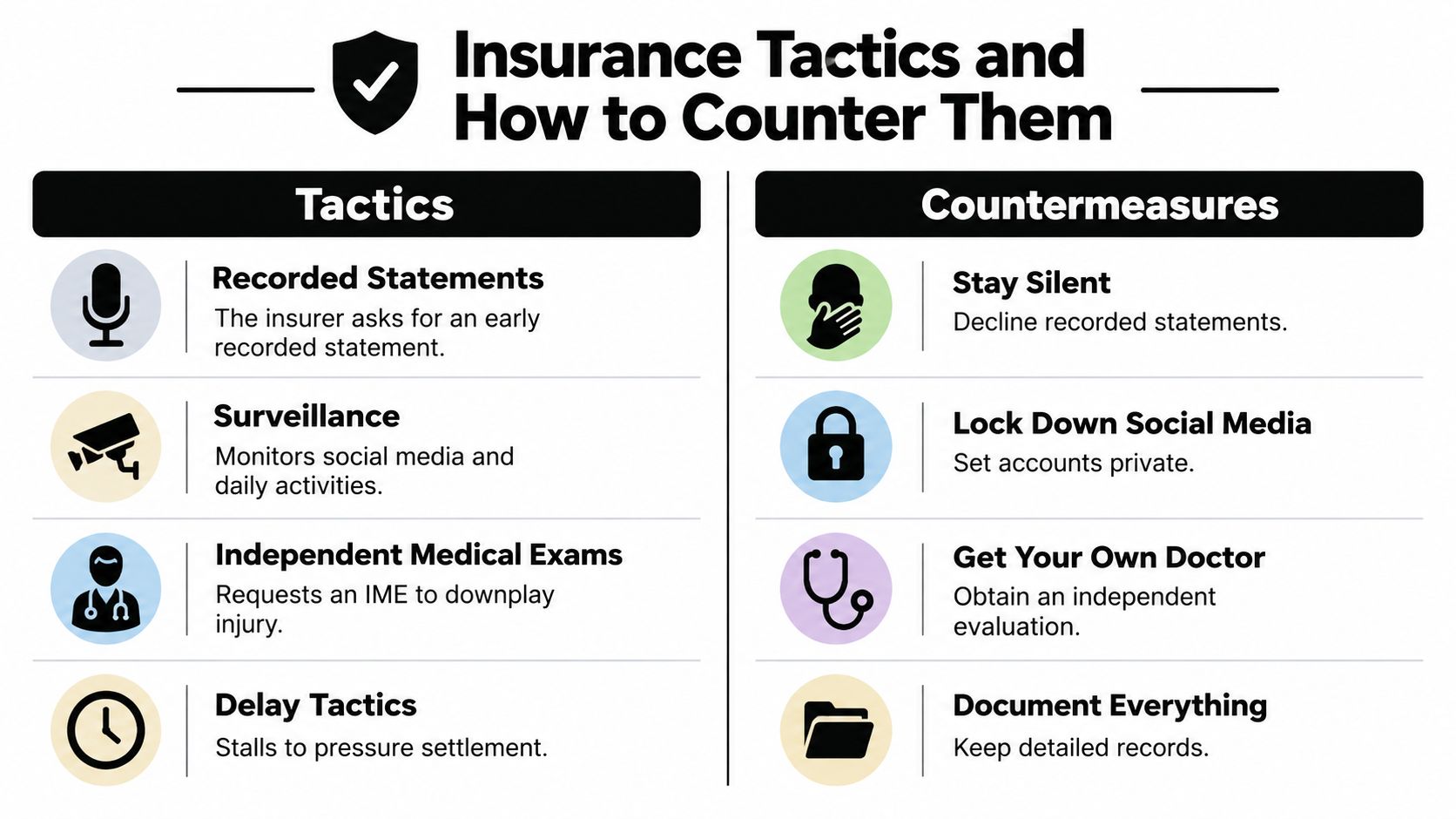
Recorded statements come first, often while you're foggy. Decline politely and refer the adjuster to counsel. Broad medical authorizations come next. Don't sign permission for a lifetime of records without advice, since unrelated history will be mined for alternative causes. If you're unsure what investigators may look for, review how an insurance company investigation typically unfolds before you authorize anything.
Gaps in treatment are the adjuster's favorite discount. Missed appointments become an argument that you recovered, even when you missed because you forgot, couldn't drive, or couldn't afford care. If you miss care, document why and reschedule. Consistency reads as credibility.
The short video below is worth watching before your next adjuster call, especially if you're tempted to explain symptoms off the cuff.
Exams and Early Offers
An independent medical exam is usually neither fully independent nor just an exam. The insurer picks the doctor. Prepare with your lawyer, answer truthfully and briefly, don't exaggerate, and don't minimize. Assume your behavior in the waiting room is observed.
A fast offer feels generous next to unpaid bills. It usually prices the ER visit, not cognitive therapy, reduced earnings, or relapse after return to work. Don't accept or sign a release until your condition and future needs are understood. A demand package should price the case for trial, with records, testing, witness statements, and expert support, rather than beg for a quick settlement. Lock down social media, stop posting activity updates, and keep every letter. One smiling photo won't disprove a brain injury, but you'll spend months explaining it.
Steps You Should Take Right After a Suspected Brain Injury
Get evaluated the same day, even if you feel mostly fine. Tell the ER about head impact, confusion, vomiting, vision changes, memory gaps, and any loss of consciousness, however brief. Then see your primary care doctor or a neurologist within days. Discharge paperwork is a starting point, not a recovery plan.
Through the first month, report every symptom at every visit. Headache, dizziness, fatigue, irritability, sleep trouble, word-finding problems, and sensitivity to light or noise all belong in the chart. A symptom you never mention is a symptom the defense argues never existed.
Keep a dated log of how you function. Missed appointments, forgotten conversations, work errors, tasks you needed help with. Two lines a day is enough, and the entries should be dull. Contemporaneous notes beat reconstructed memory in a deposition every time.
Preserve the physical record before it disappears. Vehicle photos, scene photos, dash video, damaged helmets or clothing, the crash report, witness names with phone numbers. Once a car is repaired or a helmet hits the trash, that evidence is gone. Notify your employer in writing and keep schedule changes, accommodation requests, and pay records showing missed time or reduced output.
Don't overperform recovery. Returning to full duties too soon or gritting through symptoms to look tough can set back your healing and hand the defense a story about how minor this was. Families usually spot the true cost first. Let yours tell the doctors what they see, because you may be the last to notice you're forgetting conversations or losing your temper faster.
When you meet with counsel, bring the log, the discharge papers, and one of those family members. A lawyer's investigation runs in parallel with your treatment, starting the week you hire counsel, not after your doctors discharge you. That first meeting goes better with specifics than with a summary that you're struggling.
Choosing the Right Lawyer and What Happens Next
A generalist who settles soft-tissue cases quickly may not be staffed for a brain injury. These claims need medical coordination, experts, and patience. Ask direct questions at a free consultation and listen for direct answers.
Ask how many TBI cases the firm carries, who will handle yours day to day, and what trial experience the team has when insurers discount normal imaging. Ask which specialists they work with, including neurologists, neuropsychologists, physiatrists, vestibular providers, life-care planners, and vocational experts. Ask how fees and case costs work, in plain language, before you sign.
Your First 90 Days of Representation
Expect investigation and preservation letters first, then record collection and a treatment timeline. Your lawyer should identify missing follow-up, prior records that affect causation, and insurance coverage beyond the at-fault driver's policy. You should hear what not to do as clearly as what to do, including adjuster contact, social media, and recorded statements.
You don't need a lawyer who promises a number at intake. You need one who can tell you what's missing from your file and how they'll get it.
One option in Colorado is Nares Law Group LLC, a Denver personal injury firm that represents people in motor vehicle, truck, traumatic brain injury, and wrongful death cases and handles investigation, treatment coordination, negotiation, and trial preparation. Compare any firm you interview against the criteria above, including responsiveness and willingness to co-counsel on complex trucking matters. Free resources, including webinars and the Mother Justice podcast, can also help families learn before they commit.
Do three things today. Preserve every record, photo, message, and pay stub in one folder. Stop giving statements to adjusters. Book a consultation while deadlines and video evidence are still on your side. A TBI claim has a shape, and it gets more winnable when proof is built early. You don't have to be fully recovered, or fully certain, to ask for a review of where you stand.
If your family is dealing with a brain injury after a Colorado crash or truck wreck, Nares Law Group LLC can review your records, explain your deadlines, and coordinate the medical and expert proof your claim needs. Reach out for a free consultation and get a clear plan before you talk settlement with any insurer.