In Colorado, the personal injury statute of limitations is generally 3 years from the date the injury occurred, with major exceptions for minors, mental incapacity, hidden injuries under the discovery rule, and shorter special deadlines for wrongful death and medical malpractice. If you wait too long, your case can die even if liability is obvious and your injuries are serious.
That's the part many people miss. You're dealing with pain, car repairs, medical appointments, missed work, insurance calls, and maybe a concussion that makes basic paperwork feel harder than it should. Meanwhile, the legal clock is running.
I see this problem constantly with crash victims, families dealing with traumatic brain injuries, and people who assume they'll “handle the legal side later.” Later is how deadlines get blown. It's also how evidence disappears, witnesses stop answering, and surveillance footage gets erased.
The phrase statute of limitations personal injury sounds technical. It isn't. It means one thing that matters to you right now: how long you have before Colorado courts can refuse to hear your case. Colorado's deadline is important, but generic internet answers are often sloppy. They ignore latent injuries, they ignore minors, and they ignore the fact that filing windows have changed in other states, which matters more than people think in trucking, travel, and multi-state injury cases.
What the Statute of Limitations Means for Your Colorado Injury Claim
A statute of limitations is the legal filing deadline for a lawsuit. It is not a suggestion, and it is not controlled by the insurance company's pace. If the deadline passes before a lawsuit is properly filed, the defendant will usually ask the court to dismiss the case.
That outcome surprises people because they think a strong claim survives on its merits. It doesn't. A strong case filed too late is still a late case.
Why this deadline exists
Colorado injury law uses deadlines for practical reasons:
- Evidence stays fresher: Witnesses remember more early on.
- Records are easier to find: Incident reports, photos, repair files, and treatment records are more complete.
- Defendants get finality: People and businesses aren't supposed to face open-ended lawsuit risk forever.
- Injured people are forced to act: That may feel harsh, but it's how the system works.
For injured Coloradans, the headline rule is straightforward. Colorado uses a 3-year statute of limitations for personal injury claims according to a state-law summary cited in this personal injury deadline survey. If your claim arose in Colorado, that's the number to know first.
What happens if you miss it
Practical rule: If you're even close to the deadline, stop debating and get the file reviewed immediately.
When the filing window closes, the courthouse door usually closes with it. That's true whether your injury came from a rear-end crash on I-25, a fall in a grocery store, or a work-related incident involving a third party. It also means settlement power drops fast once the other side believes you can't sue.
Some Colorado claims are more complicated from the start. Wrongful death uses a different deadline. Medical malpractice works off a different trigger. Child injury claims can be tolled. Hidden injuries can shift the accrual analysis. If you need a broader overview of the state rules that shape these cases, review Colorado personal injury laws.
How the Clock Starts in Colorado Personal Injury Cases
A crash happens on Friday. You feel sore, skip urgent care, and go back to work Monday. Two weeks later, the headaches, dizziness, and memory lapses start. Now the deadline question shows up. Did your Colorado clock start on the day of the crash, or when you reasonably connected those symptoms to the crash?
That question decides cases.
In many Colorado injury claims, the clock starts on the date of the event because the injury and its cause are obvious right away. A broken wrist after a rear-end collision is the easy example. You know you are hurt, and you know why.
The harder cases involve injuries that stay quiet at first or look minor until they do not. Concussions, traumatic brain injuries, some neck and spine injuries, toxic exposure claims, and medical harm can all create a later fight over accrual. Colorado courts do not reward guesswork here. They look at when you knew, or reasonably should have known, that you were injured and that the injury was tied to someone else's conduct.
That is where generic internet advice goes wrong. Plenty of articles flatten every state into one simple rule. Colorado's three-year window matters, but the start date still takes work in latent-injury cases. Recent rule changes in other states have made national explainers even less reliable. If you read a state-by-state article and assume Colorado works the same way, you can misread your deadline by months or even years.
Brain injury cases are a good example. A lot of injured people walk away from a crash feeling "shaken up" and nothing more. Later they develop light sensitivity, sleep disruption, confusion, mood changes, or trouble concentrating. Defense lawyers routinely argue that the person should have connected those symptoms earlier. Your job is to build the timeline before they do.
Track both dates from day one:
- The date the event happened
- The date you discovered, or reasonably should have discovered, the injury and its cause
Do not treat those as the same date unless the facts make that unavoidable.
Minor claimants make the analysis even more different from the generic version. A child injured in Colorado may get tolling protection that an adult does not. That can make the claim stronger on timing, but it does not mean families should wait. Evidence still disappears, witnesses forget details, and insurers get harder to deal with as time passes.
One warning matters here. "I did not know how serious it was" is not the same as "I did not know I was injured." Severity, diagnosis, and legal accrual are related, but they are not identical. If you are relying on delayed discovery, expect the other side to argue that a reasonable person would have investigated sooner.
Write out the timeline now. Include symptom onset, missed work, urgent care visits, primary care notes, imaging, referrals, and the first provider who tied the condition to the accident or exposure. In a close Colorado case, that timeline can be the difference between a claim that survives and one that gets dismissed.
Colorado Filing Deadlines for Personal Injury, Wrongful Death, and Medical Malpractice
Colorado injury law is dangerous because the deadlines look similar until they don't. People hear “I have a few years” and stop there. That's how families miss shorter filing windows.
Here's the comparison that matters most.
Colorado Personal Injury Filing Deadlines at a Glance
| Claim Type | Filing Deadline | Statute (C.R.S.) | Clock Starts On |
|---|---|---|---|
| General personal injury | 3 years | C.R.S. § 13-80-101 | Generally the injury date |
| Wrongful death | 2 years | C.R.S. § 13-21-102 | Generally the date of death |
| Medical malpractice | 2 years from discovery, with an 8-year repose bar | C.R.S. § 13-80-102.5 | When injury was or should have been discovered |
Where families get caught
The general Colorado personal injury rule is the most forgiving of the three listed above. But wrongful death is shorter. If a family member dies after a long hospitalization, relatives often focus on grief, probate issues, and medical questions. They may assume the same timeline applies as a standard injury case. It doesn't.
Medical malpractice is even trickier. Discovery matters there, but so does the 8-year repose limit. That means some claims can still be blocked even when the patient discovered the issue later.
Recent changes in other states also matter more than generic articles admit. A state-by-state update notes that Florida cut its general personal-injury period from 4 years to 2 years for claims accruing on or after March 24, 2023, Louisiana extended its period from 1 year to 2 years effective July 1, 2024, and Kentucky reduced its period from 5 years to 2 years starting in 2025 in this recent limitations overview. If your crash involved out-of-state drivers, trucking companies, or travel, don't assume Colorado's timing controls everything.
For families dealing with a fatal case, this is worth reading closely: Colorado wrongful death statute.
Deadline management is a real case issue
Lawyers and staff who handle litigation treat date calculation as a core case task, not a clerical afterthought. If you want a plain-English look at why systems matter, this piece on how firms avoid missed court deadlines gives useful context.
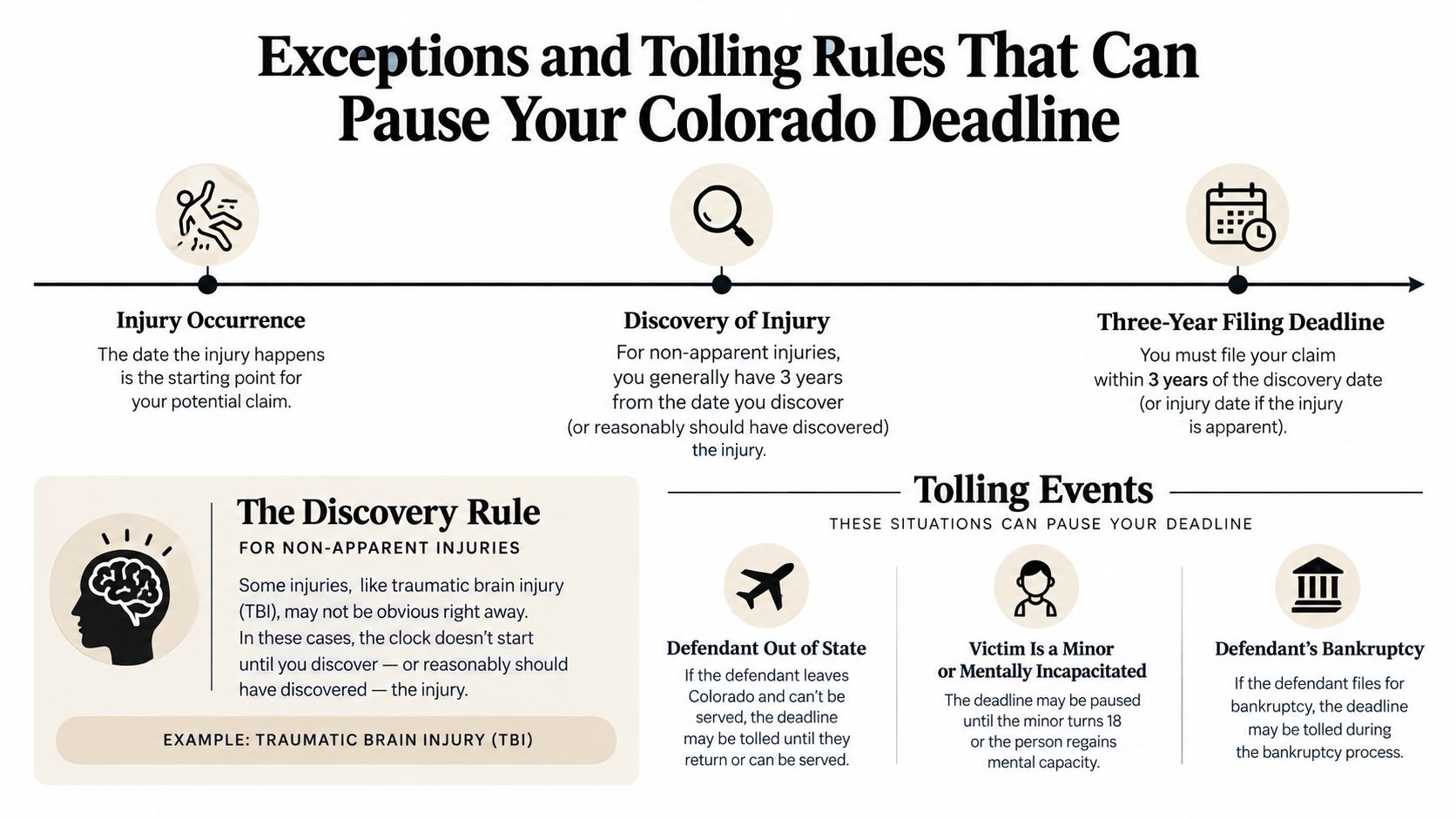
Exceptions and Tolling Rules That Can Pause Your Colorado Deadline
You leave a crash thinking you got lucky. Two weeks later, you cannot focus, your headaches are constant, and work starts slipping. That is how deadline mistakes happen. The legal clock and the medical reality do not always line up neatly.
Colorado's three-year window is the starting point for many injury claims, not the end of the analysis. Tolling and delayed accrual can make a claim stronger, weaker, or just different from the generic advice people read online. Defendants know that. If you rely on an exception, expect a fight over dates, records, and what you reasonably should have known.
Take a look at the timeline issue visually first.
Hidden injuries and delayed accrual
Latent injuries change cases. Brain injuries are the clearest example. Someone can walk away from a collision, skip the ER, and later show up with memory problems, dizziness, mood changes, or word-finding issues that did not make sense on day one.
That matters because the dispute is often not just when the crash happened. It is when the injury and its likely cause were known, or should have been known with reasonable diligence. In mild and moderate TBI cases, insurance carriers often argue that the symptoms were obvious earlier than the patient claims. You need records that show the progression, not a vague explanation built months later.
Other states have been changing their limitations rules fast, as noted earlier in this article. That is one more reason not to borrow a generic internet rule and paste it onto a Colorado case. A person injured here may still be dealing with out-of-state defendants, treatment delays, or conflicting accrual rules that affect strategy even if Colorado law controls the main claim.
Minors and mental incapacity
Children's claims need separate deadline analysis. Colorado law recognizes that minors do not protect their own legal rights the way adults do, and tolling may apply differently depending on the claim, the child's age, and who had the ability to act on the child's behalf. The Colorado General Assembly's tolling statute is the place to start, not a recycled adult deadline. See Colorado Revised Statutes section 13-81-103.
Do not assume tolling means you can safely wait. A minor's case can still be damaged long before the filing deadline if witnesses disappear, surveillance footage is erased, or a parent settles related issues without understanding how the child's claim stands on its own.
Mental incapacity can also pause or complicate the deadline. This comes up in severe concussion and traumatic brain injury cases more than families expect. If the injured person could not manage legal affairs because of cognitive impairment, that issue should be documented early with treating records, neuropsychological testing, and a clear timeline of functioning.
Here's a helpful plain-language explainer if you prefer video before documents:
Why tolling fights are won or lost early
The strongest tolling arguments are documented, not improvised.
If you think an exception applies, prove it now. Get school records for an injured child. Get neuropsychology and therapy records for a delayed brain injury diagnosis. Get physician notes that pin down when symptoms first appeared, when the condition was connected to the incident, and why that connection was not reasonably clear sooner.
Courts do not pause deadlines because a story sounds fair. They look for evidence. If your case may involve delayed discovery, minority, or incapacity, have a Colorado injury lawyer calculate the outside deadline early and build the tolling record at the same time.
Preserving Evidence Before Your Colorado Deadline Closes
Deadline law matters. Evidence wins cases.
You don't need to wait for a lawsuit to preserve the proof that will support one. In the first days and weeks after an injury, you can protect a claim by acting like the evidence may disappear tomorrow, because sometimes it will.
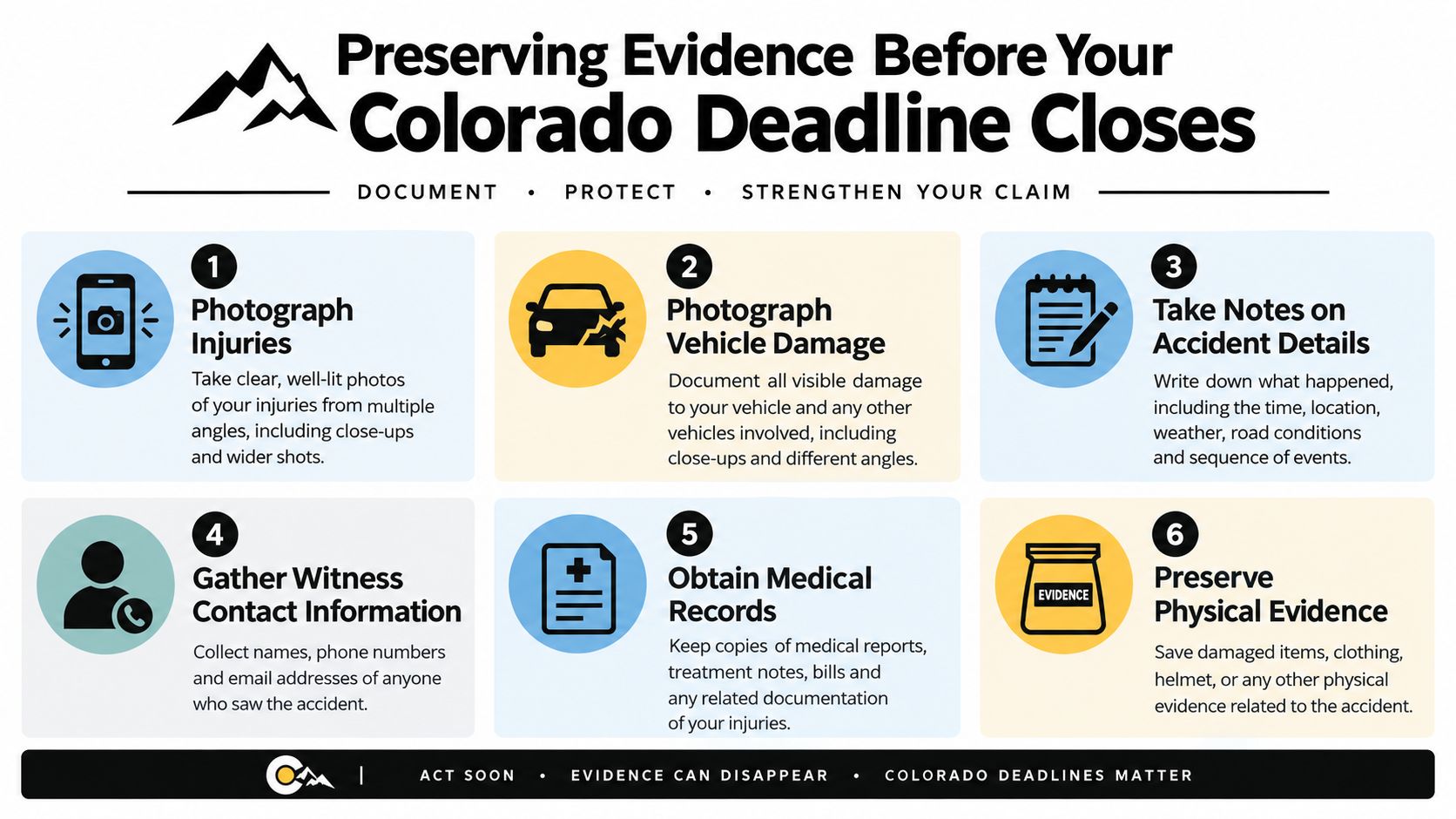
What to collect first
Start with the basics:
- Photographs of your injuries: Bruising, swelling, cuts, casts, scars, and mobility aids.
- Scene photos: Skid marks, debris, weather, lighting, broken stairs, spilled liquid, missing warnings.
- Vehicle or equipment damage: Exterior damage, interior damage, helmet damage, torn clothing, shattered phones.
- Names and contact details: Witnesses disappear faster than people think.
- Medical paperwork: Discharge instructions, imaging orders, prescriptions, referrals, work restrictions.
If police responded, request the crash or incident report. If your employer documented the event, get that report too. If a store manager wrote up a fall, ask for the report number and the name of the person who prepared it.
What people forget to preserve
A lot of critical evidence sits in someone else's hands. Think surveillance footage, maintenance logs, truck electronic data, inspection records, and internal incident emails. Those items aren't saved forever.
Send a preservation request early, or have counsel do it. If you want a practical explanation of how evidence can be lost or destroyed and why that matters, read this overview of what spoliation of evidence means.
Save the damaged property. Don't repair it, wash it, throw it away, or “clean it up” before someone has documented it.
The first month matters
In the first month after an injury, keep a simple file:
- A symptom journal with dates
- A treatment list showing every provider seen
- Insurance communications
- Receipts and out-of-pocket costs
- Time missed from work
- Any photos or videos sent by family or witnesses
Also, stop posting about the incident on social media. And don't give a recorded statement to the other side's insurer just because the adjuster sounds friendly. Adjusters are collecting material they can use later to minimize your claim.
Choosing the Right Colorado Personal Injury Attorney
Two years can feel like plenty of time until a lawyer tells you the wrong deadline, misses a tolling issue, or treats a brain injury case like an ordinary fender-bender. Then the calendar becomes the case.
Hire counsel who starts with timing, not marketing. In Colorado, that means a lawyer who can pin down whether your claim falls under the three-year motor vehicle window, a shorter or different deadline, or a rule that changes because the injured person is a minor, the harm was not immediately obvious, or another state's facts are mixed into the case. Generic injury advice often misses those details. Good Colorado counsel does not.
What to ask in the first call
Use the consult to test whether the lawyer knows how Colorado deadlines work in real cases.
- What deadline do you think applies to my case, and why?
- Does this look like a standard injury claim, a motor vehicle case, wrongful death, or possible medical malpractice?
- Do you screen for tolling issues involving minors, delayed symptoms, or cognitive injury?
- If symptoms showed up later, how do you analyze when the clock started?
- If another state is involved, what could change about the filing analysis?
- Who is responsible for confirming the deadline in writing?
A strong answer sounds specific. If your child was hurt, you are dealing with post-concussion symptoms, or the case has out-of-state drivers, treatment, or defendants, the lawyer should address those facts right away. Those issues can make a Colorado claim stronger, weaker, or just different from the one-size-fits-all explanations you see online.
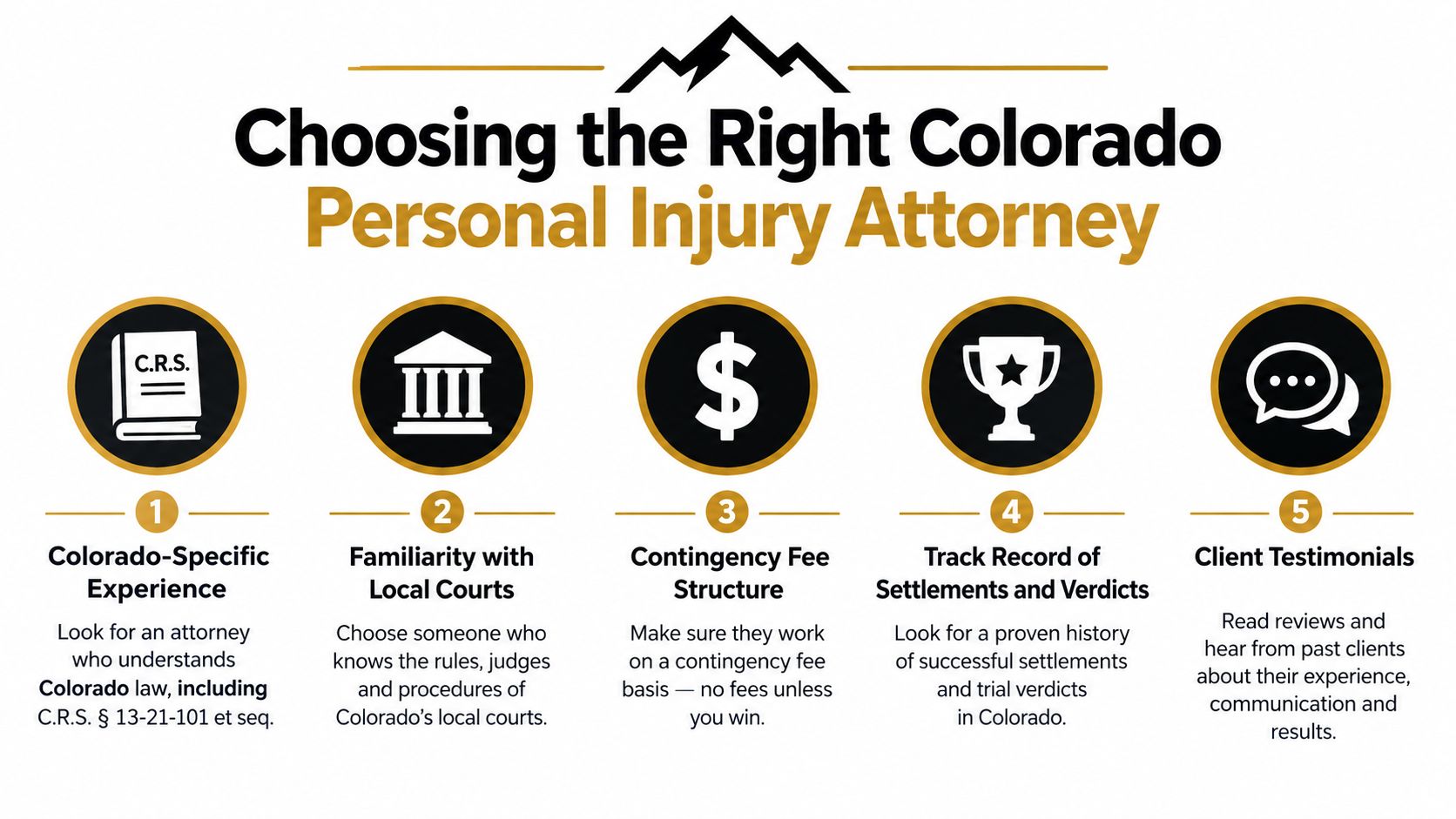
Red flags worth taking seriously
Watch for lawyers who stay vague. Vague answers cause missed deadlines.
- They will not name the likely claim type. If they cannot explain the difference between Colorado timing for injury, wrongful death, and malpractice, keep looking.
- They talk settlement before deadline analysis. A case cannot settle well if it was evaluated on the wrong filing window.
- They ignore latent injuries. Head injuries, memory problems, and delayed neurological symptoms often require a closer look at when the injury was or should have been discovered.
- They skip minor-claimant issues. Tolling rules for children can change the deadline analysis in a major way.
- They treat every case as purely local. Recent shifts in other states do not control Colorado law, but they can matter if your crash, treatment, defendant, or insurance issues cross state lines.
- They pressure you to sign without explaining the calendar. Urgency is fair. Blind urgency is not.
Nares Law Group LLC states that it reviews injury facts, identifies the applicable filing deadline, and assesses whether exceptions may protect the claim.
Your Next Steps After a Colorado Injury
If you were hurt recently, don't overcomplicate this. Your next moves should be simple and fast.
Do these within the next 48 hours
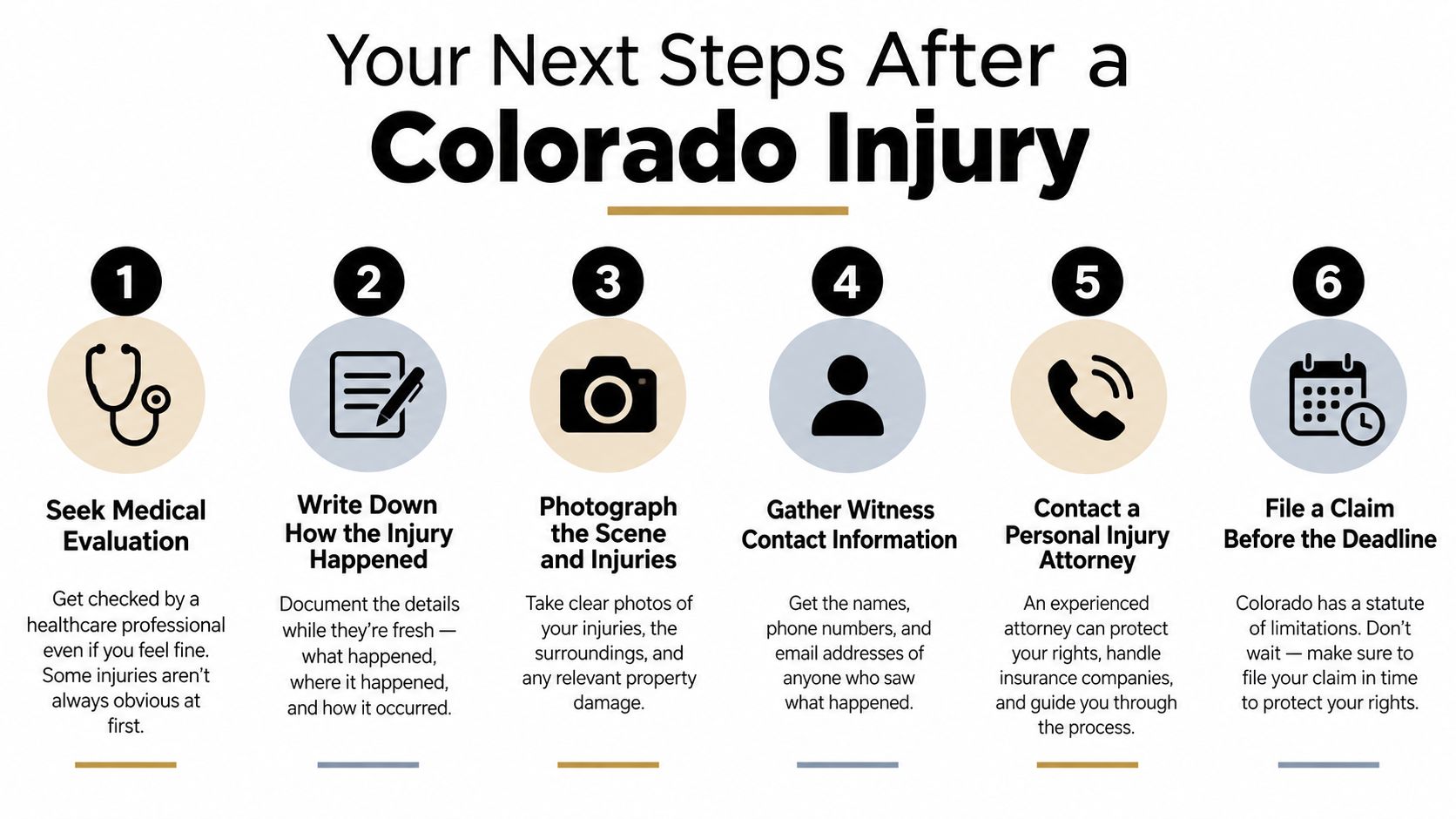
- Get medical care: Even if you think you're “mostly okay,” get evaluated.
- Write down what happened: Include time, place, weather, who was involved, and what you felt physically.
- Photograph everything: Injuries, scene conditions, vehicles, property damage, and torn clothing.
- Preserve items: Don't discard damaged gear, child car seats, helmets, or shoes.
- Request reports: Police reports, business incident reports, and employer reports.
- Stop insurer recordings: You can report the claim, but don't volunteer a recorded statement without advice.
Flag these issues on your first legal call
Tell the lawyer immediately if any of this applies:
- You're dealing with head injury symptoms
- The injured person is under 18
- A family member died after the event
- You suspect medical negligence
- The crash involved an out-of-state driver or trucking company
- A public agency, city vehicle, or government property may be involved
If there's any doubt about when the deadline starts, assume the earliest possible date until a lawyer confirms otherwise.
The history of personal injury deadlines helps explain why these issues exist. In England and Wales, the law moved from older broad limitation periods, including a 6-year rule under the Limitation Act 1623, to injury-specific rules such as the Limitation Act 1954's fixed 3-year period and the Limitation Act 1963's 1-year from date of knowledge discoverability feature, as discussed in this legal history of limitation reform. Modern systems still reflect that same tension between fixed deadlines and fairness for hidden injuries.
Across major common-law systems, personal injury deadlines are often short but structurally different, and forum choice can decide whether a claim survives, as explained in this comparative analysis of limitation periods and discoverability rules. That's exactly why Colorado families shouldn't rely on one-line internet answers when a case has brain injury, travel, trucking, or multi-state facts.
If you were hurt in Colorado and aren't sure which deadline applies, Nares Law Group LLC can review the facts, identify the likely filing window, and help you spot issues like latent injury, wrongful death timing, or tolling for a child claimant. Visit Nares Law Group LLC if you want a Colorado-focused review before a deadline turns a valid claim into a barred one.