You're driving home on I-25 after a long day, and another car drifts into your lane. The crash feels minor at first. By the next morning, your neck won't turn, the hospital has added a bill you weren't expecting, and the insurer is already asking for a statement. In Colorado, that's the moment the law stops being abstract and starts deciding who pays, how much, and how long you have to act.
Colorado personal injury laws are the rulebook that turns a painful event into a legal claim, or shuts the door on one. Some cases rise or fall on a filing deadline. Others turn on fault allocation, damage caps, or whether the defendant is a city, a hospital, or a trucking company with layers of insurance. If you're hurt now, the safest way to read the law is in the same order the case will unfold in real life, from the first insurer call to the last day in court.
When the Phone Stops Ringing and the Bills Start
A Denver driver gets sideswiped on a wet morning commute. A parent keeps taking a child back for follow-up visits after a concussion. A family opens a stack of hospital bills after a slip and fall at a grocery store. Those situations feel different, but they all trigger the same basic question, who is legally responsible for the harm, and what rules control the claim?
Colorado injury law answers that question through deadlines, fault rules, and damage limits. It also decides whether a case belongs in a standard negligence track, a wrongful-death track, or a special category like medical malpractice. That matters because the claim may look strong on the facts and still fail if the wrong notice goes out, the wrong defendant is named, or the case is filed too late.
Practical rule: The first job is not to “win” the case, it's to keep it alive long enough to prove it.
A lot of people think the legal process starts with a lawsuit. It doesn't. It starts the moment you're injured and someone begins collecting evidence, medical records, and insurance information. Colorado's rules control how long that evidence stays useful, how fault gets assigned, and how much of a recovery survives after the numbers are added up.
That's why the rest of this guide follows the claim the way a real Colorado case moves, one decision at a time. If you know which rule is in play at each stage, you can spot the traps early and avoid the kind of mistake that doesn't show up until the deadline has already passed.
The Core Rules That Govern Every Colorado Injury Claim
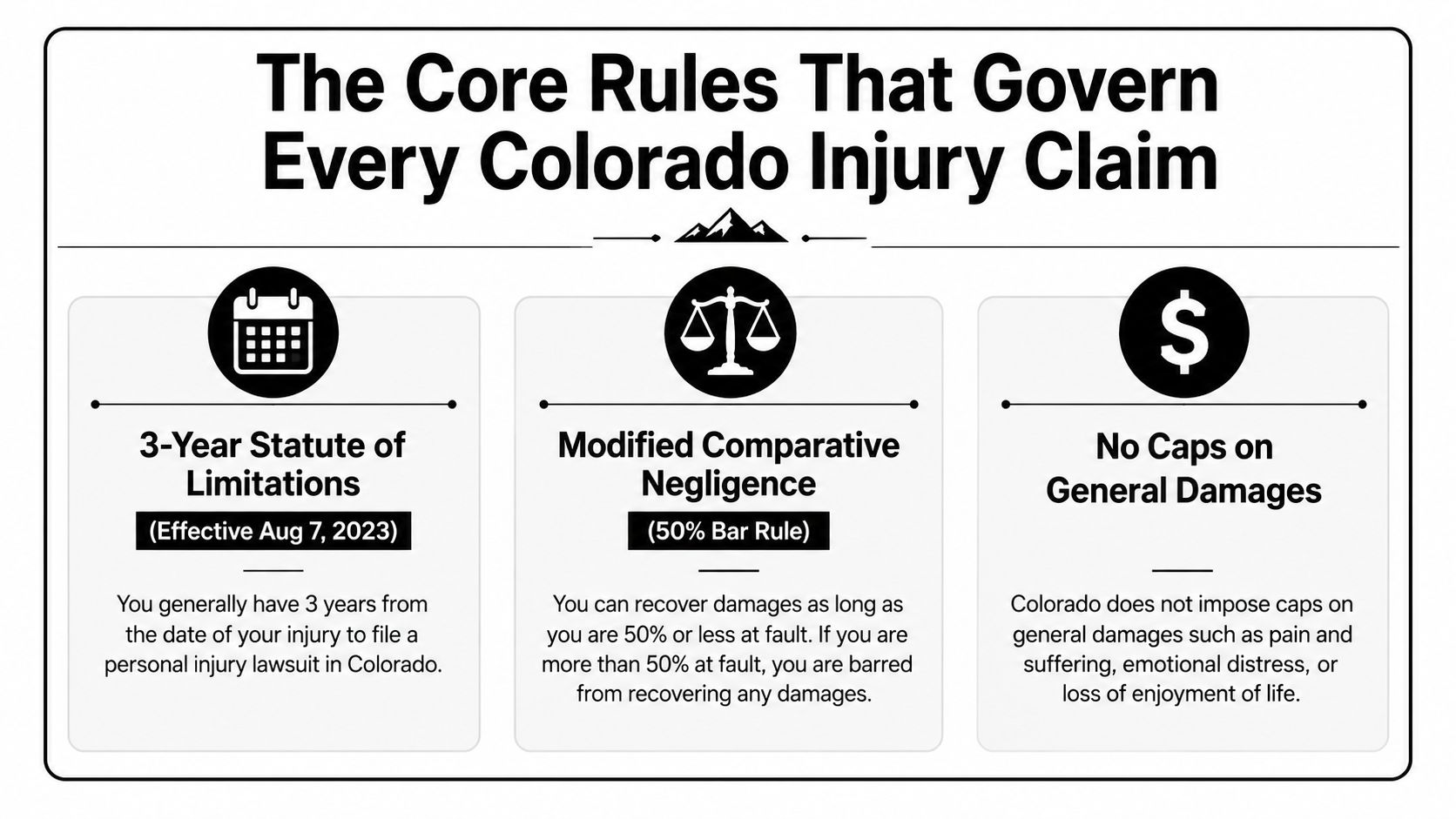
The starting point for most cases is the statute of limitations. For personal injury claims arising on or after August 7, 2023, Colorado extended the filing deadline from 2 years to 3 years under House Bill 23-1071, which gives injured people more time to finish treatment, investigate fault, and negotiate before filing (Colorado personal injury limitation changes). That extra year matters most when the injury takes time to fully reveal itself, especially in traumatic brain injury, trucking, or delayed-diagnosis matters.
Learn how limitation periods work in Colorado
Fault can cut your case value to zero
Colorado uses modified comparative negligence with a 50% bar, so a plaintiff who is 50% or more at fault cannot recover damages (Colorado comparative negligence overview). If a jury places you at 49% fault, you can still recover, but the award is reduced by your share of responsibility. If the defense can push the number to 51%, the claim is gone.
That line is where insurers focus their energy. They will look for anything that shifts blame, a rushed lane change, a missed turn signal, a wet floor warning they say was visible, or a social media post that makes your injury look less serious than it is. In Colorado, fault is not a side issue. It is often the main issue.
The new damages cap changed settlement leverage
Colorado's noneconomic damages cap for personal injury suits filed on or after January 1, 2025 rose to $1.5 million, with inflation adjustments scheduled every two years beginning in 2028. For wrongful death actions, the cap increased to $2.125 million under the same schedule (Colorado Judicial Department cap update). The filing date matters, not just the accident date, so timing can affect trial value and settlement pressure.
That said, economic damages like medical bills and lost wages remain uncapped in many cases, which is why careful documentation matters from day one (Colorado damages overview). A strong case is not just pain and suffering. It is records, bills, wage proof, future care proof, and a clean explanation of why the injury changed your life.
Where Colorado Claims Come From and What Makes Each One Different
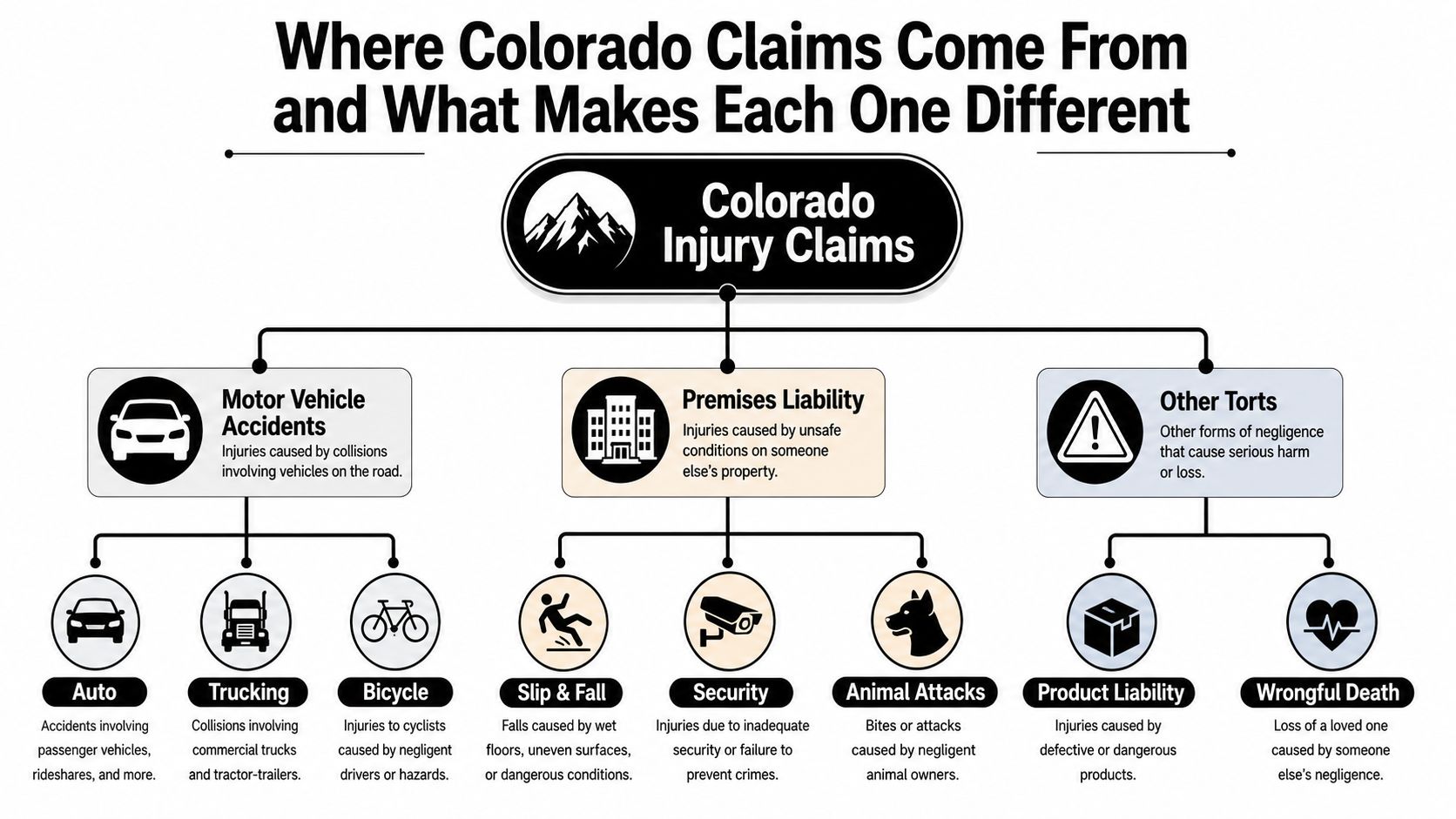
Colorado personal injury claims don't all look the same, and the evidence that wins one type of case can miss the mark in another. A rear-end crash, a truck wreck, a slip on a wet grocery aisle, and a fatal collision each bring different proof problems, different defendants, and different timelines.
Motor vehicle and trucking cases
Auto cases usually turn on the basics, photos, crash reports, vehicle damage, medical records, and witness statements. Trucking cases add another layer because there may be multiple carriers, drivers, dispatchers, and electronic records to preserve. If a trucking file is handled like a simple fender-bender, key evidence can disappear before it's ever requested.
The strongest trucking cases usually start with preservation, not argument.
That's why black-box data, driver logs, and maintenance records matter so much in commercial collisions. If the evidence is not requested early, the defense can frame the crash before your side has a chance to test it. For a more Colorado-specific breakdown of vehicle claims, see this guide to Colorado car accident laws.
Premises, products, wrongful death, and brain injury
Premises liability cases often turn on notice, inspection, and whether the property owner had a fair chance to fix the hazard. A wet floor, broken stair, poor lighting, or unsafe common area can support a claim, but only if the condition, the timing, and the owner's knowledge can be shown with evidence. Product liability usually asks a different question, whether the product was defective in design, manufacture, or warning.
Wrongful death claims bring their own structure because the family's loss, the right person to bring the claim, and the cap on noneconomic damages all matter. Traumatic brain injury cases are even more documentation-heavy. The injury may not show up neatly on a single scan, so treatment history, functional changes, and long-term care proof become central.
The mistake that kills many claims
The most common failure is treating every case like a generic negligence file. A truck case without preservation, a brain injury case without follow-up treatment, or a premises case without inspection evidence can lose value fast. The right category tells you what proof to collect first and what defense theory is coming next.
Why Medical Malpractice Plays by Different Rules
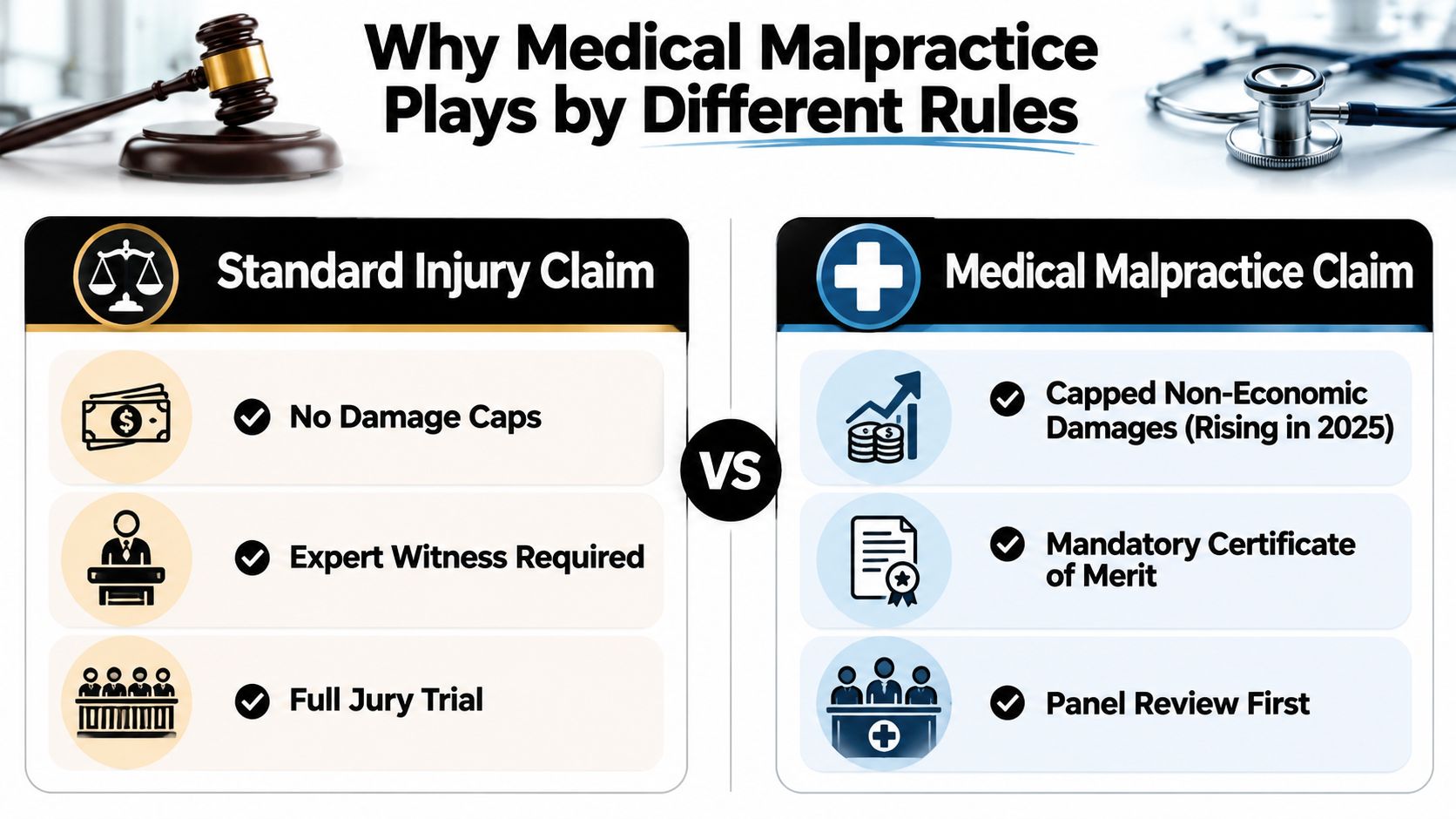
Medical malpractice cases sit inside Colorado injury law, but they don't move like ordinary negligence claims. If a doctor, nurse, hospital, or other healthcare provider's decision caused the harm, the malpractice framework usually controls first. That means different pleading requirements, different proof burdens, and a different path to settlement.
The biggest practical difference is that malpractice claims usually require stronger expert support early. In a car crash, a jury can often understand a red light, a rear-end impact, or a missed turn signal without much technical help. In a malpractice case, the issue is usually whether the provider met the medical standard of care, and that question almost always needs expert testimony to explain what should have happened and what went wrong.
Colorado's damages rules also matter here, because malpractice claims are affected by statutory limits that have been updated over time. The general point is simple, the cap structure is not the same as an ordinary injury case, and the filing process can be tighter. If a hospital-related injury is involved, the first question is not “Can I sue?” It's “Which medical-malpractice rules control this claim, and what do I need before filing?”
If the harm came from treatment, diagnosis, medication, or a provider's medical judgment, treat it as a malpractice issue before anything else.
That distinction catches people off guard. A bad outcome alone is not enough, but a preventable medical error can be actionable if the evidence supports it. The timing, the expert review, and the way the claim is presented often decide whether the case can move at all.
How a Colorado Injury Case Actually Moves Forward
A Colorado injury case usually starts before any lawsuit is filed. The first round of work is preservation, photos, video, witness names, vehicle damage, scene conditions, and medical records. If there's a business, insurer, or trucking company involved, counsel may also send preservation requests so evidence isn't overwritten or discarded.
From claim file to discovery
Once the insurance claim is open, the adjuster begins gathering the defense file. That often includes the recorded statement request, a review of medical history, and an early theory about fault or injury severity. If settlement talks stall, the case moves into a formal complaint, followed by discovery, where both sides exchange documents, take depositions, and line up experts.
| Phase | What Happens | Typical Timing |
|---|---|---|
| Investigation | Evidence collection, scene documentation, medical review, insurer notice | Immediately after the injury |
| Insurance claim | Adjuster review, liability analysis, early settlement discussions | Early weeks to months |
| Filing and pleading | Complaint is filed, defendant responds | After the claim is mature or deadlines require filing |
| Discovery | Depositions, documents, medical exams, expert exchange | After filing, before trial |
| Mediation and settlement | Negotiation with a neutral mediator or directly with insurers | Often after key discovery |
| Trial | Jury selection, witness testimony, verdict | If no settlement is reached |
The pressure usually changes after discovery gives both sides a clearer picture. That's when mediation becomes more useful, because the case value is anchored by medical proof, fault evidence, and the likely effect of Colorado's fault and damages rules. Filing suit also changes the balance of power, because the insurer has to defend the case on a set schedule instead of controlling the pace.
A case that settles early isn't always a weak case, and a case that goes to trial isn't always a better one. The difference is often whether the numbers are supported well enough to force a real negotiation.
How Colorado Insurers Actually Handle Injury Claims
The adjuster's job is not to decide what feels fair, it's to reduce exposure. That starts with the recorded statement, where a careless answer can be used later to argue that the story changed, the pain was preexisting, or the crash was less serious than it looked. A short answer given too soon can become a long problem.
Insurance companies also make early settlement offers before the full medical picture is clear. They know many people are under pressure from missed work, unpaid treatment, or stress at home. The offer may look helpful in the moment, but it can be far below the true value once future care, wage loss, and noneconomic harm are properly documented.
Watch the first offer closely. If it arrives before the treatment picture is stable, it's usually designed to close the file cheaply.
Another common move is the independent medical exam, which the defense uses to challenge injury severity or argue that the claimant has already healed. Comparative fault arguments also show up quickly, especially when police reports, witness statements, or social media posts give the carrier something to work with. In Colorado, those tactics matter because the 50% bar and the cap structure can change a claim's value dramatically.
For a closer look at the defense side of the file, see how an insurance company investigates injury claims. The practical rule is simple, every call, text, photo, and post can help or hurt the file, and the sooner a lawyer steps in, the less room the insurer has to define the story first.
What to Do in the First 72 Hours After a Colorado Injury
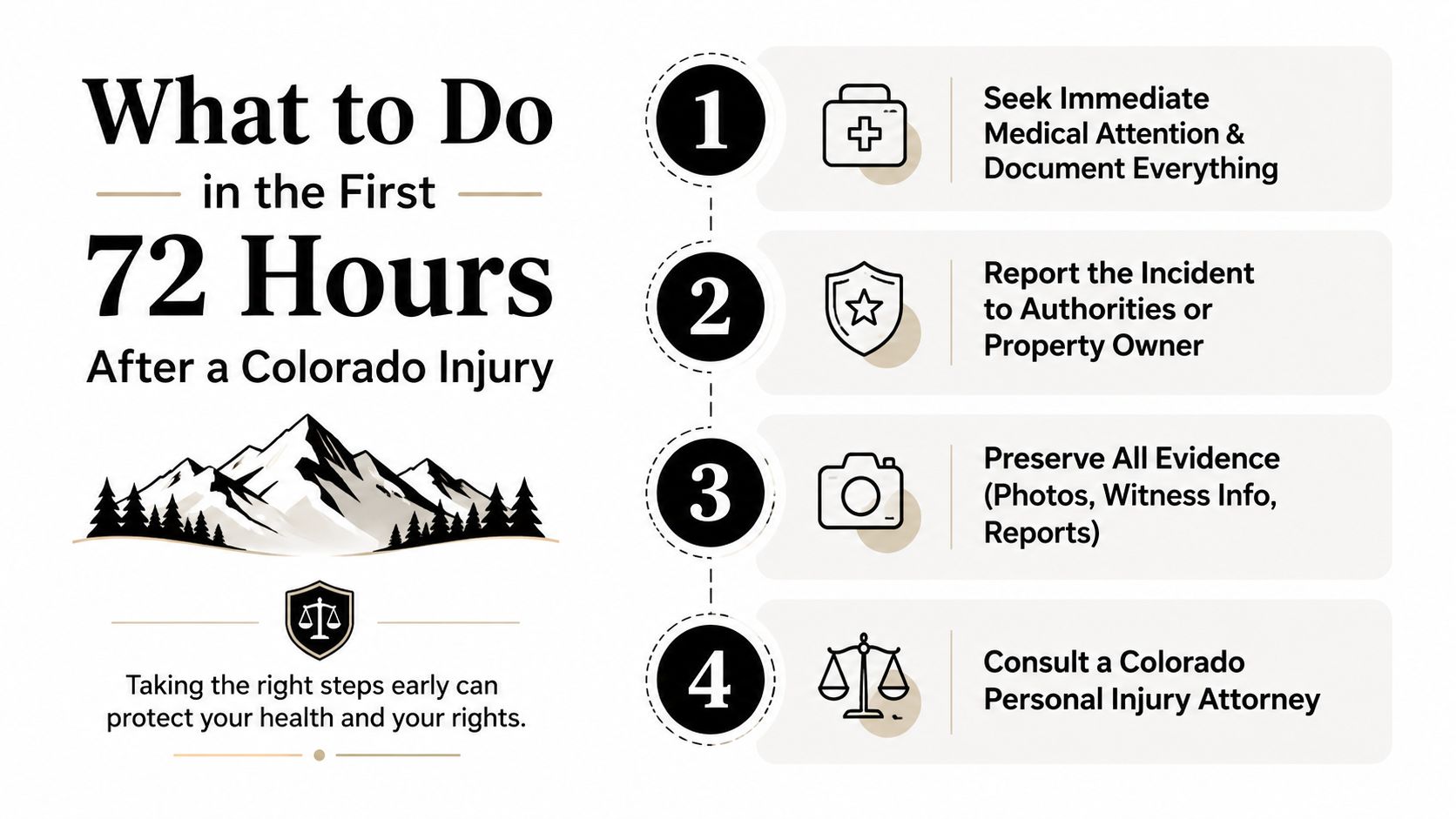
First, get medical care and follow through. In Colorado, the medical record often becomes the backbone of the damages claim, so saying yes to evaluation, imaging, and follow-up treatment matters even when the pain seems manageable at first.
Then preserve the scene. Take photos of vehicles, floors, stairs, pavement, warning signs, weather conditions, and visible injuries. Save witness names and contact details, and don't assume someone else will keep the evidence for you.
If a public entity may be involved, treat the deadline as urgent. Claims against government entities can require written notice within 182 days under the Colorado Governmental Immunity Act, which means a city bus crash, a CDOT road defect, or a school district injury can disappear long before the usual injury deadline. Motor-vehicle cases generally sit in the three-year window discussed earlier, while some wrongful-death claims tied to vehicular homicide or leaving the scene can carry a four-year period.
Keep your social media quiet. A smiling photo, a weekend outing, or a casual comment can be lifted out of context and used to argue that you're not as injured as you say. If the insurer calls, limit the conversation to basic claim information until you've had a chance to get advice.
Putting the Pieces Together and Choosing Your Next Move
Three years to file. 50% fault as the cutoff. $1.5 million for the updated noneconomic cap in many personal injury cases filed on or after January 1, 2025. 182 days for government-entity notice. Those numbers control most Colorado injury strategy, even when the injury itself feels like the whole story.
The next move is usually not dramatic. It's comparing the offer on the table to the records in hand, then asking whether the insurer has accounted for treatment, wage loss, future care, and fault arguments. If the injury is serious, getting legal help early often changes the negotiation because it stops the insurer from defining the file alone.
If you're choosing counsel, look for a Colorado lawyer who handles the kind of claim you have, knows the deadline traps, and can explain how the evidence will be built. Nares Law Group LLC is one option for injured Coloradans who need help with motor vehicle crashes, truck wrecks, brain injury matters, and wrongful death claims.
Your recovery still comes first. The law can protect it, but it can't replace the work of healing, treatment, and steady documentation.
If you're trying to figure out what your Colorado injury claim is worth, Nares Law Group LLC can review the facts, explain the deadlines, and help you decide whether to negotiate or file. Visit Nares Law Group LLC to get clear guidance on your next step and protect the claim before a deadline or defense tactic changes the outcome.