The most popular advice after a truck crash is to identify the driver and file an insurance claim. That advice is incomplete. Truck accident liability rarely ends with the person behind the wheel, because the crash may reflect decisions made by a carrier, dispatcher, shipper, maintenance contractor, broker, or manufacturer.
The driver's conduct matters, but it may be only the visible part of a larger failure. Federal crash data show why investigators must look beyond the cab. In 2021, 5,340 fatal crashes involving large trucks and buses accounted for 13.5% of all fatal crashes on U.S. roads, according to the FMCSA Pocket Guide. A serious claim therefore requires more than a quick statement about who caused the collision. It requires a disciplined investigation into who created, ignored, or failed to correct the conditions that made the crash possible.
The Hidden Web of Truck Crash Responsibility
A trucking insurer often has an immediate strategic advantage. Its investigators may reach the scene quickly, contact the driver, preserve selected records, and begin shaping the explanation before an injured person has left the hospital. The preferred explanation is usually simple: the driver made a mistake. That framing can protect the carrier from scrutiny over scheduling, training, maintenance, cargo handling, and supervision.
The law and the evidence may tell a more complicated story. The company operating the truck can face responsibility for an employee's conduct during work, while separate claims may arise from its own hiring, supervision, maintenance, or safety decisions. A truck owner may have obligations different from the motor carrier. A repair shop may have performed defective work. A shipper or loader may have created an unstable load. A broker may have arranged transportation through a complicated chain of companies.
Practical rule: Never accept the first version of responsibility before identifying every business that touched the driver, vehicle, cargo, route, or dispatch decision.
The FMCSA's crash-causation materials support this broader approach. The study found driver-related factors assigned as the critical reason in 88% of large-truck crashes, but that finding doesn't mean every case ends with individual driver negligence. A driver's decision may be connected to fatigue, inadequate training, unrealistic delivery expectations, poor supervision, or a carrier's failure to enforce safety rules.
Why the first explanation can be misleading
Consider a lane-change collision involving a fatigued driver. The carrier may describe the event as inattention and point to the driver's personal conduct. A proper investigation asks different questions. Did dispatch set a schedule that encouraged unsafe driving? Did the company review prior log violations? Did supervisors respond to complaints about fatigue? Did the carrier retain a qualified driver and provide meaningful training?
Those questions affect both proof and recovery. A driver may have limited personal assets and inadequate insurance for catastrophic injuries. The carrier, owner, loader, or contractor may have separate coverage and separate records that reveal how the crash developed. Multiple defendants also create disputes over comparative fault, causation, and responsibility for the same injuries.
The objective isn't to name every company reflexively. It's to identify each party whose conduct contributed to the crash, then match that conduct to admissible evidence. That shift from driver blame to layered responsibility is often what separates a narrow claim from a complete one.
Analyzing the True Causes of Commercial Crashes
A commercial crash rarely begins and ends with the driver's hands on the wheel. The tractor-trailer may drift, fail to stop, roll over, or lose cargo, but the legal investigation must trace the operational conditions that made that event possible.
The federal Large Truck Crash Causation Study identifies three major driver-related categories. Decision errors represented 38%, recognition errors represented 29%, and non-performance factors represented 12%, according to the FMCSA study materials. Decision errors include speeding and aggressive driving. Recognition errors include inattention and inadequate surveillance. Non-performance factors include fatigue, sleep, and medical incapacitation.
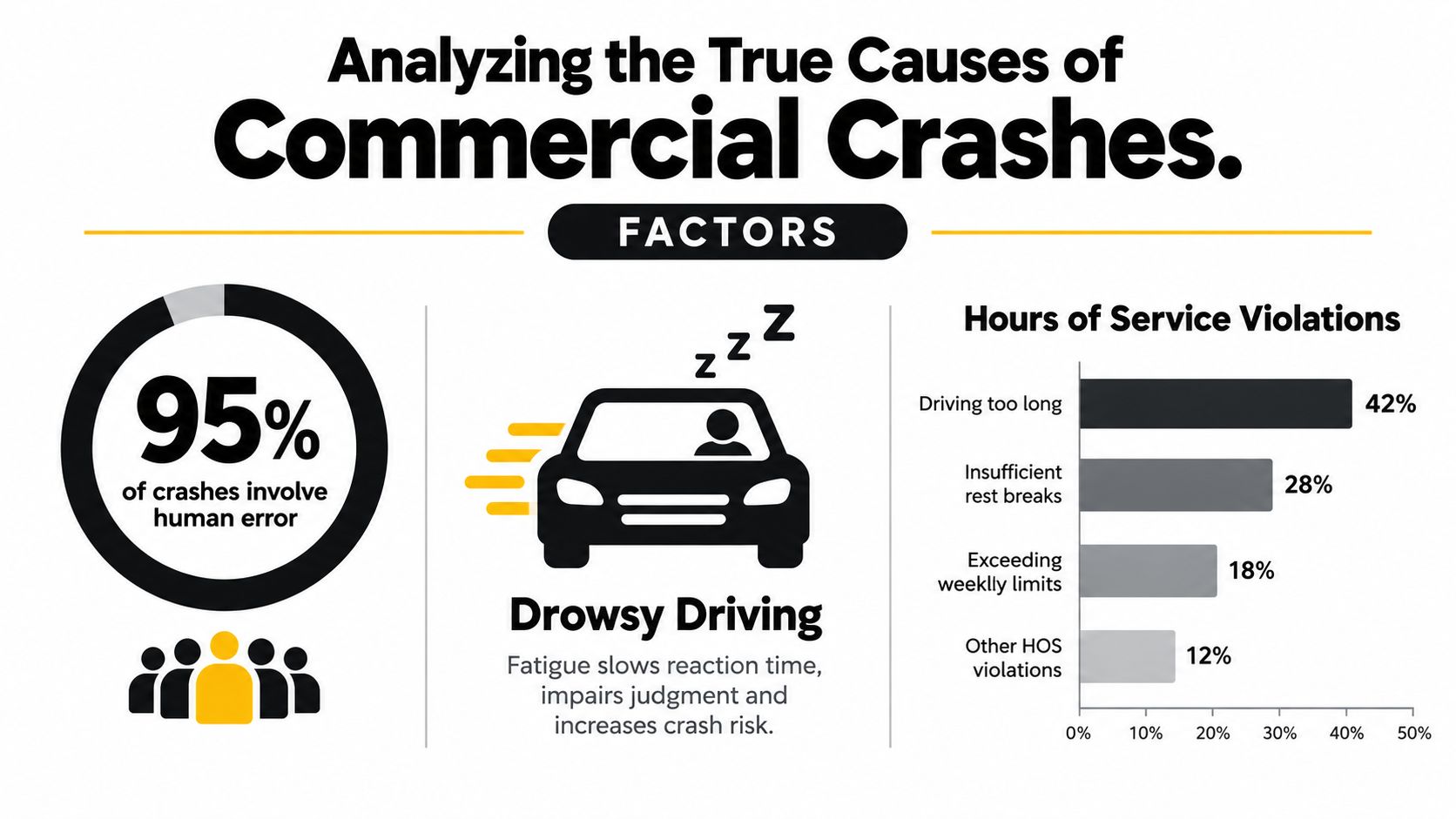
Those categories identify an immediate trigger. They do not necessarily establish the complete legal cause. A fatigued driver may have violated a safety rule, while the carrier failed to monitor logs, investigate repeated violations, or set schedules that allowed lawful rest. An inattentive driver may have lacked adequate training or been responding to dispatch pressure. Speeding may reflect an individual choice, a delivery deadline, or a company culture that rewards unrealistic performance.
Turning a driving mistake into a liability analysis
A sound investigation answers four practical questions:
- What did the driver do? Review collision evidence, witness statements, event data, logs, communications, and available video.
- Why did the driver do it? Examine fatigue, training, supervision, distractions, route demands, and dispatch instructions.
- Who controlled the relevant decision? Identify the carrier, owner, broker, dispatcher, shipper, or contractor with operational authority.
- What should have prevented the conduct? Compare company policies, monitoring, inspections, and corrective actions with applicable federal trucking regulations.
A carrier may argue that the driver violated written policy. That defense is incomplete if supervisors failed to enforce the policy, ignored warning signs, or continued assigning unsafe work. Written rules matter only when the company can show consistent training, monitoring, and discipline.
The investigation should also test whether the conduct was isolated or predictable. A driver awake too long, using a phone, rushing toward a delivery window, or failing to observe traffic may present evidence of broader operational failures. That evidence can support claims against the carrier even when the driver's conduct remains the immediate cause.
A video walkthrough of large-truck crash causation factors can help families understand why a commercial collision requires a deeper review than an ordinary traffic claim.
Holding the Motor Carrier Accountable
Vicarious liability generally connects an employer to negligent conduct by an employee acting within the scope of work. In a trucking case, that principle matters because the carrier usually controls the freight operation, benefits from the transportation service, and carries the insurance intended to address risks created during company business.
The driver may be the person who breached the duty of care, but the carrier can still answer for that conduct. Calling someone an independent contractor doesn't automatically settle the issue. Investigators examine the actual relationship, including who controlled the route, schedule, equipment, training, dispatch, and safety expectations.
That claim is different from a direct negligence claim against the company. Direct claims focus on what the carrier itself did or failed to do. Common theories include negligent hiring, retention, training, supervision, and maintenance. The trucking company negligence resource provides a useful starting point for understanding those theories.
The records that expose corporate conduct
A carrier's safety history may reveal that the crash was foreseeable. Counsel may seek:
- Driver qualification materials, including applications, licensing records, prior employment information, and safety reviews.
- Training and supervision records, including remedial instruction, complaints, disciplinary actions, and performance monitoring.
- Dispatch communications, including messages about delivery deadlines, route changes, delays, and rest opportunities.
- Hours-of-service materials, including electronic logs, edits, supporting documents, and audit records.
- Drug and alcohol testing records, where legally relevant to the collision and available through proper discovery.
- Maintenance and inspection records, especially when braking, tires, steering, or lighting are disputed.
The carrier may produce a polished safety manual and argue that a clear policy proves reasonable conduct. It doesn't. The central question is whether managers enforced the policy when enforcement threatened delivery schedules or operating costs.
A recurring defense tactic is to isolate the driver's conduct from the company's choices. The response is factual, not rhetorical. Compare the driver's records with dispatch messages. Compare the maintenance schedule with inspection findings. Compare the company's stated policy with what supervisors approved.
A company can't avoid responsibility merely by pointing to a rule it failed to enforce.
The strongest corporate-negligence cases show a connection between the company's decision and the collision. A prior violation alone may not prove causation. But a pattern of ignored warnings, inadequate training, or operational pressure can help establish that the carrier allowed an unsafe condition to continue.
Securing Critical Evidence Before It Disappears
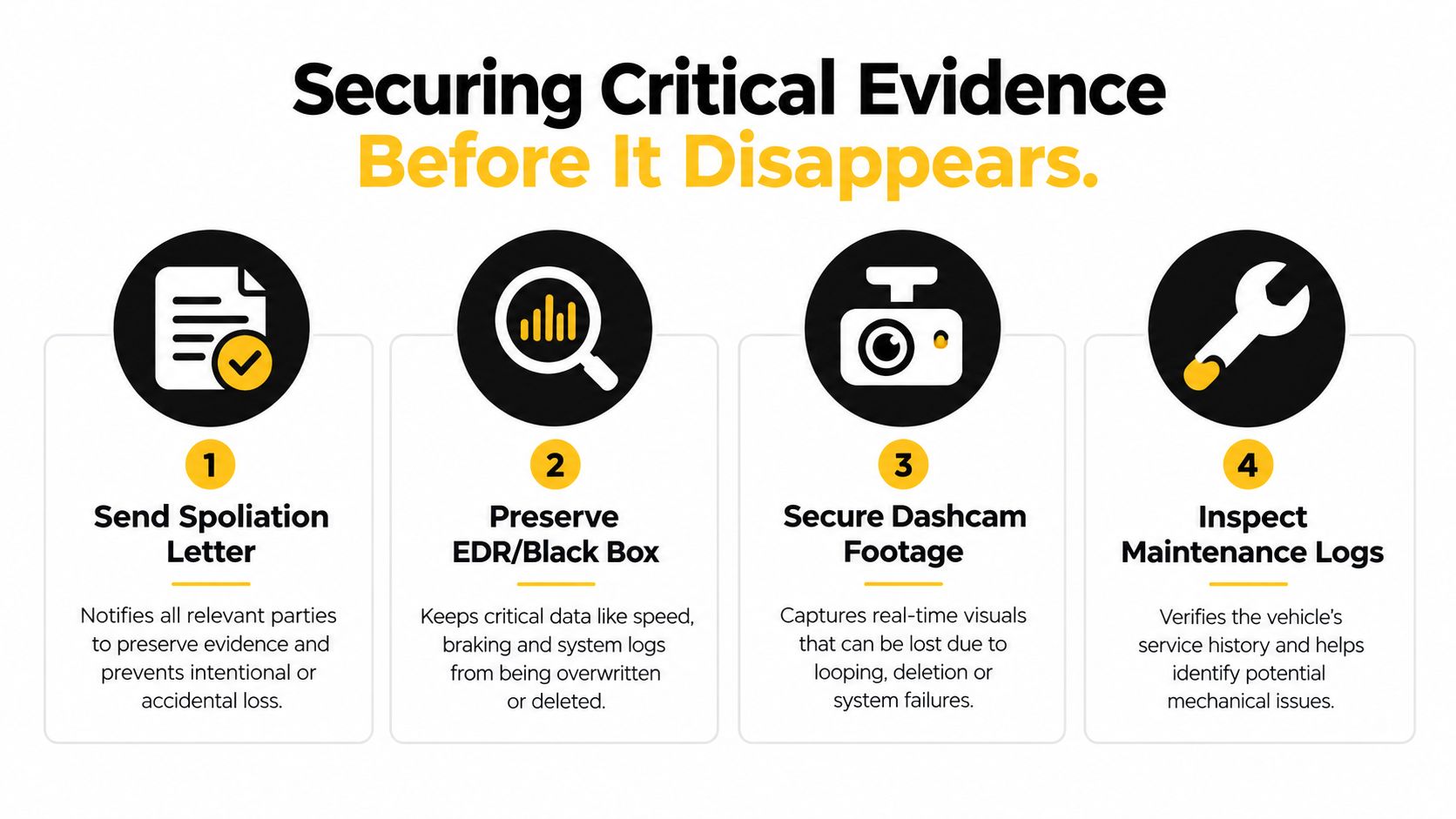
Evidence preservation begins immediately. Commercial vehicles generate records that may be overwritten, altered, discarded, or lost through ordinary business practices. A lawyer should send a detailed preservation demand, commonly called a spoliation letter, to the carrier, driver, owner, broker, shipper, maintenance company, and any other entity with relevant control.
The letter should identify the crash, demand preservation of physical evidence, and describe the electronic records that must not be deleted. It should cover the truck, trailer, cargo, driver's phone, onboard systems, video, logs, maintenance files, dispatch messages, and insurance investigation materials.
Start with the vehicle and its data
The truck should be inspected before repairs, salvage, or routine disposal changes its condition. The inspection may include:
- Electronic control module and event data. Depending on the vehicle, these systems may contain information about speed, braking, engine activity, and other operating conditions. Counsel should identify the system, secure a forensic download, and document the chain of custody.
- Telematics and fleet-platform records. GPS history, geofencing, alerts, hard-braking events, and driver-management data may show route timing, speed, stops, or company knowledge.
- Electronic driver logs. Preserve original files, audit trails, edits, supporting documents, and records showing whether the carrier reviewed possible violations.
- Dashcam and nearby video. Request truck-facing, road-facing, cab-facing, facility, intersection, traffic-camera, and surveillance footage before retention systems overwrite it.
The mechanical inspection deserves equal attention. The FMCSA analysis brief identifies brake problems as the top vehicle-related factor in the study and also identifies tire problems among the common vehicle factors. That makes brake components, tires, wheels, steering parts, lighting, and load-related damage potential evidence, not background detail.
Preserve the paper trail
Maintenance records can show whether a carrier performed inspections, reported defects, authorized repairs, and returned the truck to service. Look for work orders, invoices, inspection forms, defect reports, parts records, mechanic notes, and communications about recurring problems.
The physical truck should be photographed and stored in a secure location when possible. If a component is removed, preserve it rather than allowing it to disappear into a scrap stream. The attorney may need an engineer or qualified mechanic to connect the failed component to the crash and distinguish pre-impact failure from collision damage.
Read more about why prompt preservation matters in this guide to spoliation of evidence. A preservation letter doesn't guarantee that a company will produce every record. It does create a clear notice that relevant evidence must be protected, which can become important if records later vanish.
Uncovering Third-Party and Cargo Liability
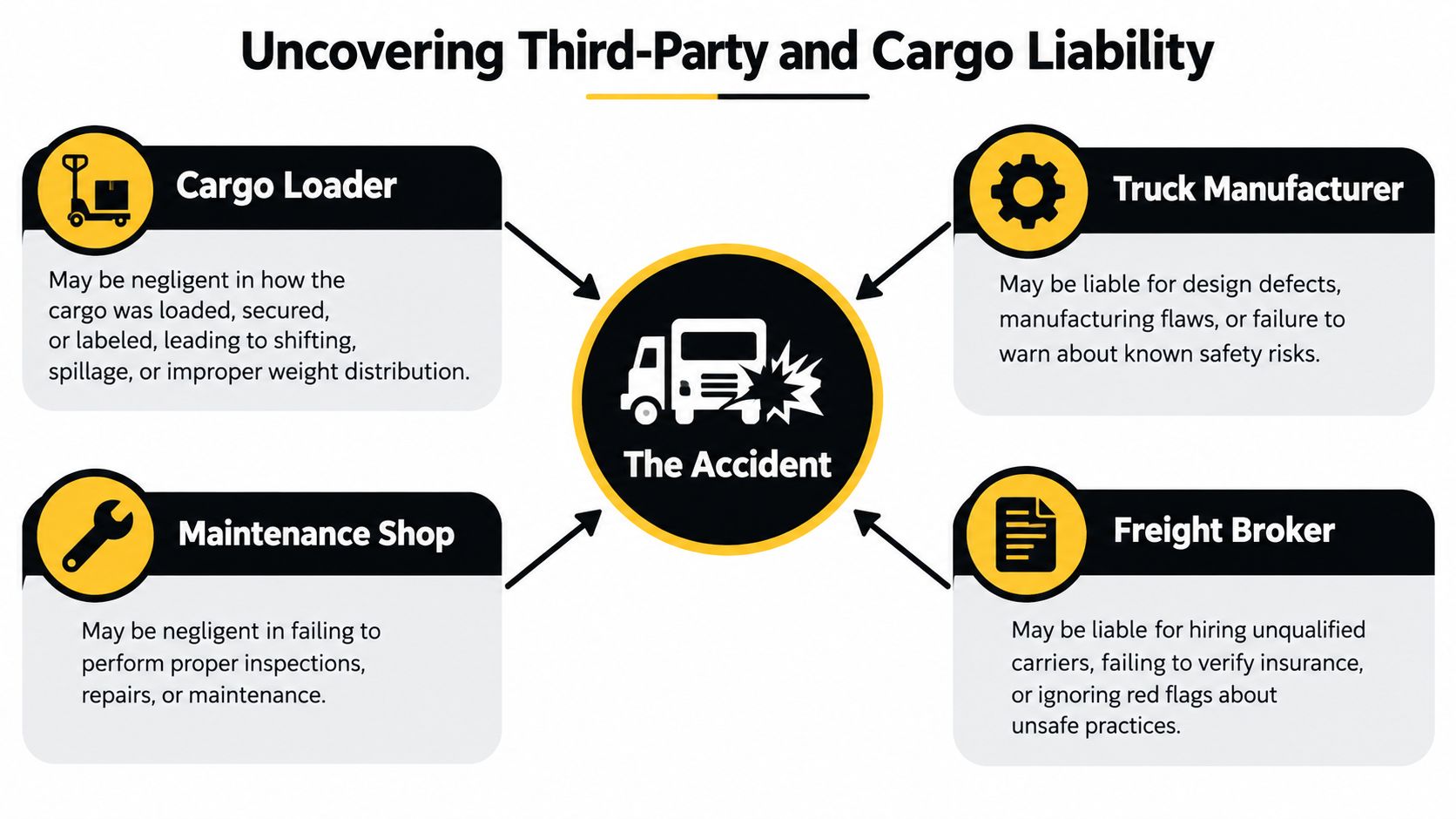
A truck's movement through the supply chain creates a chain of potential responsibility. Start with a simple example. A trailer enters a curve, the cargo shifts, the driver loses control, and the truck crosses into traffic. The carrier may blame the driver. The driver may blame the loader. The loader may say it followed the shipper's instructions. The shipper may point to the broker. The investigation must test each explanation against documents and physical evidence.
Cargo claims often turn on weight distribution, securement, packaging, loading instructions, and inspection procedures. An improperly positioned load can affect handling. Unsecured freight can move, spill, or alter the truck's balance. A party that loaded or directed the loading may share responsibility if its work created the dangerous condition.
Follow the freight documents
The bill of lading can identify the shipper, carrier, consignee, cargo description, weight, origin, destination, and handling instructions. It may not prove negligence by itself, but it helps establish who controlled each stage. Lawyers and accident investigators can use this BOL guide from Doczen to understand how bill-of-lading information fits into freight documentation.
Other useful records include loading photographs, warehouse video, pallet counts, scale tickets, seal records, delivery exceptions, inspection reports, and communications about damaged or unstable freight. The aim is to reconstruct the load before the crash, not merely describe it afterward.
A maintenance contractor may be responsible when defective service contributed to brake, tire, steering, or other mechanical failure. A manufacturer may face a product-liability claim if a component failed because of a design or manufacturing defect. The truck owner may be distinct from the carrier and may have maintained or supplied the equipment. A broker's role requires careful analysis of contracts, representations, control, and applicable federal rules.
The commercial truck liability overview explains why several parties may share responsibility and discusses circumstances in which federal rules can make the carrier responsible when its placard is displayed. That issue can matter in leased-equipment and brokered-freight disputes, but the exact result depends on the facts and governing law.
Multiple defendants can shift the case's bargaining power. Each may have separate counsel, policies, experts, and incentives to shift blame. Naming a party without evidence can weaken credibility. Failing to investigate a responsible party can leave the injured person arguing against the one defendant most eager to minimize payment. The answer is an early, document-driven allocation of responsibility.
Navigating Rising Claim Severity and Defense Tactics
Truck cases have become more financially contested even as collision frequency moves in the opposite direction. Industry data cited by the Insurance Information Institute reports that large-truck accidents fell 2.6% from 2021 to 2024, while per-mile liability losses rose 33% and average liability premiums increased by more than 18% over that period.
Those figures don't prove that every claim is worth more or that every insurer acts improperly. They do explain why carriers and insurers scrutinize serious claims aggressively. A collision involving traumatic brain injury, spinal damage, permanent disability, or death can create substantial medical, income, care, and quality-of-life consequences. Defense counsel may respond with extensive medical reviews, competing causation theories, surveillance, recorded statements, and challenges to future damages.
Why early pressure benefits the defense
An insurer may offer money before the full medical picture is known. The offer can look helpful when bills are arriving and income has stopped. It may also require a release that ends claims for future treatment, lost earning capacity, household assistance, and other consequences that haven't yet been evaluated.
A quick settlement is not automatically wrong. Settlement can reduce stress, provide needed resources, and avoid litigation risk. But a settlement made before evidence is preserved and long-term injuries are assessed can transfer uncertainty from the insurer to the injured family.
Settlement discipline: Don't value a catastrophic truck claim from the first bills. Value it from the medical prognosis, functional limitations, work impact, available coverage, and evidence supporting liability.
The defense also understands reserve pressure and claims economics. It may delay meaningful negotiations while requesting broad records, dispute treatment, or argue that a preexisting condition caused the disability. A prepared plaintiff's team responds with organized medical documentation, qualified experts, preserved vehicle evidence, and a clear damages model.
Law firms also need disciplined public education because families often search for answers before they understand the evidence problem. A practical law firm content marketing analysis can help explain complex legal issues clearly, but strong representation still depends on case-specific investigation rather than general online information.
The strategic point is straightforward. Early legal intervention protects evidence, identifies coverage, controls communications, and prevents the defense from defining the case before the injured person can respond. Trial readiness matters even when the case eventually settles, because an insurer negotiates differently when the plaintiff has built a credible path to judgment.
Protecting Your Rights After a Trucking Wreck
Your first responsibility is medical care. Follow emergency instructions, attend specialist appointments, and report symptoms accurately. Traumatic brain injuries and spinal injuries may develop or become clearer over time, so a normal first impression doesn't establish that the injury is minor.
Keep a personal file from the beginning. Save photographs, discharge papers, prescriptions, appointment notes, wage records, insurance letters, messages from the carrier, and a written account of pain, sleep disruption, cognitive problems, mobility limits, and changes in daily activities. Your own observations can help doctors and lawyers understand how the injury affects ordinary life.
Control communications and preserve facts
The trucking company's insurer may ask for a recorded statement. You don't need to speculate about speed, distance, fault, medical prognosis, or the cause of symptoms. A statement given while you're medicated, frightened, or missing key information can be taken out of context.
Use these practical safeguards:
- Don't post about the collision. Photos, comments, and apparent recovery can be misread when separated from the medical record.
- Don't sign a broad release early. Ask counsel to review any settlement, medical authorization, or document request before signing.
- Don't repair or discard damaged property casually. Preserve the vehicle, protective equipment, photographs, and relevant physical items.
- Don't wait for the insurer to investigate. The carrier has its own interests, and its investigation won't necessarily preserve evidence useful to your claim.
- Do identify every involved business. Record the truck markings, trailer details, company names, broker information, witnesses, facilities, and responding agencies.
A qualified truck-accident lawyer should send preservation demands, locate video, obtain crash records, inspect the truck, evaluate federal safety compliance, coordinate medical documentation, and identify all potentially responsible parties. The lawyer should also explain the risks of comparative fault, third-party claims, liens, insurance limits, and settlement timing in plain language.
Families need more than a demand letter. They need a case plan that accounts for treatment, household responsibilities, employment, future care, and the emotional effect of catastrophic injury or wrongful death. The right legal team should be prepared to negotiate while building the matter as though a trial may be necessary.
Nares Law Group LLC handles truck accident investigations from evidence gathering through negotiation and trial, including coordination of medical care and analysis of driver, carrier, cargo, maintenance, and other liability issues. If you or a family member has been injured, contact Nares Law Group LLC for a consultation about preserving evidence and evaluating the full scope of your truck accident liability claim.