Large trucks and buses were involved in 5,340 fatal crashes in 2021, representing 13.5% of all fatal crashes on U.S. roadways, according to the FMCSA Pocket Guide. Those figures explain why federal trucking regulations matter after a wreck. They aren't merely a checklist for carriers. They create required records, identify unsafe conduct, and give injured people and referring attorneys a way to test whether a driver and motor carrier followed the rules before impact.
A truck crash investigation should therefore ask more than who had the right of way. It should ask whether the driver was legally available to drive, whether the carrier scheduled the trip safely, whether the vehicle was maintained, whether the driver was qualified, and what the electronic records show. The answers often exist in documents the carrier was required to create or preserve.
Why Federal Trucking Regulations Matter for Crash Liability
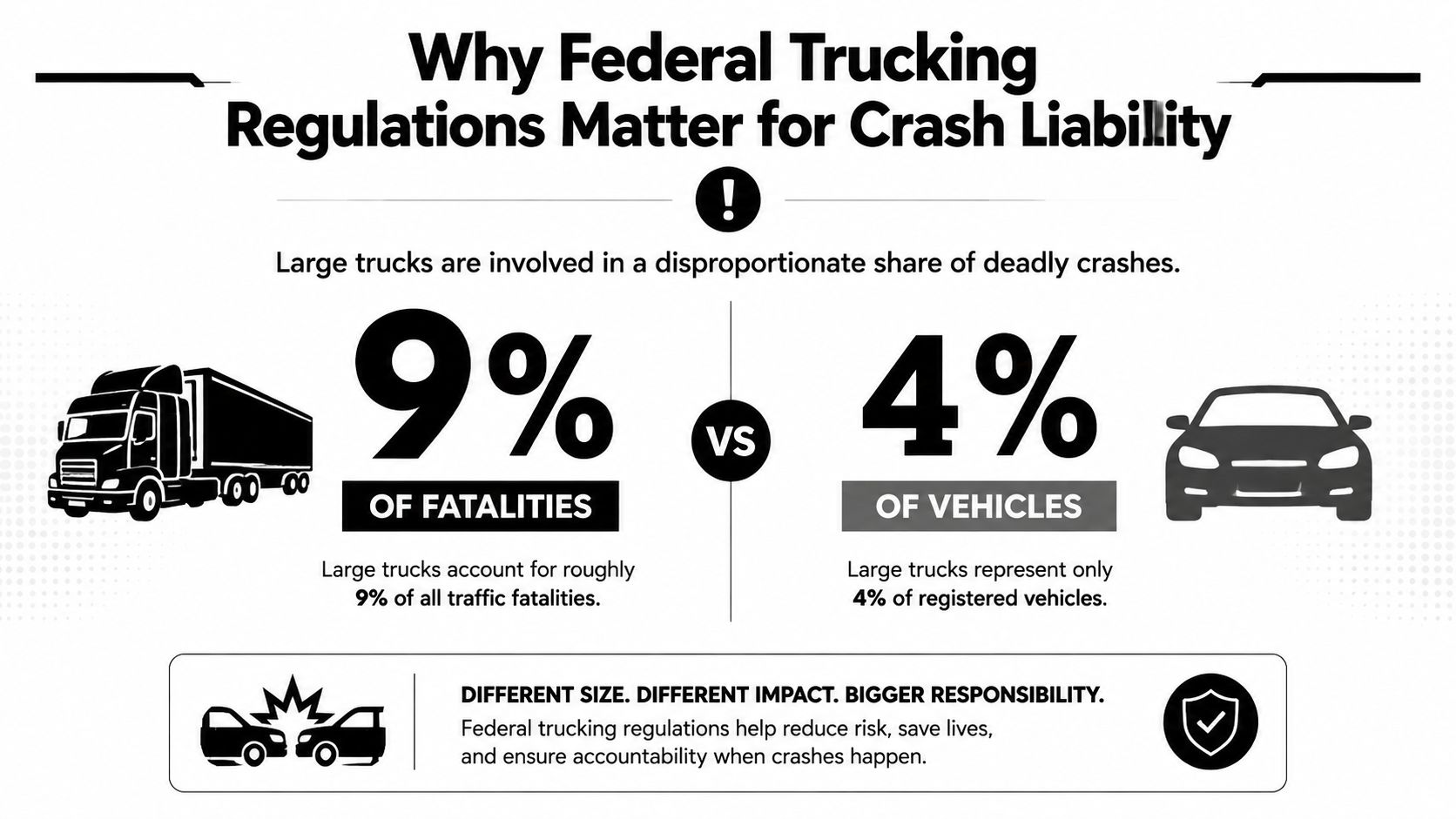
Large trucks and buses represent a relatively small share of registered vehicles and vehicle miles traveled, yet they account for a disproportionate share of fatal crashes and traffic fatalities, as the FMCSA safety summary explains. A commercial vehicle's size, weight, stopping distance, and operating environment create risks that ordinary traffic rules don't fully address. Federal trucking regulations supply the safety floor for carriers operating across state lines.
The Federal Motor Carrier Safety Administration, or FMCSA, administers much of that framework. The rules generally reach commercial motor vehicles involved in interstate commerce, including vehicles that meet federal commercial-vehicle thresholds, transport certain hazardous materials, or carry passengers. Applicability still requires a careful review of the vehicle, cargo, route, and operation. A lawyer shouldn't assume that every rule applies because a tractor-trailer was involved.
Compliance rules become liability evidence
A rule violation doesn't automatically decide every negligence claim. Its legal effect depends on the jurisdiction, the regulation, causation, and the available evidence. In some cases, a violation may support negligence per se. In others, it supplies strong evidence that the carrier or driver breached the applicable standard of care.
The practical value is documentary. An hours-of-service violation points to logs, ELD records, dispatch messages, and payroll information. A maintenance violation points to inspection reports, repair invoices, work orders, and defect histories. A qualification problem points to the driver qualification file, medical records maintained for compliance, and motor-vehicle reports.
Practical rule: Identify the regulation first, then identify every record the regulation required the carrier to create.
Insurance questions can matter too, particularly when a carrier's coverage and regulatory obligations intersect. For background on what is an MCS 90 endorsement, attorneys can review how this federal endorsement relates to public financial responsibility and judgment recovery. It isn't a substitute for analyzing the policy, the motor carrier, and the facts of the crash, but it can help frame the insurance investigation.
The Core FMCSA Rules That Govern Interstate Trucking
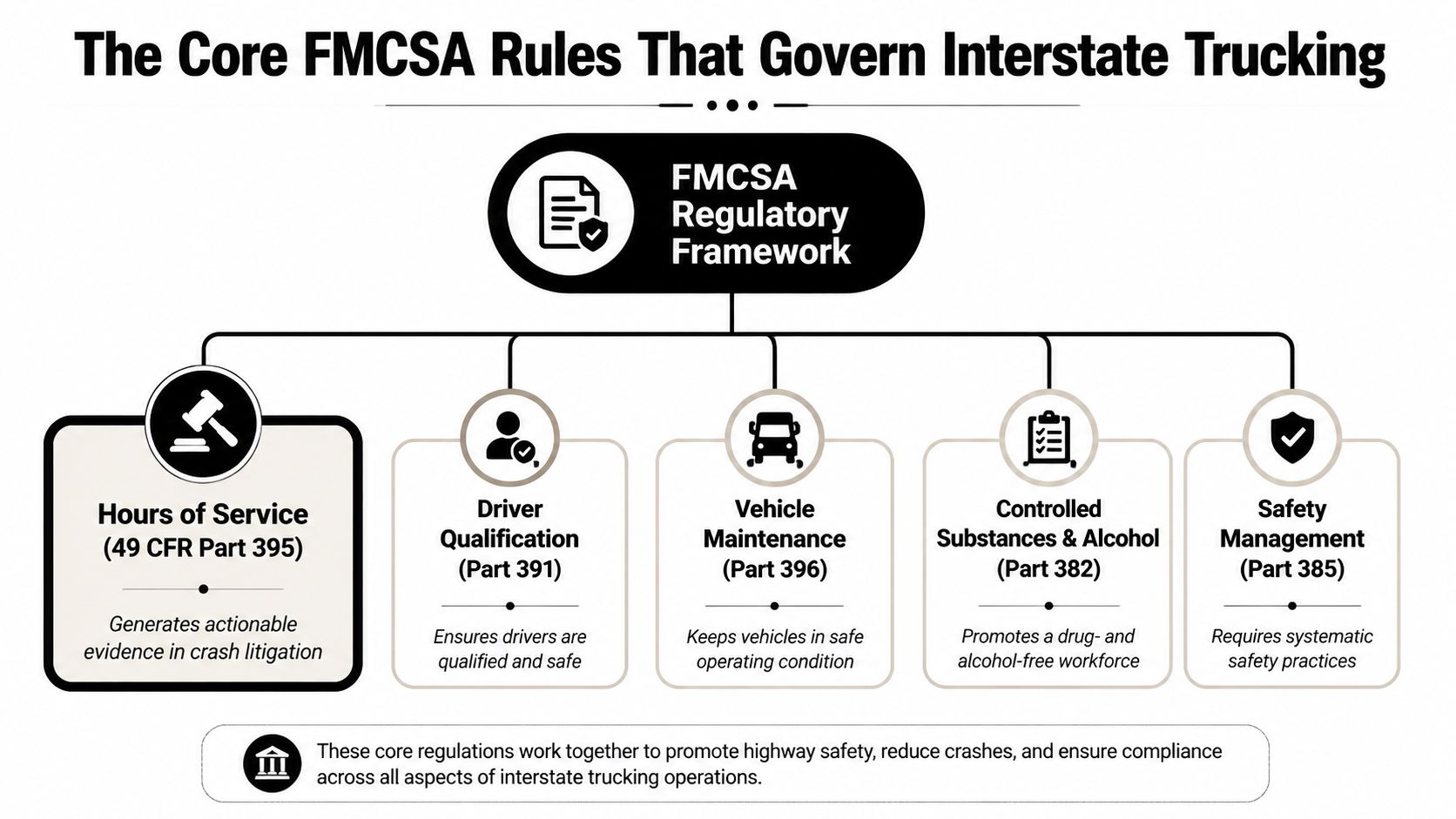
The FMCSA framework spans multiple parts of Title 49 of the Code of Federal Regulations. For crash litigation, the most useful approach is to rank those parts by the evidence they generate rather than memorizing them as an abstract index.
Part 395, the hours-of-service framework, usually comes first in a fatigue investigation. It governs driving and on-duty limits, rest, and recordkeeping. The records may include duty-status data, supporting documents, dispatch communications, and edits. A scheduling pattern can be more revealing than a single isolated log entry.
Part 396 addresses inspection, repair, and maintenance. A carrier's records should show how it identifies defects, assigns repairs, and returns vehicles to service. If a crash involves brakes, tires, lighting, steering, coupling equipment, or another mechanical system, the maintenance file can reveal whether the problem was sudden or whether the carrier had notice.
Rules that establish who and what may operate
Part 382 governs controlled-substance and alcohol testing for drivers in safety-sensitive positions. The litigation inquiry includes whether required tests were ordered, whether the collection process was followed, whether results were reported, and whether the carrier acted on disqualifying information.
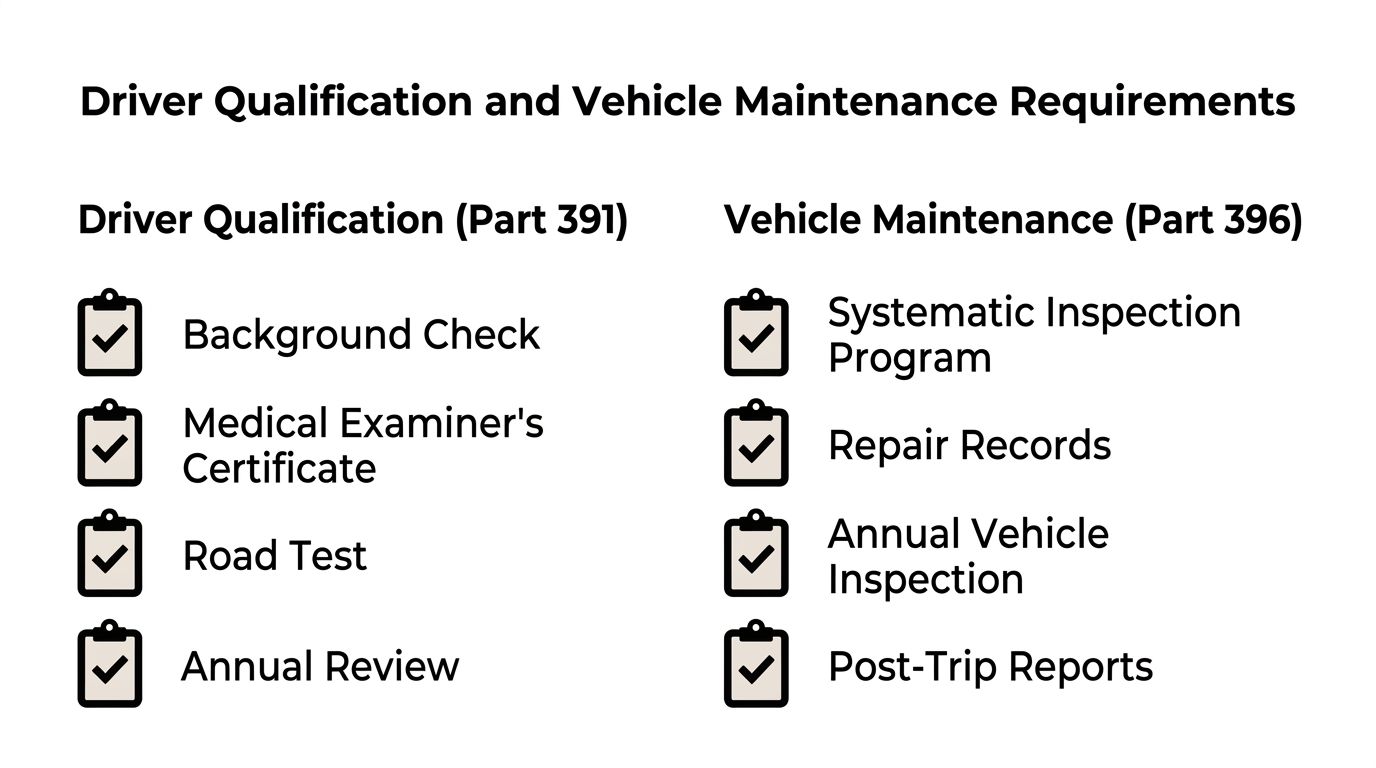
Part 391 governs driver qualification. Qualification records can show whether the carrier reviewed the driver's employment history, driving record, medical qualification, and required testing or examination materials. A missing or incomplete file doesn't prove that the driver caused the collision, but it can support negligent hiring, retention, or supervision theories when combined with other facts.
Part 393 sets standards for parts and accessories necessary for safe operation, including equipment such as brakes, lights, tires, and cargo securement components. Part 387 addresses minimum financial responsibility requirements, which vary by operation and cargo. The applicable limit must be confirmed from the carrier's operation and filings, not assumed from a general rule of thumb.
A carrier's internal system also matters. A practical fleet safety management guide can provide operational context, but litigation still requires the actual carrier records, policies, training materials, and audit history.
Hours of Service Limits and Fatigue Prevention
Hours-of-service analysis begins with the driver's entire work period, not just the time shown as “driving.” Under the FMCSA property-carrier rules, the controlling weekly cap is 60 hours on duty in 7 consecutive days or 70 hours on duty in 8 consecutive days, with a restart requiring 34 or more consecutive hours off duty, as stated in the FMCSA safety planner. Inspections, loading, waiting, fueling, paperwork, and other work can consume the on-duty clock.
The daily limits create a separate problem. The driver's available driving time and the continuous on-duty window don't move together. A driver may have unused driving hours but still be unable to drive because the on-duty window has expired. Dock delays and traffic don't stop that clock, which is why a carrier's schedule design can become central evidence.
The limits that matter in a file review
| Rule | Limit | Reset Requirement | Litigation Significance |
|---|---|---|---|
| Weekly on-duty cap | 60 hours in 7 consecutive days or 70 hours in 8 consecutive days | 34 or more consecutive hours off duty | Shows whether dispatch and scheduling consumed the driver's legal availability |
| Daily driving limit | Review the applicable property-carrier driving limit and prior off-duty period | Required off-duty rest before a new qualifying work period | Tests whether the driver could lawfully continue driving before the crash |
| Daily on-duty window | Continuous window after coming on duty | The window doesn't pause for ordinary breaks or loading delays | Reveals whether detention and delivery pressure made the schedule unrealistic |
| Rest and break compliance | Review required off-duty and break entries against movement data | Compare logs with ELD and supporting documents | Identifies fatigue evidence and inaccurate duty-status reporting |
The hours-of-service violation may appear as a single entry, but the stronger case often involves a pattern. Repeated late arrivals, compressed dispatch windows, frequent log edits, or consistent operation until the edge of the legal limit can show that the carrier built schedules without a realistic margin for weather, traffic, loading delays, or inspection time.
Split-sleeper provisions and restart planning require close attention because a technically available exception doesn't necessarily resolve the factual fatigue question. Counsel should compare the driver's claimed rest with bunk use, location data, fuel purchases, messages, tolls, and employer communications.
A logbook isn't the fatigue analysis. It's one layer in a timeline that must be tested against the truck's movement and the carrier's business records.
Electronic Logging Devices and Digital Evidence Trails
An electronic logging device is a compliance device and a litigation record. Under the FMCSA framework, the roadside-access window covers the current day and the previous 7 consecutive days, including unassigned driving time. The carrier must retain duty-status records and supporting ELD records for 6 months, according to the FMCSA ELD Final Rule.
That distinction matters immediately after a crash. Data that remains available on the device may be limited to the roadside window, while the carrier's archive should preserve the longer record. A preservation demand should address both sources, along with back-office telematics, dispatch platforms, fuel data, toll records, payroll, and geolocation information.
What to request and how to compare it
ELD data can show duty-status changes, vehicle movement, engine activity, location information, and unassigned driving. It may also contain edits and annotations identifying who changed an entry and why. Those features don't prove dishonesty by themselves. They give counsel a way to compare the driver's account with objective vehicle events.
Start with the native ELD output, not only a printed summary. Then request the carrier's audit trail, edit history, user-identification information, transfer records, and supporting documents. Compare the resulting timeline with the truck's engine-control-module data and the carrier's operational systems.
The most useful discrepancies often involve a driver logged off duty while the vehicle was moving, unassigned driving that was later assigned, or a location that conflicts with the claimed rest period. Payroll and dispatch records can also show that a driver performed work during time recorded as off duty.
The ELD retention rule creates a preservation issue, not a guarantee that every relevant record will still exist. A prompt litigation hold should cover device data, archived files, vendor-hosted information, account credentials, and backup systems.
Here is a practical discovery guide for truck wreck litigation that can help referral counsel organize requests around the records most likely to expose a timeline problem.
Driver Qualification and Vehicle Maintenance Requirements
A carrier can have a compliant-looking log and still face serious exposure if it put an unqualified driver behind the wheel or ignored a known mechanical defect. Parts 391, 396, and 382 work together because they address three different questions: could this driver legally operate, was the driver fit for safety-sensitive work, and was the vehicle safe to dispatch?
The driver qualification file should be tested for completeness and timing. Look for the application, motor-vehicle-record review, medical qualification materials, road-test documentation or accepted equivalent, and required periodic review. The key question isn't just whether a document exists. It is whether the carrier verified the information before the driver operated and responded to later changes.
Drug and alcohol records require controlled handling. Counsel should request pre-employment, random, post-accident, and reasonable-suspicion testing materials where applicable, together with consent forms, results, chain-of-custody documents, and any return-to-duty or follow-up records. A missing test may reflect a procedural failure, but the legal significance depends on the crash, the testing obligation, and the jurisdiction's evidentiary rules.
Maintenance records show notice and response
Maintenance evidence is strongest when it establishes notice. A recurring brake complaint, an unresolved tire defect, a rejected inspection item, or a repair order closed without meaningful work can connect the carrier's knowledge to the crash mechanism.
Request inspection reports, repair orders, parts invoices, annual inspection records, roadside inspection results, driver vehicle inspection reports, and out-of-service documentation. Preserve the truck itself before repairs or salvage alter the evidence. A qualified mechanical expert may need to inspect the vehicle and determine whether the alleged defect caused or contributed to the collision.
Evidence principle: A defect becomes more powerful in litigation when the records show the carrier knew about it, had an opportunity to correct it, and dispatched the vehicle anyway.
Recent Rulemaking Changes Affecting Compliance in 2025 and 2026
Recent changes make it risky to treat federal trucking regulations as a frozen paper checklist. FMCSA finalized 11 of 18 deregulatory actions proposed in May 2025, including electronic creation, maintenance, and signing of driver vehicle inspection reports, removal of obsolete flare and spare-fuse requirements, and clarification of certain equipment and labeling rules, as reported by FreightWaves. The practical result is a shift toward digital compliance and administrative simplification in selected areas, not a wholesale rewrite of the federal framework.
That shift changes discovery. If a carrier says a report was completed electronically, counsel should request the native file, revision history, signature information, access logs, and retention policy. A paper-era assumption that “no document was produced” means “no inspection occurred” may be wrong. The better question is whether the carrier can authenticate the electronic record and show when it was created, changed, signed, and stored.
Verification now deserves its own discovery category
Eligibility and enforcement developments also make driver-status records more important. Federal actions involving English-language enforcement, certain foreign-driver CDL pathways, status verification, noncompliant ELD devices, and civil penalties place greater weight on proving that the driver and equipment were legally authorized on the crash date. A licensing or registration problem doesn't establish causation by itself, but it can support negligent hiring, supervision, or retention when the carrier ignored a warning.
For a referral attorney, the discovery template should include:
- Electronic inspection records: Request original files and metadata, not only printed copies.
- ELD registration and certification: Identify the device, vendor, version, and compliance status in use.
- Driver-status verification: Obtain qualification, licensing, medical, Clearinghouse, and employer-review records that the carrier relied on.
- Enforcement history: Seek roadside inspections, compliance reviews, corrective actions, and communications about known violations.
The important change is evidentiary. Compliance is increasingly proved through system records and verification events, so the investigation must preserve the systems that generated those records.
Critical Evidence to Collect After a Trucking Crash
The first evidence demand should be specific enough that a carrier can't reasonably misunderstand what must be preserved. A broad letter saying “retain all evidence” is less useful than identifying the truck, trailer, driver, route, crash time, ELD vendor, telematics systems, and categories of records.
Start with the electronic timeline. Request ELD exports and audit files, engine-control-module information, GPS or telematics data, dispatch communications, fuel and toll records, and relevant phone or messaging records. The goal is to establish what the truck did, what the driver reported, and what the carrier knew.
Build the file around the crash mechanism
Organize the next requests by the theory of liability rather than by document type:
- Fatigue or scheduling: Obtain duty-status records, supporting documents, prior work records, dispatch instructions, appointment times, detention communications, and payroll.
- Driver qualification: Request the complete qualification file, motor-vehicle records, medical qualification materials, training documents, and employer reviews.
- Substance testing: Seek required testing records, collection documentation, results, and carrier responses.
- Mechanical failure: Preserve the tractor and trailer, then request inspection reports, repair orders, defect reports, annual inspections, roadside inspection materials, and parts records.
- Cargo movement: Obtain bills of lading, loading instructions, weight information, securement documents, photographs, and communications with the shipper or warehouse.
- Insurance and regulatory history: Request applicable insurance filings, including MCS-90 materials, safety records, prior compliance reviews, corrective actions, and carrier policies.
A truck wreck investigation guide can help counsel sequence these requests and connect each record to a potential negligence theory.
Preservation has to happen before routine systems do their work
Carriers and vendors may use automatic retention schedules, device storage limits, account deletion rules, or routine vehicle repair processes. Send preservation demands promptly, identify the records with precision, and follow up with subpoenas or formal discovery when voluntary production is incomplete. If a party fails to preserve relevant evidence, the court decides the available remedy, which can include sanctions or an adverse inference depending on the facts and governing law.
Don't wait for the carrier's first production to investigate. Photograph the scene and vehicle condition, identify witnesses, obtain public records, and track every known custodian. A reliable chronology often exposes contradictions before depositions begin.
Nares Law Group LLC investigates federal compliance records, preserves digital evidence, and develops liability theories for people injured in truck crashes and for attorneys handling complex referrals or co-counsel matters. Visit Nares Law Group LLC to discuss the evidence in your case and determine the next steps for protecting your claim.