A week after a collision, you may be sitting in your pickup truck with a repaired bumper, a straightened frame, and a vehicle that drives normally. The body shop has closed the file, but the financial loss may still be sitting in front of you. Your loan payoff can remain higher than what dealers are willing to offer, and the buyer who once praised the truck may now ask whether it has been in an accident.
That question matters because a repair invoice measures the cost of restoring the vehicle, not necessarily the vehicle's full economic loss. A repaired car can be safe and functional while still selling for less because its collision history follows it into resale, trade-in, and financing conversations. That remaining market loss is generally called diminished auto value. If you're also documenting medical bills, lost income, or other losses, a resource on how to calculate accident damages correctly can help you keep the vehicle claim in the larger picture.
The Moment You Realize the Repair Wasn't the Whole Loss
At trade-in, the repaired truck may look ready for the next buyer. The frame is straight, the alignment is within specifications, the airbags work, and the drivetrain was never touched. Then the dealer checks the vehicle-history report and reduces the offer because the truck carries a collision record. The repair solved a physical problem, while the market still remembers the event.
Ordinary depreciation affects every vehicle as it ages, gains mileage, and responds to changing market conditions. The narrower question is what value did the vehicle lose because of this particular crash, after accounting for the repair and everything unrelated to the crash? That distinction keeps a diminished-value claim from becoming a demand for ordinary wear, maintenance, or market decline.
The repair order and the market price answer different questions
The repair order records the cost of restoring damaged parts. A valuation analysis examines two market snapshots: what the vehicle could have commanded immediately before the collision and what comparable buyers or dealers would offer afterward. Those are related measures, like the cost of rebuilding a house versus the price a buyer will pay for a house with a known fire in its history.
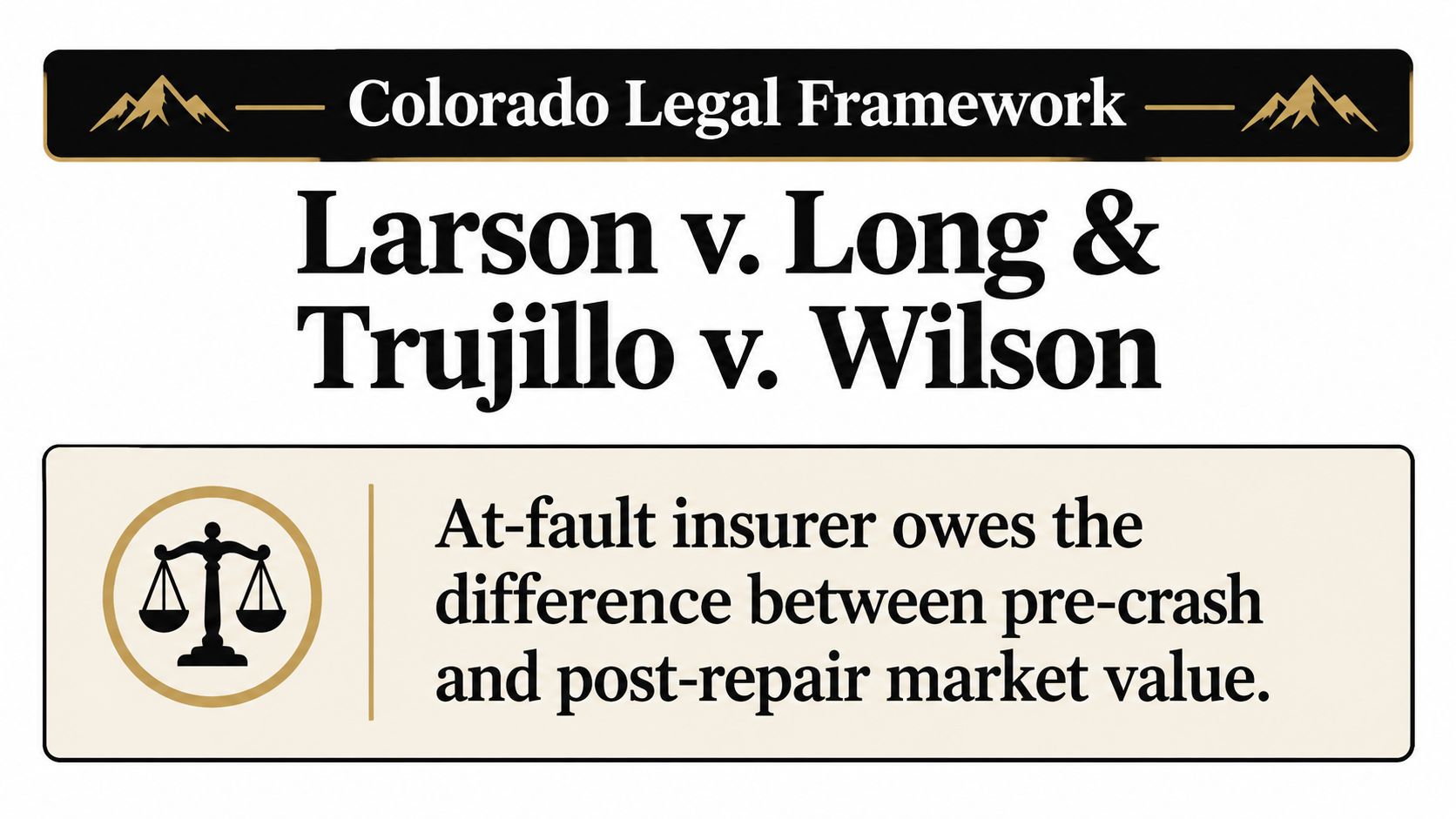
Colorado courts have recognized accident-related depreciation as recoverable since the 1920s. The detailed discussion of Larson v. Long, Trujillo v. Wilson, and Colorado's before-and-after measure belongs with the state-specific rules. A Colorado diminished value appraisal resource also summarizes that legal framework.
The practical point is clear. A completed repair doesn't automatically erase the market loss. A buyer may worry about hidden damage, prior structural work, paint matching, replaced safety components, or a harder resale. A dealer may use the collision record to justify a lower appraisal even when the shop followed proper repair procedures.
Before accepting an insurer's formula, compare similar vehicles with and without reported collisions. Their mileage, trim, condition, location, and options should be close. That before-and-after evidence helps separate crash-specific loss from the depreciation the truck would have experienced anyway. For the broader claim, you can also calculate accident damages correctly.
Three different losses can hide under one label
The recognized categories are immediate diminished value, inherent diminished value, and repair-related diminished value. Each arises at a different point and calls for different supporting evidence.
What Diminished Auto Value Actually Means
Diminished value is the reduction in a vehicle's market value caused by a collision or its consequences. It isn't the same as ordinary depreciation, maintenance, mileage, or wear. Those factors affect what almost every vehicle is worth. A diminished-value claim isolates the additional reduction tied to the accident.
The National Association of Insurance Commissioners' discussion of diminished value identifies three technically different categories.
Immediate diminished value
Immediate diminished value is the loss created at the moment of impact, before anyone repairs the vehicle. Suppose a mid-cycle SUV is struck on a Tuesday and assessed on Wednesday. Even before the shop begins work, a buyer who knows the SUV was damaged may pay less than a buyer would have paid for the same SUV without the crash.
This category can be difficult to separate from repair cost because the vehicle's condition is changing rapidly. It matters conceptually because the accident can affect market value before the repair process begins.
Inherent diminished value
Inherent diminished value is the market stigma that remains after proper repairs. A vehicle may return to safe, functional condition, but its accident history can still appear in a vehicle-history report. A buyer comparing two otherwise similar certified pre-owned vehicles may prefer the one with no reported collision, or may demand a lower price for the vehicle with the record.
This is the category most Colorado claimants usually mean when they ask about diminished auto value. The claim isn't that the shop failed. The claim is that the market treats a documented accident as a negative feature even after quality work.
Repair-related diminished value
Repair-related diminished value comes from deficient workmanship or incomplete restoration. Examples include mismatched paint, uneven panel gaps, improper alignment, inadequate frame documentation, or incomplete restraint-system work. This loss is different from inherent stigma because the vehicle's reduced value flows from the quality of the repair itself.
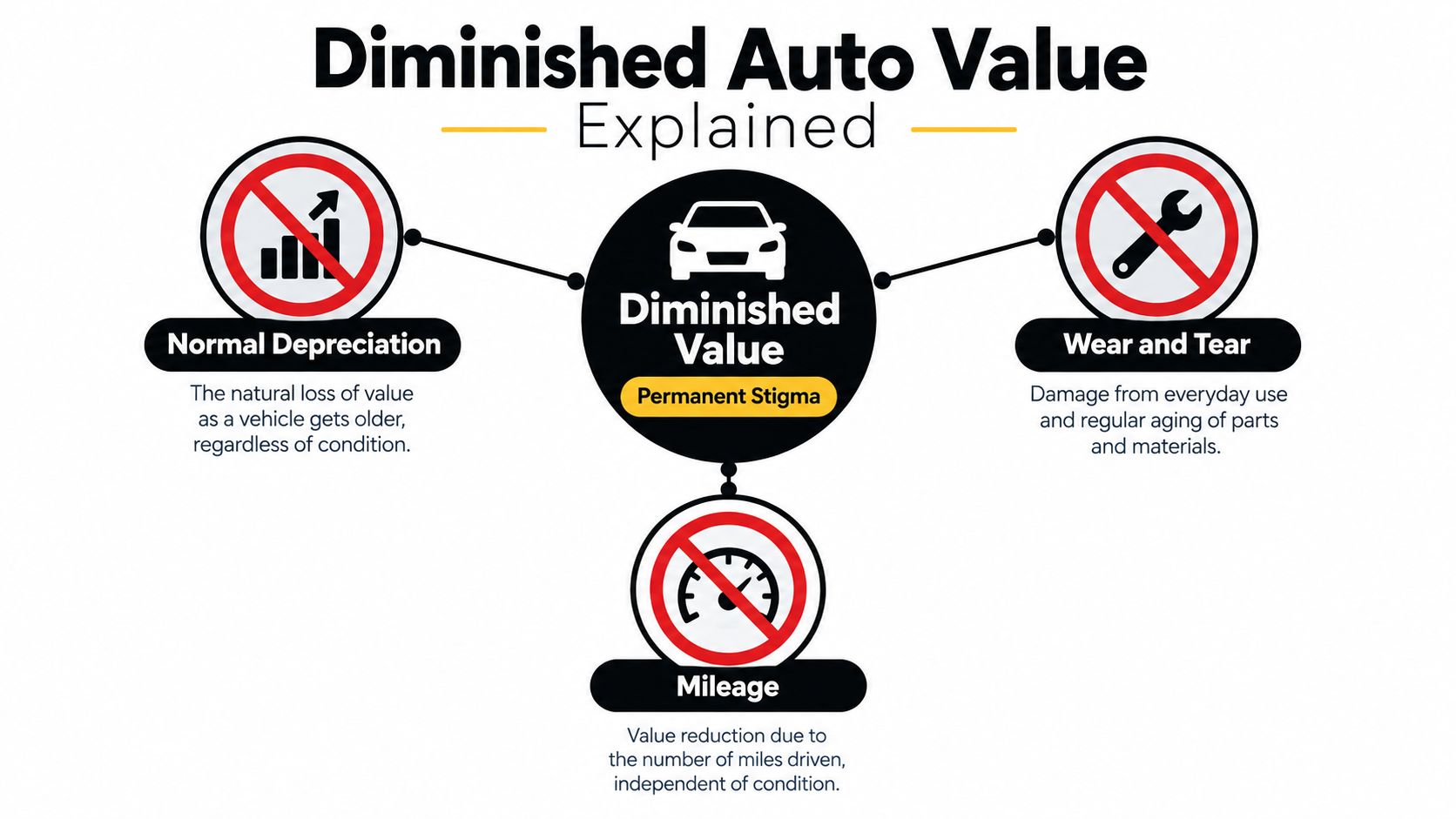
Start by identifying the condition of your vehicle. If the repair was poor, preserve evidence for a repair-quality claim. If the repair was sound but the accident is reported, focus on inherent diminished value. If the vehicle has not yet been repaired, document its pre-repair condition and the market effect of the collision separately.
How the Loss Is Calculated and Proved
A percentage shortcut can produce a quick estimate, but it doesn't answer the central evidentiary question: what was this specific vehicle worth before the crash, and what is it worth after the crash history became available?
One widely referenced formula, historically associated with Georgia's 17(c) approach, begins with 10% of the vehicle's market value and then applies damage and mileage modifiers. The Boston University Law Review analysis of diminished value explains why a structured formula can be a starting point but may understate or overstate loss. A formula can't fully account for unusual vehicle value, extensive structural or safety-system damage, title status, repair quality, or a market with few useful comparables.
An insurer may present the formula as if it were the answer. It isn't automatically the answer. Treat it as a reasonableness check, then test it against market evidence.
Comparable evidence follows the buyer's decision
The stronger method compares vehicles that are alike. Match the year, trim, mileage, options, condition, geographic market, and relevant history. Then create two evidence sets:
- Clean-history vehicles: Comparable vehicles without the collision history, used to establish the market baseline.
- Accident-history vehicles: Comparable vehicles carrying a similar reported collision history, used to estimate the post-crash market reaction.
Adjust for ordinary depreciation, mileage added after the collision, market movement, title branding, structural damage, airbag deployment, and repair documentation. The goal isn't to find a convenient price. It's to isolate the part of the price difference caused by this crash.
| Factor | Georgia 17(c) Formula | Comparable-Sales Method |
|---|---|---|
| Starting point | A percentage of market value | Actual market evidence for similar vehicles |
| Main advantage | Fast and easy to apply | Tied to the vehicle and its market |
| Main weakness | May miss unusual damage, condition, or demand | Requires careful matching and adjustments |
| Insurer's likely use | A quick benchmark or payment limitation | A detailed basis for negotiation |
| Best role | Preliminary reasonableness check | Primary support for a defensible demand |
A written appraisal can explain the adjustments and methodology. Dealer quotes, documented offers, auction information, pre-loss listings, photographs, repair records, and vehicle-history data can reinforce it. No single document carries the whole claim. The persuasive package shows how each item answers a different valuation question.
Practical rule: Don't let an adjuster turn a convenient formula into a substitute for evidence about your actual vehicle.
Documentation That Makes a Diminished Value Claim Credible
A diminished-value demand becomes credible when the records tell one consistent story. The story starts with the vehicle before impact, identifies the damage caused by the collision, shows the work performed, and then demonstrates how the market treats the repaired vehicle.
Build the repair file first
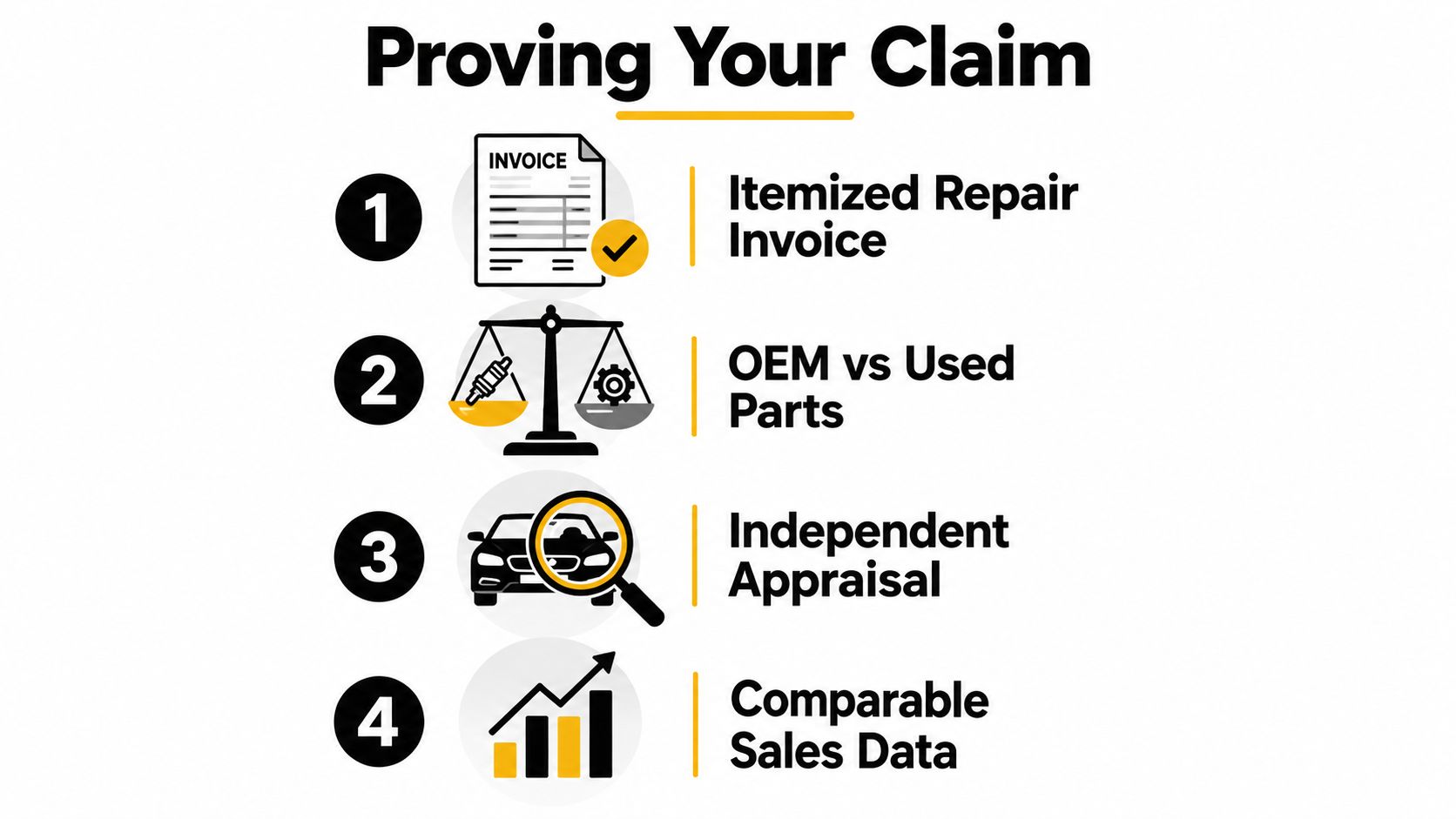
Save the initial estimate, every supplement, the final invoice, parts information, and records showing structural or frame work. If the shop used original equipment, used, or aftermarket parts, preserve that information. Alignment results, diagnostic scans, restraint-system records, calibration records, and repair photographs can reveal the severity and quality of the work more clearly than a summary invoice.
Photograph the vehicle before repairs if possible, during disassembly, and after completion. Keep the original files and their timestamps. The police report and adjuster correspondence help connect the damage and repairs to the specific crash rather than to an earlier event.
Establish the vehicle's identity and baseline
Obtain the vehicle-history report from a service such as Carfax or AutoCheck. Review it for the collision entry, prior damage, title status, mileage history, and ownership information. A history report isn't a valuation by itself, but it helps explain what buyers and dealers can discover.
Pre-loss listings, prior dealer appraisals, service records, and condition photographs help establish what the vehicle looked like before the crash. Comparable vehicles should match the relevant year, trim, mileage, options, condition, and region. A generic guide value that ignores those details gives the insurer an easy reason to reject the analysis.
Make the evidence interlock
Your records should allow an adjuster, appraiser, or court to answer four questions without guessing:
- What existed before the crash? Show the vehicle's condition, equipment, mileage, and market position.
- What damage occurred? Use the report, photographs, estimates, and supplements.
- What repair was completed? Provide invoices, parts records, measurements, and diagnostic documentation.
- What changed in the market? Compare clean-history and accident-history vehicles and explain the adjustments.
If you need help obtaining a motor-vehicle report and understanding the information it contains, this crash-report resource can help you identify the records to request. Keep copies before sending originals to an insurer.
How Insurers Typically Handle a Diminished Value Demand
An adjuster may not reject the idea of diminished value outright. Instead, the carrier may acknowledge that accident history can affect a vehicle and then offer an amount based on a narrow formula, an internal guideline, or a quick inspection. That approach sounds technical, but it can leave out the evidence that matters most, such as comparable vehicles with similar accident histories.
The first coverage distinction is important. A claim against your own insurer is a first-party claim governed primarily by the policy language. Many policies don't promise payment for inherent diminished value under collision coverage, so the carrier may deny it or argue that the policy pays only to repair physical damage.
A claim against the at-fault driver's liability insurer is a third-party claim. Its legal foundation is the property damage caused by the other driver, and Colorado precedent recognizes market-value evidence as relevant to that loss. The policy and facts still matter, but the analysis isn't identical to a request under your own collision coverage. Guidance on the relevant coverage questions appears in this discussion of collision insurance coverage.
The common lowball sequence
A typical exchange may look like this:
- You submit repair records, a vehicle-history report, and a valuation.
- The adjuster responds with a smaller figure based on a formula.
- The carrier says the repairs restored the vehicle's value.
- You ask which comparable vehicles support that conclusion.
- The adjuster requests another inspection or repeats the original offer.
The problem isn't that an insurer asks questions. Questions are appropriate. The problem arises when the carrier treats a generic cap or formula as conclusive while ignoring matched market evidence.
A fair conversation focuses on the actual vehicle. The adjuster reviews the repair severity, asks about prior damage, examines the comparables, and explains the adjustments. If language access affects the process, a guide to interpreting services for insurance claims can help you understand what an adjuster is requesting and communicate accurately.
Keep communication written where possible. Ask the insurer to identify the valuation method, the comparables relied upon, the adjustments made, and whether the payment resolves diminished value separately from repair costs. Don't sign a broad release until you understand which vehicle claims it closes.
A Sample Before-and-After Valuation
Consider a hypothetical mid-size SUV with moderate mileage that suffers a rear-end collision. The shop completes the repairs, the vehicle drives properly, and the final file shows the work performed. The owner wants to determine whether the post-repair accident history affects the SUV's market value.
The first step is to establish the pre-loss baseline. The owner collects local listings and sales for vehicles with the same configuration, similar mileage, comparable options, and similar condition. The most useful records are close in time to the crash and explain why each comparison is similar. The owner then removes or adjusts for differences such as unusually high mileage, upgraded equipment, prior damage, or a different title status.
The second step is to examine comparable vehicles after an accident history appears. A clean-history listing cannot stand alone as proof of the repaired vehicle's value. The analysis should look for vehicles with comparable collision records, repair severity, and market conditions. If accident-history vehicles receive lower offers, sit longer, or require larger price concessions, those observations may support a post-loss adjustment, but the evaluator must explain how the evidence connects to this SUV.
| Vehicle / Comparable | Mileage | Condition Notes | Sale or List Price | Notes |
|---|---|---|---|---|
| Clean-history comparable | Similar range | Similar trim and equipment | Recorded market price | Establishes the pre-loss market set |
| Clean-history comparable | Similar range | Minor condition differences | Recorded market price | Adjust for mileage or options |
| Accident-history comparable | Similar range | Reported collision and completed repair | Recorded market price or offer | Helps estimate post-loss market treatment |
| Accident-history comparable | Similar range | Similar damage description | Recorded market price or offer | Check repair quality and title status |
The difference between the adjusted clean-history set and accident-history set is the potential crash-specific loss. A valuation professional may use the 10% to 20% benchmark sometimes observed in claims practice as a reasonableness check, as described by the NAIC source cited earlier. That benchmark isn't a universal rule and can't replace comparable-sales evidence.
The sample has limits. Mileage, repair quality, structural involvement, regional demand, prior history, and the reliability of the price records can change the result. A defensible report states those assumptions instead of presenting a precise figure that the underlying evidence can't support.
Colorado-Specific Rules Every Claimant Should Know
After a Colorado crash, the repairs may look complete while the vehicle still brings less money in the market. Colorado handles that problem mainly through court decisions, not a statute devoted specifically to diminished auto value. As covered earlier, Larson v. Long and Trujillo v. Wilson supply the before-and-after market-value measure. A Colorado legal overview of diminished value summarizes that framework, while the Colorado Department of Insurance has indicated that no Colorado insurance statute specifically addresses diminished value.
What that means for a claimant
Your demand should identify a market loss caused by the collision and remaining after repairs. It should separate that loss from ordinary depreciation caused by age, mileage, prior damage, title branding, market changes, and unrelated mechanical problems. Before-and-after comparable vehicles provide the cleanest way to make that separation. A similar clean-history vehicle shows the likely pre-crash market. Comparable vehicles with disclosed accident histories help show how buyers treat the repaired vehicle afterward.
The usual target is the at-fault driver's liability insurer. Payment under your own collision policy depends on its language and exclusions. A carrier paying the repair bill does not automatically owe inherent diminished value under that policy.
Keep this demand separate from personal injury protection, medical-payments coverage, rental costs, and repair expenses. Each category compensates a different loss. Read any property-damage release carefully, because its wording may affect related claims.
Vehicle history matters. A clean title, reliable pre-loss records, complete repair documents, and comparable sales that match the vehicle strengthen the analysis. Salvage branding, earlier collisions, missing records, or poor repairs can reduce the claimed amount or make the comparison less reliable. They do not decide the issue automatically.
Deadlines also matter. A lawyer should identify the applicable deadline before negotiations continue and review every proposed release. Do not rely on an adjuster's informal statement about when the claim expires. If the carrier will not explain its position, a claimant can review the Colorado Division of Insurance complaint process and preserve the demand, valuation, repair file, photographs, history report, offers, and response dates. A complaint may create regulatory review, but it does not replace evidence of the vehicle's market loss or guarantee payment.
The following video provides another way to review the legal framework:
Legal Options When the Insurer Won't Pay Fairly
Start with a focused written demand. Identify the crash, explain the completed repairs, state the claimed market loss, and attach the evidence that supports each part of the analysis. Include the repair file, photographs, vehicle-history report, pre-loss market records, post-loss comparables, and any independent appraisal. Ask the carrier to respond to the methodology, not just the requested amount.
Escalation should match the evidence
If the insurer makes a low offer, request the carrier's written valuation and the comparables it used. A second review can resolve a genuine disagreement about mileage, options, repair severity, or prior history. It can also expose a formula-only evaluation that never addressed the actual market.
Some policies contain appraisal or alternative-dispute provisions. Read the provision carefully. It may address physical damage under the policy and may not control a third-party liability claim for inherent diminished value. A policy dispute and a valuation dispute aren't automatically the same issue.
If the carrier unreasonably delays or denies a first-party claim, Colorado's insurance statutes may provide additional arguments, including provisions addressing unreasonable delay or denial. Those theories are fact-specific and shouldn't be asserted casually. Preserve letters, emails, estimates, reports, offers, and the dates of every response.
Court is a business decision
A claimant can consider the appropriate Colorado court based on the amount and complexity of the dispute. Small-claims procedures may fit a straightforward, well-documented loss within that court's jurisdiction. Larger or more complex matters may require county or district court, especially when the insurer disputes fault, repair quality, prior damage, or expert methodology.
The filing cost, appraisal expense, attorney time, and risk of a defense valuation all matter. A documented modest loss may be resolved efficiently through negotiation. A stubborn carrier may justify an attorney demand. Litigation makes more sense when the evidence is strong and the disputed loss is substantial enough to justify the expense.
For practical guidance on presenting a dispute, see this resource on how to dispute an insurance claim. Nares Law Group LLC can review the crash evidence, repair records, vehicle valuation, and insurer communications to determine whether negotiation or litigation is proportionate to the loss. Contact the firm through Nares Law Group LLC for a case-specific evaluation of your diminished auto value claim and the broader damages arising from the collision.