You're sitting in a hospital room, answering calls from an insurance adjuster while your family tries to understand what happens next. Your vehicle is destroyed, your injuries may keep you from working, and the trucking company already has people focused on the crash. You may feel pressure to accept an early offer or hire the first lawyer who promises to help.
Slow down, but don't wait. Choosing a truck accident lawyer is not mainly a review-count or personality decision. It's a decision about evidence, strategy, liability, and whether your lawyer can prepare the case for trial before the defense controls the narrative.
The Real Stakes of Your Trucking Claim
A commercial truck crash can affect your health, income, family responsibilities, and future independence. Serious orthopedic injuries, traumatic brain injuries, and wrongful death claims demand more than a standard car-accident investigation. They often involve extensive medical evidence, long-term financial consequences, multiple insurance policies, and a trucking company with a defense team ready to challenge fault and damages.
That's why a general personal injury lawyer may not be enough. A lawyer who handles routine auto claims may understand negligence in broad terms but still miss the operational details that shape a trucking case. The driver's conduct is only one part of the investigation. The carrier's hiring and supervision, the truck's maintenance, the cargo loading, the driver's records, and the relationships among the businesses involved can all affect the result.
Representation changes your negotiating position
The Insurance Research Council reports that claimants represented by counsel recover about 3.5 times more on average than unrepresented claimants, and represented claimants receive a payout 91% of the time compared with 51% for those without counsel. Those figures are reported in this discussion of choosing a truck accident lawyer.
That doesn't mean a lawyer can guarantee a particular recovery. It does mean representation can materially change how an insurer evaluates your claim. A prepared attorney can document liability, challenge incomplete investigations, calculate the full effect of an injury, and show the defense that your family is prepared to continue if settlement discussions fail.
The right question isn't “Can this lawyer take my case?” It's “Can this lawyer protect the case before the trucking company's evidence and strategy get ahead of us?”
Ask prospective lawyers whether they regularly handle commercial trucking claims, not merely motor vehicle accidents. Ask about serious brain injuries, permanent disability, and wrongful death. Ask who will investigate the crash, who will speak with experts, and whether the lead lawyer personally remains responsible for the file.
You also need a lawyer who understands that an early settlement may be dangerous when the medical picture is incomplete or the evidence is untested. An insurer may present speed as helpful. In a serious trucking claim, speed without investigation usually benefits the insurer.
Securing Fragile Evidence in the First 48 Hours
The most important hiring question may be the one most consumers never ask: what will your firm do immediately after signing the case?
Truck crash evidence can be vulnerable to alteration, loss, overwriting, disposal, or repair. A qualified trucking firm should have a written response process, not a vague promise to “look into it.” The guidance on preserving spoliation-sensitive evidence identifies the first 48 hours as a critical period for preservation and analysis.
Ask for the firm's evidence plan
During the consultation, ask these questions directly:
- Who sends preservation letters? The firm should identify the person responsible for sending immediate demands to the carrier, driver, owner, broker, shipper, and other relevant businesses.
- What records will you request? The answer should address electronic control module and event data recorder information, maintenance files, driver logs, inspection records, dispatch material, onboard video, cargo documentation, and communications relevant to the trip.
- Who visits the scene and inspects the vehicles? A serious case may require a qualified accident-reconstruction professional to examine damage, roadway conditions, visibility, vehicle positions, and mechanical issues.
- Who owns the file day to day? You should know whether the lead attorney, an associate, a case manager, or an outside referral lawyer will handle the investigation.
- How will you respond if the defense says evidence no longer exists? The lawyer should explain how the firm documents preservation demands, follows up, and evaluates potential spoliation issues. You can also review this plain-language resource on spoliation of evidence.
A preservation letter should do more than announce that a claim exists. It should identify categories of evidence that must be protected and instruct the recipient not to overwrite, alter, discard, repair, or destroy relevant material. The request should account for both physical evidence and digital records.
Test the lawyer, not the sales pitch
A lawyer who understands trucking litigation should explain how evidence fits into the liability theory. For example, the firm should be able to tell you why driver logs matter, how maintenance records may support or undermine a mechanical-failure theory, and how electronic data could clarify speed, braking, steering, or vehicle movement.
You don't need to know the technical vocabulary before the consultation. You do need to receive a concrete answer about who will obtain the information and how the firm will verify it.
This video offers additional context for people evaluating the investigation and legal issues that can follow a truck crash:
Walk away from a firm that says it will request records later without explaining what it will preserve now. Evidence control is not an administrative detail. It's the foundation of your case.
Navigating Federal Safety Rules and Liability Layers
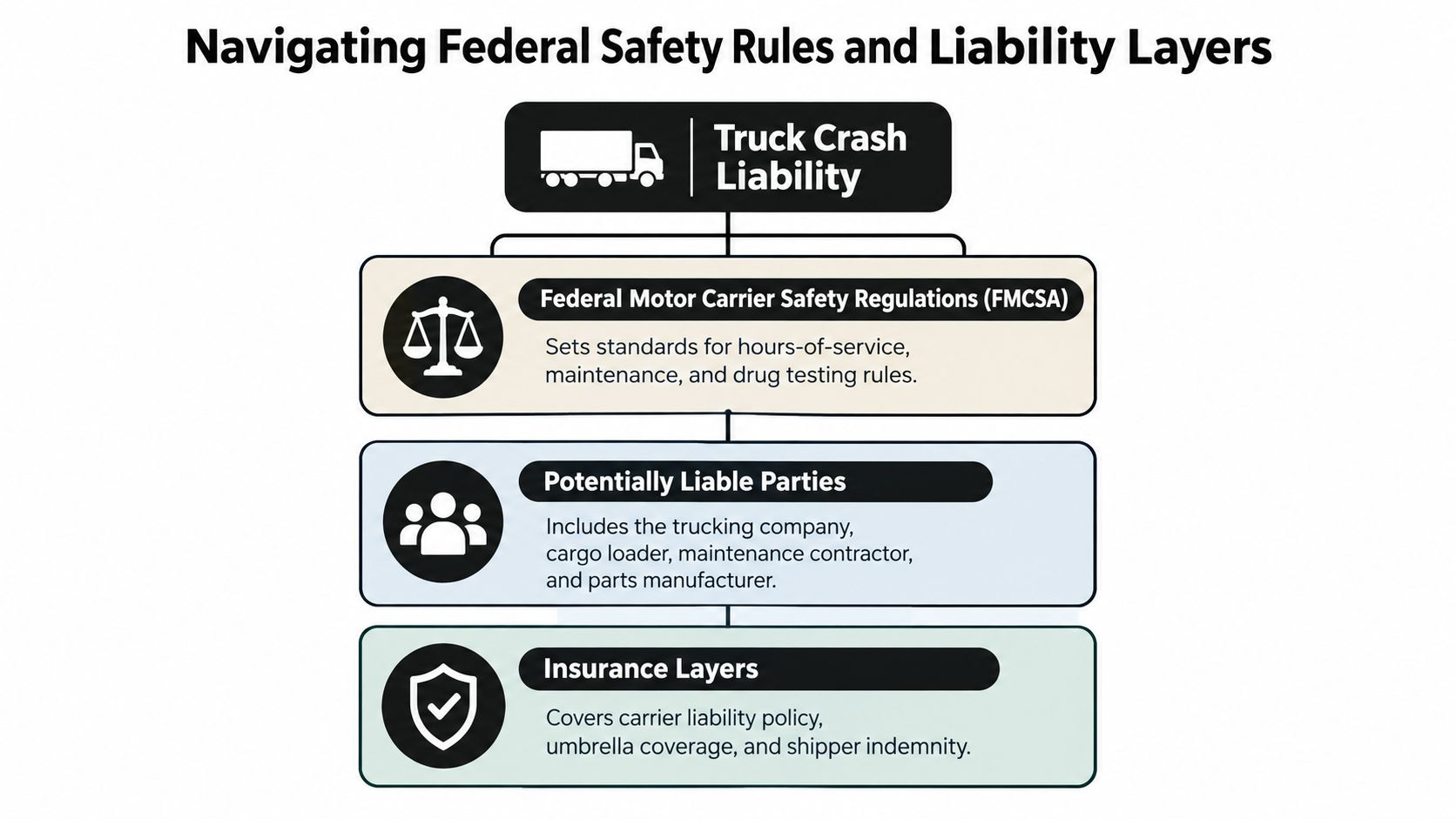
A truck crash can appear to be a simple rear-end or lane-change case until the carrier's records reveal excessive driving hours, aggressive dispatching, poor maintenance, or a cargo problem. Truck cases differ from ordinary car claims because federal safety rules govern commercial driving and carrier operations. A lawyer who does not understand those rules may focus only on the collision and miss evidence showing why the truck was on the road, how the driver was managed, and whether the carrier followed required practices.
FMCSA reporting shows the scale of large-truck crashes. A secondary summary of FMCSA truck-crash data and federal driving limits states that more than 160,000 crashes involving large trucks occur each year in the United States, with 5,375 large trucks involved in fatal crashes in 2023 and 164,347 total crashes involving large trucks and buses that year. Treat those figures as a starting point. Your lawyer still must connect the applicable rule to the facts and proof in your collision.
Regulatory knowledge must be practical
For property-carrying truck drivers, FMCSA rules limit driving to 11 hours within a 14-hour on-duty window and require a 30-minute break after 8 cumulative hours. A qualified truck-litigation lawyer should know how to test compliance, not merely recite the limits.
That work can include comparing electronic logging information with fuel purchases, dispatch messages, delivery schedules, toll records, GPS data, inspection records, and witness accounts. A mismatch does not establish liability by itself. It can expose fatigue, scheduling pressure, falsified records, or inadequate carrier oversight, then point investigators toward the records and witnesses that matter.
Ask this direct question during the consultation: “What regulatory records would you seek in my case, and how would you compare them with the physical evidence?” The answer should identify specific records, the people responsible for obtaining them, and the way those records could support or weaken a liability theory. A lawyer who cannot explain that process is treating a commercial trucking claim like a routine vehicle collision.
Look beyond the driver
The driver may bear responsibility, but the driver is rarely the only person or business worth examining. Potential defendants can include:
- The motor carrier: The trucking company may face questions about hiring, training, supervision, scheduling, inspection, and maintenance.
- The broker or shipper: Contract terms and delivery demands may show who controlled the work and what information each business held.
- The cargo loader: Improperly secured or distributed cargo can affect stability and stopping performance.
- The maintenance vendor: A contractor may have performed inadequate repairs or failed to address a known safety problem.
- The vehicle or parts manufacturer: A component failure may support a product-liability investigation alongside a negligence claim.
A specialist should identify these parties early, then narrow the case according to the evidence. Corporate defendants often point at one another, deny control, shift blame, or claim that another company alone caused the crash.
Ask the lawyer to draw a liability map for your collision. It should address the driver, carrier, broker, shipper, maintenance providers, and every business connected to the truck or load. Choose counsel who examines the entire commercial operation, not just the person named in the police report.
Evaluating True Trial Readiness and Case Focus
Many firms describe themselves as trial lawyers. That phrase alone tells you very little. A firm can have trial language on its website while resolving nearly every case before meaningful litigation begins.
That isn't automatically wrong. Settlement can be the right result when it reflects the claim's full value and the evidence supports it. The problem arises when a firm's business model rewards quick closures, low investigation costs, or transferring difficult cases to someone else.
Ask for litigation specifics
Recent legal-market guidance increasingly urges prospective clients to compare how many trucking cases a lawyer has litigated, whether the lawyer has taken such a case to verdict, and whether the firm handles matters in-house or refers them elsewhere. You can review that discussion of verifying true trucking specialization.
Ask questions that require a factual answer:
| Question | What a useful answer should reveal |
|---|---|
| How many trucking cases have you personally litigated? | Whether the lawyer's experience is direct or merely associated with the firm |
| Have you taken a trucking case to verdict? | Whether the lawyer has tested evidence and damages before a jury |
| Who will handle depositions and expert witnesses? | Whether the promised trial lawyer will actually do the work |
| Do you refer complex cases out? | Whether another firm may assume control after you sign |
| What serious injuries do you regularly handle? | Whether the team understands brain injury, disability, or fatal-loss evidence |
The lawyer doesn't need to promise a trial. The lawyer does need to demonstrate the ability to prepare for one. That includes developing witnesses, challenging defense experts, presenting medical proof, and explaining long-term losses in a way a jury can understand.
Examine staffing and communication
A serious trucking claim may involve accident reconstruction, medical specialists, vocational professionals, economists, and life-care evidence. Ask whether the firm has established relationships with those professionals and whether the case budget supports the investigation.
Also ask who will communicate with you. If a paralegal or case manager handles routine updates, that can work well. You should still know when the attorney will review major decisions and how quickly the firm responds to urgent developments. Clear secure client communication tips can help you protect sensitive information while communicating with your legal team.
Trial readiness means preparation you can see, not courtroom photographs or confident slogans.
A lawyer who talks only about settlement may be optimizing for speed. A lawyer who talks only about trial may be performing for the consultation. Choose the firm that can explain both paths, identify the evidence required for each, and show who will do the work. Families can also review this guide to preparing for trial to understand the level of organization a serious case may demand.
Understanding Jurisdiction and Fee Structures
Commercial trucks cross state lines, and the crash location may not be the only place relevant to the case. The driver may live elsewhere, the carrier may be based in another state, the broker may operate nationally, and witnesses or records may be scattered across jurisdictions.
You don't need to solve those issues yourself. You do need to ask how the firm will manage them. Confirm where the lawyer is licensed and whether the firm can appear in the court handling your claim. If the case requires work outside the firm's home jurisdiction, ask whether the firm uses properly structured co-counsel arrangements and who remains responsible for the strategy.
Confirm who will actually represent you
Co-counsel can be valuable in a complex trucking case, especially when local court knowledge or additional litigation resources are necessary. It becomes a problem when the arrangement is hidden from the client or when responsibility becomes unclear.
Ask for plain answers:
- Which lawyer will be your primary contact?
- Which firm will make strategic decisions?
- Will another lawyer attend depositions or court hearings?
- How will the firms divide work and fees?
- Who will explain settlement recommendations to you?
- Will you receive a copy of the written fee agreement?
A professional firm should welcome these questions. You're not being difficult by asking who controls your case. You're protecting yourself from confusion at the point when the claim becomes more demanding.
Read every fee provision
Most injury firms use a contingency arrangement, meaning the attorney's fee is paid from a recovery rather than collected upfront. The written agreement should explain what happens if there's no recovery and should distinguish the attorney's fee from case expenses.
Case expenses may include records, filing fees, expert work, deposition costs, travel, investigation, and other litigation services. The agreement should state whether those expenses are deducted before or after the contingency fee is calculated, who advances them, and whether you could owe them if the case doesn't produce a recovery.
Don't rely on a verbal explanation. Ask the lawyer to walk through a hypothetical recovery using the actual contract language. You should understand the financial arrangement before signing, including any liens, medical reimbursement issues, or costs that could affect what your family ultimately receives.
Spotting Red Flags and Marketing Traps
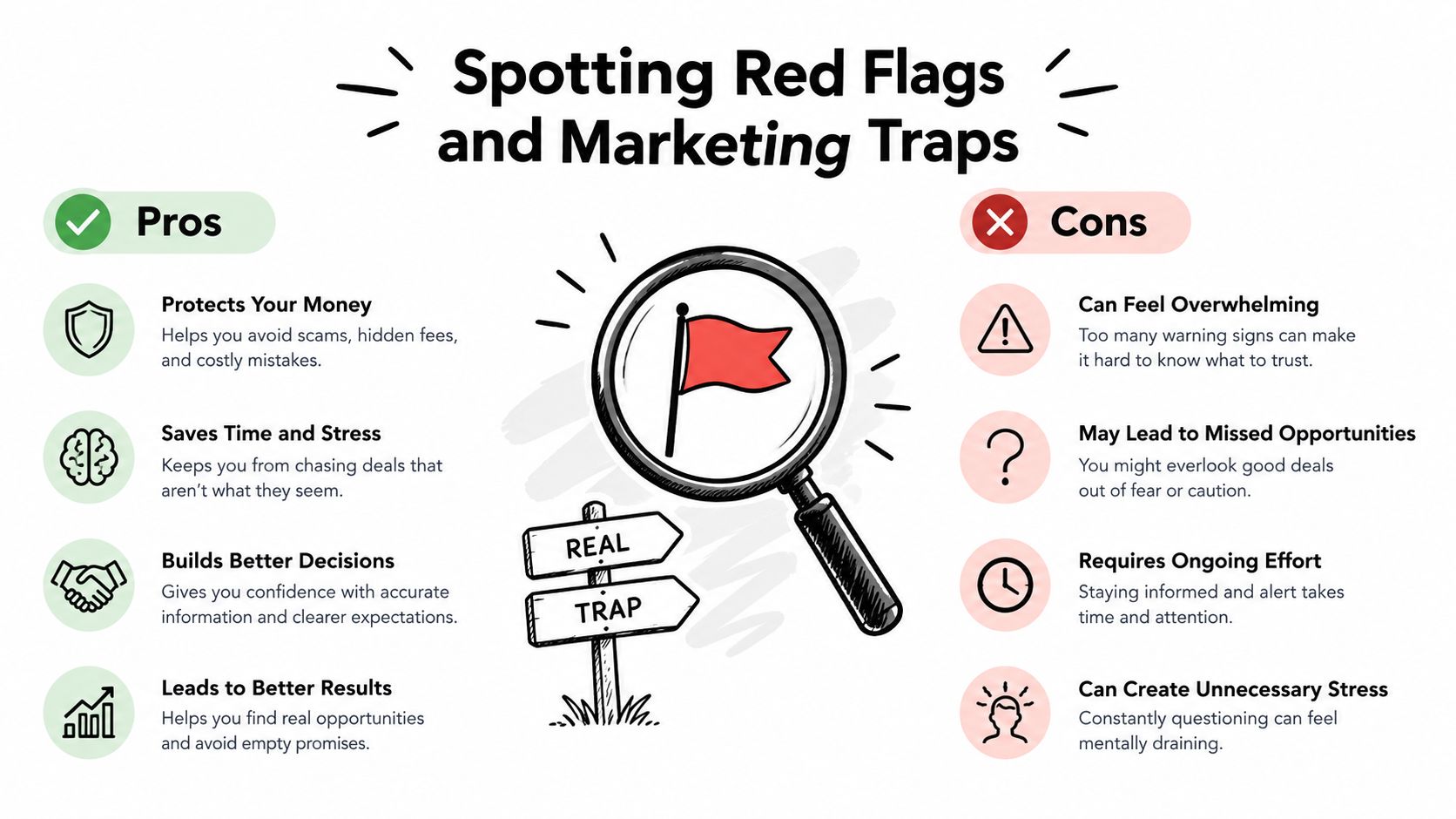
Aggressive advertising can make an ordinary firm look like a trucking specialist. A polished website, a memorable slogan, and a free consultation don't prove that the firm can investigate a commercial crash or take a serious injury claim to trial.
Your best protection is to compare promises with processes. A trustworthy lawyer should be willing to discuss the investigation, staffing, communication, fees, and litigation plan without pressuring you to sign immediately.
Walk away from unsupported promises
Be cautious if a lawyer:
- Guarantees a specific result: No ethical lawyer can promise a particular recovery before investigating liability, injuries, insurance, and defenses.
- Avoids direct answers: Vague references to “our team” aren't enough. Ask who will send preservation demands, take depositions, and advise you about settlement.
- Pushes an immediate signature: You should have time to read the agreement, discuss it with your family, and ask questions.
- Claims every case settles quickly: A serious trucking claim may require substantial investigation before its value can be evaluated.
- Talks about credentials instead of case work: Awards and years in practice matter less than direct experience with trucking evidence, serious injuries, and contested litigation.
- Won't explain expenses: Unclear deductions can create unpleasant surprises when the case resolves.
The lawyer should also explain what the firm needs from you. That may include medical records, employment information, photographs, insurance documents, witness names, and a careful account of how the crash affected daily life. A firm that listens closely during the consultation is more likely to understand the human and financial consequences of the claim.
Choose investigation over image
Most existing guides emphasize generic selection criteria but rarely help victims determine whether a firm can preserve fragile trucking evidence quickly enough. That gap is also reflected in consumer guidance on hiring a truck accident lawyer, which makes the evidence-urgency question especially important during your consultation.
Your decision should come down to a few practical tests. Does the firm understand the trucking operation? Can it identify the relevant parties and records? Will the lead lawyer stay involved? Is the firm prepared to fund expert work and litigate if necessary? Can the team explain the fee agreement without evasions?
A strong lawyer won't minimize your stress or make promises that the facts can't support. The lawyer will give you a clear plan, identify immediate risks, and tell you what still needs to be learned. That's the standard you should demand.
Nares Law Group LLC offers free consultations for truck wreck matters and handles investigation, medical treatment coordination, negotiation, trial, and settlement, including complex trucking and brain injury cases. Visit Nares Law Group LLC to discuss your situation with a team that can evaluate the evidence, potential liability, and next steps.