You've just heard the insurance adjuster agree to a settlement, and you're already planning what to pay first. Then the days pass without a check. That silence is normal, because agreeing on a number is only one part of the payout process.
The amount you take home can differ substantially from the gross settlement stated in the agreement. Attorney fees, case expenses, medical liens, insurance reimbursement claims, and the tax treatment of particular damages can all affect the final amount. Understanding how personal injury settlements are paid out helps you evaluate the offer before you sign away your rights.
What Happens Right After You Agree to a Settlement
A verbal agreement with an adjuster usually isn't the final step. Your lawyer will document the agreed terms, including the settlement amount, the claims being resolved, and any conditions attached to payment. The insurance carrier then prepares a written release of all claims.
That release matters because it typically ends your legal right to pursue additional compensation for the incident. It may cover known injuries, future complications, and claims you haven't discovered yet. Before signing, read the document carefully and ask your attorney to explain language you don't understand. You can also review practical guidance about whether an insurer can change its position in this discussion of settlement offers and rescission.
Practical rule: Don't treat the adjuster's verbal promise as money in hand. The written release controls what you give up and what the carrier must pay.
The paperwork that turns a promise into a payment
After you approve the terms, your attorney usually sends the signed release and any required settlement documents back to the insurer. The carrier verifies signatures, confirms that the person signing has authority to settle, and starts its payment process. Missing information, an incorrect payee name, or an incomplete form can send the package back for correction.
Your lawyer's office also uses this period to gather the financial information needed for a closing statement. That may include:
- Medical records and bills: These support outstanding treatment balances and help identify providers asserting repayment rights.
- Lien information: Hospitals, health insurers, Medicare, Medicaid, and other payers may claim reimbursement from the recovery.
- Case expenses: Filing charges, records fees, experts, investigators, and other expenses may be owed under the fee agreement.
- Payment instructions: The carrier needs accurate payee and delivery information before it can issue funds.
The attorney can't responsibly calculate your net proceeds until those obligations are identified and addressed. Depending on the agreement, the outcome may be a single lump-sum payment, scheduled annuity payments, or a combination of both.
Lump Sum vs Structured Settlement Payments
Suppose your settlement agreement provides a gross recovery, but your immediate needs include medical care, modified housing, and lost income. The payment method affects how quickly you receive funds and how much control you have over them. It does not, by itself, determine your net check. Attorney fees, case costs, medical liens, and other obligations are addressed before the amount available to you is calculated.
A lump sum delivers the agreed settlement proceeds in one payment after the release and disbursement requirements are complete. You can direct the money toward treatment, housing changes, debt resolution, or investment planning without waiting for future installments. That flexibility also places the planning responsibility on you. A large balance can be spent faster than expected, while an injury may continue to affect your work and care needs.
The payment may be excluded from federal income tax when it compensates for qualifying physical injuries, but taxable components require separate analysis under IRS settlement guidance. Tax treatment is one part of the decision, not a substitute for reviewing the deductions that reduce the gross recovery before disbursement.
A structured settlement generally uses an annuity issued by a life insurance company. The defendant or insurer funds the annuity, and you receive payments on the schedule stated in the agreement. Annuity.org's structured-settlement overview explains that qualifying arrangements can provide periodic benefits that are not subject to personal income taxation.
Structured payments can support regular budgeting and dependable cash flow. Their tradeoff is access. You cannot generally use the entire future recovery for a major expense today, and assignment restrictions may limit a later sale of the payment stream. Factoring companies commonly apply discount rates ranging from 9% to 18% when purchasing future payments, so converting that stream to immediate cash can leave you with less value over time.
A hybrid arrangement combines an upfront payment with an annuity. The initial amount can address immediate expenses, while scheduled payments reserve money for ongoing care, housing, or household support.
Lump Sum vs Structured Settlement at a Glance
| Feature | Lump Sum | Structured Settlement |
|---|---|---|
| Delivery | One payment after required processing | Scheduled payments through an annuity |
| Control | Immediate control over the full net amount | Predictable payments, less immediate liquidity |
| Planning | Requires you to manage the recovery | Creates an automatic payment schedule |
| Funding | Usually paid by the carrier after release completion | Typically backed by an insurance company rather than a bank deposit |
| Flexibility | Easier to address a large immediate expense | Assignment restrictions may limit early access |
| Common decision factors | Immediate medical, housing, or financial needs | Long-term care, budgeting, and income stability |
The choice depends on the size of the recovery, your age, and anticipated medical or living expenses. Review the proposal with both your lawyer and a qualified financial professional, especially in catastrophic-injury or wrongful-death cases. MetLife research on structured-settlement recipients reported that 96% were happy with monthly payments, 94% felt financially secure, and 90% said recurring payments made budgeting easier. Those findings do not make a structure appropriate for every claimant, but they show why immediate access is not the only measure of a successful payout.
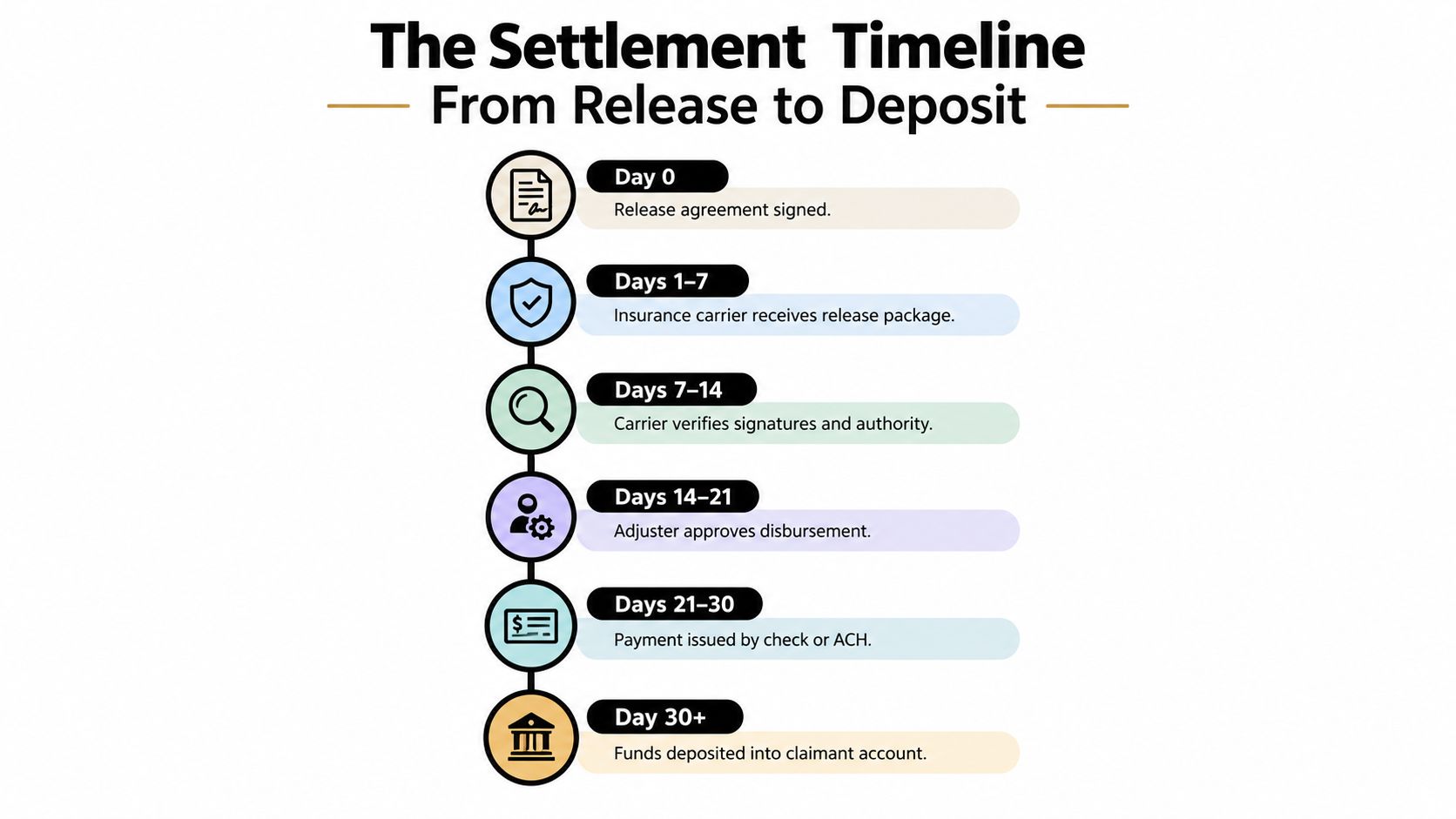
The Settlement Timeline From Release to Deposit
The release-to-deposit period has several separate stages. Your attorney may receive the carrier's check before you receive any money because the office must deposit it into a trust account, wait for clearance, resolve obligations, and prepare the final accounting.
The milestones that control the calendar
- Release signed: You return the completed release and related documents.
- Carrier review: The insurer confirms the signatures, settlement authority, and payment instructions.
- Lien work: Your lawyer requests payoff figures, challenges improper claims, and negotiates valid reimbursement demands where possible.
- Trust accounting: The office records the gross recovery, agreed fee, case costs, lien payments, and your net share.
- Payment delivery: The carrier sends the check or electronic payment to the designated recipient, often the attorney's trust account.
- Client disbursement: Once funds clear and the settlement statement is approved, the office sends your proceeds by check or direct deposit.
A carrier may process payment in roughly 21 to 30 days after receiving a signed release, based on the timing described in Illinois settlement-payment guidance. That isn't a universal deadline. Medicare, Medicaid, private health claims, or disputed subrogation can extend the process, and a minor's settlement may require court approval before distribution.
Attorney-held funds are generally released within a few business days after the bank confirms clearance and the accounting is complete. The two delays clients most often encounter are unresolved reimbursement claims and missing tax or payee information, such as a required W-9.
The following video gives another visual explanation of the process:
If your check has arrived but your lawyer hasn't disbursed funds, ask whether the bank has cleared the payment, whether any lien remains disputed, and whether the settlement statement is ready for review.
What Comes Out Before You See Your Net Check
The settlement figure in the agreement is usually the gross recovery, not the amount deposited into your personal account. Before distribution, the office deducts or pays obligations required by the fee contract, case expenses, and enforceable reimbursement claims. Nares Law Group's explanation of medical liens describes why providers and insurers may seek payment from the recovery.
The main deductions
Attorney fees come from the contingency agreement. The percentage may vary depending on whether the case settles before litigation, during litigation, or after trial. Your contract should state whether the fee is calculated from the gross recovery or after certain costs are deducted.
Case costs are separate from the fee itself. They can include filing fees, expert witness charges, medical-record retrieval, deposition transcripts, investigation, service of process, and litigation technology. Some firms advance these costs, while others charge them as they arise. The written agreement controls.
Liens and reimbursement claims can include hospital liens, health-insurer subrogation, Medicare or Medicaid recovery, and workers' compensation claims. The attorney may negotiate the amount, but a claim shouldn't be ignored just because the provider was already paid. The settlement statement should identify the claimant, amount, and payment status for each demand.
A worked example
Assume, only as an illustration, that the gross settlement is $150,000. Suppose the fee agreement applies a one-third attorney fee, documented case costs total $5,000, and negotiated medical reimbursement claims total $20,000.
| Calculation | Amount |
|---|---|
| Gross settlement | $150,000 |
| Attorney fee at one-third | -$50,000 |
| Case costs | -$5,000 |
| Medical liens and reimbursement claims | -$20,000 |
| Illustrative net amount | $75,000 |
This example isn't a prediction of your result. Actual fees, expenses, lien amounts, reductions, and contractual terms differ from case to case. It shows why a six-figure settlement can produce a considerably smaller client check.
Ask for the arithmetic, not just the headline number. A written settlement statement should let you trace the recovery from gross amount to final net proceeds.
The IRS discussion of settlement and judgment tax implications also warns that tax treatment can depend on what the payment compensates and whether related medical expenses were previously deducted. That tax question belongs in the closing review, even when the primary recovery is for physical injury.
Tax Treatment of Settlement Money
Federal tax law generally excludes damages received because of physical injuries or physical sickness under IRC Section 104(a)(2). The exclusion can apply whether qualifying compensation arrives as a lump sum or periodic payments. The IRS also explains that a claimant may need to include an amount in income if related medical expenses were previously deducted and produced a tax benefit.
The label in the release matters. A payment isn't automatically tax-free merely because the case involved an accident. The underlying purpose of each component controls.
| Settlement Component | Federal Tax Treatment |
|---|---|
| Compensation for qualifying physical injury or sickness | Generally excluded from federal gross income |
| Lost wages allocated to a qualifying physical-injury recovery | May be covered by the physical-injury exclusion under the applicable IRS analysis |
| Punitive damages | Generally treated differently and commonly taxable |
| Interest | Generally taxable as interest income |
| Emotional-distress damages without a qualifying physical injury | Generally taxable, subject to applicable exceptions |
| Previously deducted medical expenses that produced a tax benefit | The benefited portion may need to be included in income |
Structure changes timing, not the underlying character
A structured settlement doesn't automatically convert taxable damages into tax-free damages. Likewise, paying qualifying physical-injury compensation in a lump sum doesn't make it taxable just because the claimant receives it at once. The settlement agreement's allocation, the nature of the injury, prior deductions, and applicable federal rules must be reviewed together.
State taxes may not follow the federal result. A CPA should review the release language, allocation of damages, interest provisions, and any taxable component before you sign. For broader planning context, San Diego residents may also find this resource on tax savings advice for San Diego residents useful, although it shouldn't replace advice specific to the settlement.
Don't assume attorney fees automatically eliminate tax on a taxable component. The interaction between taxable damages, legal fees, and federal deduction rules can be complicated, particularly after changes in federal law. Get the allocation reviewed before the agreement becomes final.
State-Specific Rules and a Colorado Example
Settlement mechanics depend on the law governing the claim. Rules for minors, incapacitated claimants, medical liens, collateral sources, structured assignments, and public-benefit eligibility can differ by state. A general internet explanation may describe a process that doesn't apply to your court, insurer, or settlement type.
Colorado provides a useful example. Structured settlements involving protected persons can require court oversight, and Colorado's statutes address structured-settlement protections under C.R.S. § 13-64-101 et seq. A minor or incapacitated person may need court approval before the settlement can be finalized or distributed. The court's role is to protect the recipient, not merely to delay payment.
Colorado issues that deserve early attention
A qualified assignment company may assume responsibility for funding an annuity, which can protect the defendant from ongoing payment obligations while preserving the payment schedule for the claimant. The documents should identify the parties, the annuity issuer, payment dates, beneficiaries, and what happens if the recipient dies.
Colorado also applies specific rules to collateral sources, med-pay, and personal injury protection issues. Whether an insurer or another payer can seek reimbursement depends on the policy, statute, and facts. Medical lien resolution may involve the Colorado Hospital Lien Statute, C.R.S. § 38-22-701, so a hospital claim shouldn't be treated like an ordinary unpaid bill.
Other states use different approval procedures and lien frameworks. A state may impose distinct rules on hospital claims, public-benefit recipients, structured-settlement transfers, or the treatment of insurance payments. Ask a local attorney to identify the rules that govern your case before accepting a payment structure or signing a release.
Questions to Ask Your Lawyer Before You Sign
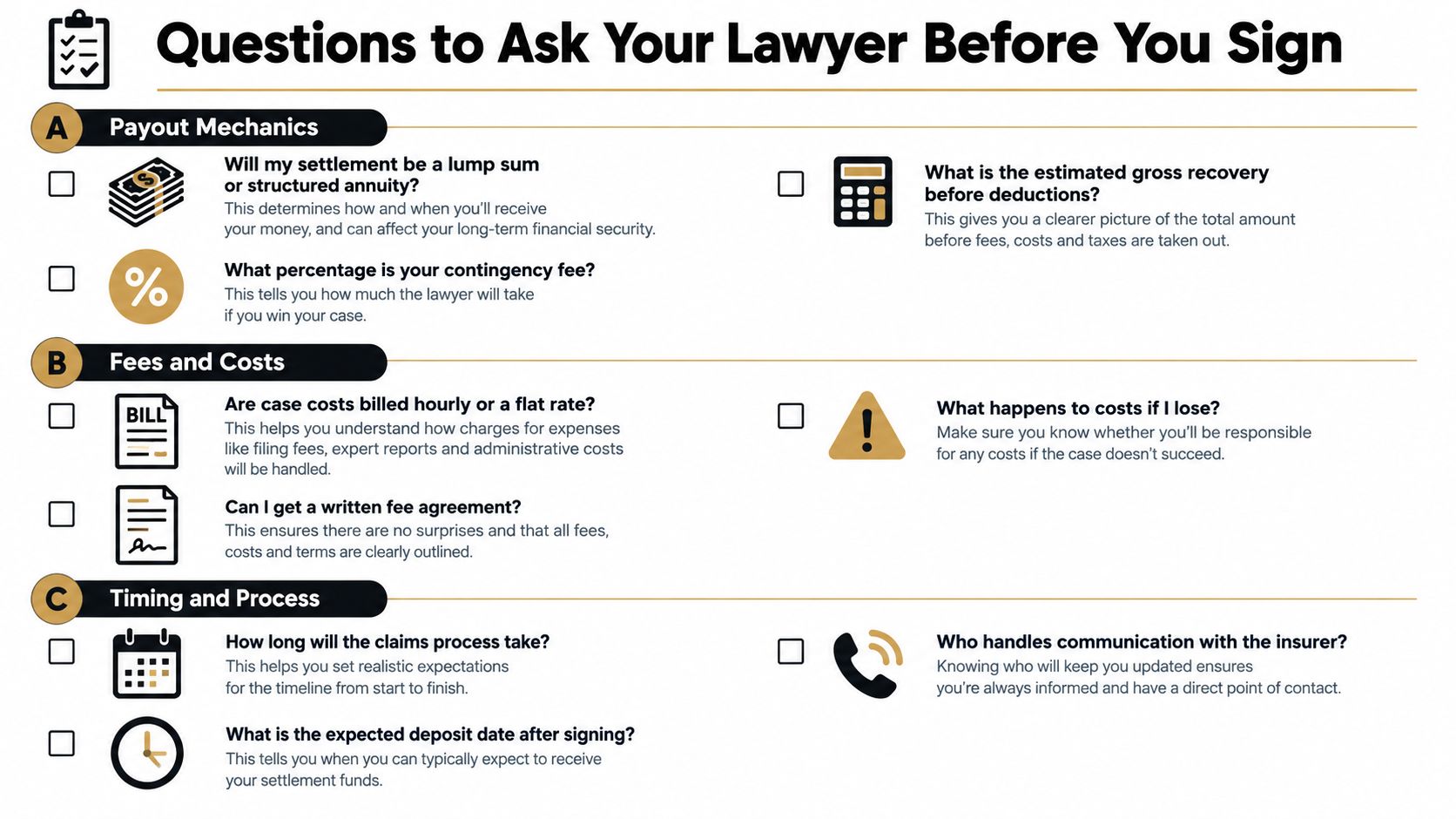
Settlement acceptance is a decision point, not a formality. Before signing, you should know what the gross recovery is, what you will likely receive, who will hold the funds, and which rights the release removes.
Start with the payment mechanics:
- What payment method is proposed? Ask whether the agreement uses a lump sum, a structured annuity, or a hybrid.
- Who funds the payments? For a structure, request the annuity issuer, qualified assignment company, payment schedule, beneficiary terms, and transfer restrictions.
- What happens after the carrier pays? Confirm whether funds go to the attorney trust account, how clearance is confirmed, and when disbursement is expected.
- What is the estimated net recovery? Request a written projection that separates the gross amount from fees, costs, liens, and other deductions.
Then examine the deductions. Your attorney should be able to explain the contingency percentage, the fee base, and every expense charged under the agreement. Ask for current payoff figures for hospitals, health insurers, Medicare, Medicaid, workers' compensation, and any other claimant.
Questions about legal and financial consequences
Ask whether the release covers unknown injuries, future medical treatment, derivative claims, and claims belonging to a spouse or family member. If you receive public benefits, discuss whether a special needs trust or another benefits-preservation arrangement is necessary. Bankruptcy, child-support obligations, and creditor issues can also affect how funds should be handled.
Request a sample closing statement or closing letter before you sign. It should show the proposed gross recovery, attorney fee, case costs, lien payments, tax-related allocations, and net proceeds in a format you can understand. Also ask whether your lawyer will continue resolving disputed liens after the insurer pays, or whether you must handle any remaining claim yourself.
A written fee agreement should answer many of these questions. You can also review this explanation of personal injury lawyer fees and use it to identify issues that need clarification. For readers evaluating how legal services and digital communication support law firms, a personal injury law page offers additional context, but your own engagement agreement remains the controlling document.
Before signing: Ask for written answers and schedule a final walkthrough call. Verbal assurances are easy to misremember once the release is signed.
Nares Law Group LLC helps injured clients understand settlement terms, coordinate the payment process, and account for fees, costs, and medical reimbursement claims. If you're weighing an offer in Colorado, Texas, or New York, visit Nares Law Group LLC to request a consultation and discuss what your gross recovery may mean for your actual net check.