The most popular advice about a car accident hit from behind settlement is also the most misleading: “The other driver was at fault, so the insurance company has to pay.” Clear fault helps, but it doesn't tell an adjuster what your injury is worth. A rear-end crash can produce a modest claim for temporary soreness, or a serious claim involving disc damage, surgery, lost income, and permanent limitations.
The main dispute usually begins after liability is accepted. The insurer asks whether your symptoms came from this collision, how long they lasted, whether treatment was necessary, and what evidence proves your future losses. That's why medical records, treatment continuity, imaging, and functional restrictions often matter more than the fact that your vehicle was struck from behind.
Why Clear Fault Does Not Guarantee a High Payout
A rear-end collision often gives the injured driver a strong liability position. The trailing driver may have been following too closely, distracted, or unable to stop safely. But fault and damages are separate questions. The insurer can concede that its driver caused the impact while arguing that your injuries are minor, unrelated, temporary, or exaggerated.
That distinction explains the low offer many people receive after an apparently obvious crash. An adjuster may look at a repair estimate, photographs showing limited bumper damage, and an emergency-room record that says “neck pain,” then value the claim as a short-lived soft-tissue case. Your account of pain matters, but the carrier wants objective support that connects the collision to the condition and shows how the condition affected your life.
Practical rule: A clear liability case still needs a clear damages case.
Published settlement pages often provide broad ranges, but they don't provide a dependable national answer to how much value disappears when an injury story is medically contested. Settlements are private, and no published national median establishes a reliable distribution of rear-end outcomes. As this discussion of rear-end settlement valuation explains, many online ranges rely on attorney-reported figures rather than verifiable national settlement data.
What the adjuster is really evaluating
The adjuster typically separates the claim into several questions:
- Causation: Did this collision cause the condition, or did it aggravate an existing problem?
- Severity: Is the diagnosis supported by examination, imaging, or specialist records?
- Duration: Did the symptoms resolve, or do they continue despite reasonable care?
- Economic effect: Did you miss work, lose income, or need future treatment?
- Credibility: Do the records, statements, and treatment history tell the same story?
A person with no visible fracture can still have a legitimate and valuable injury. Rear impacts can trigger neck and back symptoms that don't appear on ordinary imaging. The challenge is proving the condition through consistent clinical observations, documented limitations, appropriate treatment, and a medical opinion addressing the connection to the crash.
Pre-existing degeneration doesn't automatically defeat a claim, either. It gives the defense an argument, especially if earlier records show similar complaints. Your medical team must distinguish the baseline condition from the change caused by the impact, such as new symptoms, increased severity, reduced mobility, or a new treatment recommendation.
The practical lesson is uncomfortable but useful. You don't win a settlement because the other driver was obviously wrong. You improve the claim by building a record that makes it difficult to dispute what changed, what treatment you needed, and what the injury has cost you.
The Core Factors That Determine Your Settlement Value
A rear-end claim's value usually follows the injury record rather than the direction of impact. The strongest inputs include confirmed diagnosis, treatment duration, imaging findings, missed work, and future care needs, according to published guidance on rear-end accident settlement valuation.

The medical record
Start with the diagnosis, not the settlement range. “My neck hurts” describes a symptom. A clinical record that identifies cervical strain, restricted range of motion, muscle spasm, radicular symptoms, or a disc injury gives the adjuster something more concrete to evaluate.
Imaging can strengthen the claim, but it doesn't replace a clinical explanation. A scan may show degeneration that existed before the crash. Your physician should explain whether the collision caused a new injury, aggravated an existing condition, or made an earlier condition symptomatic and functionally limiting.
Treatment duration also matters. A brief course followed by documented recovery presents a different valuation picture from persistent symptoms requiring physical therapy, injections, specialist evaluation, or surgery. Treatment must be medically appropriate, though. Unnecessary appointments, unexplained escalation, or inconsistent complaints can give the defense an argument that the care was driven by the claim rather than the injury.
Work and daily function
Lost wages are easier to calculate when you preserve pay records, employer verification, work restrictions, and missed-shift information. If you continued working while changing duties, reducing hours, avoiding lifting, or relying on help at home, those limits should appear in the medical notes and your personal records.
Functional loss can also support non-economic damages. Keep a contemporaneous account of sleep disruption, driving difficulty, childcare limitations, household tasks you can't perform, and activities you stopped. Don't inflate the account. Specific, consistent examples are more persuasive than a general statement that everything hurts.
The defense adjustments
A treatment gap gives the insurer a simple argument: if the pain was serious, why didn't you seek care? That argument may be unfair when cost, transportation, scheduling, or a mistaken belief that symptoms would resolve caused the delay, but you still need to explain the gap and document what happened.
Comparative fault can create another reduction where the facts support it. In a chain collision, for example, the carrier may argue that a driver stopped unexpectedly or failed to maintain a safe position. The issue depends on the evidence, including the police report, photographs, witness accounts, vehicle damage, and available video.
A useful working formula is straightforward:
Settlement value rises when medical proof, functional loss, and future needs reinforce one another. It falls when the records leave causation, necessity, or duration open to attack.
Realistic Settlement Ranges by Injury Severity
No settlement range can price your claim by itself. Policy limits, jurisdiction, treatment, comparative fault, medical liens, lost income, and the permanence of the injury all affect the result. Still, historical summaries provide useful benchmarks when you treat them as context rather than a promise.
One 2026 settlement summary reported that minor whiplash cases with full recovery often fell between $10,000 and $30,000, while cases involving herniated discs requiring injections or surgery were commonly valued between $50,000 and $250,000. Those figures appear in historical rear-end collision settlement data, not in a guaranteed schedule used by every insurer.
| Injury Severity | Typical Medical Intervention | Estimated Settlement Range |
|---|---|---|
| Minor soft-tissue injury | Evaluation, conservative care, and recovery without lasting impairment | $10,000 to $30,000 |
| Disc-related injury | Diagnostic imaging, injections, extended treatment, or surgery | $50,000 to $250,000 |
| Catastrophic injury | Extensive care, permanent disability, or profound long-term impairment | $3 million or more in reported catastrophic examples |
The lowest category generally involves symptoms that resolve and limited economic loss. A person who returns to normal activities, misses little work, and has no ongoing care faces a different negotiation from someone whose neck pain continues, limits work, and requires specialist treatment.
The middle category changes the economics because the claim includes measurable medical intervention and a stronger possibility of lasting impairment. A documented herniated disc isn't automatically worth a particular amount. The insurer will still examine whether the crash caused it, whether treatment was necessary, whether surgery was reasonable, and whether the condition affects future work and daily life.
At the top end, the case may no longer function as a conventional whiplash claim. A spinal cord injury, traumatic brain injury, paralysis, or permanent loss of earning capacity can create medical and life-care needs that overwhelm ordinary settlement comparisons. Reported rear-end outcomes range from $10,000 to $400,000 or more, with catastrophic examples reaching $3 million or more, as summarized by recent rear-end settlement examples.
The broader insurance context also explains why soft-tissue cases receive scrutiny. The Insurance Research Council estimate cited in that same summary places the annual U.S. bodily-injury claim cost associated with whiplash at about $8 billion to $10 billion, and identifies whiplash in about 65% of bodily-injury claims in rear-end crashes. The scale of those claims doesn't reduce an individual's rights, but it does help explain why carriers develop aggressive methods for challenging symptoms that don't appear clearly on basic imaging.
For a separate overview of how injury severity and other variables affect outcomes, review car accident settlement payouts. The useful question isn't “Which range applies to me?” It's “Which medical and financial facts place my claim in one category rather than another?”
How Insurers Devalue Whiplash and Soft-Tissue Claims
Whiplash has a recognizable physical mechanism. In a rear impact, the torso moves forward before the head, producing a rapid extension and flexion sequence in the neck. The clinical research on whiplash and settlement timing supports the connection between rear impacts and whiplash-type symptoms, while also showing why persistence and documentation can affect negotiation outcomes.
The defense usually doesn't need to prove that whiplash is impossible. It only needs to persuade the adjuster, a mediator, or a jury that your particular symptoms are less serious than claimed.
Common arguments against value
Minor vehicle damage is a frequent theme. The carrier may argue that a lightly damaged bumper couldn't have caused meaningful injury. Vehicle repair costs don't provide a complete medical analysis, however. Your provider should document the reported mechanism, examination findings, symptoms, and functional effects rather than leaving causation to photographs alone.
Delayed symptoms create another opening. Neck and back pain may not dominate your attention immediately after an adrenaline-filled collision. If symptoms appear later, tell the provider exactly when they began and how they progressed. Don't guess, minimize, or claim immediate pain if that isn't accurate.
Pre-existing degeneration can become the central dispute. The insurer may point to earlier treatment or imaging and say the crash changed nothing. Bring prior records to your lawyer and doctors so they can compare the baseline with the post-crash condition. A prior condition may be relevant to causation, but it doesn't erase a documented aggravation.
Treatment gaps invite the question of whether the injury was serious. If you missed appointments, write down the reason and discuss it with your provider. Financial hardship, transportation problems, caregiving responsibilities, and improving symptoms can all matter, but unexplained silence leaves the defense to fill in the story.
Protecting the record
Follow medically appropriate care, describe limitations consistently, and avoid posting online material that contradicts your reports. If gentle movement is part of your recovery plan, a resource covering stretches for neck and back pain at SunnyBay may help you discuss safe activity with your clinician. It isn't a substitute for an examination or individualized medical advice.
Don't give a recorded statement to the other driver's insurer before understanding your rights. For practical guidance when a carrier disputes the claim, see how to dispute an insurance claim. The objective isn't to hide facts. It's to prevent a casual, incomplete conversation from becoming the insurer's main evidence about your injury.
The Timeline From Crash to Final Resolution
A rear-end claim develops in stages, and the medical timeline should lead the negotiation timeline. At the scene, prioritize safety, emergency assistance, photographs, witness information, and an accurate description of what happened. Don't speculate about fault or promise that you're uninjured just because you can stand and speak.
Seek medical evaluation when symptoms warrant it, then follow the recommended plan. A road-safety guideline review found that about 13% of drivers and front-seat occupants in rear-end crashes reported whiplash symptoms lasting longer than one month, while 9% had symptoms lasting beyond six months, according to the RCAR whiplash injury guideline review.
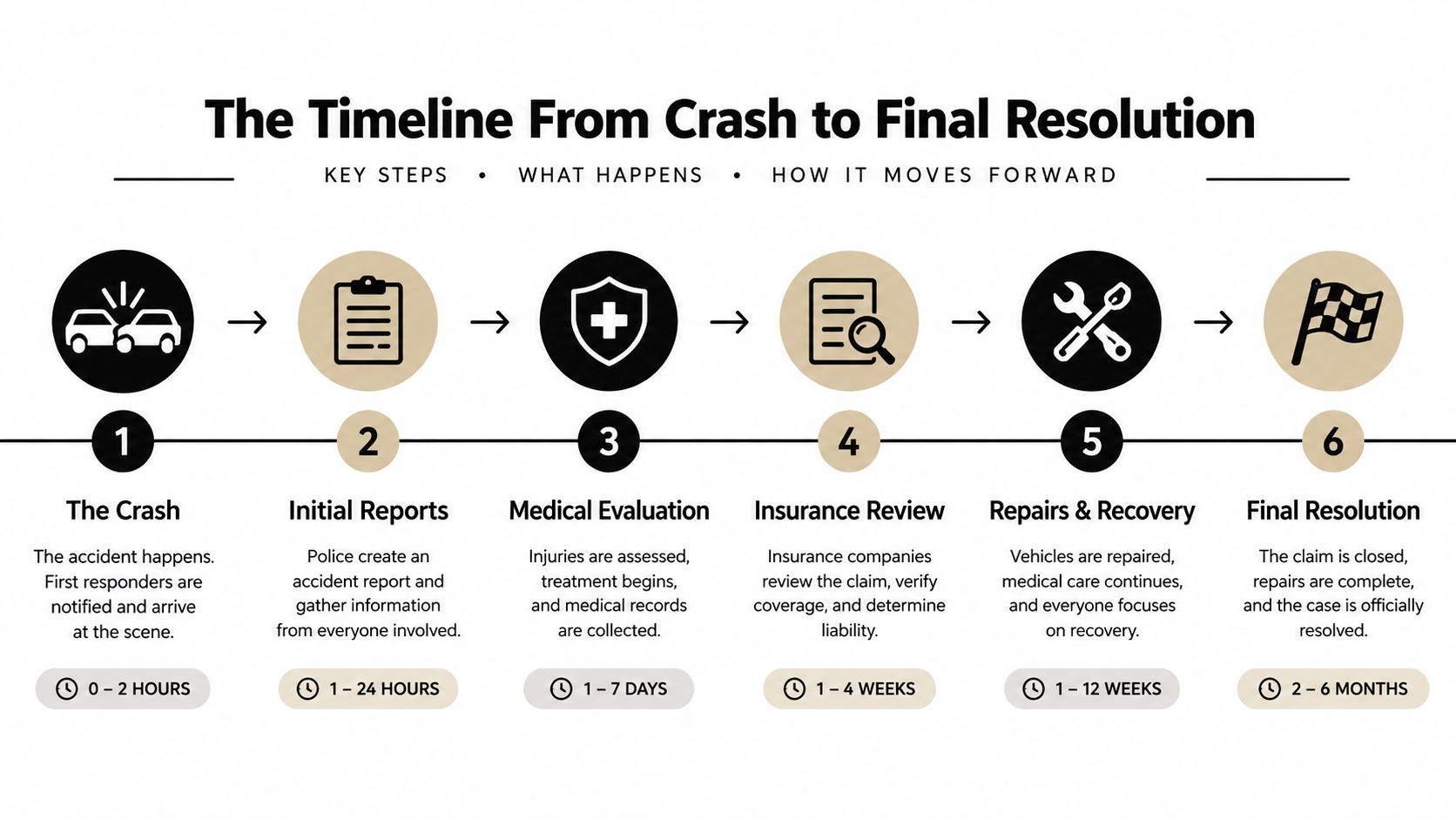
A realistic claim progression
Consider a driver who feels stiff the evening after impact. The initial evaluation finds no fracture, but follow-up records document restricted movement and persistent pain. The driver attends therapy, misses work, and later receives imaging because symptoms haven't resolved.
At that point, settling immediately would create risk. The carrier may offer money before the diagnosis and prognosis are clear, but signing a release can end the claim even if surgery, injections, or future care becomes necessary. A lawyer normally wants enough information to understand whether the patient has reached maximum medical improvement, or whether further recovery and treatment remain reasonably expected.
The demand package generally collects the police report, photographs, medical records, bills, wage documentation, treatment history, and an explanation of ongoing limitations. The insurer evaluates the package and may request additional records or a medical authorization. Negotiations can involve several offers and counteroffers, especially when causation or future care remains disputed.
A case may resolve through negotiation or mediation. If the carrier refuses to pay a fair amount, filing suit can create a formal process for discovery, depositions, expert testimony, and trial preparation. Litigation doesn't guarantee a particular result, but it changes the setting from an adjuster's internal valuation to a legal dispute where both sides must support their positions.
For a more detailed process overview, review the car accident settlement timeline. Don't confuse patience with inactivity. Evidence should be preserved early, treatment should be coordinated, and legal deadlines should be identified before financial pressure forces a premature decision.
How a Trial-Tested Lawyer Increases Your Recovery
A lawyer adds value when the claim requires more than forwarding medical bills to an adjuster. The most important work often happens before the demand is sent, including preserving evidence, identifying every available insurance policy, obtaining prior records, and asking doctors to address causation and future care in precise language.
A trial-ready approach also changes the insurer's risk calculation. A carrier can make a small offer when it expects the claimant to accept it or abandon the case. It has a different problem when counsel has organized the evidence, prepared witnesses, retained appropriate experts, and demonstrated a willingness to file and try the case.
Where representation earns its cost
Medical coordination helps prevent fragmented care. A lawyer can identify missing records, track referrals, and make sure the claim reflects the complete course of treatment rather than only the first emergency visit.
Causation analysis matters when the defense points to degeneration or earlier complaints. Comparing pre-crash and post-crash records, consulting radiologists, and obtaining a treating physician's explanation can turn a vague dispute into a focused medical question.
Damage calculation extends beyond bills. Lost wages, reduced earning capacity, household limitations, pain, and future treatment need supporting evidence. A lawyer can organize those losses without overstating them.
Litigation preparation provides an advantage even when the case settles. Depositions, expert review, discovery requests, and trial exhibits force both sides to confront weaknesses in their positions. Settlement should reflect informed risk, not exhaustion.
Not every minor claim requires formal representation. A straightforward injury that resolves quickly, with complete records and no contested issue, may be manageable without counsel. But ongoing symptoms, disputed causation, missed work, surgery, policy-limit concerns, or a recorded statement request justify an early consultation.
Nares Law Group LLC handles motor-vehicle injury claims through investigation, medical coordination, negotiation, settlement, and trial, with licensed practice in Colorado, Texas, and New York. The right lawyer for your case should explain the likely disputes, the evidence needed to address them, and the costs before you commit.
Your Next Steps After a Rear-End Collision
Your strongest protection is a consistent record created before the insurer defines the story for you. Start with safety and medical care, then preserve evidence and control communications. Don't treat a friendly adjuster as a neutral advisor. The adjuster works for the insurer and evaluates exposure on its behalf.

Use this checklist:
- Get medical attention: Tell the clinician about every symptom, including pain that develops after the crash, and follow reasonable recommendations.
- Preserve the scene: Save photographs of vehicle damage, the roadway, traffic controls, visible injuries, and relevant property damage.
- Collect identifiers: Keep the other driver's information, insurance details, police information, witness contacts, and any available dashcam footage.
- Track function: Record missed work, changed duties, sleep problems, household limitations, appointments, prescriptions, and out-of-pocket expenses.
- Explain treatment gaps: If cost, transportation, scheduling, or improvement interrupted care, document the reason and discuss it with your provider.
- Protect prior medical context: Give your lawyer and doctors accurate information about earlier neck or back problems so they can address aggravation clearly.
- Limit insurer communications: Don't guess about your prognosis, minimize symptoms, admit fault, or provide a recorded statement before receiving advice.
- Don't settle too soon: Wait until the medical picture and future-care needs are sufficiently clear, unless a lawyer has evaluated the risks of an early resolution.
The central lesson is simple. A rear-end impact may make liability easy to explain, but settlement value depends on whether the records prove injury, duration, causation, treatment necessity, lost income, and lasting limitations. Preserve the evidence while it exists, and get advice before signing a release.
Nares Law Group LLC offers free consultations for people injured in rear-end collisions, including help with evidence, medical documentation, insurer negotiations, and litigation strategy. Visit Nares Law Group LLC before accepting an offer or giving a recorded statement so your claim can be evaluated on its full medical and financial picture.