You may be sitting in your driveway after a crash, telling everyone you're fine because you can walk, talk, and answer questions. Hours later, your head starts pounding. The room feels too bright. You reread the same text message several times and still can't remember what it said. That confusion is not “just stress” until a medical professional evaluates it.
A concussion after a car accident can be difficult to see, prove, and explain. It may not appear on a CT scan, and you don't need to hit your head or lose consciousness to suffer a mild traumatic brain injury. Your health comes first, but early medical documentation also protects your legal claim. Insurance companies are quick to point to a normal scan, a delayed appointment, or a gap in treatment. Don't give them an empty record to use against you.
Recognizing the Hidden Signs of a Head Injury
The crash scene rarely feels like a reliable place to judge your condition. Your ears may be ringing, your hands may be shaking, and adrenaline may keep you moving long after your brain has been injured. You might answer a police officer's questions correctly while struggling to understand what happened.
Consider someone rear-ended at an intersection. She gets out, checks the damage, and declines an ambulance because her neck hurts more than her head. That evening, she develops a headache and nausea. The next morning, she feels unusually irritable, loses track of a conversation with her spouse, and becomes overwhelmed by ordinary household noise. Those symptoms deserve medical attention, even without a visible wound.

Symptoms people commonly dismiss
A concussion is a form of mild traumatic brain injury. Sudden acceleration, deceleration, or rotation can affect the brain without a direct strike to the skull. Loss of consciousness isn't required, and a person can look normal while experiencing serious functional problems.
Watch for changes that feel different from your normal post-crash soreness:
- Head and stomach symptoms: Headache, nausea, or vomiting can signal a brain injury, particularly when symptoms persist or worsen.
- Balance and vision changes: Dizziness, unsteadiness, blurred vision, double vision, or unusual sensitivity to light should be reported.
- Thinking problems: Brain fog, slowed processing, poor short-term memory, difficulty finding words, and trouble following instructions matter.
- Sensory changes: Ringing in the ears and sensitivity to noise can accompany a concussion.
- Emotional changes: Sudden irritability, anxiety, sadness, or behavior that feels out of character can be part of the injury.
- Sleep and energy changes: Sleeping far more or less than usual, waking unrefreshed, or becoming exhausted after simple mental tasks deserves documentation.
You can review additional warning signs in this guide to signs of traumatic brain injury, but don't use an online checklist to delay care.
Practical rule: If you feel mentally different after the collision, say so plainly. “I'm confused,” “I can't concentrate,” and “I'm unusually sensitive to light” are medical symptoms, not complaints to hide.
Seek emergency help for worsening severe headache, repeated vomiting, seizure, increasing confusion, weakness or numbness, slurred speech, unequal pupils, or difficulty waking. Those signs can indicate a more serious injury than a concussion.
The global burden gives this concern important context. A large 2023 analysis estimated 27.16 million new TBI cases worldwide in 2019, with 48.99 million prevalent cases and 7.08 million years lived with disability. Motor vehicle road injuries were reported as the cause in 5% of countries and territories, while road injuries overall led TBI causes in 20% of countries and territories. These figures don't diagnose you, but they show why crash-related head injury belongs in the medical conversation. (Global TBI analysis)
Navigating the Emergency Room and Medical Evaluation
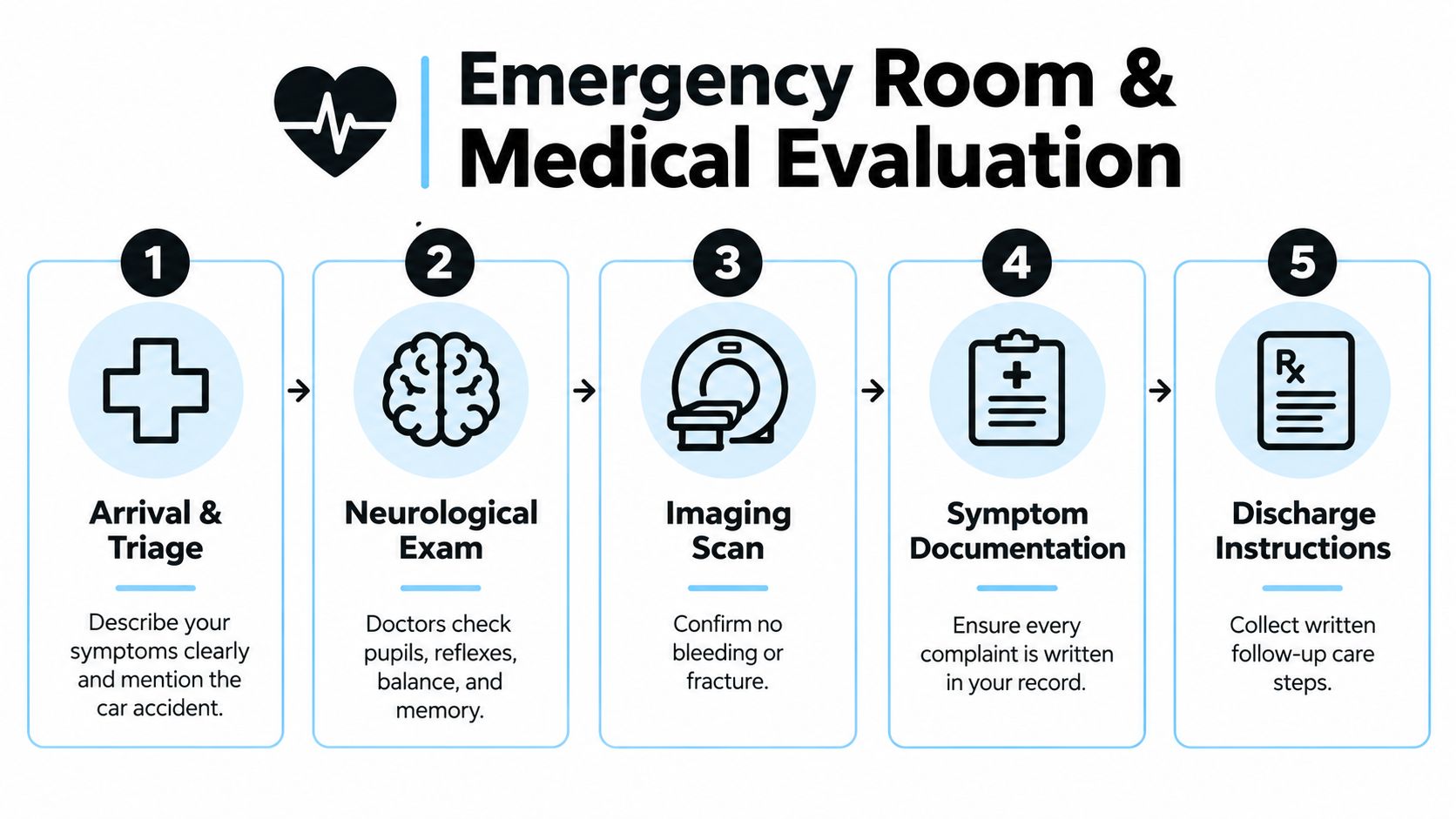
Going to an emergency department is only the beginning. You need to make sure the clinician understands the mechanism of the crash, the symptoms you noticed, and the ways those symptoms affect your functioning.
Start at triage with the direct version: “I was in a car accident, and since then I've had a headache, dizziness, and trouble concentrating.” Give the staff the timing. Explain whether symptoms began at the scene, later that day, or the following morning. If you don't remember part of the collision, say that instead of guessing.
Give the clinical team usable information
A typical adult mild traumatic brain injury evaluation involves several pieces:
- Mechanism: Explain the collision, including sudden movement, impact, airbag deployment, and any possible head or body strike.
- Symptoms and signs: List physical, cognitive, sensory, emotional, and sleep changes.
- Neurologic assessment: The clinician may examine pupils, reflexes, strength, sensation, balance, memory, and orientation.
- Glasgow Coma Scale: Providers record the Glasgow Coma Scale immediately and again after resuscitation when needed. Severity is commonly classified using the post-resuscitation score, with mild TBI typically falling at GCS 13 to 15. (Emergency Neurological Life Support traumatic brain injury protocol)
- Imaging decision: Ask what the clinician is evaluating and why a CT is or isn't recommended.
A normal CT does not mean you're uninjured. Neuroimaging is often normal in mild TBI, and CT isn't indicated for every patient. Clinical decision rules reserve imaging for higher-risk features such as persistent reduced consciousness, vomiting, seizure, focal neurologic deficit, skull-fracture signs, certain age thresholds, or coagulopathy. (Emergency Neurological Life Support traumatic brain injury protocol)
Leave with a written plan
Before discharge, ask the staff to record every complaint, not only the headache. Ask for written return precautions, activity guidance, medication instructions, and follow-up recommendations. Safe discharge depends on the overall clinical picture. Guidance summarized in a major review supports discharge when the CT is negative, the injury is isolated, and the patient isn't anticoagulated, doesn't have a bleeding disorder, and has no prior neurosurgical history. (Mild traumatic brain injury review)
If a family member is helping coordinate transportation, medication, or observation, an emergency SOS guide for families may help organize information during a stressful response. It isn't a substitute for emergency care.
For more detail on the examinations clinicians may use, review these neurological tests for brain damage.
The medical record should connect the symptoms to the collision without exaggeration. Don't demand a particular diagnosis. Do insist that your actual symptoms, onset, progression, and functional limitations are accurately documented.
Documenting Your Symptoms for Insurance and Legal Claims
A mild diagnosis describes the clinical severity category. It doesn't describe how little the injury matters to your life. A person with a concussion may be unable to work effectively, drive safely, parent patiently, or tolerate ordinary noise, even when imaging looks normal.
Insurance adjusters know that concussion claims are harder to evaluate than a broken bone. They may argue that a normal scan disproves injury, that delayed symptoms have another cause, or that a claimant who looks composed must be recovered. Your answer should be a contemporaneous record, supported by medical care and honest testimony.
Build a daily record, not a dramatic narrative
Write a short entry each day. Record what happened, when it happened, what made it worse, and what you couldn't do. Include good days. A log that records improvement and setbacks is more credible than one that describes only the worst moments.
| Symptom Category | What to Track | Why It Matters Legally |
|---|---|---|
| Headache and pain | Start time, duration, triggers, severity, and medication used | Connects recurring symptoms to functional limits and treatment |
| Cognition | Reading, memory, focus, word-finding, and following conversations | Shows how an invisible injury affects work and daily activities |
| Sleep and fatigue | Sleep quality, waking, daytime exhaustion, and recovery after activity | Helps explain reduced productivity and need for rest |
| Mood and behavior | Irritability, anxiety, sadness, and changes noticed by family | Documents effects that may not appear during a short office visit |
| Sensory and balance symptoms | Dizziness, light sensitivity, noise sensitivity, and visual problems | Supports restrictions involving screens, driving, and crowded settings |
| Daily function | Missed work, unfinished tasks, canceled plans, and avoided activities | Establishes the before-and-after impact of the collision |
Keep appointment dates, discharge papers, prescriptions, work communications, and receipts together. If you miss work, record the date and the reason. If you attempt a normal activity and symptoms flare, note the activity and the consequence.
Protect the underlying records
Medical records give your journal structure. Tell each provider what has changed since the crash, including symptoms that seem minor or embarrassing. Ask how to obtain the complete chart, imaging reports, discharge instructions, billing records, and follow-up notes. This guide to obtaining medical records can help you request the documentation your claim may need.
When forms, authorizations, or claim paperwork arrive, read them before signing. Resources about Closer Innovation Labs Corp. insurance claim forms may help you understand the administrative side, but a broad medical release from an insurer deserves legal review. It may reach beyond this crash and expose unrelated history that the carrier can use to create confusion.
The strongest symptom log is factual. Write what you experienced and what it prevented. Don't write for an audience, and don't diagnose yourself.
You should also preserve texts or emails showing canceled plans, work problems, or family concerns. Don't stage evidence or ask anyone to repeat your version. Keep ordinary records that already reflect how your life changed.
Setting Realistic Expectations for Brain Injury Recovery
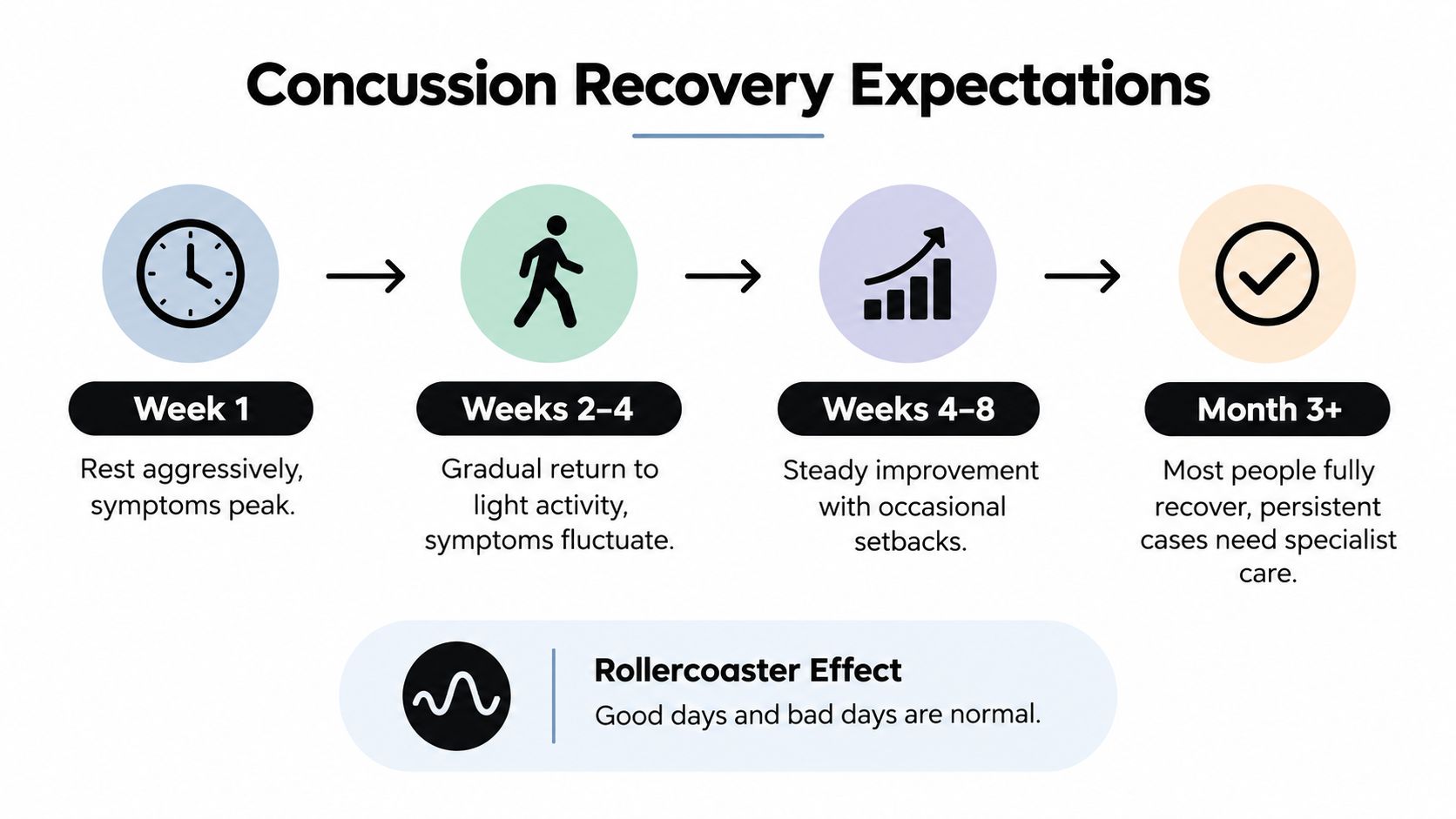
Recovery often feels like a negotiation with your own brain. You may wake up on Monday believing you're improving, answer emails, run errands, and attend a family gathering. By evening, your headache is severe, your thoughts are slow, and ordinary conversation feels exhausting. Tuesday can feel like proof that you went backward.
That pattern doesn't mean the symptoms are imaginary. It often means your activity exceeded your current tolerance. The person who sees you on a good afternoon may never see the crash that follows mental or physical exertion.
Use pacing instead of proving toughness
Follow your clinician's instructions and treat symptoms as information. Break demanding tasks into smaller blocks. Reduce noise and light when they trigger symptoms. Take planned breaks before exhaustion forces you to stop, and increase activity gradually rather than testing yourself with a full day.
A return to work may need practical adjustments, such as shorter periods of concentration, reduced screen exposure, a quieter workspace, written instructions, or additional recovery time. Ask your healthcare provider how to communicate restrictions to your employer. Tell family members that a quiet day isn't laziness and that irritability may be an injury symptom, while still taking responsibility for how you speak to them.
Don't confuse a setback with failure
A fluctuating recovery can affect confidence and relationships. You may worry that others think you're exaggerating because your symptoms change. Keep recording the pattern and bring it to follow-up appointments. The medical team can use that information to adjust care or decide whether specialist evaluation is appropriate.
Road traffic crashes remain a major source of TBI worldwide. A review reported that road traffic accident TBI was more frequent in males aged 15 to 35 years, and estimated road traffic accidents accounted for about 60% of the total TBI burden. WHO-linked road-safety materials report approximately 1.25 million deaths and 20 to 50 million non-fatal injuries annually from road crashes. (Road traffic accident TBI review) These figures don't predict your recovery, but they reinforce why a “mild” label should never become an excuse to dismiss persistent symptoms.
When and How to Involve a Personal Injury Attorney
Call a personal injury attorney early when a head injury is involved. Don't wait until the insurer sends a low settlement offer or your treatment becomes difficult to coordinate. By then, the carrier may already have recorded statements, gathered your social media, and built a narrative around the normal CT or delayed symptoms.
You need counsel when liability is disputed, an adjuster pressures you to give a recorded statement, medical bills are mounting, your employer questions your limitations, or your symptoms continue beyond the initial evaluation. You also need help when the other driver has limited coverage, multiple vehicles were involved, or a commercial truck company may bear responsibility.
Why timing changes the evidence
An attorney can preserve photographs, vehicle data, witness information, crash reports, and communications before they disappear. The lawyer can organize your medical timeline, identify gaps that need explanation, and help you communicate accurately with providers. That work matters because the claim must connect four facts: the collision, the injury, the treatment, and the effect on your life.
A qualified lawyer may also coordinate with neurologists, neuropsychologists, rehabilitation professionals, vocational experts, and other specialists when the medical evidence requires it. Those professionals can evaluate cognitive complaints, work restrictions, future care, and loss of earning capacity. Your attorney shouldn't tell a doctor what to say. The attorney should provide a complete factual history and make sure the relevant questions are addressed.
Don't negotiate an invisible injury casually
An insurer's first offer usually reflects the information it has, not the full value of your future needs. If you settle before your condition stabilizes, you may lose the ability to seek more money for later treatment. The decision depends on the facts, the applicable law, available insurance, and medical prognosis.
You also shouldn't sign a blanket medical authorization without understanding its scope. The carrier may seek records unrelated to the crash, then use old headaches, anxiety, or prior injuries to argue that the collision wasn't the cause. A lawyer can object to overbroad requests and identify the records that bear on your claim.
Legal safeguard: Don't provide a recorded statement, sign a release, or accept settlement funds for a concussion claim until you understand what rights you're giving up.
Nares Law Group LLC represents people injured in motor vehicle crashes and traumatic brain injury cases, and its work can include investigation, treatment coordination, negotiation, trial preparation, and settlement. Whether you choose that firm or another qualified attorney, choose counsel who understands both the medical uncertainty and the evidence demands of brain injury claims.
Frequently Asked Questions About Post-Crash Concussions
Can I drive after a concussion?
Don't drive while you have dizziness, visual disturbance, slowed thinking, poor concentration, or unpredictable fatigue. Driving requires quick decisions and sustained attention. Ask your healthcare provider when driving is safe, and arrange transportation rather than testing your reaction time in traffic.
What if symptoms begin days after the crash?
Seek medical evaluation as soon as you notice them and explain the delay accurately. Symptoms can evolve after the immediate shock wears off, but the gap gives an insurer an argument about causation. Your medical history, symptom journal, witness observations, and consistent reporting can help explain what happened.
Does a normal CT mean I don't have a concussion?
No. CT is designed to identify problems such as bleeding or fracture, while concussion symptoms may exist without a visible abnormality. The emergency evaluation should consider the mechanism, neurologic findings, Glasgow Coma Scale, risk factors, and symptoms, not the scan alone. (Mild traumatic brain injury review)
Should I return to work when I feel better?
Return gradually and follow medical guidance. A short task may feel manageable while a full workday causes a delayed symptom flare. Ask for written restrictions if you need modified duties, and record how attempted work affects your concentration, fatigue, headache, and productivity.
Should I sign the insurer's medical release?
Not automatically. Read the dates, providers, and subject matter covered by the authorization. A broad release can expose unrelated medical history and create avoidable disputes. Have a personal injury attorney review it before you sign.
Is a concussion claim possible without loss of consciousness?
Yes. A concussion doesn't require a blackout or visible head wound. What matters is the collision mechanism, the clinical findings, the symptoms you report, and the functional consequences documented over time.
Your recovery may not be linear, but your next steps can be clear. Get evaluated, follow the care plan, record the changes in your daily life, and protect your claim before an insurance company defines the story for you.
Contact Nares Law Group LLC for guidance after a concussion following a car accident, including help with medical documentation, treatment coordination, insurance communications, and the long-term effects on work and daily life. The firm offers personal injury representation for motor vehicle and traumatic brain injury claims, so schedule a consultation before signing a release or accepting an early settlement.