The hours after a crash often feel unreal. One moment you're dealing with police, tow trucks, and phone calls. The next, someone in scrubs is saying words like “neurological exam,” “CT,” “MRI,” or “concussion protocol,” and you’re trying to keep up while your head is pounding and your family is terrified.
For many people, the most unsettling part is that a brain injury doesn’t always look dramatic at first. You may be awake, talking, and even sent home, yet something feels wrong. You forget simple details. Light bothers you. You can't focus long enough to answer basic questions. Your spouse says you seem different, but a scan may come back “normal.”
That disconnect is frightening. It also creates real medical and legal problems.
Families often assume that if a test is ordered, it must tell the whole story. It rarely works that way with brain trauma. Different neurological tests for brain damage answer different questions. Some are designed to find bleeding that needs emergency treatment. Others measure consciousness. Others look for tiny injuries in the brain’s wiring, or document how memory, balance, language, and attention have changed over time.
When you understand what each test does, the process starts to feel less random. It becomes easier to ask better questions, follow the medical record, and recognize when an insurance company is pretending a limited test means “no injury.”
Navigating the Fog After an Accident
A common scene looks like this. A person is rear-ended or hit by a truck, gets checked in the emergency room, answers questions, has a head scan, and goes home believing they were lucky. Then the next few days get stranger. They sleep at odd times, lose words mid-sentence, cry more easily, or can't follow a conversation without feeling drained.
Family members usually notice the changes first.
A husband may say, “You asked me that already.” A teenager may whisper, “Mom’s acting weird.” The injured person often starts doubting themselves. They wonder whether they’re overreacting because they don’t have a cast, a visible wound, or a dramatic diagnosis.
Brain injuries are confusing partly because the symptoms can be obvious to the family but hard to prove in a single snapshot.
That confusion gets worse when everyone around you is moving fast. Emergency doctors are focused on life-threatening problems. Adjusters may call before you’ve had time to understand what happened. Employers want to know when you’ll return. Meanwhile, you're trying to remember discharge instructions you barely heard.
This is why clear explanations matter. A neurological test is not just a medical checkbox. It can shape treatment, referrals, rehabilitation, daily support at home, and the evidence available if you later need to prove what the crash took from you.
If you're overwhelmed, that reaction makes sense. Most families never planned to learn the language of traumatic brain injury. But once you break the tests into simple categories, the fog starts to lift.
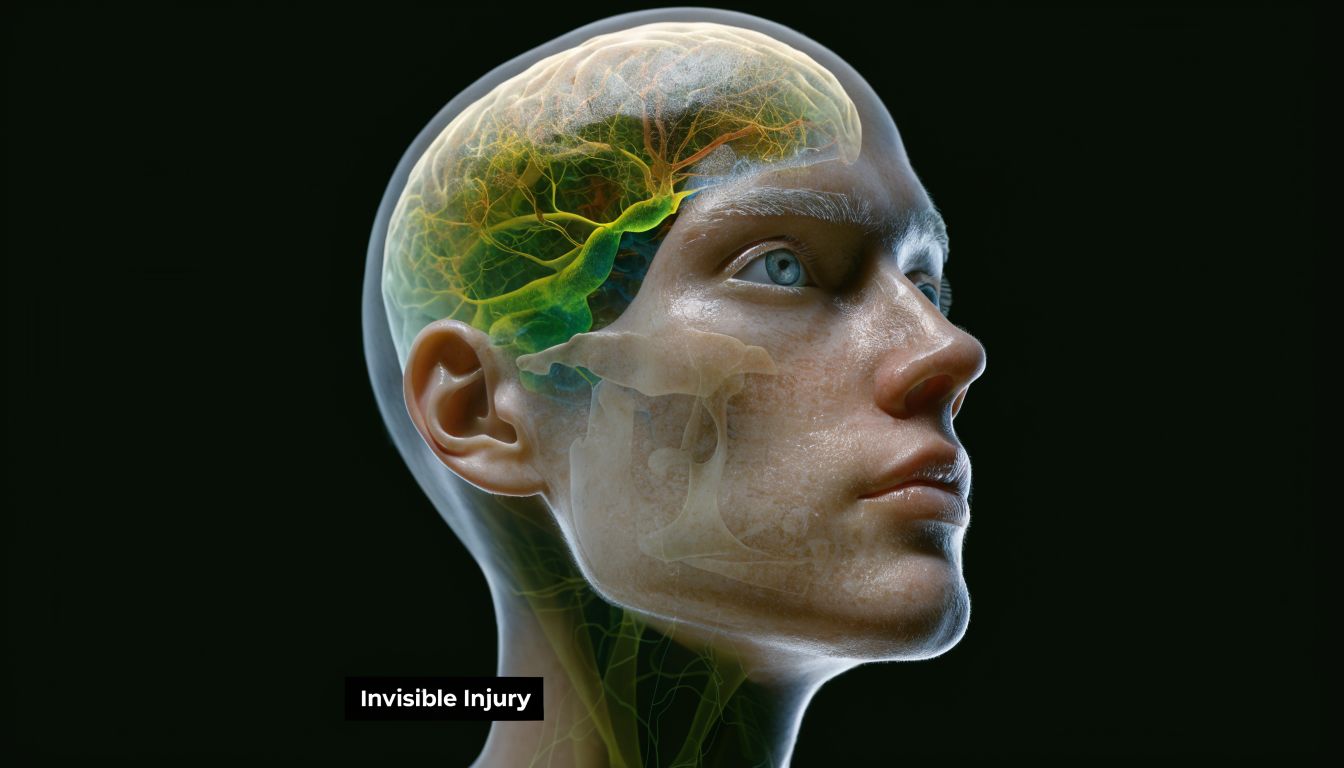
Why Your Brain Injury Is an Invisible Injury
A broken arm is a structural problem. The bone cracks, and an X-ray often shows the break clearly. A brain injury is often different. It can be less like a snapped branch and more like damage to a city’s electrical grid. The buildings are still standing, but power isn’t moving the way it should.
That’s why someone can look “fine” and still struggle to think, regulate emotions, tolerate noise, or keep their balance.
What people miss about brain trauma
In a crash, the brain can move inside the skull. That movement can disturb delicate pathways that help different parts of the brain communicate. A person may not have a skull fracture or a large visible bleed, yet still have a very real injury affecting memory, attention, reaction time, sleep, mood, and sensory processing.
Families often find themselves puzzled, thinking, “If the scan was okay, why is my loved one different?” The answer is that some injuries are too small, too early, or too function-based to show up on basic imaging.
A standard scan is useful, but it isn’t the whole picture.
Why symptoms can outlast the first hospital visit
The brain controls everything from speech to stress tolerance. So when its communication system is disrupted, symptoms can appear in ways that seem unrelated at first.
You might see:
- Memory slips that feel out of character
- Brain fog that makes simple tasks take much longer
- Mood changes such as irritability, anxiety, or emotional swings
- Balance problems that don’t look dramatic but make daily life harder
- Sensitivity to light, sound, or busy environments
None of that is imaginary. It reflects how the injured brain is processing information.
Practical rule: A “normal” first test does not automatically mean a normal brain, especially when symptoms continue.
Why this matters medically and legally
When an injury is invisible, the burden often shifts onto documentation. Doctors need the right tests to connect symptoms to actual brain dysfunction. Families need to report changes clearly and consistently. Lawyers, when involved, need records that show more than “patient complains of headache.”
That’s one reason neurological tests for brain damage matter so much. Each one captures a different part of the story. One may show emergency severity. Another may identify microscopic damage. Another may reveal how the injury affects work, school, relationships, and independence.
The goal isn’t to chase tests for their own sake. The goal is to build a truthful map of what the injury did.
Your Guide to Neurological Tests for Brain Damage
A family leaves the emergency room relieved that the first scan did not show a large bleed. Two days later, their loved one cannot follow a conversation, gets dizzy walking to the bathroom, and forgets what was said five minutes earlier. That gap between “the scan looked okay” and “something is clearly wrong” is where brain injury testing becomes confusing.
Each neurological test answers a different question. One checks for immediate danger. Another looks for damage in the brain’s wiring. Another measures how the injury is affecting memory, attention, balance, or the ability to work. That distinction matters for treatment. It also matters in an injury claim, because insurers often point to one normal test and act as if the whole case is weak.
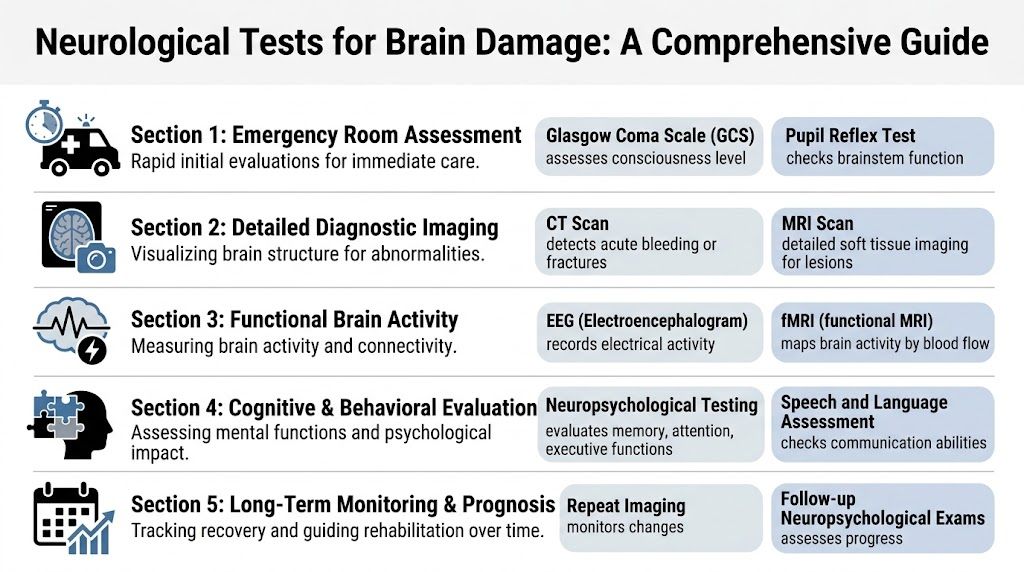
Emergency assessment with the Glasgow Coma Scale
One of the first tools used after a serious head injury is the Glasgow Coma Scale, or GCS. It scores three areas: eye opening, verbal response, and motor response. Together, those scores help the medical team judge how impaired a person appears right after the injury.
According to this forensic overview of brain injury indicators, GCS totals range from 3 to 15. The same source explains that traumatic brain injury severity is commonly grouped as mild at 13 to 15, moderate at 9 to 12, and severe below 9.
For families, GCS is often the first objective snapshot of what the brain was doing in the earliest hours. That can become important later. Insurance adjusters sometimes focus on a label like “mild TBI” and treat it as if “mild” means short-lived or insignificant. In real life, a so-called mild brain injury can still disrupt work, parenting, sleep, mood, and independence for months.
Here is what GCS does, and what it does not do:
| GCS role | What it helps show |
|---|---|
| Immediate triage | How responsive the person was right after the injury |
| Medical urgency | Whether severe brain trauma needed rapid intervention |
| Early documentation | A time-stamped record before memories and details fade |
| Claim value | One piece of objective evidence, not the full story |
GCS is a starting point. It does not measure subtle memory loss, slowed thinking, sensory overload, or the ability to return to normal life.
Structural imaging with CT and MRI
A CT scan is usually the fast first look. It is good at finding urgent structural problems such as bleeding, skull fractures, or swelling that may need immediate treatment.
An MRI gives a more detailed picture of soft tissue. It can detect some injuries a CT misses.
Families often hear “normal scan” and understandably think that means “no brain injury.” A better way to read it is this: the scan answered the question it was designed to answer. CT is very good at spotting major emergencies. It is not built to catch every microscopic injury that can disrupt concentration, mood, processing speed, or balance.
That difference matters in court and in settlement talks. A defense lawyer or insurer may point to a normal CT and argue that the symptoms must be exaggerated or unrelated. A careful legal team puts that scan in context, then pairs it with later imaging, specialist evaluations, symptom records, and testimony from the people who saw the changes at home.
Advanced imaging with Diffusion Tensor Imaging
Diffusion Tensor Imaging, or DTI, is a specialized form of MRI that looks more closely at white matter, the pathways that carry signals from one part of the brain to another.
White matter works like the brain’s wiring. A house can look fine from the street and still have damaged electrical lines inside the walls. In the same way, a routine scan may look normal while the brain’s communication system is struggling.
As noted earlier in the article, DTI can be highly sensitive in some mild traumatic brain injury cases and may reveal traumatic axonal injury that standard CT or MRI does not show. That is why doctors sometimes order it when symptoms continue but routine imaging does not explain them.
For legal purposes, DTI can help connect persistent symptoms to visible abnormalities in brain structure. It does not decide a case by itself. It adds another layer of objective support. This overview of diffusion tensor imaging of the brain explains why it often becomes part of the discussion after “normal” early scans.
Blood biomarker testing with GFAP and UCH-L1
Some hospitals also use blood tests that measure GFAP and UCH-L1, two biomarkers associated with brain injury. These tests can help identify whether a structural brain injury may be present soon after the trauma.
Families sometimes find that surprising. They are used to thinking of bloodwork as something that checks infection, anemia, or organ function. In brain injury care, biomarker testing can give doctors another early clue while they decide what imaging or monitoring is needed.
From a claim perspective, early blood biomarker results can help create a clearer timeline. They may show that concerns about brain injury were present from the start, not added later after an insurance dispute began. Insurers may still argue over what the results mean, so those findings are strongest when they are paired with scans, neurological exams, and clear symptom documentation.
Functional tests and electrical activity studies
Some tests focus less on structure and more on function. An EEG records the brain’s electrical activity and may be used when doctors are concerned about seizures, seizure-like episodes, or unusual changes in awareness.
That matters because brain injury is not only about what shows up on a picture. It is also about how the brain behaves.
Functional studies do not always produce a simple yes-or-no result. They can still support the medical record by showing that symptoms such as staring spells, blackouts, confusion, or altered responsiveness need a neurological explanation.
Neuropsychological testing and real-world function
Neuropsychological testing often becomes one of the most meaningful parts of the whole process, especially when the person looked “fine” to others but is no longer functioning the same way.
This testing examines areas such as:
- Attention and concentration
- Memory for new information
- Executive function, including planning and organization
- Language and word finding
- Processing speed
- Problem-solving and mental flexibility
A scanner shows structure. Neuropsychological testing shows performance.
That distinction is often powerful in a personal injury claim. If a former project manager now cannot track deadlines, if a student cannot retain reading assignments, or if a parent becomes overwhelmed by ordinary noise and multitasking, this testing can help document those changes in a way a jury, insurer, or mediator can understand. It turns “something is off” into a measurable pattern.
Balance and vestibular testing
Brain injuries can also disrupt the vestibular system, which helps control balance, eye movement, and spatial orientation. That is why some people feel dizzy in grocery stores, unsteady on stairs, or sick during car rides long after the initial injury.
Vestibular testing can help identify those deficits and guide treatment. It can also document limits that affect daily safety and independence. Those details matter in a legal case because compensation is not only about hospital bills. It is also about what the injury changed in everyday life.
A practical way to read the testing lineup
No single test tells the whole story. The stronger approach is to line them up like pieces of a puzzle.
| If the question is… | The test may help with… |
|---|---|
| How impaired were they right after the crash? | GCS |
| Is there a dangerous bleed or fracture? | CT |
| Is there more detail about brain structure? | MRI |
| Could white matter pathways be injured even if routine scans look normal? | DTI |
| Were there early biological signs of brain injury? | GFAP and UCH-L1 |
| How is the person thinking and functioning now? | Neuropsychological testing |
| Why are dizziness and balance problems continuing? | Vestibular and related testing |
If you remember one point from this section, let it be this: a normal early scan does not end the conversation. It means one tool answered one question. A good medical team, and a good legal team, keep building the full picture so the injury is treated seriously and documented accurately.
What to Expect During Your Neurological Exams
You are in a dim exam room a few days after the crash. Your head hurts. Questions feel harder than they should. A nurse hands you forms, someone mentions imaging, and your family is trying to follow words that all sound technical. That moment can feel frightening because you are being asked to measure an injury you cannot see.
The good news is that these exams are usually more tiring than painful. Each one checks a different part of how the brain is working, much like checking lights, wiring, and signals after a house has taken a hit in a storm. The process can feel slow, but the details matter for treatment and for proving what changed after the accident.
What an MRI or DTI usually feels like
For an MRI, and sometimes a DTI sequence within that scan, you lie on a table that slides into the machine. It is loud. The sounds are repetitive and sharp, and the space can feel tight if you are already anxious, dizzy, or sensitive to noise.
The test depends on stillness. That is often the hardest part. If you have headaches, nausea, claustrophobia, neck pain, or trouble lying flat, tell the staff before the scan begins. They can explain how long each part lasts and may be able to offer comfort measures.
Families often ask what this test means if the first ER scan looked normal. A later MRI or DTI may give your doctors more detail to compare against your symptoms and daily problems. That also matters in a claim. Insurance companies sometimes point to one early “normal” image as if it settles everything, but your legal team looks at the full timeline, including later imaging, specialist notes, and how your functioning changed after the wreck.
What a neuropsychological exam feels like
This exam often feels like school on your worst day.
You may be asked to remember lists of words, copy designs, answer questions, solve simple problems, name objects, or switch attention between tasks. Some parts seem easy at first. Then fatigue sets in, and that is part of what the examiner is measuring.
The goal is to map how your brain is working now, not to judge effort or intelligence. Honest answers matter more than perfect ones. If you lose focus, need repetition, get overstimulated, or feel mentally drained halfway through, say so. Those reactions can help explain why work, parenting, driving, or basic routines suddenly feel harder.
That information can also protect your legal rights. A person may look fine in a short office visit and still be struggling with memory, speed, concentration, or irritability all day long. Neuropsychological testing can turn those invisible problems into documented findings that are harder for an insurer to dismiss.
What balance and eye movement testing can bring up
Balance and eye movement testing often reproduces the symptoms you have been trying to describe. You might follow a target with your eyes, turn your head, change positions, stand on different surfaces, or report when dizziness starts and how long it lasts.
That can feel unsettling. It can also be validating.
If a certain movement brings on vertigo, blurred vision, or a sense that the room is shifting, the examiner can record that response in a structured way. For families, this is one of the clearest examples of why “normal” on paper does not always match real life. A claim is not only about what showed up in the first hours after the accident. It is also about what your body and brain cannot do safely now.
A few practical steps can make the day easier:
- Bring a companion if memory problems, fatigue, or dizziness make appointments harder
- Write down symptoms ahead of time so you can describe patterns clearly
- Ask for copies of reports or visit summaries for your records
- Plan quiet recovery time afterward because these exams can leave you wiped out
If you are also trying to make sense of the bedside score used soon after the accident, this plain-language guide to the Glasgow Coma Scale and what it means in a brain injury case can help connect those early observations to the rest of the testing.
How Test Results Build Your Medical and Legal Case
Medical tests do two jobs after a serious crash. First, they guide treatment. Second, they create evidence. Those two tracks overlap more than most families realize.
When an insurer reviews a brain injury claim, the company isn’t just looking at your pain. It’s looking for proof it can measure, question, or minimize.

How “normal” gets misused
A major problem in traumatic brain injury claims is that up to 50% of mild TBI cases show normal initial CT or MRI scans despite persistent symptoms, and insurance companies often use those negative results to deny or downplay claims, according to NYU Langone’s discussion of common neurological tests and their limits.
Families feel gaslit. They know something changed. Friends know something changed. Work performance falls apart. But the insurer points to one early scan and acts as if the case is closed.
That argument sounds medical, but often it’s just selective.
A CT was never designed to answer every question about subtle brain injury. A normal early MRI may still leave room for white matter injury, cognitive dysfunction, vestibular impairment, or delayed findings that only become clear with time and specialist follow-up.
What a strong brain injury file usually includes
A good claim doesn’t depend on one miracle test. It uses a set of records that fit together.
That often includes:
- Emergency records showing the mechanism of injury, symptoms, and initial observations
- Early neurological findings such as consciousness changes, confusion, or concerning bedside exam results
- Follow-up specialist evaluations that document persistent deficits
- Advanced testing when routine imaging doesn’t explain ongoing symptoms
- Functional evidence from neuropsychological or balance-related exams
- Daily impact documentation from family reports, work changes, and treatment notes
The legal value comes from consistency. If the emergency record, later cognitive testing, and the family’s observations all point in the same direction, the case gets harder to dismiss.
Why timing matters
Brain injury claims often rise or fall on chronology. Did symptoms start right after the crash? Did they persist? Did they interfere with work, school, parenting, driving, or basic household tasks? Did the testing evolve as the medical picture became clearer?
Those questions matter because insurers often exploit gaps. If there was a delay in specialty care, they may blame something else. If the first scan was normal, they may ignore later objective findings. If the symptoms are cognitive or emotional, they may try to relabel the problem as stress.
That’s why careful record-building matters from the beginning.
Legal reality: A negative first scan is not the end of a brain injury case. It is often the beginning of a more careful proof process.
How medical language becomes legal evidence
Here’s what families rarely get told. Every report carries a different kind of legal weight.
| Record type | Why it matters in a claim |
|---|---|
| Emergency notes | They capture the earliest symptoms before outside influence or memory fade |
| Imaging reports | They show what was ruled in or ruled out structurally |
| Neuropsychological findings | They connect the injury to day-to-day cognitive losses |
| Vestibular findings | They explain dizziness, instability, and safety concerns |
| Biomarker results | They can add objective early data when imaging is inconclusive |
A lawyer handling a traumatic brain injury case has to do more than collect records. They have to translate them into a story the insurer, defense lawyer, mediator, or jury can understand. The story must show not only that the brain was injured, but how that injury changed the person’s earning capacity, independence, medical needs, and quality of life.
This short video offers another view of how evidence and advocacy come together in serious injury cases.
The combination approach is often the most persuasive
A brain injury case becomes stronger when multiple forms of evidence line up. For example, a person may have an early CT that doesn’t show a large acute injury, but later have advanced imaging suggestive of axonal damage, neuropsychological testing that documents deficits, and treatment notes showing persistent dizziness and headaches.
That pattern matters. It mirrors real brain injury far better than the old myth that every serious injury should be obvious on the first scan.
For families, this also explains why legal help can’t be separated from medical understanding. The records don’t speak for themselves. Someone has to know what each test can prove, what it cannot prove, and how insurers typically try to twist the difference.
Coordinating Your Care and Protecting Your Future
At first, the job is survival. Then the paperwork starts, the appointments multiply, and a new kind of pressure sets in. A spouse is trying to remember which doctor said what, an injured parent is missing work, and an insurance adjuster is already asking questions as if the picture is clear.
For many families, this is the point where brain injury feels less like a single medical event and more like a thousand loose pages blowing across the room. Someone has to gather them before important details disappear.

What to do when symptoms continue
Ongoing symptoms deserve follow-up care, especially when daily life still feels off weeks or months later. If the current explanation does not match what you are seeing at home, ask whether the care plan needs to widen. That may include neurology, neuropsychology, vestibular therapy, vision assessment, or a closer review of imaging and test results.
Specific examples help doctors connect symptoms to function.
Instead of saying, “something is wrong,” describe the missed steps, the forgotten bills, the panic in a grocery store, or the exhaustion after a short conversation. Those details do two jobs at once. They guide treatment, and they create a clearer record of how the injury is affecting work, parenting, school, and independence.
A claim often turns on that level of detail. Insurance companies often point to a normal early scan and suggest recovery should be complete. Daily examples show the gap between that assumption and real life.
Keep a record that matches real life
A symptom journal works like a timeline for a foggy period. It does not need to be polished. It needs to be honest and consistent.
Write down what happened, when it happened, how long it lasted, what seemed to trigger it, and what had to stop because of it. If a headache forced your child to leave school early, note that. If dizziness made a shower unsafe without help, note that too. Small moments add up to a much more accurate picture than a single office visit.
That record can also protect you later. If an insurer argues that the person “seemed fine” because one appointment note was brief, a steady journal can show a pattern of problems that never really let up.
Ask questions that clarify the next step
Appointments move fast, and brain injury appointments can feel especially hard when memory and concentration are already strained. Bring a written list. Bring another person if you can.
Questions like these often help families get clearer answers:
- What does this test show, and what does it not show?
- If the result looks normal, what could still explain these symptoms?
- Do the current findings support work restrictions, school accommodations, or help at home?
- Would another specialist add useful information about balance, cognition, mood, or fatigue?
Those questions matter medically, but they matter legally too. They help create records that explain limits in plain terms instead of leaving room for an insurer to fill in the blanks.
Keep the records in one place
Brain injury care often stretches across several providers. Emergency medicine, primary care, neurology, therapy, imaging, and workplace disability paperwork can all sit in different portals or folders. Bring them together.
Keep copies of imaging reports, specialist notes, discharge instructions, medication lists, work restrictions, school letters, and bills in one place. If possible, save a simple timeline of appointments and major changes in symptoms.
That organization helps your doctors see the full pattern. It also helps a legal team show how the injury unfolded over time, especially when defense lawyers try to isolate one “normal” record and ignore the rest.
Choosing support that understands both medicine and claims
Some families reach a point where they need more than appointment reminders. They need help making sure the medical evidence is understood in the same way the family is living it. That is especially true in brain injury cases, where symptoms can be obvious at home and easy to minimize on paper.
Working with counsel familiar with complex TBI documentation can help protect that story. Nares Law Group’s Certified Brain Injury Specialist resource explains how brain injury evidence, ongoing care, and claim development intersect.
A lawyer does not replace your doctors. A good legal team helps make sure the records are gathered, the right questions are asked, and the insurer cannot misuse incomplete or early test results as proof that nothing serious happened.
If you’re caring for someone with a brain injury, your role is not to become a neurologist overnight. Your role is to notice changes, write them down, keep the records together, and make sure an invisible injury is documented clearly enough to protect both recovery and future financial stability.
If you’re dealing with persistent symptoms after a crash and need help understanding how medical testing fits into a personal injury claim, Nares Law Group LLC can help you evaluate the records, identify gaps in documentation, and understand your options while you focus on recovery.