The phone keeps ringing. One doctor wants a follow-up. A therapist mentions “executive function.” Someone from insurance asks whether your loved one is “back to normal yet.” Meanwhile, the person you know so well may now forget conversations, snap in frustration, sleep at odd hours, or seem like themselves one hour and completely different the next.
That’s the part many families don’t expect after a traumatic brain injury. The injury may happen in a moment, but the confusion afterward can stretch for months.
A lot of people assume recovery is only a matter of attending appointments and waiting. In real life, recovery is usually messier. It involves medical care, behavior changes, home routines, school or work concerns, transportation issues, medication questions, and often a legal claim running in the background. Families aren’t just trying to help someone heal. They’re also trying to prove what changed, what care is needed, and why the injury still matters.
That’s where a certified brain injury specialist can become vitally important. Not just as a rehabilitation professional, but as someone who helps connect the dots between daily struggles and the evidence needed to support a serious injury claim.
The Overwhelming World After a Brain Injury
A family might leave the hospital feeling relieved that their loved one survived, then discover that the hardest part begins at home.
The cast may come off. The scans may look “stable.” But now the injured person can’t follow a recipe, gets lost driving familiar roads, or melts down over a minor change in plans. To everyone else, they may look fine. To the family, life feels split into “before” and “after.”
Why families feel so disoriented
A brain injury affects more than memory. It can change judgment, impulse control, mood, sleep, stamina, communication, and the ability to manage ordinary tasks.
That creates a strange mismatch. The person may be physically home, but daily life no longer works the same way.
Common pain points include:
- Mixed messages: One provider focuses on headaches, another on speech, another on balance, while no one explains how the pieces fit together.
- Invisible symptoms: Trouble concentrating or controlling emotions can be profound, even when there’s no obvious outward sign.
- Unclear timelines: Families want to know what recovery will look like, but progress after TBI often comes unevenly.
- Insurance pressure: Adjusters may treat the case like a short-term injury when effects are ongoing.
For many families, the best starting point is learning how recovery often unfolds over time. A practical overview of TBI recovery time can help put some of that uncertainty into context.
Recovery after a brain injury rarely looks like a straight line. Good days and bad days can both be real at the same time.
Where a CBIS enters the picture
A Certified Brain Injury Specialist, often called a CBIS, can serve as a steady guide when everything feels scattered.
Think of this person as someone who understands both the medical language and the lived reality. They help families understand why a loved one is acting differently, what supports may help, what needs to be tracked, and which changes matter over time.
That matters emotionally. It also matters legally.
When families don’t have a clear way to describe the injury’s day-to-day impact, insurers often fill in the blanks for them. A CBIS helps replace guesswork with organized observation, practical support, and clearer documentation.
What a Certified Brain Injury Specialist Credential Means
The term certified brain injury specialist sounds straightforward, but many people understandably ask the same question. Is this just a job title, or is it a real credential?
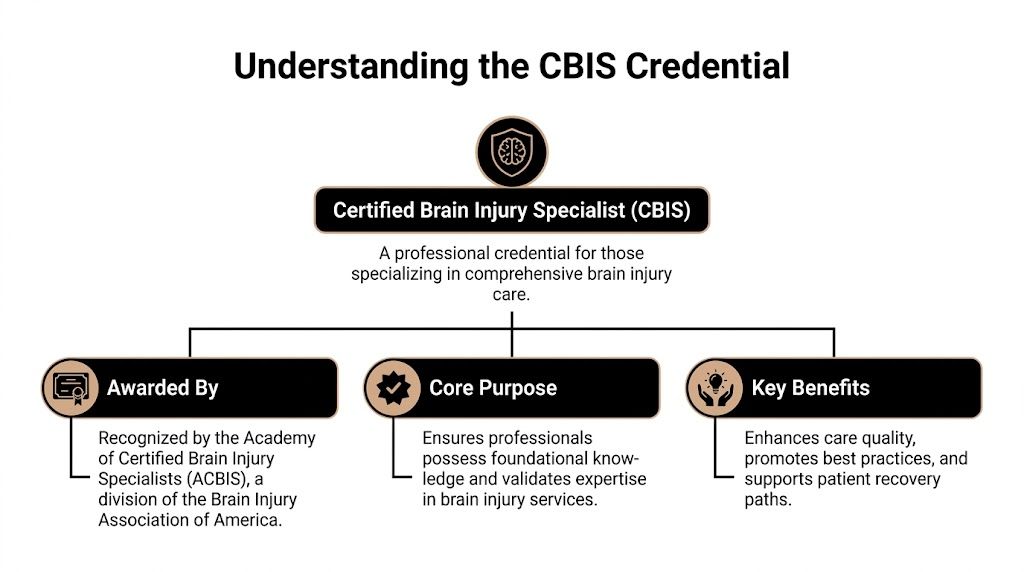
It’s a real credential. The Certified Brain Injury Specialist (CBIS) certification is administered by the Academy of Certified Brain Injury Specialists, or ACBIS.
Near the start of your search, it helps to see the credential visually.
Think of a CBIS as the general contractor for brain recovery
If your home had major structural damage, you wouldn’t want random workers showing up with no shared plan. You’d want someone who understands the whole job, knows what each professional does, and can tell when one problem affects another.
That’s a useful way to think about a CBIS.
A neurologist may diagnose. A speech therapist may work on communication. An occupational therapist may help with routines and safety. A psychologist may address mood or behavior. A CBIS understands how those pieces interact in the day-to-day reality of brain injury care.
They’re not a replacement for every provider. They’re the person with specialized brain injury knowledge who can help make the care plan make sense.
What a person must do to earn the credential
According to the ACBIS CBIS eligibility requirements, applicants must have at least 500 hours of direct, verifiable contact experience working with individuals with brain injury. They also must hold at least a high school diploma, have their qualifying experience verified, and pass a remote proctored examination with a score of 80% or higher.
That matters for a simple reason. It means the credential isn’t based on interest alone.
A person doesn’t become a CBIS by reading a few articles or attending one weekend class. They must show real contact experience with brain injury patients, and they must meet a standardized testing requirement.
Later, many families want to understand the exam itself and what kind of preparation it reflects. This short video offers added context.
What that training actually prepares them to handle
The credential covers more than one narrow issue. CBIS training reaches into the practical areas families run into every day.
A CBIS may be equipped to help with:
- Patient interaction: Communicating in ways that reduce confusion and frustration.
- Behavioral management: Recognizing that anger, impulsivity, or withdrawal may reflect brain changes, not stubbornness.
- Medical complications: Understanding how symptoms, medications, and recovery issues can overlap.
- Medication safety: Helping families pay attention to how medications affect functioning.
- Family support: Guiding caregivers who are suddenly carrying a much heavier load.
The certification also includes knowledge related to different kinds of brain injury, including stroke, mild traumatic brain injury, and concussion, as described in the same ACBIS eligibility material.
Practical rule: A credential doesn’t guarantee a perfect fit for every case, but it does tell you the person has met a recognized baseline in brain injury-specific knowledge and experience.
The CBIS Role in Clinical Care and Daily Recovery
The most helpful way to understand a certified brain injury specialist is to watch what they do in ordinary life.
Not in a brochure. In a kitchen, a therapy waiting room, a school meeting, or a living room where everyone’s patience is frayed.

What care coordination looks like in real life
A CBIS often helps with care coordination, which can sound abstract until you see it up close.
Say a person with TBI is attending speech therapy, occupational therapy, and medical follow-ups. The family is also dealing with sleep disruption, missed medications, and sudden emotional outbursts.
A CBIS may help by:
- Connecting the dots across providers: If speech therapy notices memory trouble and occupational therapy notices safety problems in cooking, those aren’t separate stories. They may point to the same functional issue.
- Helping the family build routines: Written schedules, simple checklists, quiet rest periods, and lower-stimulation environments often matter more than families realize.
- Flagging practical risks: Maybe the problem isn’t just “forgetfulness.” Maybe it’s leaving the stove on, taking medications twice, or wandering off during a busy outing.
For families looking into treatment options that address attention, memory, and problem-solving, this overview of TBI cognitive therapy can help clarify how rehabilitation targets these everyday challenges.
A small example with big consequences
Consider a person who keeps blowing up at dinner.
Without brain injury training, relatives may read that as rudeness or laziness. A CBIS may notice something else. The person has already used most of their mental energy for the day. The kitchen is noisy. Multiple conversations are happening at once. They can’t process everything quickly enough, and overload turns into anger.
That observation changes the response.
Instead of punishment or conflict, the family might try one speaker at a time, a calmer environment, shorter meals, and more structure before evenings. That doesn’t cure the injury. But it can reduce harm, stress, and misunderstanding.
Why this matters beyond comfort
Clinical support isn’t only about getting through the day more smoothly. It also creates a clearer record of what the injury is doing.
When a CBIS helps track missed tasks, behavior triggers, medication effects, fatigue patterns, and functional limitations, the family ends up with something very important. They have specifics.
Not “he’s different.”
More like:
- He can start a task but can’t finish it without cues.
- She becomes overwhelmed in busy environments.
- He forgets new information unless it’s written down.
- She needs help managing medications and appointments.
Those details are useful for treatment. They also become critical when someone later asks what support will be needed in the future.
Why a CBIS is Crucial for Your Personal Injury Case
A brain injury case is often hardest to prove when the injured person doesn’t “look injured.”
That’s one reason families get so frustrated. They can see the change every day, but insurance companies often focus on snapshots. A normal-looking clinic visit. A short conversation. A scan that doesn’t tell the whole story. A note that says the patient is “alert and oriented.”
The legal problem with invisible injuries
Many effects of TBI are functional rather than obvious.
A person may still walk, speak, and smile. But they may no longer manage money, keep a job, regulate emotions, drive safely, remember appointments, or handle a full day without crashing. Those are serious losses. They’re just harder to present unless someone knows how to document them clearly.
That’s where a certified brain injury specialist can make a major difference.
According to the ACBIS overview and programs information, a key role for a Certified Brain Injury Specialist in personal injury cases is validating long-term TBI impacts like cognitive deficits, behavioral changes, and quality-of-life losses. That expertise can help counter insurance denials and strengthen a lawsuit by providing expert biopsychosocial assessments that quantify the need for future care.
What that means in plain language
“Biopsychosocial assessment” sounds technical, but the idea is practical.
It means the specialist looks at the whole picture:
- Bio: What physical and neurological symptoms are present?
- Psycho: How has the injury affected mood, behavior, coping, and thinking?
- Social: What has changed at home, at work, at school, and in relationships?
A lawyer can argue that a client needs future support. A CBIS can help show why.
That distinction matters. Courts and insurers respond better to concrete evidence than to broad statements of concern.
In a serious TBI case, the question isn’t only “What was the diagnosis?” It’s also “What can this person no longer do reliably, safely, and independently?”
How a CBIS strengthens the case file
In legal claims, a CBIS often helps translate lived experience into usable proof.
That can include documentation of:
- Cognitive changes: memory problems, slowed processing, poor planning, confusion, distractibility
- Behavior changes: irritability, impulsivity, emotional swings, social withdrawal
- Functional losses: trouble cooking, working, driving, parenting, organizing, or handling finances
- Care needs: supervision, therapy support, medication management, structured routines, home assistance
This is especially important in motor vehicle and truck crash cases, where insurers may argue that symptoms are exaggerated, temporary, or unrelated.
A CBIS can also help families and legal teams talk more precisely with other experts. If you’re already exploring the broader medical side of these claims, a head trauma specialist often plays a different but complementary role.
Why timing matters
Families sometimes wait too long to involve someone with brain injury-specific knowledge.
By then, important details may be lost. Early behavior changes weren’t written down. Home struggles weren’t tracked. The spouse who became a full-time organizer, scheduler, and safety monitor never thought to document those tasks because they were too busy surviving them.
A CBIS helps capture what daily life requires.
That doesn’t just strengthen a lawsuit. It helps protect the resources needed for care, supervision, treatment, and long-term support.
How to Find and Verify a Qualified Brain Injury Specialist
Finding the right professional can feel like another full-time job. The key is to slow the process down and check for fit, not just availability.
Start with credential verification
First, confirm that the person is a Certified Brain Injury Specialist through the appropriate ACBIS pathway.
Don’t rely only on website bios or business cards. Ask the professional directly about their certification status and whether their work has focused on the kind of brain injury issues your family is facing.
You’re not being difficult. You’re doing due diligence.
Look for the kind of experience your case needs
Not every brain injury case requires the same kind of support.
A child with school challenges, an adult with severe executive dysfunction, and a truck crash victim involved in active litigation may all need different strengths from the professional they hire.
As you evaluate candidates, look for evidence of experience with:
- Home and family education: Can they explain symptoms in plain language and help caregivers adapt routines?
- Functional observation: Do they pay attention to how the injury affects real-world tasks, not just clinic performance?
- Documentation habits: Can they write clearly and consistently about limitations, support needs, and change over time?
- Collaboration: Are they comfortable coordinating with physicians, therapists, case managers, and attorneys when needed?
Understand the advanced CBIST level
Some professionals hold a higher-level designation called Certified Brain Injury Specialist Trainer, or CBIST.
According to the CBIST eligibility requirements from ACBIS, this advanced credential requires a bachelor’s degree, five years of brain injury field experience, and demonstrated teaching skills. These professionals are qualified to deliver official CBIS preparatory courses. In legal settings, their involvement can also provide benchmark recovery information that may support negotiations with insurers.
That doesn’t mean every family needs a CBIST.
It does mean that if the case is complex, contested, or likely to involve long-term future care questions, an advanced professional may bring added value.
The best specialist for your case isn’t always the one with the longest resume. It’s the one whose training, communication style, and documentation skills match the problems you need to solve.
A simple screening checklist
| What to verify | Why it matters |
|---|---|
| Current CBIS or CBIST status | Confirms specialized brain injury credentialing |
| Direct experience with similar patients | Improves the chance they’ll recognize relevant patterns |
| Comfort with family education | Families need explanations, not jargon |
| Ability to document function over time | Legal and insurance claims depend on clear records |
| Willingness to coordinate with other professionals | TBI care rarely works in isolation |
Key Questions to Ask a Potential CBIS
A short call or consultation can tell you a lot, if you ask the right questions.
The goal isn’t to quiz the professional. It’s to learn whether they can help both with recovery support and with the documentation demands that often follow a serious crash.
Vetting your Certified Brain Injury Specialist
| Area of Inquiry | Sample Question to Ask |
|---|---|
| Clinical background | What kinds of brain injury cases do you work with most often? |
| Day-to-day function | How do you evaluate problems that show up at home, not just in appointments? |
| Communication style | How do you explain cognitive or behavior changes to family members who are overwhelmed? |
| Care coordination | How do you work with therapists, physicians, and case managers when several people are involved? |
| Documentation | What kinds of records or written observations do you keep about daily limitations and support needs? |
| Legal familiarity | Have you worked on cases where your observations or assessments were used in a personal injury claim? |
| Future care needs | How do you help identify what support may be needed over time? |
| Family role | What do you expect from caregivers, and how do you help them avoid burnout? |
| Practical fit | Are you comfortable working with issues like memory failure, anger, fatigue, and supervision needs? |
| Scope and boundaries | What can you do directly, and when do you refer out to another specialist? |
What good answers tend to sound like
You’re listening for clarity.
Strong candidates usually answer in plain language, give specific examples, and seem comfortable discussing both treatment realities and documentation. Weak answers often stay vague, overpromise, or sound unfamiliar with how TBI affects family life outside the clinic.
A few helpful signs:
- They talk about function, not just diagnosis.
- They mention collaboration without sounding territorial.
- They understand that legal cases require precision.
- They respect the family’s observations instead of dismissing them.
If a professional can’t explain their approach clearly, that’s a concern. Brain injury is complicated enough. Your support team shouldn’t make it harder to understand.
Helpful Resources for Your TBI Recovery Journey
Families coping with brain injury usually need two things at once. Better support for daily life, and better structure for proving what the injury has cost.
A certified brain injury specialist can help bridge those needs. Clinically, they can help make treatment more organized and realistic. Legally, they can help describe the injury in a way insurers, experts, and decision-makers can understand.
Resources worth knowing about
If you’re looking for next steps, these are useful places to start:
- Brain Injury Association of America for national brain injury information and broader support resources.
- Academy of Certified Brain Injury Specialists for credential information and program details.
- Local brain injury support groups in your state or region for caregiver support, practical tips, and community connection.
- Your treating providers for referrals to brain injury-focused rehabilitation professionals who understand functional change over time.
Training for family members matters too
Not every helpful support person is a licensed clinician. Family members and caregivers often carry a huge part of the recovery burden.
The ACBIS Brain Injury Fundamentals program is designed for non-licensed caregivers, family members, and first responders. It covers topics such as cognition, behavior, medications, and family coping, and it can help people supporting recovery at home document challenges for legal and insurance purposes.
That’s a meaningful option for families who keep thinking, “I need someone to teach me how to do this.”
A grounded way to move forward
You don’t need to master brain injury medicine overnight.
You do need people around you who understand what brain injury looks like in ordinary life, can explain it clearly, and can help preserve the evidence of what your family is living through. That’s the practical value of the certified brain injury specialist role.
When the system feels fragmented, the right professional can help make it legible again.
If you or your family are dealing with a traumatic brain injury after a crash and need legal guidance that takes both medical reality and long-term impact seriously, Nares Law Group LLC can help. The firm represents injured people and families facing complex motor vehicle, truck wreck, wrongful death, and TBI cases, with a focus on clear communication, strong advocacy, and the resources needed for a more stable future.