You've made it home from a Westminster crash. Your phone won't stop ringing. The insurance adjuster sounds polite but rushed. Your head hurts, your back feels tight, and someone keeps telling you to “just get checked out if it still hurts tomorrow.”
That's how people lose value in good injury claims.
If you're dealing with a car wreck, truck collision, or a head injury that doesn't look dramatic on day one, you need to get organized fast. The biggest mistakes happen early. People talk too much, wait too long, skip follow-up care, or treat a brain injury like a sore neck. Insurance companies count on that.
A good Westminster personal injury attorney doesn't just file paperwork. That lawyer protects evidence, controls the story, and makes sure delayed symptoms, future care, and trucking-specific proof don't get brushed aside.
Getting Oriented After a Crash
The first day after a crash feels messy because it is. Police reports may not be ready. Your primary doctor may tell you to monitor symptoms. The other driver's insurer may ask for a recorded statement before you even know what's wrong.
Slow down and get disciplined.
Start with three priorities:
-
Get medical care
If you hit your head, lost focus, felt dizzy, vomited, forgot details, or developed light sensitivity, treat that as a possible brain injury. Don't wait for dramatic symptoms. -
Preserve what happened
Save photos, tow records, discharge papers, names of witnesses, and every insurance message. If a truck was involved, preserve anything that identifies the carrier, trailer, and driver. -
Stop casual conversations about fault
Don't guess. Don't speculate. Don't try to be fair by minimizing your own injuries.
Practical rule: If you wouldn't want a defense lawyer reading your words in a deposition, don't text it, post it, or say it to the adjuster.
The hidden problem in Westminster-area injury cases isn't just proving a collision happened. It's proving the full medical and human impact before the insurer locks you into a cheap narrative. That problem gets worse in two kinds of cases: traumatic brain injuries and truck wrecks. Both require better evidence, earlier action, and more serious legal handling than is commonly understood.
Immediate Actions That Protect Your Claim
What you do in the first hours matters more than is often realized. A strong claim starts with boring, disciplined documentation. Not emotion. Not outrage. Proof.
A simple visual checklist helps keep you from missing key items.
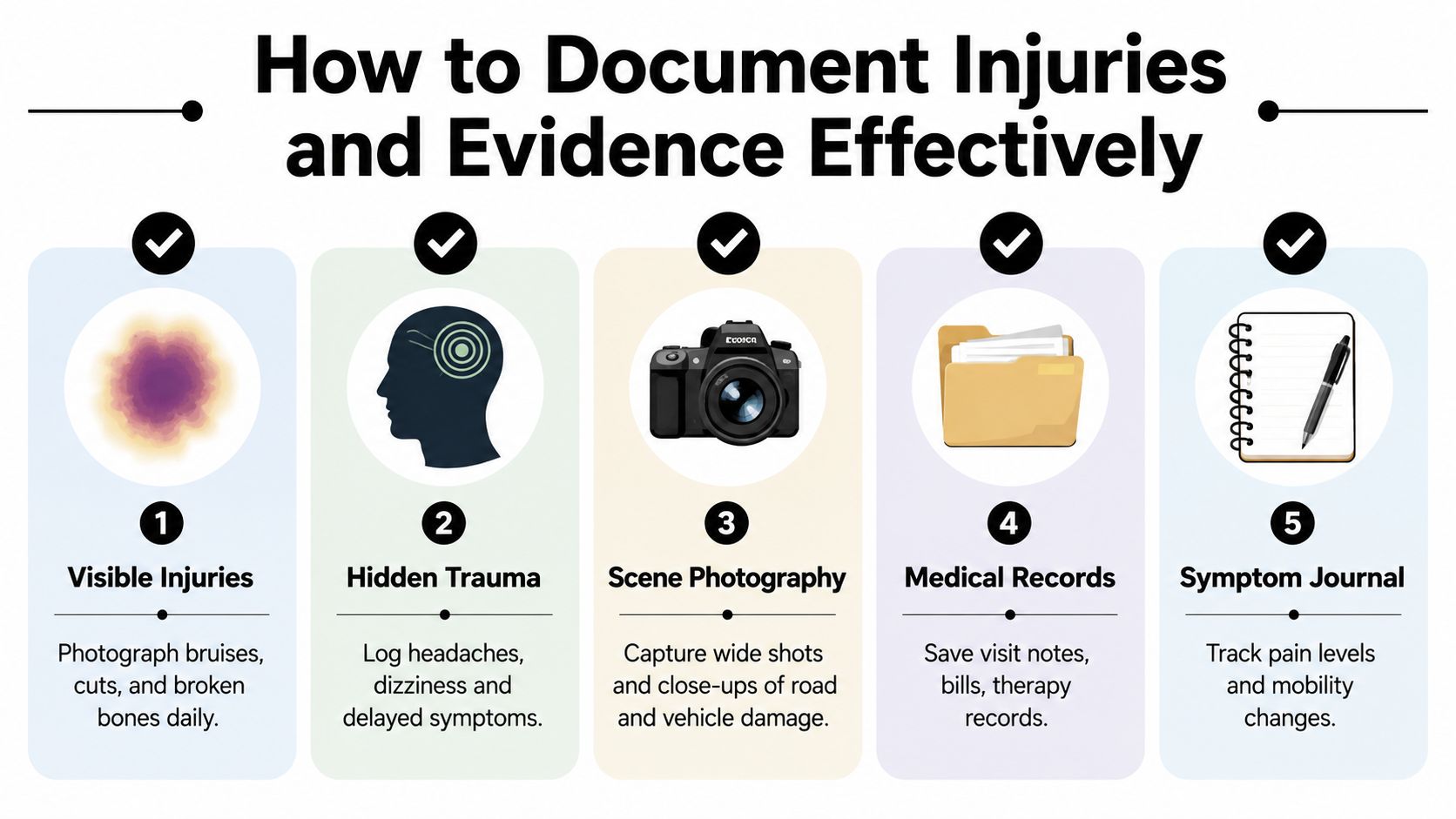
At the scene and right after
If you're physically able, do these things:
- Photograph the whole scene. Get wide shots of the intersection, lane positions, debris, skid marks, weather, traffic signals, and vehicle damage.
- Get witness names and numbers. Independent witnesses often disappear fast.
- Identify every vehicle involved. In truck cases, photograph the cab, trailer, company markings, and plate numbers.
- Call police and cooperate. Give facts, not theories.
- Accept medical evaluation if responders recommend it.
A common Westminster scenario goes like this. A driver gets rear-ended near a busy corridor, feels “mostly okay,” declines ambulance transport, and goes home. Two days later the headache starts, concentration drops, and neck pain gets worse. The insurer then argues the injury wasn't serious because the person didn't seek immediate care. That's avoidable.
What not to do
The wrong move can weaken a valid case fast.
- Don't admit fault. Even a casual “I didn't see them” can get twisted.
- Don't give a recorded statement early.
- Don't repair or destroy evidence before your lawyer has what's needed.
- Don't disappear from treatment once you start.
If you want a practical post-crash checklist, these steps to take after a car accident are worth reviewing while events are still fresh.
Here's the other piece people ignore. Your body doesn't care that the insurance company wants a quick answer. Brain injury symptoms and soft-tissue injuries often develop over time. What matters is whether your records show a clear timeline from crash to symptoms to treatment.
Later in the process, many claims turn on whether the injured person created a clean evidence trail in the first week. Start that trail now.
A short walkthrough can help you think about the early decisions that matter most:
How to Document Injuries and Evidence Effectively
A weak paper trail is how valid injury claims get discounted. That happens all the time in concussion cases and truck wrecks. The victim knows something is wrong, but the chart is thin, the photos stopped after day one, and nobody tied the symptoms to work problems, family strain, or long-term care needs.
That gap costs money.
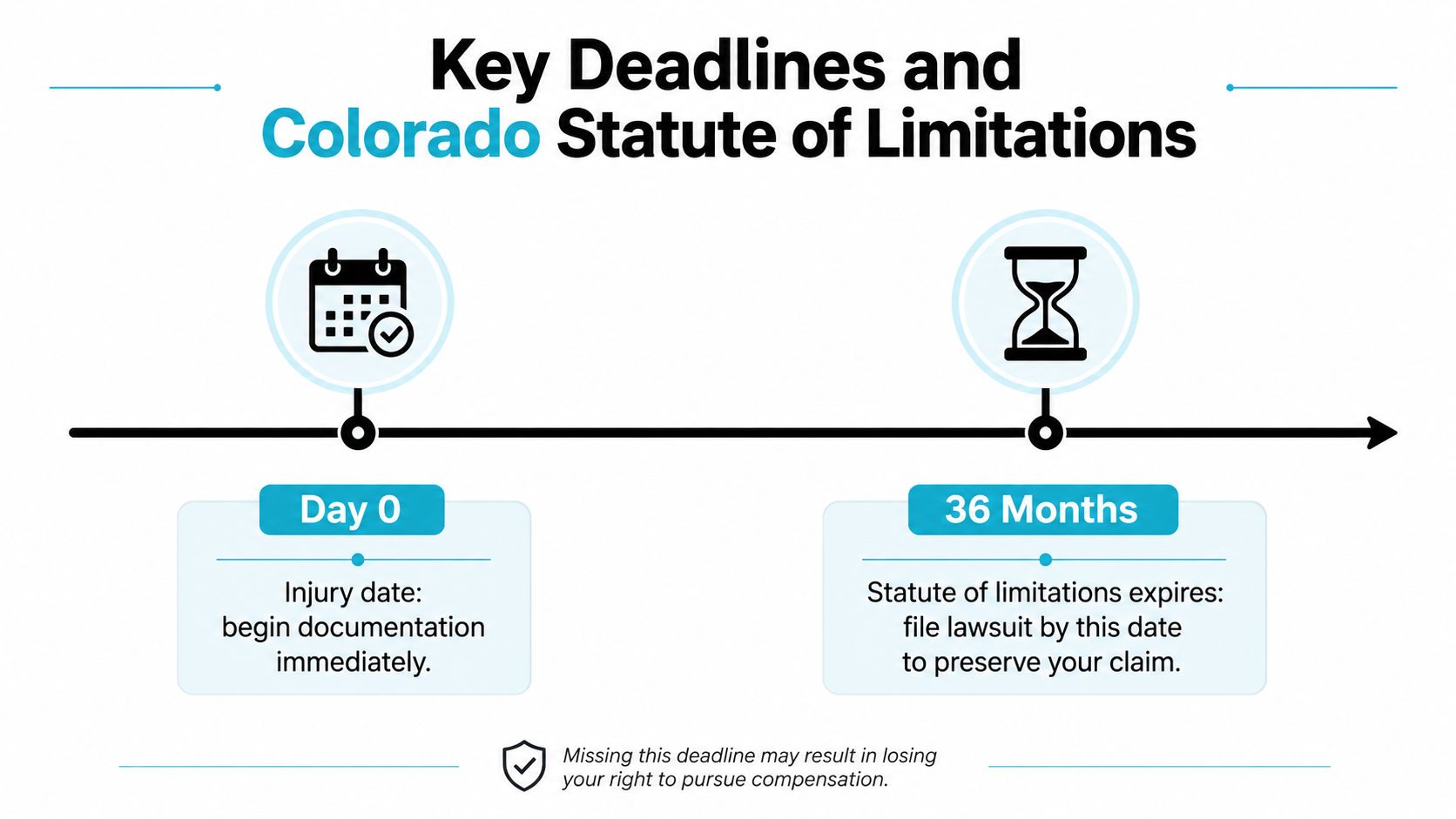
Build proof for what the scan does not show
Bruises, lacerations, casts, and staples usually speak for themselves. Brain fog does not. Headaches do not. Slowed processing, irritability, missed deadlines, and getting lost on a familiar drive do not.
Document both the physical injury and the functional fallout.
Use a system that is simple enough to keep up with:
- Take photos more than once. Photograph bruising, swelling, cuts, casts, surgical sites, and scarring every few days as they change.
- Keep a symptom log. Write down headaches, dizziness, nausea, sleep disruption, memory problems, light or noise sensitivity, mood changes, and concentration trouble.
- Track work problems. Note missed shifts, reduced duties, extra breaks, errors, slower pace, and tasks you used to handle without help.
- Track home problems. Record trouble with childcare, driving, cooking, cleaning, exercise, yard work, and basic routines.
- Save outside proof. Keep discharge papers, prescriptions, therapy homework, mileage to appointments, wage-loss records, and messages showing canceled plans or requests for help.
For brain-injury cases, details matter more than labels. A chart that says "mild concussion" can still support a serious claim if your records show six months of cognitive problems, failed work attempts, and consistent treatment. Without that timeline, the insurer will argue you recovered in a week.
Get medical records that answer the legal question
Medical care is about treatment. Injury claims are about proof. Those are related, but they are not the same.
If you suspect a brain injury, tell every provider exactly what changed after the crash. Do not just say "head hurts." Say you are forgetting appointments, losing your train of thought, snapping at family, sleeping at odd hours, or struggling to finish routine tasks. Specific complaints make better records. Better records make stronger claims.
In more serious cases, the medical file may need imaging, follow-up neurology, neuropsychological testing, vision or vestibular evaluation, psychological assessment, and future-care opinions. Trucking cases raise a different problem. Key evidence often sits with the company, not the victim. That can include driver qualification files, black-box data, dashcam footage, inspection records, driver logs, and dispatch communications. If nobody demands preservation early, it may be overwritten or discarded. This explanation of spoliation of evidence shows why that happens and why fast legal action matters.
Experts can also make a major difference in complex brain-injury and trucking cases. Not because experts magically increase value, but because they explain what ordinary records miss. A neuropsychologist can connect subtle deficits to daily impairment. An accident reconstructionist can pin down force and mechanics. A life-care planner can put a future price on care needs the insurer wants to ignore. If the case involves hidden injury and high damages, do not let the insurance adjuster define it with incomplete records and a rushed review.
Evaluating and Choosing Your Attorney in Westminster
Two weeks after a crash, a lot of injured people make the same expensive mistake. They hire the lawyer who called back first, sign the fee agreement, and assume the case is in good hands. Then the trucking company locks down its records, the concussion gets dismissed as “minor” because nobody built the medical proof correctly, and the claim loses value before serious negotiations even start.
Pick your lawyer the same way you would pick a surgeon for a complicated procedure. General confidence is not enough. You need someone who knows where brain-injury and trucking cases get undercut, and who can explain how they prevent that from happening.
What to screen for first
Start with case fit, not advertising.
A Westminster personal injury attorney should be able to answer direct questions about the problems that reduce case value in this type of claim:
- How do you build a mild TBI case when CT scans are normal but memory, focus, mood, and fatigue problems keep showing up?
- What do you do in the first few days to preserve trucking evidence?
- Which experts do you use in brain-injury and truck cases, and when do you bring them in?
- How do you prove future losses if the client can work some days but not consistently?
- Will I talk to the lawyer handling strategy, or only to intake staff and case managers?
Weak answers are a warning.
If the lawyer cannot explain the medical-legal side of delayed concussion symptoms, neuropsych testing, future care, or trucking-company document retention, keep looking. Those are not niche details. They are often the difference between a routine settlement and a properly valued claim.
What good answers sound like
You are looking for specifics. A good attorney will talk about timelines, records, and proof.
In a trucking case, that means early preservation letters, driver logs, electronic data, inspection and maintenance records, onboard video if it exists, dispatch communications, and the company's safety file. In a brain-injury case, that means more than emergency-room notes. It means tracking symptom progression, getting the right referrals, and tying cognitive problems to work limits and daily function in a way an insurer cannot shrug off as “subjective.”
The fee question and the red flags
Contingency fees are the standard setup in personal injury cases. You should not be writing a check up front just to get a lawyer to investigate an injury claim.
Red flags are usually obvious if you ask the right questions:
- Pressure to settle before the diagnosis is clear
- No real discussion of specialist referrals in a head-injury case
- No plan for preserving truck-company evidence right away
- Heavy sales pitch, thin case strategy
- Promises about results instead of an explanation of risk
- No clear answer about who is responsible for your file
One bad hire can cost you more than a bad adjuster. The insurer is expected to minimize your claim. Your own lawyer is supposed to stop that.
If you want a practical checklist, this guide on how to hire a personal injury lawyer lays out the questions worth asking before you sign anything.
One factual option in this market is Nares Law Group LLC, a Denver-based firm that handles investigation, treatment coordination, negotiation, trial, and co-counsel work in complex trucking and brain injury matters. That matters if your case needs more than routine claim handling.
Key Deadlines and Colorado Statute of Limitations
A common mistake looks like this: the insurance claim is open, treatment is ongoing, and the injured person assumes the legal deadline is being handled somewhere in the background. It is not. I have seen brain-injury and trucking cases lose value fast because families spent months chasing appointments, only to learn later that the filing deadline was getting close and key evidence was already harder to get.
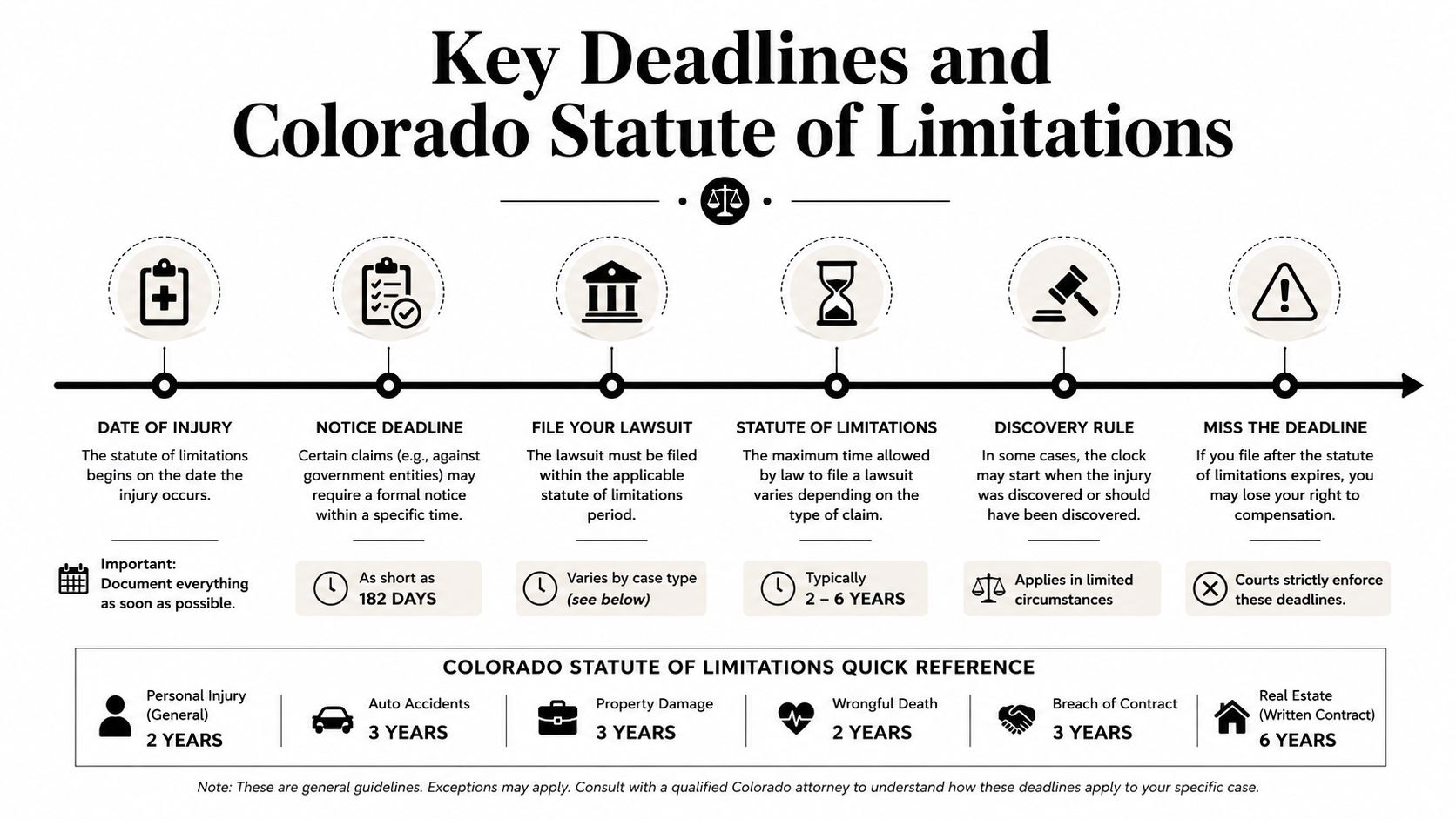
The rule you need to remember
Colorado sets different deadlines depending on the type of claim. For many car accident cases, the filing deadline is three years. Many other personal injury claims are subject to a two-year deadline. You can review the statute itself in the Colorado Revised Statutes, section 13-80-101.
Do not guess which bucket your case falls into. Get that answer early.
That point matters even more in truck-crash and head-injury cases. Trucking claims may involve multiple defendants, including the driver, motor carrier, maintenance contractor, or cargo company. Brain injury claims often take longer to diagnose correctly, and that delay fools people into thinking they have more time than they do. They do not.
What actually causes people to miss the deadline
Insurance negotiations do not extend the statute of limitations. Ongoing treatment does not extend it either. Waiting for a neurologist, hoping symptoms clear up, or assuming the trucking insurer will "work with you" are all ways claims get undercut or lost.
The hidden problem is not just late filing. It is late preparation.
In a trucking case, electronic logging data, onboard systems, dispatch records, and maintenance documents need attention early. In a mild traumatic brain injury case, the legal deadline may still look distant, but the medical proof gets weaker if no one is tying headaches, memory problems, slowed processing, and work restrictions together in a clear record. By the time a lawsuit is finally discussed, the defense is already arguing that the symptoms came from stress, a prior condition, or a gap in care.
Practical deadline habits
Use a basic system and do it now:
- Write down the crash date and injury date in your phone, calendar, and email.
- Set reminders at 6 months, 12 months, and 18 months after the incident.
- Ask a lawyer to confirm the exact filing deadline instead of assuming every injury case gets three years.
- Act faster if a commercial truck was involved because company records and electronic evidence can disappear.
- Act faster if you have concussion or brain-injury symptoms because underdocumented cognitive harm is routinely discounted.
Do not wait until treatment is finished to get legal advice. If your diagnosis is still developing, that is usually the reason to speak with counsel sooner. Early legal work protects the case while the medicine catches up.
What to Expect During Investigation Negotiation and Trial
Most personal injury cases don't go to trial. That doesn't mean trial readiness is optional. It's often the pressure point that makes a fair settlement possible.
In Colorado, approximately 94% of personal injury cases settle out of court through attorney-led negotiations, according to this Westminster personal injury overview discussing settlement practice.

The claim usually moves in four phases
-
Investigation
Police reports, witness statements, insurance information, crash photos, and in truck cases, company records and electronic data. -
Medical coordination
Consistent treatment records matter. Gaps in care become defense arguments. -
Demand preparation
Your lawyer packages liability, medical proof, lost income, and quality-of-life harm into a settlement demand. -
Negotiation or mediation
The insurer tests your proof. Your lawyer pushes back with records, expert support where needed, and a willingness to litigate.
When settlement is a bad idea
Not every offer is a good offer. Be careful when:
- You still don't understand your diagnosis
- Your symptoms keep evolving
- The insurer dismisses cognitive problems as stress
- A trucking company has not produced critical records
- Future treatment needs remain unclear
Settle when the evidence is mature enough to value the case honestly. Not when the adjuster gets impatient.
Trial becomes more likely when liability is disputed, medical causation is attacked, or the defense refuses to value long-term harm seriously. Even then, the work that drives results usually happens well before the courtroom. Good investigation and disciplined medical proof move the number.
Next Steps and When to Call Nares Law Group
In the next two days, do four things. Get evaluated. Save every record and photo. Stop talking casually with the insurer. Speak with a lawyer if your case involves a truck, a head injury, disputed fault, or symptoms that keep changing.
That's not overreacting. That's protecting the value of your claim before somebody else defines it for you.
If your case may require out-of-state experts, co-counsel support, or a tighter medical-legal strategy around TBI or trucking evidence, get that conversation started early.
If you need direct guidance after a Westminster crash, Nares Law Group LLC offers free consultations for injury cases involving motor vehicle collisions, truck wrecks, traumatic brain injuries, and wrongful death. If you're dealing with delayed symptoms, confusing insurance pressure, or missing evidence, contact the firm promptly so your next steps are based on proof, not guesswork.