The first minutes after a motorcycle crash rarely feel organized. You may be sitting on the shoulder near Powers, trying to catch your breath, checking whether you can move your leg, listening to traffic, and wondering whether the pain in your back is serious or just shock. Your bike may be down. Your phone may be buzzing. The other driver may already be talking to their insurer.
That confusion matters because insurers and defense lawyers start building their version of events immediately. Riders often don't.
When considering motorcycle accident attorneys in Colorado Springs, you may not even be ready to hire one yet. That's fine. The most important job right now is protecting your health and preserving the facts before they disappear. In motorcycle cases, small details decide big disputes. A lane position, a scrape mark, a witness who leaves too soon, a helmet that gets thrown away, a delayed urgent care visit. Those details can change how fault is assigned and how your injuries are valued.
Colorado Springs saw 289 motorcycle crashes in 2025, with nearly half occurring between 2 PM and 7 PM, and 3 PM identified as the most dangerous hour for riders, according to Colorado Springs motorcycle crash data summarized from CSPD. Those numbers reflect what injured riders already know. These crashes happen fast, often in ordinary daytime traffic, and the aftermath gets messy just as quickly.
Your Guide Through the Aftermath of a Motorcycle Crash
If you were hit today, or if you were forced off the road and never made contact with the other vehicle, you're probably dealing with two problems at once. First, you need medical help and stability. Second, you need to make sure the record of what happened doesn't get distorted before you've had a chance to think clearly.
That second problem is where many claims go sideways.
Motorcycle cases aren't treated like ordinary fender-benders. Riders often face unfair assumptions about speed, risk, and fault. Insurers know that. They look for delays, gaps, and casual statements they can use later. A simple comment like "I'm okay" at the scene can become part of an argument that you weren't seriously hurt. A missing photo of a lane merge can become part of an argument that no one else caused the wreck.
Practical rule: Start treating the crash scene and the next two days as evidence collection, not just cleanup.
The good news is that you can do a lot before any attorney is hired.
What matters first
Focus on a short chain of priorities:
- Get safe and get evaluated. Your body comes first.
- Create a clean factual record. Photos, witnesses, and police involvement matter.
- Avoid helping the insurer minimize your claim. Don't guess. Don't speculate. Don't volunteer blame.
- Preserve everything. Your gear, bike, phone photos, and medical paperwork all have value.
If there was no contact
A no-contact motorcycle crash can still be a valid injury claim. If a driver changed lanes, drifted into your path, turned left in front of you, or crowded you until you laid the bike down, the lack of impact doesn't automatically defeat liability. It does mean proof becomes more important, and it usually has to be gathered early.
That's why the steps below aren't legal theater. They're practical protection.
Critical Actions to Take at the Crash Scene
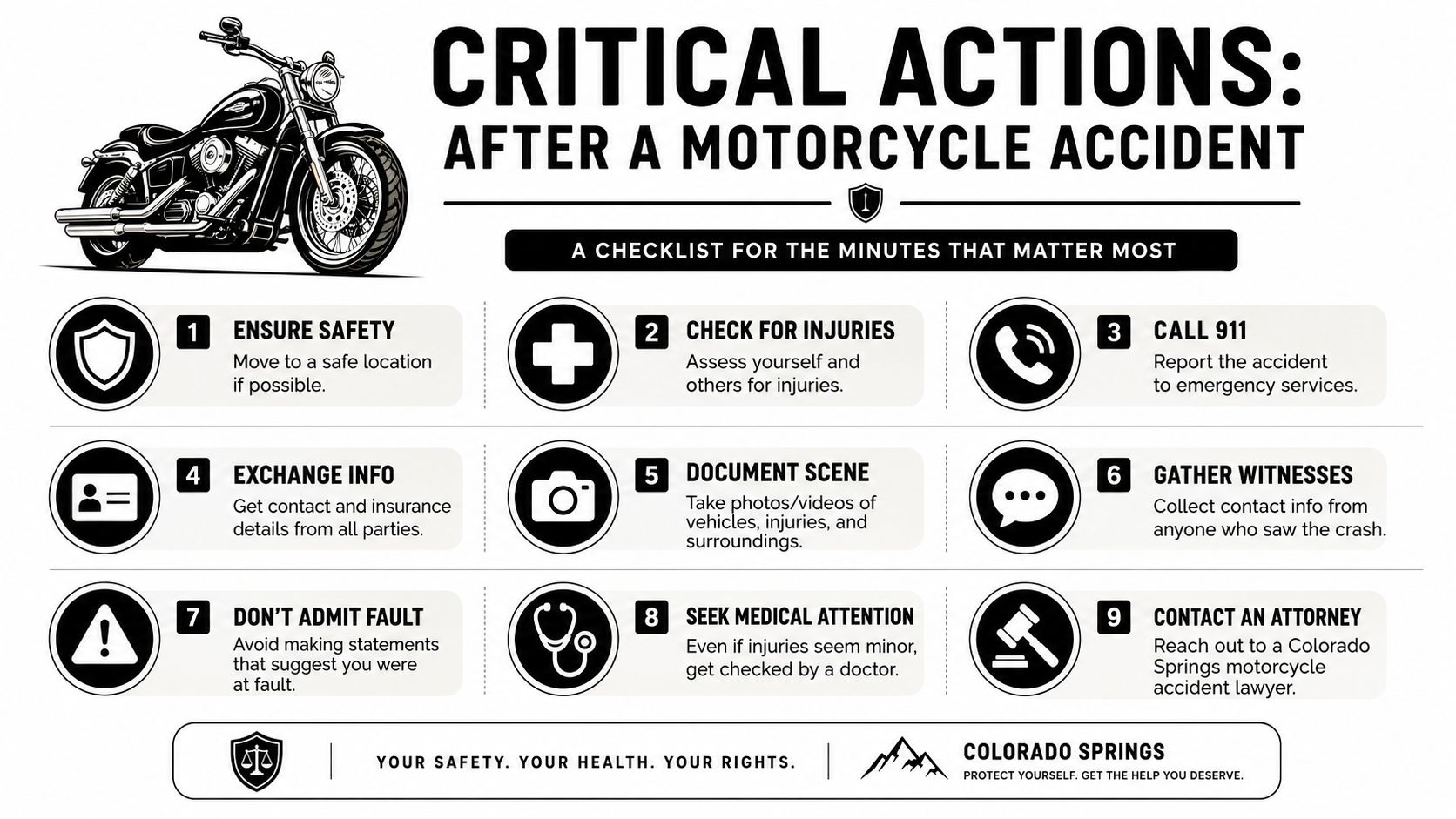
At the scene, keep it simple. You don't need a speech. You need a checklist.
Start with safety and emergency response
Move only if you can do so safely. If you're in active traffic and able to get out of danger, do it. If you suspect a head, neck, or back injury, stay still and wait for responders.
Call 911. Ask for police and medical help. Even if you think you'll "shake it off," a documented response helps establish that the event happened, where it happened, and who was involved.
Accept medical evaluation. Motorcycle crashes produce injuries that don't always announce themselves immediately. Pain can build after the adrenaline drops.
Build the first layer of proof
Once emergency needs are handled, gather what you can without arguing with anyone.
- Driver information: Name, phone, address, insurance, plate number, and vehicle description.
- Witness information: Names and direct phone numbers from anyone who saw the collision or the driving behavior right before it.
- Scene photos: Wide shots first, then close-ups.
- Road evidence: Skid marks, debris, gouges, fluid, broken parts, traffic lights, signs, lane markings, and anything blocking visibility.
- Your condition: Visible injuries, torn clothing, damaged helmet, boots, gloves, and jacket.
If you're physically limited, ask a bystander or responding officer whether someone can help you document the scene. Individuals are generally willing to help if asked directly.
Don't worry about taking perfect photos. Worry about capturing what disappears first.
What to photograph before the tow truck arrives
A quick sequence works best:
| What to capture | Why it matters |
|---|---|
| All vehicles in position | Shows angles, lane placement, and impact points |
| The motorcycle from all sides | Preserves damage before storage or repair |
| The road approach | Helps show sight lines and merge patterns |
| Traffic control devices | Confirms lights, signs, and turn restrictions |
| Your helmet and gear | Documents force and damage tied to the crash |
What not to say
This part matters as much as the photos.
- Don't apologize: People say "sorry" reflexively. Insurers may frame it as an admission.
- Don't guess about speed or distance: If you don't know, say you don't know.
- Don't debate fault: The roadside isn't the place to persuade anyone.
- Don't downplay injuries: "I'm fine" is often just shock talking.
If you want a broader accident checklist that overlaps with many of these immediate steps, this guide on what to do after a crash is a useful companion.
Protecting Your Claim in the Days That Follow
The crash scene is only the start. The next two days often decide whether your claim looks organized and credible, or scattered and easy to attack.
Insurance adjusters know many accident victims go home, rest, and assume the details will still be there later. Often they won't. Bruising changes. road debris gets cleared. surveillance footage gets overwritten. Witnesses stop answering unknown numbers. Riders also make a common mistake in this window. They try to be cooperative with the other driver's insurer before they understand their injuries.
Get medical care quickly and follow through
If you haven't had a full evaluation, get one. That means emergency care, urgent care, your primary doctor, or a specialist referral, depending on symptoms. What matters is that a medical professional examines you and creates a record.
According to Colorado motorcycle claim guidance on delayed medical reporting, success rates drop from 94% to 61% when clients delay medical reporting beyond 48 hours, and insurers use delayed reporting in 58% of denied claims to argue the injury wasn't accident-related. You don't need to memorize those figures to understand the lesson. Delay gives the insurer room to argue.
Preserve the evidence people usually lose
Most riders save the bike and forget the rest. That's a mistake.
Keep these items exactly as they are if possible:
- Helmet and visor: Don't clean or toss them.
- Jacket, gloves, pants, and boots: Tears and abrasion patterns can support how you landed and where force was applied.
- Bike-mounted devices: GoPro, phone mount, GPS unit, Bluetooth comms.
- Photos and videos: Back them up somewhere other than your phone.
- Receipts and discharge papers: Start one folder and keep everything in it.
Be careful with insurance calls
The other driver's insurer may sound helpful. That's not the same as being on your side.
You can report basic facts. You don't need to give a recorded statement before you understand your medical condition, your time away from work, or the evidence issues in the case. If an adjuster asks for speculation, broad medical authorizations, or a rushed settlement conversation, slow it down.
The safest answer to a loaded question is often, "I'm still being evaluated, and I don't want to guess."
No-contact crashes need fast proof
These are some of the hardest motorcycle cases and some of the most misunderstood. A driver doesn't have to hit you to cause your wreck. If you swerved to avoid a sudden lane change, got run off the road by a wide turn, or laid the bike down to avoid a car cutting across your path, liability may still exist.
The challenge is proof. Start looking for:
- Nearby cameras: gas stations, storefronts, home doorbell cameras, traffic-facing business systems.
- Witnesses who saw the move, not just the aftermath
- Your route data: phone location history or bike-mounted footage
- Damage patterns and roadway marks: they can support an evasive maneuver, even without vehicle contact
No-contact cases often fail because the rider assumes the absence of impact means there's no claim. That's wrong. What it usually means is that you need better documentation, sooner.
Navigating Key Colorado Motorcycle Accident Laws
Colorado law doesn't reward sympathy alone. It rewards proof, timing, and a clear argument about fault. Two rules matter early in almost every case: comparative fault and filing deadlines.
Colorado riders also face a practical reality. The consequences are significant because these collisions are often severe. In Colorado, motorcycles make up only 3% of vehicle registrations but account for 20% of traffic fatalities, and in 2022, 75 of 148 motorcycle fatalities involved riders not wearing helmets, according to Colorado motorcycle fatality data discussed here. That doesn't decide your case, but it does show why insurers and juries often view motorcycle wrecks through the lens of serious harm and disputed blame.
Modified comparative fault in plain English
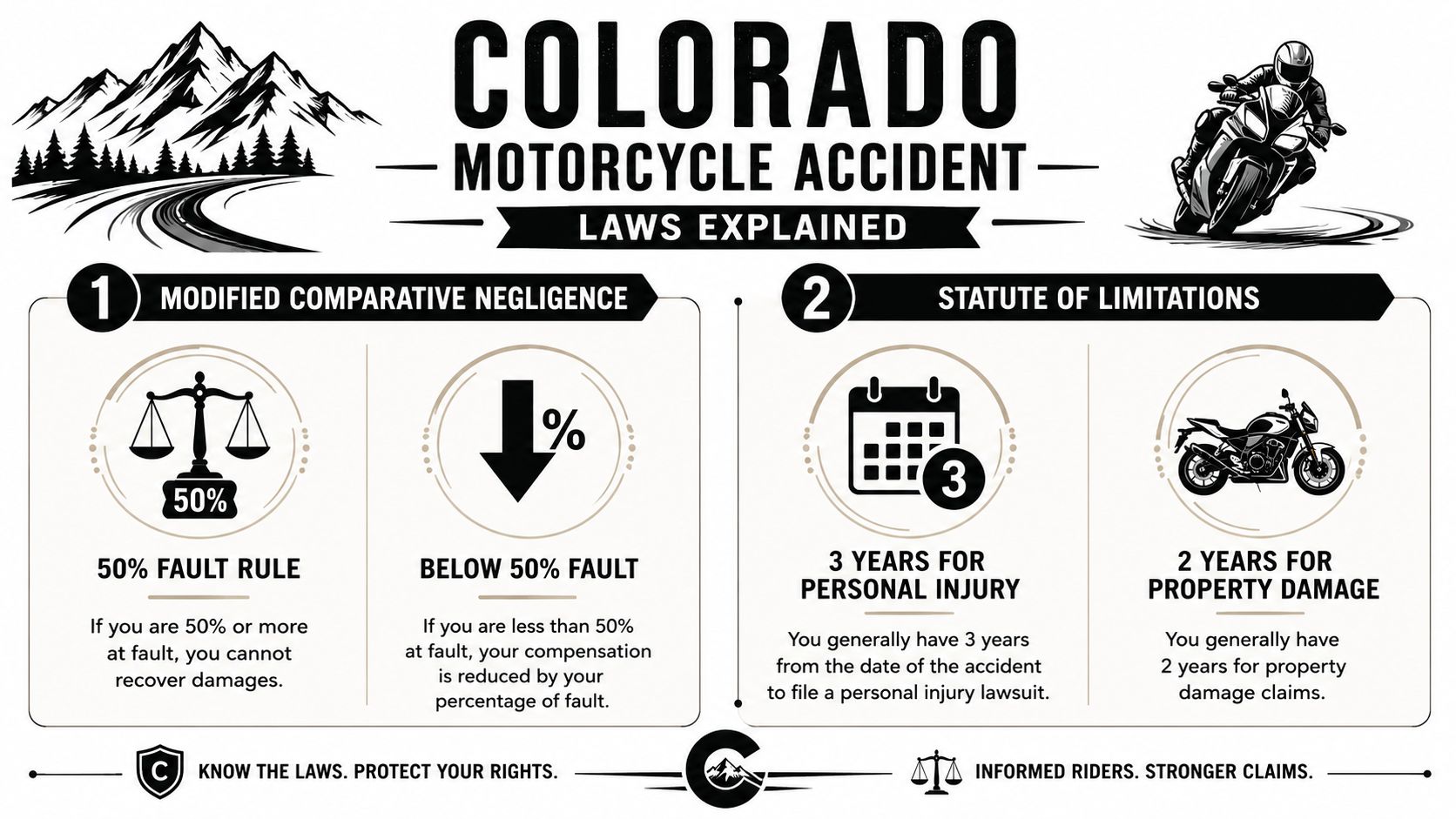
Colorado uses modified comparative fault. In practice, that means your compensation can be reduced if you share blame. If you are 50% or more at fault, you cannot recover damages. If you are below that threshold, recovery is reduced by your percentage of fault.
Here is the trade-off. Defense lawyers don't need to prove you caused everything. They only need enough facts to increase your share of blame. That's why scene photos, witness statements, bike damage, and roadway evidence matter so much in motorcycle cases. They help push back against vague claims that the rider was "coming in too fast" or "must have been lane splitting" or "was hard to see."
For a broader overview focused on riders, this resource on motorcycle accidents in Colorado is worth reviewing.
The filing deadline is not flexible
Colorado generally gives you 3 years from the date of a motor vehicle accident to file a personal injury lawsuit and 2 years for property damage claims. That sounds like a long time until medical treatment stretches on, witnesses disappear, and the insurer keeps asking for more records while the clock keeps running.
Waiting also creates a practical problem. Even when the legal deadline is still open, stale evidence weakens your position.
This video gives a short overview of how these rules affect crash claims in Colorado:
Property damage isn't just repair cost
Motorcycle cases often involve more than medical losses. If your bike is repaired but worth less afterward, that reduced market value may matter too. Riders who want to understand how car value loss in Colorado works can use that framework as a starting point when thinking about post-repair value issues. The principles are often useful in vehicle damage discussions, even though motorcycle valuations can involve their own appraisal questions.
How to Choose the Right Attorney for Your Case
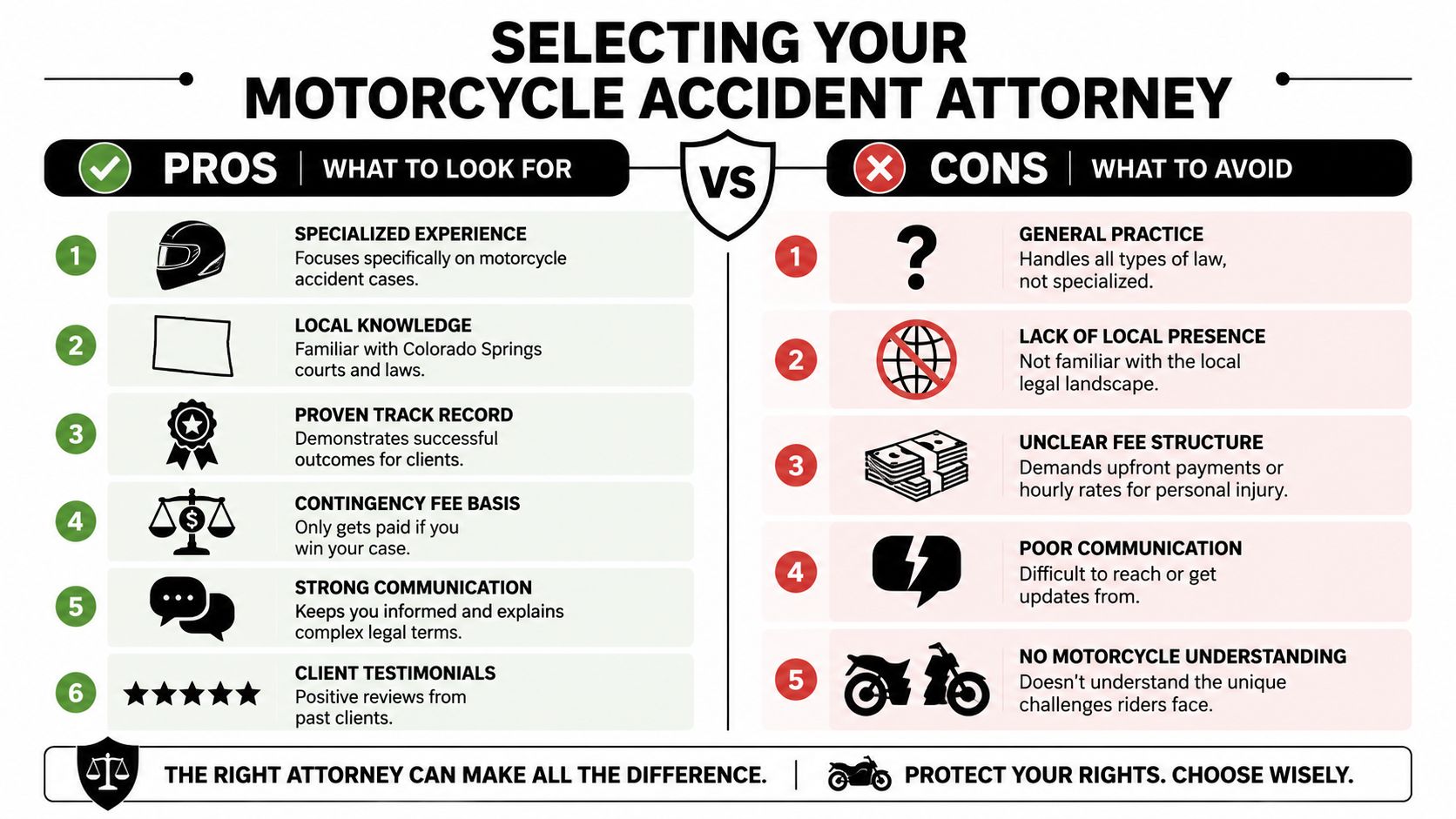
Not every personal injury lawyer is the right fit for a rider's case. Motorcycle claims have their own liability themes, their own insurance biases, and their own evidence problems. If a lawyer treats your case like a routine rear-end collision, that's a warning sign.
The best hiring decision usually comes from asking sharper questions, not from listening to the longest ad.
Questions worth asking in the consultation
Use the consultation to learn how the lawyer thinks.
- How do you handle motorcycle-specific bias? You want to hear a concrete answer about blame shifting, rider stereotypes, and how evidence is used to counter them.
- Who will work on my file? Some firms sign the case and hand it off almost immediately.
- How do you approach early investigation? This matters more than a polished intake process.
- Are you prepared to litigate if the insurer won't pay fairly? Settlement talk is easy. Trial readiness is different.
- How do you keep clients updated? You shouldn't have to chase your own lawyer for basic information.
If you want a useful baseline before those meetings, this guide on how to find a good personal injury lawyer gives a practical framework.
Early investigation separates strong counsel from reactive counsel
One of the clearest signs of serious representation is what happens in the first days. According to guidance on early motorcycle crash reconstruction, top attorneys secure accident reconstruction experts within 72 hours, and delaying beyond 14 days can reduce success rates by 42% because evidence degrades. That timing is a major factor in larger settlements, including those exceeding $150,000.
That doesn't mean every case needs a reconstructionist. It does mean your attorney should know when a scene inspection, download, photography review, or expert consultation can't wait.
A good lawyer doesn't just react to the police report. They test it against the physical evidence.
Red flags that should make you pause
Some warning signs are easy to miss when you're injured and overwhelmed.
| Red flag | Why it matters |
|---|---|
| They speak vaguely about motorcycle cases | You may be getting generic personal injury handling |
| They push settlement before records are complete | Early money can mean undervaluing future losses |
| They can't explain fees clearly | Confusion now often becomes conflict later |
| They promise a result | Serious lawyers don't guarantee outcomes |
| They don't ask detailed facts about the scene | That suggests weak liability development |
Fee structure and alignment
Most motorcycle injury attorneys work on a contingency fee, which usually means the fee is paid from the recovery rather than upfront by the client. That's often the right structure for injured riders because it aligns the lawyer's financial interest with the outcome of the case.
But don't stop at "no fee unless we win." Ask what litigation expenses are handled, when they are reimbursed, and what happens if the case doesn't settle and has to be filed.
Understanding the Full Value of Your Compensation
A motorcycle claim is never just about the ER bill. That's the number insurers like to start with because it's concrete and limited. Your actual losses are usually broader and more personal than that.
A proper case valuation has to account for what the crash changed, not just what the hospital charged on day one.
Economic damages you can document
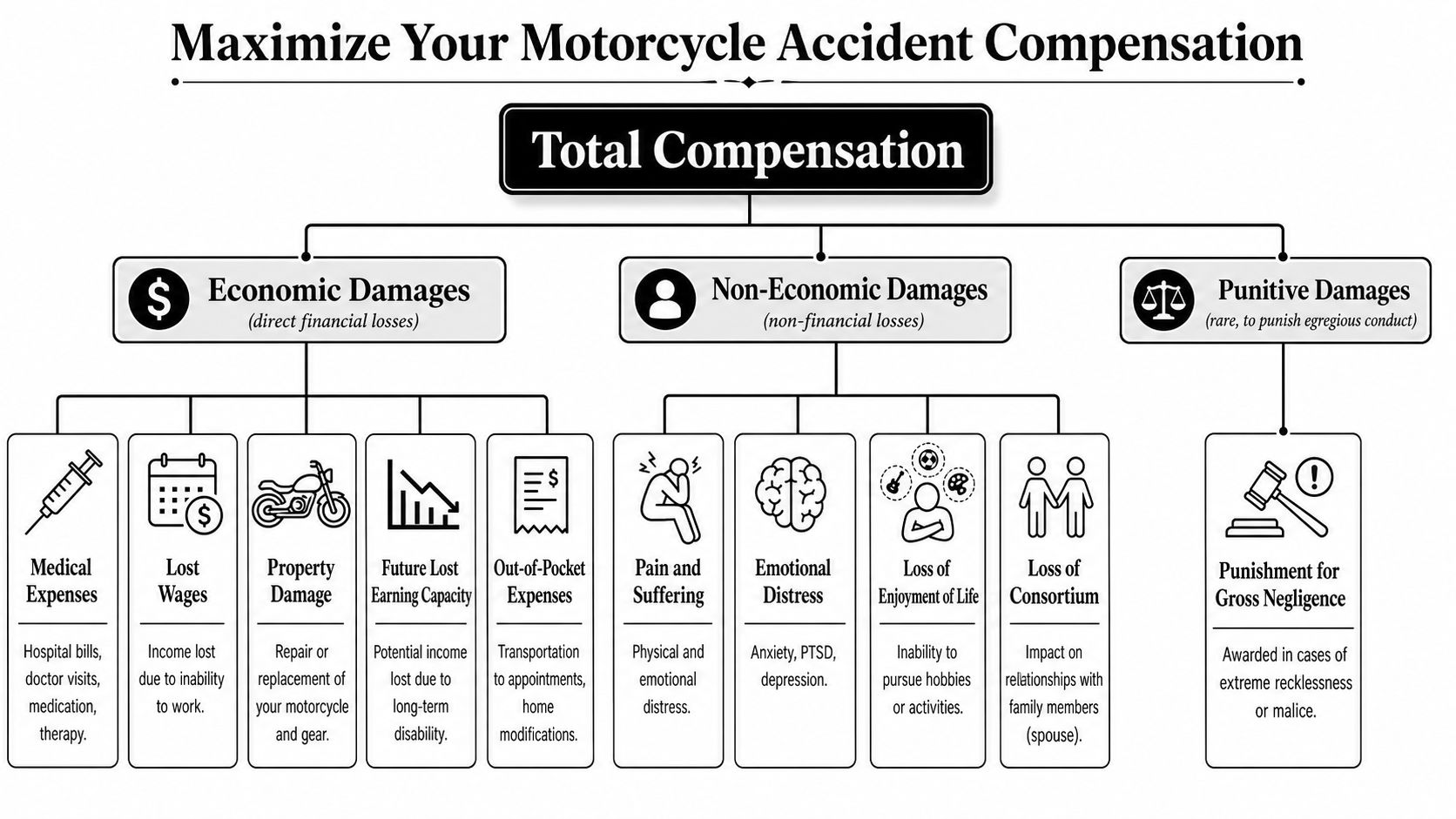
These are the direct financial losses tied to the crash. They often include medical bills, follow-up care, medication, therapy, lost pay, and damage to the motorcycle and riding gear.
Some losses are obvious immediately. Others develop later. A rider may return to work but lose overtime, miss a promotion path, or need future treatment long after the insurer first asks to settle. Good valuation takes those downstream effects seriously.
Property damage should also be viewed broadly. That can include the bike, helmet, electronics, luggage, and other damaged equipment. If your vehicle was repaired and you're trying to understand the concept of claiming diminished value after an accident, that resource gives a practical overview of why a repaired vehicle may still be worth less in the market.
Non-economic damages are real, even though they don't come with receipts
Pain and suffering isn't a throwaway phrase. In serious motorcycle crashes, it often reflects the hardest part of the case to explain and the most important part of the client's daily life.
That can include:
- Physical pain: ongoing discomfort, limited movement, disrupted sleep
- Emotional distress: anxiety, fear in traffic, depression, traumatic stress
- Loss of enjoyment: giving up riding, sports, travel, parenting activities, or ordinary independence
- Relationship impact: strain on a spouse or family because your role changed
Why early settlements often undervalue the case
Insurers prefer to talk numbers before the picture is complete. That's not accidental. A claim often looks cheapest before specialists weigh in, before physical therapy stalls, before work restrictions become clear, and before you understand how long recovery will really take.
If you settle while you're still discovering the full extent of your injuries, you usually absorb that uncertainty yourself.
A practical way to think about value
Ask whether the proposed resolution covers the full impact of the crash in three directions:
- What has already cost you
- What the injury is still costing you
- What it will likely cost you going forward
That approach keeps the case grounded. It also helps avoid a common mistake in motorcycle claims, which is treating a life disruption like a stack of bills instead of a long-term change in function and independence.
If you need help after a motorcycle crash, Nares Law Group LLC offers free consultations for injured riders and families in Colorado. A good legal team can step in early, preserve evidence, handle insurer communication, and help you understand what your case may involve before you make decisions that can't be undone.