You may be reading this from a hospital room, your kitchen table, or your phone in the middle of the night after another call from an insurance adjuster. The crash happened fast. The aftermath doesn't. Bills arrive. Work gets interrupted. Your family wants answers. One of the first questions almost everyone asks is simple: what is the average truck accident settlement?
It sounds like the right question. Usually, it isn't.
A truck collision claim isn't priced like a used car. It's built from the facts of your injury, the evidence of fault, the available insurance, and the long-term effect on your life. For people in Colorado, that means understanding both the numbers people throw around online and the legal realities that shape a claim here.
The Problem with the Average Settlement Number
A lot of people start the same way. They type "average truck accident settlement" into a search bar, hoping one number will tell them whether the insurance company is being fair. That search feels practical. It also creates confusion almost immediately.
One published figure says the national average truck accident settlement is about $103,654, while the median is $30,000 according to truck accident settlement data discussed here. Those are very different numbers. That gap matters more than the average itself.
Average and median are not the same thing
Think about ten homes on one street. If nine are ordinary houses and one is a mountain estate worth several million, the average home price jumps sharply. But that doesn't mean most families on that street live in mansions. The median shows the middle result. In injury law, that often gives a more realistic picture of what a typical case looks like.
That is why the average can mislead injured people after a truck crash. A small number of catastrophic cases pull the average upward. Those cases are real, and they matter, but they don't describe every claim.
Practical rule: If you're comparing your case to one number alone, use that number with caution. The median is often the steadier reference point.
If you're trying to sort through the basics, this guide to understanding truck accident settlements offers a useful overview of how these claims are commonly evaluated.
Why this matters right now
Insurance companies know many seek a shortcut. They also know an injured person may not yet understand future care needs, wage loss, or how legal deductions can affect the final amount. Even a seemingly strong settlement number can feel very different once medical reimbursement issues come into play. If that part is unfamiliar, it helps to learn how a medical lien on settlement can affect what someone ultimately receives.
The better question isn't "What's the average?" It's "What facts increase or decrease the value of my specific case in Colorado?" That question leads to a much clearer answer.
What Really Makes Up a Truck Accident Settlement
A settlement isn't a prize. It's a financial attempt to account for harm.
When lawyers and insurers evaluate a truck crash claim, they usually aren't pulling a random number from the air. They're looking at several categories of loss. Some are easy to see on paper. Others are personal and harder to measure, but no less real.
The core pieces of a settlement

Economic damages
These are the concrete losses. They usually include medical bills, lost income, and property damage. If you needed emergency care, follow-up treatment, prescriptions, imaging, physical therapy, or surgery, those records help show what the crash cost you financially.
Lost wages matter too. Some people miss a week of work. Others can't return to the same job at all. In a serious truck case, the claim may need to account not just for income already lost, but for reduced earning ability going forward.
A vehicle claim also belongs in this category. Repair costs, replacement value, and damage to personal items can all become part of the broader settlement picture.
Non-economic damages
This category is where many clients feel uncertain, because there isn't a receipt for pain.
Non-economic damages address the human cost of an injury. Physical pain. Sleep disruption. Anxiety about driving. Loss of independence. The inability to pick up your child, return to hobbies, or move through a normal day without discomfort. These harms are real even though they don't arrive as monthly invoices.
One reason truck cases often settle differently from ordinary car wrecks is the scale of the harm involved. The insurance structure in commercial trucking can also shape negotiations. For readers who want a plain-language look at liability coverage for Florida trucks, that resource helps show how commercial policies differ from standard personal auto coverage.
Punitive damages are different
Punitive damages are not part of every case. They're generally tied to especially dangerous or reckless conduct. In plain terms, they are aimed less at compensating the victim and more at punishing conduct that goes far beyond ordinary carelessness.
A fatigued driver, falsified records, ignored maintenance issues, or blatant safety violations can change the legal posture of a case. Whether punitive damages are available depends on the facts and the law that applies.
A truck accident settlement usually grows from proof, not emotion alone. Strong cases connect medical evidence, financial loss, and the day-to-day reality of what changed after the crash.
Why the "average" still doesn't tell you much
If you averaged the value of a modest sedan and a luxury motorcoach, the result wouldn't help you price either one accurately. Truck settlements work the same way. The public number may grab attention, but the categories underneath the claim do the real work.
If you want a rough starting point to organize those categories, a truck accident settlement calculator can help you think through medical costs, income loss, and other case inputs. It won't replace a legal review, but it can help you ask smarter questions.
Key Factors That Determine Your Settlement Value
A settlement is built more like a house than pulled from a chart. One case has a strong foundation, clear liability, complete medical records, and enough insurance coverage. Another has serious injuries but weak proof on fault or major gaps in treatment. Those cases do not land in the same place, which is why a national "average" often confuses more than it helps.
For Colorado victims, the better question is not, "What is the average truck accident settlement?" It is, "What facts in my case raise or lower value?" The median can be a more realistic way to think about outcomes because it is less distorted by a handful of very large verdicts or wrongful death settlements. But even that number is only a starting point. Your case value comes from the parts below.
Injury severity sets the ceiling
The seriousness of the injury usually has the biggest effect on value because it touches nearly every category of damages.
A strained neck that improves with conservative care is usually evaluated very differently from a spinal cord injury, traumatic brain injury, crush injury, amputation, or wrongful death claim. More serious harm often means more treatment, longer time away from work, greater pain, and a higher chance that future care will be needed. It also tends to require stronger expert proof, especially if the defense argues that some symptoms were preexisting or should have resolved sooner.
A simple way to picture it is to compare a cracked phone screen with structural damage to a home. Both are damage. Only one changes how you live every day.
| Injury Type | Potential Settlement Range |
|---|---|
| Temporary minor injury with recovery | Lower end of the overall spectrum |
| Injury requiring extended treatment | Moderate range depending on fault and documentation |
| Permanent impairment | High range if future losses are well supported |
| Catastrophic injury or wrongful death | Can move into multi-million-dollar territory when supported by evidence and available coverage |
This table is illustrative, not a promise. The final number depends on the evidence, the law, the available coverage, and how convincing the damages proof is.
Liability affects how much pressure the defense feels
Even a very serious injury claim can lose value if fault is disputed.
Truck cases often involve several possible defendants, not just the driver. Depending on the facts, liability may extend to the motor carrier, a maintenance company, a shipper, a broker, or a loading company. That matters because each layer of responsibility can change both the available insurance and the settlement pressure.
The proof also looks different from an ordinary car crash. A lawyer may examine logbooks, electronic data, inspection records, maintenance files, dispatch communications, training materials, and post-crash testing. If fatigue may have played a role, evidence related to hours-of-service rule violations in truck accident cases can become an important part of showing why the wreck happened.
Clear liability usually increases settlement value because the insurer is pricing risk. If a jury is likely to blame the trucking company, the defense has more reason to pay fairly.
Medical records often decide whether damages feel concrete or speculative
Insurance adjusters and defense lawyers look for a timeline that makes sense from start to finish.
They compare the collision, the first complaints, the diagnosis, the treatment course, and the current limitations. If those pieces line up, the claim is easier to understand and harder to dismiss. If care starts late, stops for long periods, or contains inconsistent reporting, the defense may argue that the injury was minor, unrelated, or already present before the crash.
Good records answer practical questions such as:
- What injury did the crash cause?
- What treatment was reasonable and necessary?
- What symptoms remain today?
- What future care is likely?
That kind of proof matters because settlement value comes from documented loss, not from labels alone. Two people can both be told they have a back injury. The one with imaging, specialist care, work restrictions, and a clear prognosis usually has a stronger damages case than the person with vague complaints and little follow-up.
Lost income and future limitations can change the case significantly
Medical bills are only part of the picture.
Many truck accident victims lose income while recovering. Some cannot return to the same job at all. A delivery worker with a shoulder injury, a nurse with lifting restrictions, or a construction worker with chronic back pain may face losses that continue long after the emergency room bill is paid. In higher-damage cases, economists or vocational experts may be used to show how the injury affects future earning capacity.
This is one reason headline settlement numbers can be misleading. A case with moderate medical bills but permanent work restrictions may be worth more than a case with higher short-term treatment costs and a full recovery.
Insurance coverage places real limits on what can be collected
People often assume value and collectability are the same thing. They are related, but they are not identical.
A case may involve serious harm and strong liability, yet still run into practical limits if the available insurance is lower than the full amount of the loss. On the other hand, commercial trucking claims often involve larger policies than ordinary passenger-car crashes, which can make full compensation more realistic in severe injury cases. The policy structure, the number of defendants, and whether excess or umbrella coverage exists all matter.
If you want a broad comparison of how damages categories are described in another major trucking market, truck accident compensation options in California offers a useful overview. Colorado law is different, but the basic compensation buckets are similar.
The person presenting the case matters too
Settlement value is also shaped by credibility.
That includes the injured person's consistency, the quality of witness testimony, the skill of the treating doctors in explaining limitations, and whether future losses are supported with detail instead of guesswork. Venue can matter as well. Some courts and juries respond differently to corporate safety failures, permanent impairment, and pain-related damages.
A truck settlement is not one number hidden in a database. It is the result of many parts working together. The median may give you a steadier frame of reference than a flashy average, but the actual answer comes from how your facts, records, and legal proof fit together.
Navigating the Claim Process and Timeline
A common Colorado truck-crash scenario goes like this. A person leaves the hospital with follow-up appointments, missed work, and a stack of bills, then hears almost nothing useful from the insurer for weeks. That silence can feel like the claim is being ignored. In many cases, the opposite is true. The company is gathering records, reviewing liability, and protecting its position while the injured person is still trying to get stable medical care.
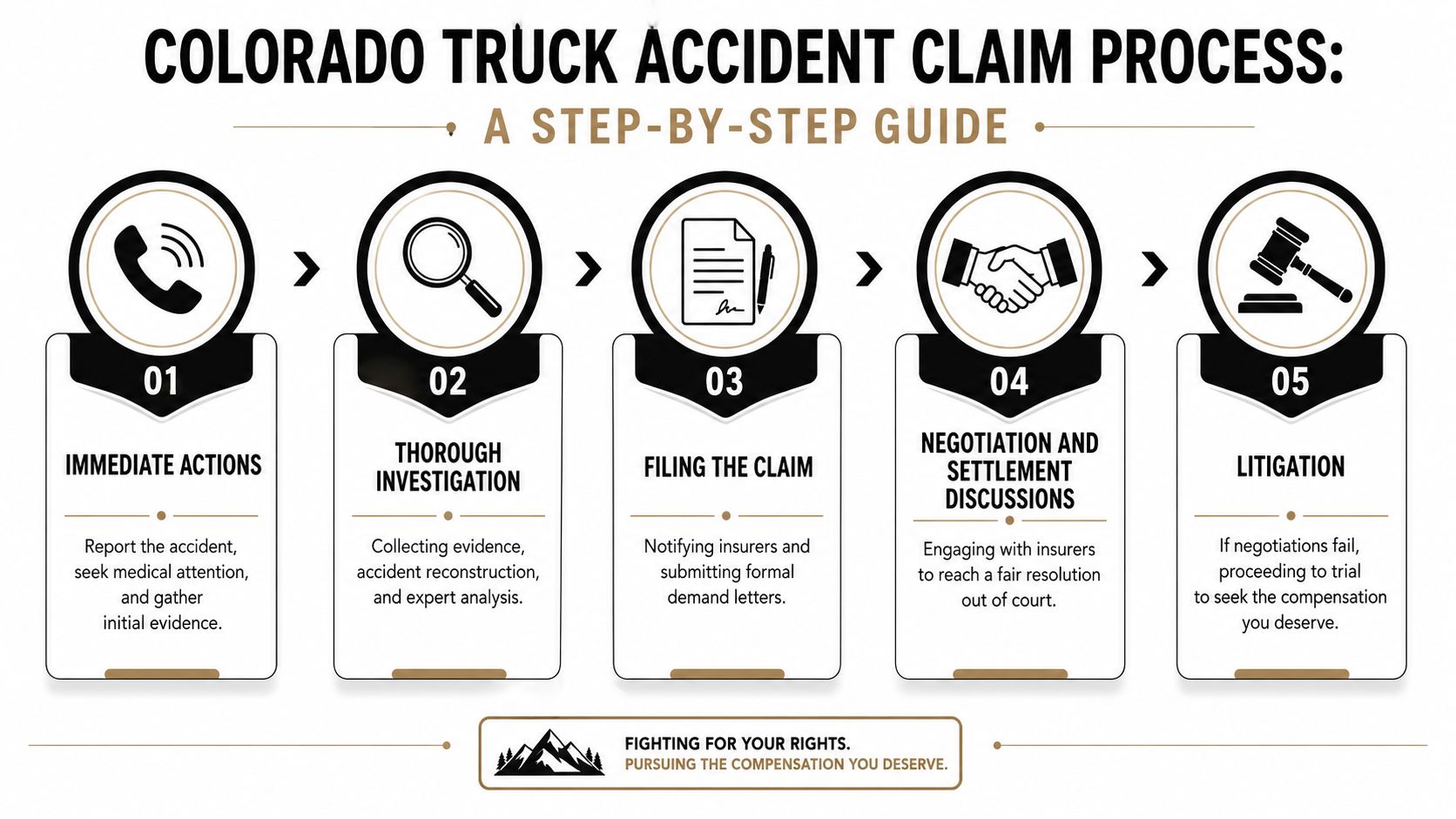
Time matters in a truck case because value usually becomes clearer in stages, not all at once. A settlement works a lot like putting a financial picture together from separate pieces. Early on, you may know the ambulance bill and the emergency-room diagnosis. Later, you learn whether the injury heals, turns into chronic pain, limits work, or requires surgery. If the case settles before those pieces are visible, the number may reflect an incomplete picture.
The first stretch after the crash
The opening phase is usually about protection and documentation.
- Get medical care quickly: Treatment protects your health and creates records that connect the injuries to the collision.
- Make sure the crash is reported: A police report or other formal report helps fix basic facts in time and place.
- Save what you already have: Photos, witness names, discharge instructions, tow records, and insurer messages can all matter later.
Then the case shifts into evidence collection. Truck claims often require records that do not exist in an ordinary car wreck, such as driver logs, dispatch communications, maintenance files, onboard data, inspection history, and training records. That is one reason the process can feel uneven. The trucking company often starts with control over much of the evidence.
Why the timeline is often longer than people expect
Serious truck claims rarely move in a straight line. They usually slow down at predictable points.
One delay comes from the medical side. Doctors may need time to see whether symptoms resolve or become permanent. Another delay comes from the defense side. Commercial carriers and their insurers often route major claims through several layers of review before anyone has authority to make a meaningful offer. In plain terms, settling a truck case can resemble getting a large repair approved by a company instead of paying a small bill out of pocket.
There is also a strategic reason to be careful. An early offer can sound reassuring when money is tight, but it may arrive before future treatment, work restrictions, or long-term pain are understood.
Colorado rules can change the clock
Colorado law adds deadlines and pressure points that injured people should know about early.
The filing deadline depends on the type of claim. Cases involving a public entity can trigger special notice requirements on a much shorter timetable. Fault allocation matters too. If the defense claims you share responsibility for the crash, that can reduce what you recover, and in some situations it can block recovery under Colorado's comparative fault rules.
Those rules affect timing and case preparation. They are not paperwork details.
The trucking company often begins its internal review immediately after the wreck. You should assume records, statements, and defense planning begin long before settlement talks become serious.
What the process usually looks like
Although every case has its own pace, the path often looks like this:
- Early investigation: records are requested, witnesses are contacted, and key evidence is identified and preserved.
- Medical development: treatment continues until doctors can say more confidently what the injuries mean in the short and long term.
- Demand preparation: the claim is organized into a package that explains liability, damages, and supporting proof.
- Negotiation: the parties test whether the case can be resolved without filing suit.
- Litigation, if needed: a lawsuit may be filed if fault is disputed, the damages are undervalued, or the insurer will not negotiate fairly.
Some cases settle before a lawsuit. Some do not. The main point is that delay by itself does not tell you whether the eventual result will be fair or unfair. In truck litigation, the more useful question is whether the claim is developing enough evidence to support a number that reflects the actual loss, not just a rushed average.
Why a Specialized Trucking Attorney Is Essential
Truck cases aren't just bigger car wrecks. They involve a commercial defendant, layered insurance, business records, federal safety rules, and often a defense team that begins working the case right away.

A general personal injury practice may handle auto claims well and still miss what makes trucking litigation different. In these cases, details matter. Was the driver properly trained? Were logs accurate? Was the truck inspected as required? Did the company preserve electronic evidence? Was the load secured correctly? Those questions don't usually show up in an ordinary two-car crash.
What specialized counsel actually does
A trucking attorney should know where the evidence lives and how fast it can disappear.
That work often includes:
- Sending preservation demands: So key records and electronic data aren't lost.
- Reviewing compliance issues: Hours, maintenance, training, and supervision often matter.
- Finding all responsible parties: Liability may extend beyond the driver alone.
- Building damages carefully: Medical proof, work loss, and daily life impact all need support.
A specialist also understands negotiation posture. In a modest auto case, an adjuster may be focused on closing quickly. In a significant truck case, the carrier may defend aggressively because the exposure is much larger and the claim can affect multiple corporate actors.
Trial readiness changes negotiation
Insurers can tell the difference between a lawyer who prepares a file and a lawyer who prepares a case for trial.
That doesn't mean every case should go to court. Most don't. It does mean the defense values risk differently when they know opposing counsel can handle experts, complex records, depositions, and a jury presentation if needed.
This is also where practical tools can help clients get oriented early. One example is the truck claim estimator offered by Nares Law Group LLC, which gives users a quick way to organize key damages inputs before a formal legal review.
For a brief overview from the firm's team, this video adds context to how these cases are approached in practice.
Colorado clients benefit from local and trucking-specific judgment
A lawyer can know personal injury law and still be unfamiliar with the rhythm of a commercial trucking case in Colorado. Local filing practices, local insurers, local defense firms, and local jury expectations all matter. So does the ability to coordinate medical records and keep a client informed while the case moves through a long process.
If you're dealing with a life-changing truck crash, you don't need a lawyer who is learning trucking law on your case.
Your Next Steps with Nares Law Group
After a truck crash, individuals don't need more noise. They need a short list.
Start with your health. Keep your appointments. Save paperwork. Avoid guessing when an adjuster asks for a recorded statement. Don't assume an early number reflects the full value of the claim, especially if treatment is still unfolding.

A practical checklist
- Keep a file: Put bills, discharge instructions, repair estimates, wage loss information, and insurer letters in one place.
- Write down symptoms: Pain levels, sleep problems, missed activities, and work limits help show how the injury affects daily life.
- Be careful with settlements: Once you sign a release, you usually can't reopen the claim later.
- Get legal guidance early: Not because every case must be filed immediately, but because evidence and strategy matter from the beginning.
What a consultation should give you
A good consultation should leave you with more clarity than you had before the call. You should come away understanding what facts matter, what documents to gather, what deadlines may apply, and what problems need attention first.
You should also be able to ask direct questions:
- Is fault disputed?
- Are there signs of a commercial safety violation?
- What records should be preserved now?
- Is the offer on the table premature?
- What damages may be missing from the insurer's evaluation?
A fair settlement usually comes from preparation, not pressure. If you're in Colorado and trying to regain control after a truck crash, speaking with counsel can help you replace guesswork with a plan.
Frequently Asked Questions About Truck Settlements
How long does a truck accident settlement take
It depends on injury severity, fault disputes, the amount of evidence that must be gathered, and how the trucking company handles review. A case with straightforward liability and completed treatment may resolve faster than one involving permanent injury, future care questions, or multiple defendants.
Will I have to go to court
Not always. Many truck claims settle without trial. But a case often settles better when the other side believes your lawyer is ready to litigate if necessary. Trial readiness and actual trial are not the same thing.
Why are truck cases more complicated than car accident cases
They often involve business records, commercial insurance, company safety policies, federal regulations, and more than one potentially responsible party. There is usually more evidence to gather and more resistance when the claim is serious.
Should I accept the insurance company's first offer
Usually, you should be cautious. Early offers may come before your medical condition is fully understood. If future treatment, permanent limitations, or lost earning ability are still unclear, settling too soon can leave important damages unpaid.
What if I was partly at fault
That issue needs careful legal review under Colorado law. The defense may raise speed, following distance, distraction, lane position, or other arguments to reduce value. Partial fault doesn't automatically end every case, but it can have a major effect on outcome.
How are attorney fees usually paid
In personal injury matters, attorneys commonly work on a contingency basis, which means the fee is typically tied to the result rather than billed hourly up front. The exact terms depend on the fee agreement, and you should always ask for a clear explanation of fees, costs, and how medical claims or liens may affect the final distribution.
What should I bring to a consultation
Bring whatever you have. That may include the crash report, photos, insurance letters, medical records, discharge instructions, repair estimates, wage information, and notes about what happened. A complete file helps, but don't wait to get guidance just because your paperwork isn't perfect.
If you or someone you love is dealing with the aftermath of a serious truck crash, Nares Law Group LLC offers a place to get clear answers about your situation. A consultation can help you understand what may be driving the value of your case, what steps to take next, and how to protect your rights while the claim is still developing.