A truck crash turns life upside down fast. One moment you're driving home, thinking about dinner or the kids or your next appointment. Then there's twisted metal, an ambulance, calls from insurance adjusters, and a question you can't stop replaying: how did this happen?
In many serious truck wrecks, the answer isn't obvious from the crash scene. You can see skid marks, broken glass, and the damaged vehicles. You can't see the driver's exhaustion. You can't see the pressure from dispatch. You can't see the electronic log edit made hours earlier. That's where an hours of service violation often enters the picture.
For injured families, this topic can sound technical and distant. It isn't. These rules exist for one reason: to keep dangerously tired commercial drivers off the road. When a driver or trucking company breaks them, that violation can become a powerful part of a personal injury or wrongful death case. The key is knowing how to connect the rule on paper to the actual harm your family suffered.
The Unseen Factor in Devastating Truck Wrecks
After a major truck collision, initial attention often goes to what is immediately identifiable. Was the truck speeding? Did the driver drift into another lane? Did traffic suddenly stop? Those questions matter, but they don't always get to the root cause.
A tired truck driver can look a lot like a distracted or careless one. Fatigue slows reaction time, dulls judgment, and makes simple driving decisions harder. A driver who should have braked may hesitate. A driver who should have stayed in the lane may drift. A driver who should have stopped for the day may keep going because the schedule, load, or company pressure pushed them past safe limits.
That is why hours of service rules matter so much. They are the federal safety limits that tell commercial drivers when they must stop driving and rest. When those limits are ignored, the danger isn't abstract. It shows up in rear-end crashes, lane departure wrecks, rollover events, and intersection collisions that families remember for the rest of their lives.
A truck crash case often turns on invisible evidence. The driver's fatigue may not appear in the police photo, but it may be written all over the records.
Families also run into another problem. They assume the logbook will tell the truth. Sometimes it does. Sometimes it doesn't. A paper log can be false. An electronic log can be edited. A company can say the driver was compliant while other records tell a different story.
That gap between what the log says and what really happened is where legal investigation becomes critical. If your family is dealing with injuries, lost income, or the death of a loved one, understanding that hidden layer can change how you see the entire case.
Understanding Federal Hours of Service Rules
The easiest way to understand these rules is to think of a truck driver's alertness like a safety battery. Driving, loading, waiting, and working drain that battery. Real rest recharges it. The Federal Motor Carrier Safety Administration, or FMCSA, sets the rules that are supposed to keep a driver from operating a huge commercial vehicle after that battery is too low to do the job safely.
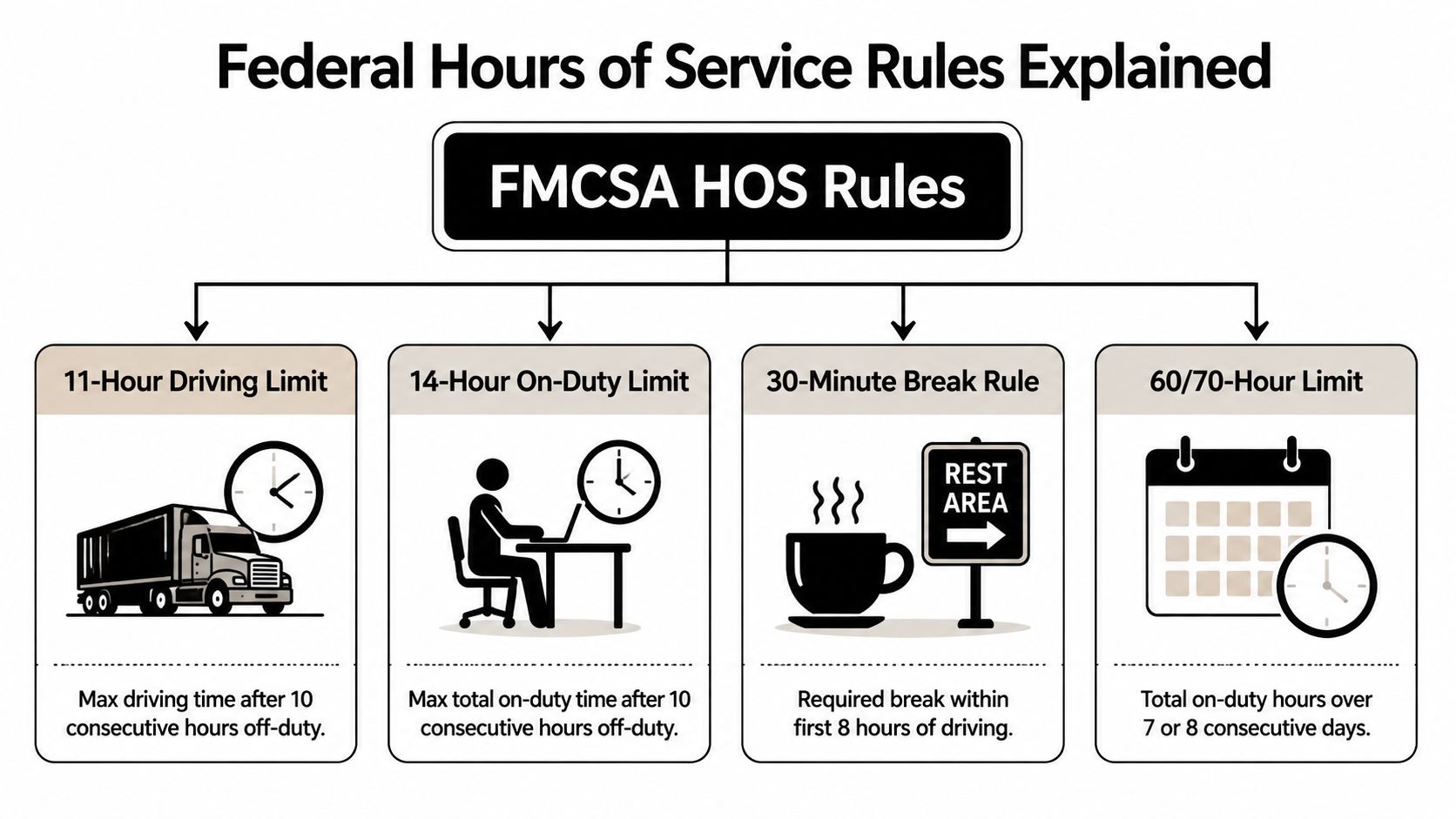
The core limits families should know
The most important rule is the 11-hour driving limit. A property-carrying commercial driver can't drive beyond 11 hours after getting 10 consecutive hours off duty, according to the explanation in CRST's overview of common HOS violations. In simple terms, a driver must get a real block of rest before starting a new driving window.
There is also the 14-hour on-duty limit. This is broader than driving time. It covers the total work window after that off-duty period begins. A driver may still have some driving hours left on paper, but once the workday window closes, the driver isn't supposed to keep driving.
The 30-minute break rule is another piece families often hear about. If a driver keeps going without the required break, fatigue can build unnoticed. People sometimes assume a quick stop for fuel fixes the problem. It doesn't necessarily count the right way, and it doesn't always provide meaningful recovery either.
Then there are the 60/70-hour limits, which address cumulative work over multiple days. These rules exist because fatigue isn't only about one very long shift. It can also come from repeated long workdays stacked on top of each other.
Why these rules are more than paperwork
These aren't technicalities. They are a public safety framework. Trucking companies are supposed to monitor compliance through systems such as Electronic Logging Devices, or ELDs, which function like digital timekeepers. Those systems record driving and duty status, but a record is only as trustworthy as the conduct behind it and the way the company handles it.
For businesses trying to build safer oversight systems, broader discussions of corporate fleet governance can help explain why supervision, documentation, and accountability matter beyond a single trip.
A good plain-language resource on the larger regulatory structure is this guide to federal truck regulations, especially if you're trying to understand how HOS rules fit into a broader safety system.
Practical rule: If a trucking company treats HOS compliance as a scheduling inconvenience instead of a safety obligation, families often find that attitude reflected in the records after a crash.
The consequences are serious. According to this summary of FMCSA penalty levels, in 2026 the FMCSA imposes a maximum civil penalty of $19,246 per carrier violation for each HOS violation, and up to $4,812 per violation for the driver. Those numbers matter because they show how seriously the system treats violations tied to fatigue risk.
How Common Violations Increase Crash Risk
A family gets the call no one wants. The truck that hit their car did not drift because of bad luck alone. In many cases, the driver had been working past the point where safe judgment starts to fade, and the paperwork only tells part of that story.
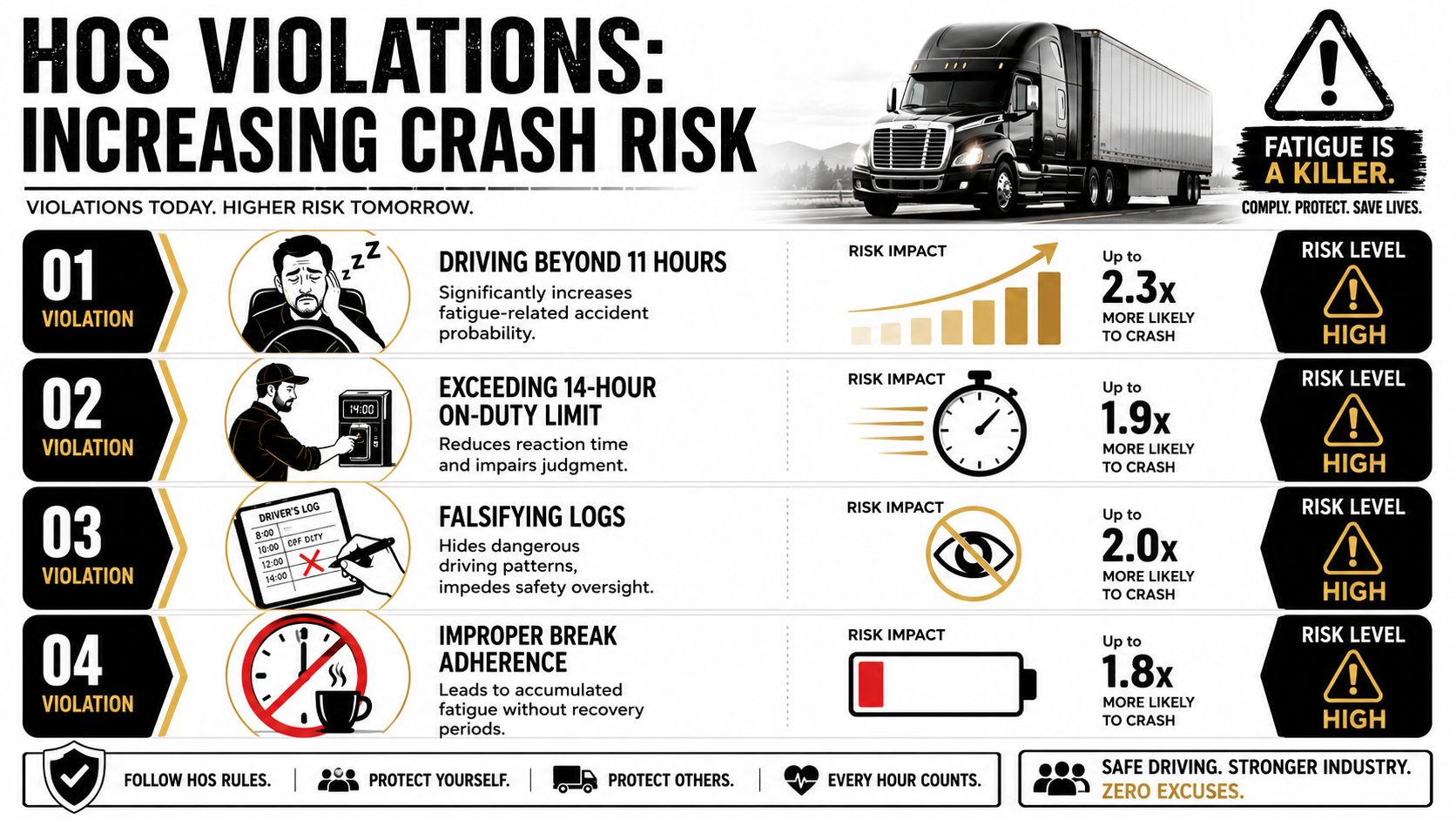
Fatigue changes driving in quiet but dangerous ways. A tired truck driver may miss a slowing line of traffic, react late to a lane change, brake too hard, or make a simple judgment error at the worst possible second. With a fully loaded commercial truck, even a short delay in reaction can turn an avoidable problem into a catastrophic crash.
The patterns lawyers watch for
Certain HOS violations show up again and again in serious wreck cases because each one points to the same safety problem: too much work and too little recovery.
| Violation pattern | What it means in real life | Why crash risk goes up |
|---|---|---|
| Driving too long | The driver stays behind the wheel after legal driving time should have ended | Mental sharpness drops, reaction time slows, and lane control can suffer |
| Exceeding the on-duty window | The workday stretches on, even if the driver was not driving every minute | Long shifts drain attention and patience, especially late in the day |
| Skipping required breaks | The driver keeps working instead of taking time to recover | Fatigue builds instead of easing |
| Falsifying logs | The official record hides the driver's actual work and travel time | It may show the driver and carrier knew the trip was unsafe and tried to cover it up |
The false-log issue matters for another reason. A changed record can point to pressure from dispatch, unrealistic scheduling, or weak safety oversight by the company. That is why a case should not stop with the logbook itself. A lawyer may compare the timeline to dispatch records, maintenance activity, and the driver's qualification file requirements for commercial truck operators to see whether the carrier ignored warning signs.
Why these violations cause so much harm
A truck driver does not need to be asleep at the wheel for fatigue to matter. Fatigue often works like a dimmer switch, not an on off switch. Attention narrows. Decision-making slows. Small errors stack up.
That helps explain why hours violations are so dangerous in practice. A driver who has worked too long may still be able to keep the truck moving down a straight road. The problem comes when traffic suddenly changes and the driver needs quick, accurate judgment.
Families are often told after a crash that no one can know whether the driver was tired. That is not true. Investigators can often test the company's version of events against outside records. For example, if you verify commercial truck details and match that information to trip records, equipment data, and timing evidence, the vehicle's actual movements can start to tell a clearer story than the paper log alone.
One more point matters here. An hours violation rarely stands alone. It often sits beside speeding, missed inspections, overloaded schedules, or dispatcher pressure to keep rolling. In a personal injury case, that broader pattern can help show negligence by both the driver and the carrier.
How We Prove an Hours of Service Violation Happened
A strong truck crash investigation doesn't stop at the driver's log. It starts there, but it doesn't trust that record blindly. The actual work is building a timeline from many separate pieces until the full trip tells one consistent story.

The timeline puzzle
The process is akin to assembling a puzzle when someone has hidden the box cover. One piece might be a fuel receipt. Another might be GPS pings from the truck. Another might be a weigh station ticket. On their own, those records look ordinary. Together, they can show a driver was moving, working, or waiting at times that don't match the official log.
According to Roth Lawyer's discussion of HOS violations in truck cases, attorneys corroborate ELD edits or false logs with fuel receipts, GPS data, weigh station tickets, cell phone records, and dispatch messages to build irrefutable timelines. That is the part most generic articles leave out, and it's often the part that decides whether a case stays speculative or becomes provable.
What lawyers compare against the log
A careful investigation may involve records such as these:
- Fuel receipts with timestamps: A fuel purchase can place the truck at a specific location at a specific time.
- GPS and telematics data: These records can show where the truck traveled and when it stopped or moved.
- Weigh station and toll records: These create fixed checkpoints that are hard to argue away.
- Dispatch messages: Instructions from dispatch may reveal schedule pressure or knowledge of over-hours driving.
- Cell phone records: Calls or texts can help establish whether the driver was active when the log says off duty.
- Shipping documents: Bills of lading, pickup times, and delivery records can reveal a trip schedule that doesn't fit lawful driving hours.
If your family is trying to identify the truck and carrier accurately before records disappear, tools that verify commercial truck details can sometimes help confirm vehicle information tied to the investigation.
How contradictions expose false compliance
Here is a simple example. Suppose the ELD shows the driver went off duty at night and restarted properly the next morning. But the fuel receipt shows the truck purchased diesel during that supposed rest period. Then a GPS record places the truck miles away later that same night. Then a dispatch text asks for an early delivery before sunrise.
The issue isn't one suspicious document. It's the pattern. Each outside record narrows the room for excuses. By the time all the timestamps line up, the log may no longer be believable.
Some investigations also look at the driver's broader file. Training, medical certification, prior compliance issues, and supervision records can all matter. If you're trying to understand what belongs in that broader record set, this overview of the truck driver qualification file helps explain part of the paper trail carriers are expected to maintain.
This walkthrough gives a helpful visual summary of the kinds of records and system issues that can surface in HOS disputes.
Why speed matters
These records don't always stay easy to access. Companies may rotate data, lose supporting documents, or frame the event in a way that minimizes fatigue issues from the start. That is why early legal action often matters so much in a truck case.
The truth in an HOS case rarely lives in one document. It usually appears when many ordinary business records are placed next to each other in the right order.
For families, that should be reassuring. Even if a driver lied. Even if the first report sounds incomplete. Even if the insurer says there is no issue. The case may still be provable if the evidence is gathered before the trail goes cold.
Legal Consequences for Negligent Drivers and Carriers
An hours of service violation can lead to government penalties, but for an injured family, the bigger point is this: those penalties can also help show negligence. They establish that the rule mattered, the violation was serious, and the conduct wasn't just unfortunate. It was unsafe.
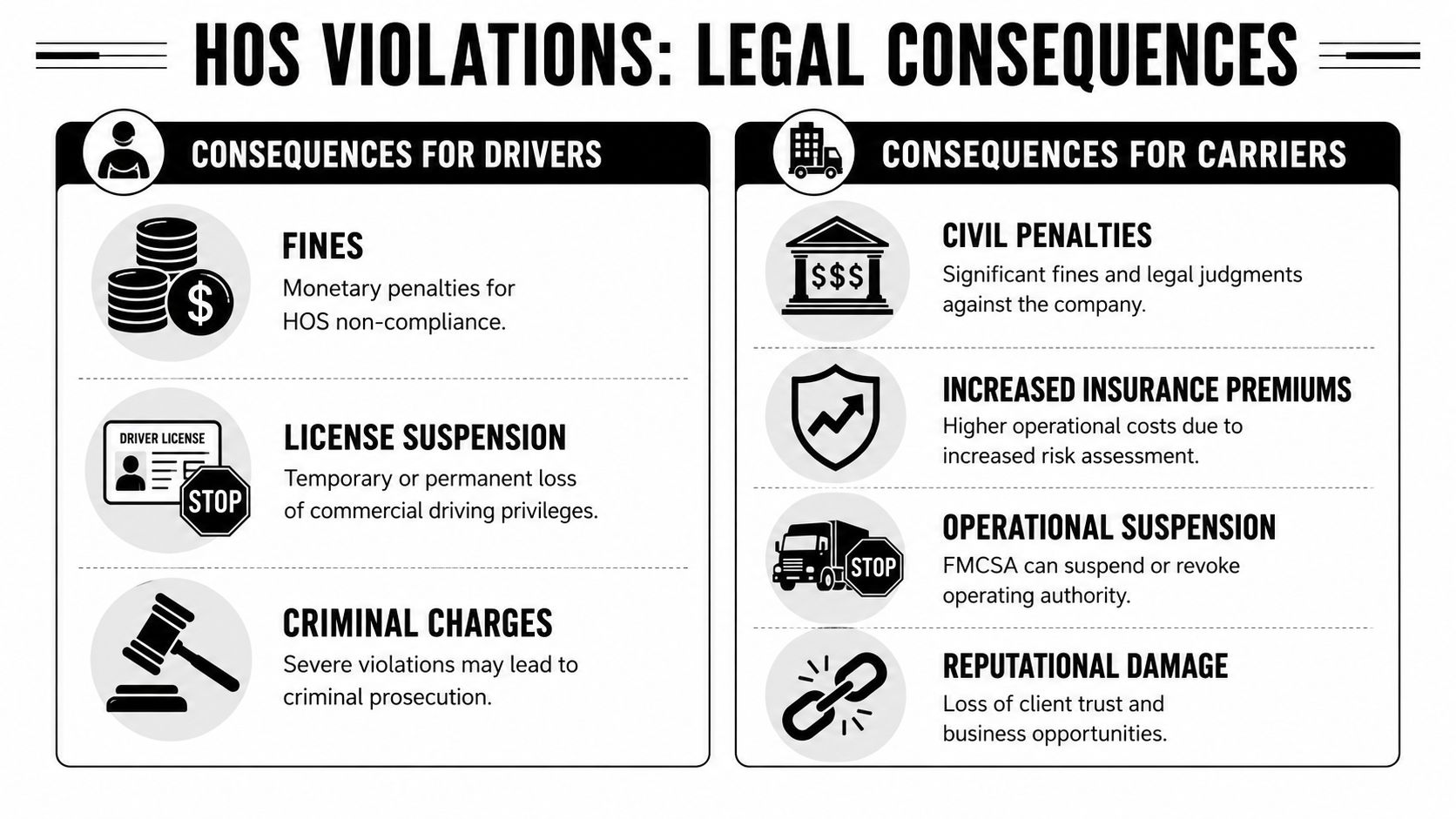
The driver and the company may both be responsible
Families often start with the driver. That makes sense because the driver was behind the wheel. But truck cases usually require a wider lens. Carriers hire, dispatch, monitor, and supervise. They review logs. They set delivery expectations. They choose whether to respond to warning signs or ignore them.
That is where the legal idea of constructive knowledge becomes important. It means the company knew, or should have known, that unsafe conduct was happening. A carrier doesn't get a free pass just because it avoided looking too closely.
According to GPS Insight's HOS FAQ, recent data shows nine of the top 20 driver violations relate to HOS, and that pattern connects directly to the constructive knowledge doctrine in serious injury and wrongful death cases. In practical terms, if the company had access to ELD data, repeated warning signs, or obvious scheduling problems, a family may argue the carrier had enough information to act and failed to do so.
How liability often expands beyond one bad decision
Consider how these facts can build on each other:
- The driver exceeded legal limits: That supports the argument that fatigue may have contributed to the crash.
- The logs were altered or incomplete: That can suggest awareness of wrongdoing.
- Dispatch pushed unrealistic timing: That helps show company pressure, not just individual error.
- Supervisors ignored recurring issues: That points toward a broader safety culture problem.
A civil case is about accountability, not just rule enforcement. If a company lets violations continue because on-time delivery matters more than public safety, that choice can become central to the case.
Why federal penalties strengthen the story
Government fines don't automatically win a lawsuit, but they matter. They show these rules are mandatory and backed by real consequences. They also give jurors context. An HOS rule isn't a suggestion. It's a safety line that the federal system treats seriously when someone crosses it.
That can be especially important when the defense tries to minimize the violation as minor or technical. A family can point to the regulatory structure and say, correctly, that these rules exist because fatigue in commercial trucking is dangerous and foreseeable.
When a carrier had the records, had the authority, and had the chance to intervene, "we didn't know" may not be a convincing defense.
In many truck cases, the strongest claims don't arise from one moment of bad driving alone. They arise from a chain of choices that allowed an unsafe driver to keep operating until someone got hurt.
Actionable Next Steps for Colorado Truck Crash Victims
A truck hits your family member on I-25. By that night, the trucking company already knows more about the driver's day than you do. It may have electronic logs, GPS pings, dispatch messages, fuel purchases, and inspection records. Some of that evidence can disappear, get overwritten, or become harder to obtain if no one moves quickly.
Start with two priorities at the same time. Get medical care. Protect the paper trail and digital trail.
What to do in the first days
Even if you feel shaken, small steps now can make a major difference later.
- Get medical care and keep every record: Save discharge papers, imaging results, prescriptions, work restrictions, and follow-up instructions.
- Preserve what is already in your hands: Keep photos, video, dashcam footage, damaged property, towing paperwork, and repair estimates.
- Write down your memory while it is fresh: Note the time, road, traffic, weather, what the truck did before impact, and anything the driver or witnesses said.
- Be careful with insurance conversations: A recorded statement given too early can lock you into details before the full injury picture is clear.
- Tell your lawyer why you suspect fatigue: If the truck drifted, failed to brake, made a late correction, or the driver said they had been on the road a long time, that detail can shape the investigation from day one.
For a practical general checklist, this guide on steps to take after a car accident is a useful starting point. In truck cases, those same basics matter, but the evidence list is often much larger.
What a trucking lawyer should do early
A strong truck case is rarely built from the driver's logbook alone. A log can be incomplete, edited, or made to look cleaner than the actual schedule. The essential work is comparison.
A good legal team should move quickly to demand preservation of records such as:
- ELD data and log edit history
- GPS and telematics records
- Fuel receipts and credit card transactions
- Dispatch messages, trip plans, and delivery deadlines
- Bills of lading, weigh station tickets, and toll records
- Driver qualification and prior violation files
Those records work like timestamps from different clocks in the same room. If one says the driver was resting, but another shows the truck moving, buying fuel, or passing a weigh station, the story starts to break apart. That is often how an hours of service case becomes provable.
Questions worth asking before you hire counsel
Truck wrecks are different from ordinary car wrecks because the evidence sits inside a company system.
Ask direct questions such as:
- Do you investigate ELD data, GPS records, and log edits together?
- Have you handled cases involving false logs or missing records?
- Do you send preservation letters right away for electronic data and company documents?
- How do you show the carrier knew, or should have known, the driver was operating beyond the rules?
Those questions help you find a lawyer who knows how to connect a driver's schedule, the company's pressure, and the crash itself.
Why speed matters in Colorado
In these cases, delay helps the other side. Electronic data may be overwritten. Receipts get lost. Witness memories fade. A family can lose the chance to compare the logbook against the other records that expose what really happened.
Colorado also has legal deadlines, and the exact timing can depend on the facts of the case. Waiting can shrink your options while the trucking company keeps control of the evidence.
If you suspect the driver was too tired to be on the road, say that plainly when you speak with a lawyer. That one concern can change the first preservation letter, the records requested, and the direction of the entire case.
You Don't Have to Fight This Alone
An hours of service violation is not just a trucking rule on a government chart. In the right case, it is evidence that a tired driver stayed on the road too long, a carrier failed to intervene, or both. That can make the difference between a vague suspicion and a clear negligence claim.
Families don't need to become trucking experts overnight. They do need to understand one basic truth. The logbook is only the beginning. Fuel receipts, GPS data, dispatch messages, weigh station tickets, and other records can reveal what really happened when the official version doesn't add up.
If your family is dealing with a truck wreck in Colorado, clarity matters. So does speed. The sooner the evidence is protected, the stronger your path forward can be.
If you or someone you love was hurt in a truck crash, Nares Law Group LLC can help you understand whether an hours of service violation may have contributed to the wreck and what evidence should be preserved right away. The firm works with injured families to investigate trucking records, hold negligent drivers and carriers accountable, and pursue compensation for medical bills, lost income, and long-term harm.