You get the call from the body shop, the car is ready, and for the first time in weeks you're relieved. Then you look at the vehicle history, the repair invoice, and the way the front end still feels somehow different, and a new problem shows up. The car may be fixed, but it doesn't feel whole anymore, and a future buyer may see it the same way.
That gap has a name: diminished value. In plain English, it means your car can be worth less after a crash even if the repairs were done correctly, because the accident itself now sits in the vehicle's history and changes what a willing buyer would pay. The Insurance Information Institute describes diminished value as the difference between a car's pre-accident market value and its post-repair market value, and industry guidance commonly places that loss at about 10% to 20% of the direct property damage amount in many claims (NAIC CIPR report on diminished value).
That's why this issue matters so much in real life. It isn't a complaint about paint color or a feeling that the car “just isn't the same.” It's a market loss that shows up when buyers, dealers, and insurers price in the fact that the vehicle was in a crash.
The Moment Your Repaired Car Feels Worth Less
You hand over the keys, get the vehicle back, and everything looks fine at a glance. The panels line up, the lights work, and the shop says the job is done. But the moment a buyer sees an accident on the record, the conversation changes. A clean repair and a clean history are two different things in the market.
That price gap is the heart of a diminished value claim. It is the formal request for payment of the difference between what the car was worth right before the crash and what it is worth after repair, even when the repair work is solid. The loss belongs to the market, not to your frustration, and not to whether the body shop did decent work. That is why a claim can still matter when the car looks fine in your driveway.
A repaired motorcycle with a replaced frame makes the point clearly. Even if the rebuild is done correctly, a future buyer may still worry about hidden stress, resale risk, or what else changed under the surface. Cars are priced the same way, because buyers often treat accident history as a warning flag and adjust their offer accordingly.
Practical rule: if the crash left a permanent mark in the car's history, the value loss can remain even when the damage does not.
That is why this claim is more than a repair gripe. It is a property-value issue, and insurers know it. If you are dealing with an adjuster and need a starting point for that conversation, a guide on negotiating with Progressive can help you see how these discussions are usually framed in the world.
The key is separating appearance from value. A car can look repaired and still be worth less because the market prices in risk, history, and buyer hesitation. That is the loss a diminished value claim is meant to recover.
The Three Forms of Diminished Value Explained
The term diminished value covers three different kinds of loss, and they are easy to mix up if you only look at the repair bill. One kind comes from the crash history itself, one comes from imperfect repairs, and one describes the value drop right after the collision. A car can involve more than one of these at the same time, which is why the labels matter.
A repaired smartphone with a replaced screen shows the idea clearly. Even when the repair works and the phone functions normally, a buyer may still pay less for a device that has a cracked-screen history. Cars are treated the same way, because accident history can change how the market sees the vehicle.
The three forms are usually discussed as inherent diminished value, repair-related diminished value, and immediate diminished value. Each one points to a different cause of loss, and each one tells you something different about what an adjuster may argue.
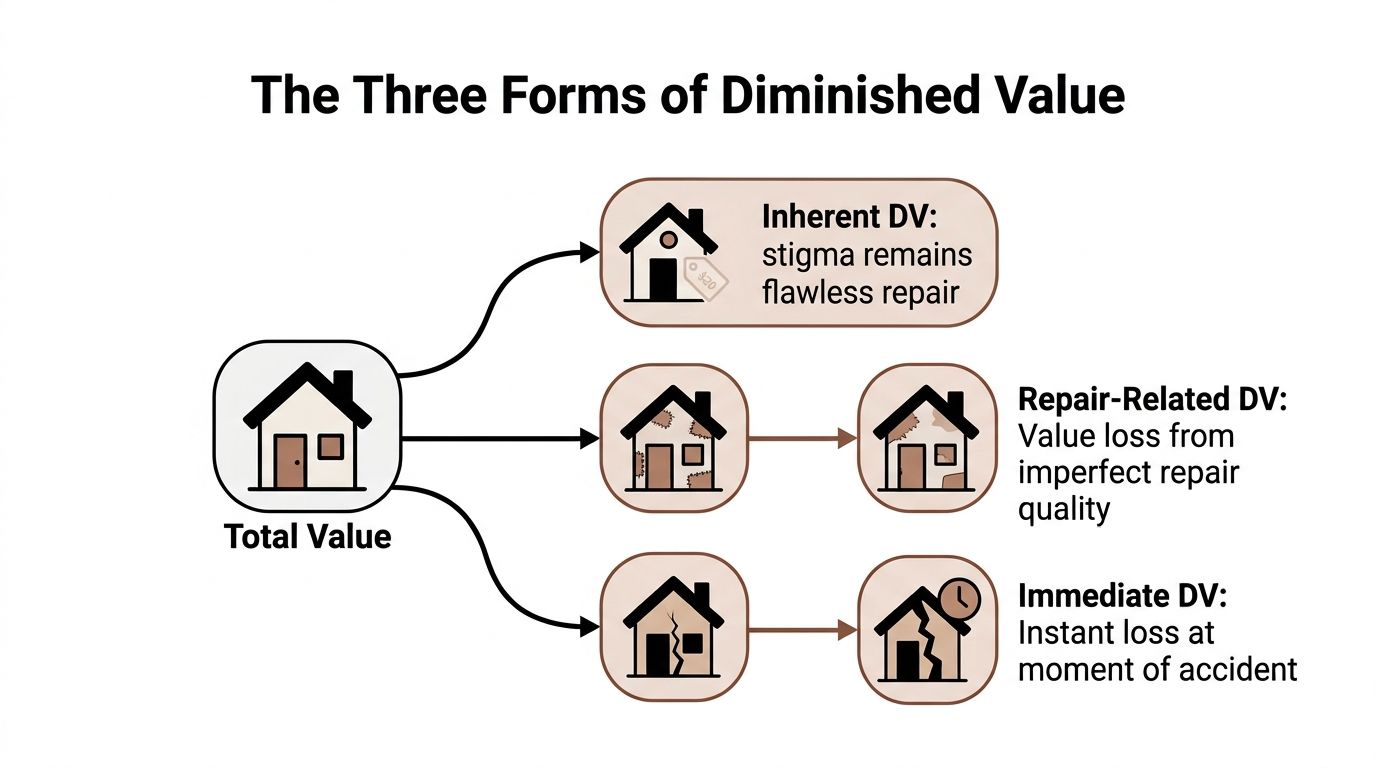
Inherent diminished value is the market penalty that remains after decent repairs because the car still carries an accident record. That record can make a future buyer hesitate, even if the body shop did everything correctly. This is the form people usually mean when they talk about the car being worth less after the crash.
Repair-related diminished value comes from the repair work itself. If the paint does not match, the panels line up poorly, or a mechanical issue remains, the car may be worth less because it was not restored as fully as it should have been. In plain English, the problem is not just that the car was damaged, it is that the fix left something behind.
Immediate diminished value is the loss that exists right after the collision, before repairs are completed. It measures the drop in fair market value at the moment the vehicle is damaged, which helps explain why a claim can arise even before the car goes back to the shop. A crash changes the car's condition at once, and the market reacts to that change.
Which one matters most in a Colorado claim
For many Colorado drivers, the main dispute is over inherent diminished value. That is the loss tied to accident history itself, separate from whether the repairs were decent or poor. Repair-related problems can help support a claim, but they also create a second issue about repair quality, which can distract from the value question.
The cleaner the repairs and the paperwork, the easier it is to show the remaining market penalty. Appraisals, repair invoices, photos, and records of what changed all help draw the line between “fixed enough to drive” and “worth the same as it was before.” A claim often lives in that gap, where the car looks repaired but still carries the stigma of a crash.
For a closer look at how insurers examine those records, see how an insurance company investigation works.
Why Insurance Companies Resist Paying for Diminished Value
Many drivers assume the hard part is proving the accident happened. In practice, the fight starts after the repairs are finished, when the insurer has to decide whether the accident history caused a payable loss in market value. That's where adjusters get careful.
A diminished value claim is easy to push back on because the loss is less visible than a broken bumper. The insurer can question the valuation method, argue that the repairs fully restored the vehicle, or say the claimed drop in value is too speculative. In other words, the carrier has room to disagree without needing to deny that the crash happened.
What the adjuster usually attacks
Insurers often look for one of three weak points:
- Causation: they argue the car didn't lose market value because of the crash history alone.
- Methodology: they challenge whether the estimate came from a formula, an appraisal, or dealer comparisons.
- Proof: they say the file lacks enough documentation to show an actual loss.
That's why many claims stall. The adjuster isn't always saying “no value loss exists.” More often, the insurer is saying the file doesn't prove it well enough yet. The link that matters most is the proof chain from damage to repair to reduced market value, and that's where many claimants come up short.
Practical rule: the weaker the documentation, the more likely the insurer is to treat the claim like a negotiable nuisance instead of a real property loss.
If you want to understand the internal file review process insurers use while they evaluate these kinds of claims, this internal guide on insurance company investigation is a helpful companion read.
There are also situations where payment comes more easily, usually when the liability picture is clean and the documentation is strong. Total-loss negotiations, policy language that recognizes the claim, or the pressure of a lawsuit can all change the tone quickly. The lesson is simple. Filing the claim is not the same as getting paid.
How Diminished Value Is Calculated and Documented
A repaired car can look finished on the outside and still bring less on the open market. That is the basic problem behind a diminished value claim. The core question is not whether the repair happened. It is how a buyer, dealer, or appraiser would price the car after seeing the repair history.
The claim usually turns on two things, the method used and the proof behind the number. If you can explain both in plain language, the file starts to make sense to an adjuster instead of looking like a guess.
One common starting point is the Georgia 17(c) formula, a historical method that became well known in diminished value disputes. It begins with 10% of the vehicle's retail value and then applies damage and mileage modifiers. A $25,000 vehicle would start at a $2,500 base before those adjustments, but the number can move down quickly once the car has higher mileage or the damage is limited to a repairable area. For example, a mileage modifier may reduce the starting figure on an older vehicle, while a severe structural hit may keep more of the loss in play than a small bumper repair. That is why the formula works as a starting point, not a final answer, as discussed in the NAIC CIPR report on diminished value.
Two main ways people prove the number
| Feature | Georgia 17(c) Formula | Market Comparable Appraisal |
|---|---|---|
| Basic idea | Formula-based estimate tied to vehicle value, damage, and mileage | Market-based estimate using comparable vehicles and real-world pricing |
| Strength | Easy to present in an initial demand | Often more persuasive in negotiation because it reflects actual market conditions |
| Weak point | Can look mechanical and detached from the local market | Depends on the quality of comparable data and appraisal work |
| Best use | Starting point for a claim | Stronger support when the insurer disputes the number |
A market appraisal matters because buyers do not shop by formula. They look at the car's history, condition, mileage, and comparable listings, then decide what the vehicle is really worth to them. That is also why a car history report for used car buyers can be useful context, since it shows how accident history becomes part of the resale conversation.
What should be in the file
A strong claim file usually includes the repair order, itemized invoices, before-and-after photos, and a vehicle history report. If you can add a written appraisal that explains the market loss in plain terms, the claim becomes much harder to brush aside. The goal is to make the loss look measurable, repeatable, and tied to the vehicle itself, not just to the owner's frustration after the crash.
A helpful file also answers the question an adjuster will ask without saying it out loud, “Who says the market sees this car as less valuable?” That answer can come from dealer comparisons, appraisal notes, and the story told by the repair records. When those pieces line up, the claim looks less like an opinion and more like a property loss.
A demand package that only repeats the repair bill is easy to resist. A package that shows the repaired damage, explains why the repair history still follows the car, and ties the loss to actual market behavior gives the insurer something concrete to weigh. If the claim may later involve a reimbursement fight between insurers, the basic idea is similar to a subrogation claim explanation, because the paper trail has to show who paid, what was damaged, and why the loss belongs where it was placed.
A good demand package does not just say the car lost value. It shows why a buyer would pay less for it today than before the wreck.
Filing Against Your Insurer Versus the At-Fault Driver's
The next decision is tactical. You can pursue diminished value through your own carrier, if your policy gives you that route, or you can go after the at-fault driver's insurer. Those are not the same process, and they don't create the same advantage.
Filing with your own insurer is usually cleaner if first-party coverage exists. The process tends to be more direct, but only because you're dealing with your own policy language and the coverage you already bought. If that coverage isn't there, the path often ends before it starts.
Filing against the at-fault driver's insurer usually takes more work. You have to establish liability, then prove the market loss, then survive the insurer's pushback on method and value. That route creates more friction, but it also puts the claim where the loss belongs.

If you're comparing how claim handling changes when the repair file is being handled as an insurance matter, this overview of how repair claims work in Ontario can help you see how different carriers structure the process.
What changes on the back end
- Your own carrier: the claim is usually more policy-driven, with faster access to the file but tighter contract language.
- The at-fault carrier: the claim is usually more contested, but the legal theory is cleaner because the other driver caused the loss.
- The settlement posture: your position depends on documentation, liability, and whether the insurer thinks you'll keep pushing.
For Colorado drivers, that last point matters a lot. Comparative fault arguments can cut into recovery if the insurer claims you share responsibility, and that can affect how hard it is to settle. If the at-fault driver's insurer sees a small file, it may also choose to stand firm unless the evidence is well organized.
The subrogation process matters too, especially when another insurer is trying to recover money after paying the repair claim. This internal explanation of what a subrogation claim is is useful if you're trying to understand why multiple carriers may be involved in the same crash file.
Colorado Law and Local Insurance Realities
Colorado drivers usually run into the same basic diminished value problem, but the local details matter. The crash happened here, the market is here, and the insurer's response is shaped by Colorado law and Colorado repair records. That makes the claim more local than many national articles admit.
One of the most important Colorado realities is comparative negligence. If an insurer argues you contributed to the crash, that can shrink the amount available for property damage recovery. The diminished value claim doesn't disappear just because fault is disputed, but the negotiation gets harder fast when the liability story is mixed.
What local insurers often focus on
Colorado carriers commonly push back with the same themes. They may say there's no permanent impairment, that the repairs restored the vehicle fully, or that the valuation method is too aggressive for the actual loss. They may also ask for more proof of market impact before moving off an initial offer.
That's where local documentation matters. Denver-area adjusters tend to want the repair file, photos, and a valuation that makes sense for the car's actual condition and history. If the file looks generic, the insurer may treat it like a template claim instead of a real economic loss.
Practical rule: in Colorado, the claim gets stronger when the paperwork tells one consistent story from crash to repair to resale loss.
The state timeline also matters. Property-damage claims have deadlines, and waiting until the file goes stale can weaken your position even when the loss is real. That's why a claimant should gather the repair records, valuation support, and correspondence early, not after the insurer starts stalling.
If you want a broader insurance-law frame for Colorado crash claims, this guide on whether Colorado is a no-fault state is a helpful reference point. The short version is that the state's system does not make diminished value automatic, so the claimant still has to prove the loss clearly.
When the Claim Is Worth Pursuing and When to Move On
A repaired car can look fine and still bring less on the market. That gap is what makes a diminished value claim worth considering, but only if the likely recovery is large enough to justify the appraisal, the paperwork, and the back-and-forth with the insurer.
A useful rule of thumb is to compare the expected loss to the cost of proving it. If a repair runs about $8,000, the likely diminished value may land in the range of roughly $800 to $1,600, and that may or may not support paying for a professional appraisal or a long dispute. The point is not to chase every claim. The point is to decide whether the numbers make business sense for your car.
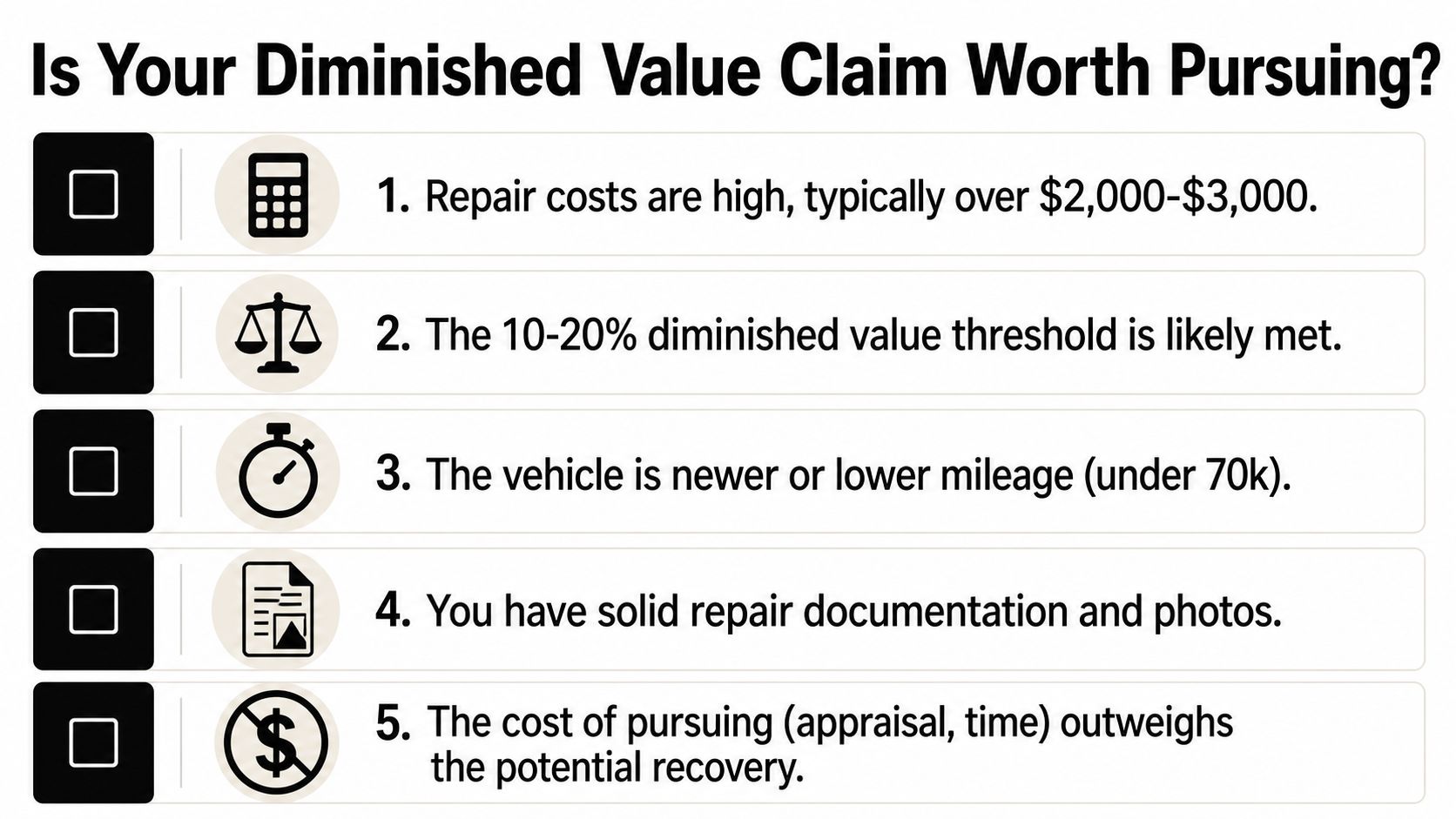
A simple go or no-go screen
- Higher repair spend: bigger damage usually means a bigger market loss, so the claim is more likely to matter.
- Better vehicle profile: newer vehicles and cleaner histories tend to support stronger claims.
- Solid documentation: photos, repair invoices, and vehicle history records make the loss easier to prove.
- Low-friction recovery: if the insurer is already disputing liability, the process usually takes more work.
- Time versus payoff: if the appraisal and follow-up will cost more than the likely recovery, moving on can be the smarter choice.
Vehicle condition changes the math. Older cars, high-mileage cars, and lower-value vehicles often fall into the “probably not worth it” category because the market already discounts them for age and wear. A salvage-title vehicle can be even harder to support, since buyers are already expecting a built-in loss in value. A newer vehicle with visible repair history and clean records usually gives you a much better claim.
The practical test is simple. Ask whether a buyer would see the crash history and lower the offer. If the answer is clearly yes, the claim deserves a closer look. If the vehicle already sits near the bottom of its market range and the expected recovery is small, the time spent pushing the insurer may be better used elsewhere.
Common Questions Colorado Drivers Ask About Diminished Value
A lot of drivers want a fast answer to one question, can I get paid for this. The honest answer is yes, but only if the claim is supported, timely, and worth the effort. The insurer won't hand over money just because the car was in a crash.
People also ask how long they have to file. The safe answer is that deadlines matter from the start, and waiting can hurt the claim even when the loss is real. Filing early protects the record, and it keeps the insurer from arguing that the file went stale.
Another common question is whether a lawyer is worth it for a smaller loss. Sometimes it isn't. If the potential recovery is modest, the better move may be to document the claim carefully and make the demand yourself, especially if the insurer's position is weak and the file is clean.
Practical rule: the more the insurer fights liability, methodology, or valuation, the more legal help starts to make economic sense.
Readers also ask what to do with a low offer. Don't accept it too quickly. Compare the offer to your repair file, your appraisal, and the market evidence, then push back in writing so the record shows exactly why the number is off.
If the at-fault driver is uninsured, the path gets more complicated, because there may be no easy third-party insurer to pursue. In that situation, the policy language on your own coverage becomes much more important. It's also one reason Colorado drivers should read their declarations page carefully before they assume a diminished value claim is available.
A first-party claim also raises a worry about premiums going up. That concern is real for many drivers, but the answer depends on the policy, the claim history, and the carrier's own rules. It's another reason to ask direct questions before making a filing decision.
One Colorado driver I spoke with through a case file had a newer vehicle, clear liability, and a strong repair record after a multi-vehicle crash. That combination made the claim worth pursuing, and the insurer had a hard time dismissing the market loss once the documentation was organized. A different driver with an older, lower-value car and very limited repair damage would have spent more on appraisal and follow-up than the claim could reasonably return.
If you're trying to sort out whether your claim is real money or just paperwork, Nares Law Group LLC reviews crash files, repair records, and insurer position letters for Colorado drivers who want a clear answer before they keep fighting. Visit Nares Law Group LLC to talk through your options and get a practical read on whether your diminished value claim is worth pursuing.