You're home from the ER, the discharge papers are on the counter, and your phone won't stop buzzing. A claims adjuster may already be asking for a statement, the first medical bills are arriving, and your family is trying to tell the difference between normal post-accident confusion and something more serious. In that moment, traumatic brain injury compensation is less about abstract legal categories and more about one hard question, what do you need to protect the recovery, the income, and the future that just got thrown off course?
The short answer is that a TBI claim is rarely about one bill or one diagnosis code. It's about proving the full cost of the injury, including the care you've already needed, the care you're likely to need later, the work you can't do the same way anymore, and the way the injury changed daily life. A practical overview like TBI settlement advice from Mattiacci Law can help families see how settlement thinking works, while a screening resource such as traumatic brain injury screening is useful when the symptoms are still being sorted out.
What matters most right away is timing. The first decisions, what gets documented, who talks to the insurer, whether treatment stays consistent, often shape the number more than people realize. If you're already dealing with missed work and uncertainty, the goal isn't to guess at a fair amount on day one. It's to build the record that lets the full claim come into focus.
Where Families Stand When the Diagnosis Is New
A family often sits at the kitchen table a few hours after the hospital visit, trying to read through discharge notes while one person is still light-sensitive, confused, or unusually tired. The adjuster's first call can arrive before anyone knows whether the symptoms will resolve in days or become a long-term problem. That gap between the immediate chaos and the later medical picture is where many low settlements happen.
The insurer wants a quick snapshot. Your family needs a longer one. A rushed release can close off the chance to account for follow-up neurology visits, rehabilitation, missed paychecks, and the possibility that symptoms worsen once the person tries to resume normal routines.
Practical rule: don't let the first conversation with the insurer define the value of the case.
A TBI claim is not a single number sitting somewhere in a file. It's a stack of losses that has to be documented piece by piece, and the early record often determines whether those pieces are later treated as real damages or as speculation. That's why early symptom tracking, consistent treatment, and careful intake matter so much, especially when the injury isn't obvious from the outside.
Families looking for a legal yardstick usually want to know whether their situation is the kind of case that can support significant compensation or just a modest payment. The answer usually turns on the evidence, not the label. A useful starting point is the firm's economic damages calculation page, because that's where wage loss, medical bills, and future care start to become concrete.
The Categories of Compensation a TBI Case Can Reach
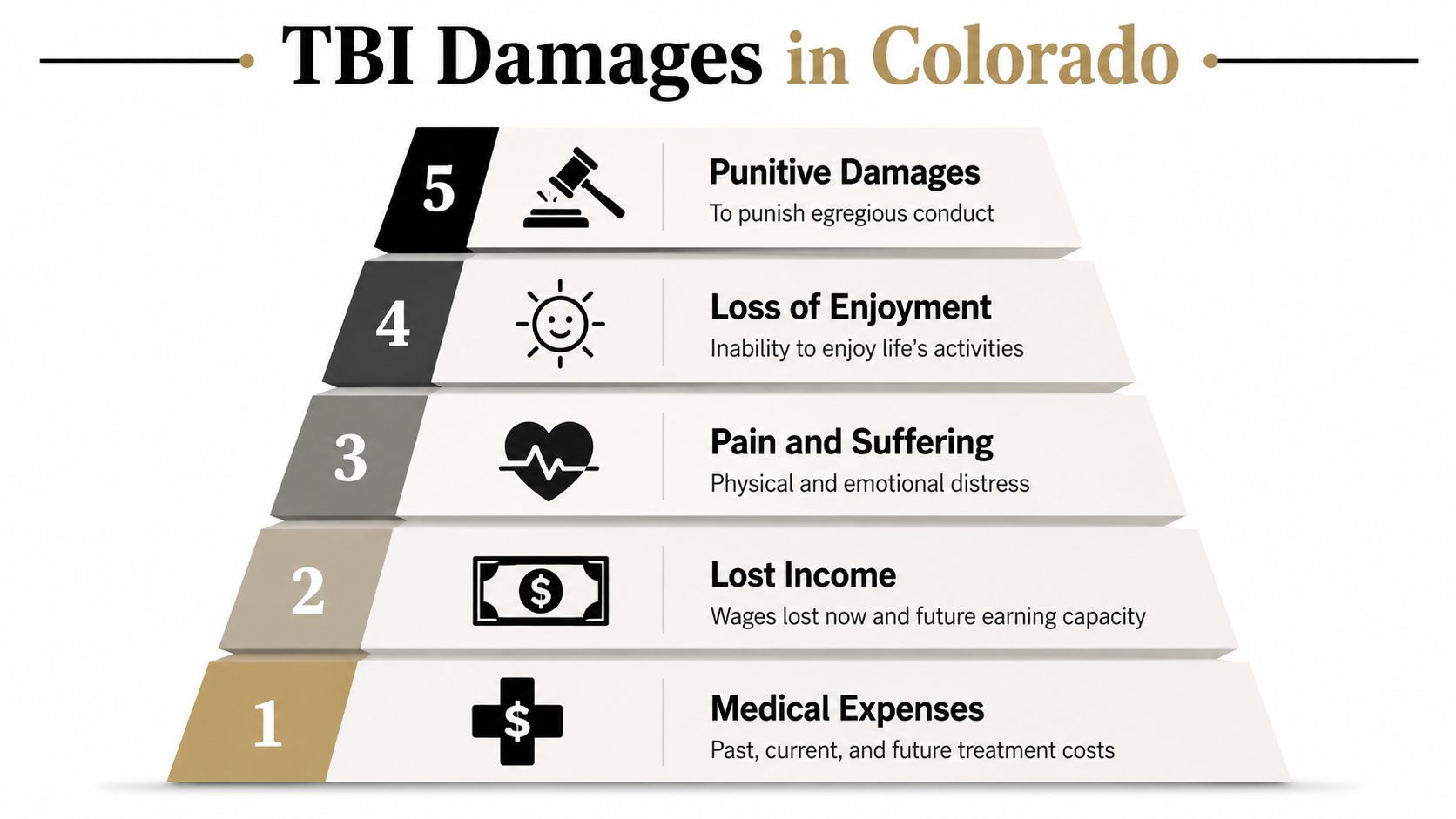
The law usually breaks traumatic brain injury compensation into separate buckets, because each one needs different proof. That matters in practice. An adjuster may accept one category, such as a stack of emergency room bills, while fighting another, such as future earning loss or the daily impact of cognitive fatigue.
Medical costs and future care
Medical expenses cover treatment already provided and treatment likely to be needed later. That includes emergency care, imaging, specialist visits, therapy, medication, and in some cases long-term supervision or attendant care. The stronger the records, the harder it is for the insurer to argue the care was unrelated or unnecessary.
Lost income and reduced earning power
Lost wages are the paycheck losses that already happened. Diminished earning capacity is the harder part, because it asks what the injury did to the person's ability to earn over time. Employer records, tax history, attendance records, and vocational evidence matter here, because a brain injury often affects pace, concentration, memory, and reliability in ways that don't show up on a pay stub.
Pain, suffering, and loss of enjoyment
These non-economic losses are where a lot of families feel the injury. Pain and suffering includes physical symptoms and emotional strain, while loss of enjoyment of life captures the activities the person no longer does the same way, or not at all. Neuropsychological testing and consistent symptom reporting help give these claims structure instead of leaving them to be dismissed as subjective complaints.
Life care planning and disability protection
A life care plan projects the care that may be needed across years, sometimes decades. That can include therapy, medication management, home support, and future evaluations. Families dealing with disability concerns sometimes also look at resources like Duncan & Associates disability insurance options because income protection and injury compensation often interact in real life, even though they're separate systems.
One small but important point, punitive damages are not part of every case. They depend on the conduct and the governing law, so they're not something to assume at the start.
How Adjusters and Juries Actually Price a Brain Injury
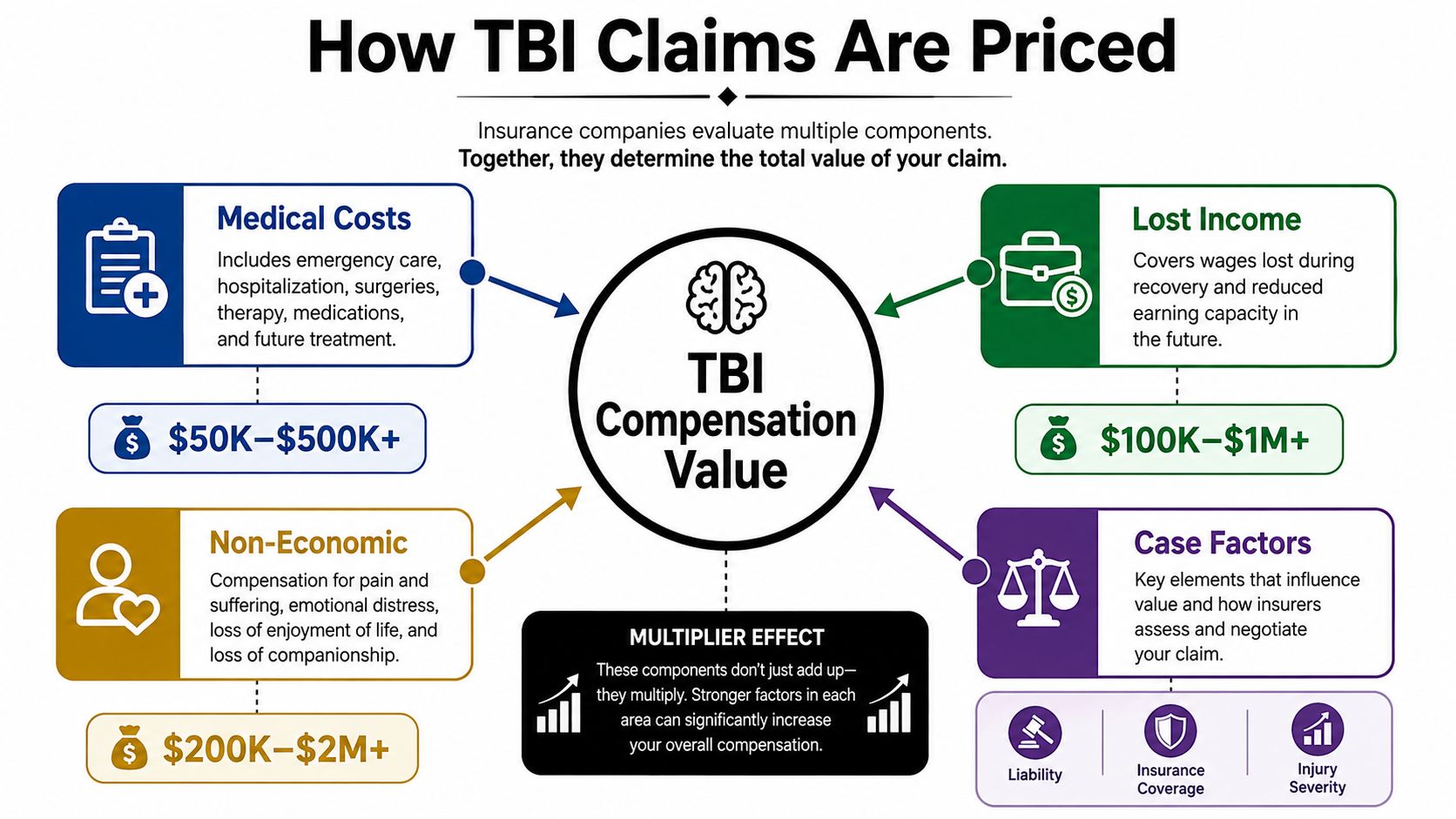
The starting point for valuation is simple enough. The ending point usually isn't. Adjusters look at medical bills, work disruption, and the quality of the proof, then they test the claim against what they think a jury would believe if the case were tried.
The most useful evidence is the kind that shows function. A normal MRI doesn't end the case, and an abnormal scan doesn't automatically make it valuable. What changes the number is documented cognitive loss, trouble with executive function, reduced work tolerance, and credible testimony from people who see the day-to-day effects.
The diagnosis matters. The functional loss moves the money.
That's where experts come in. A life care planner turns future needs into a care roadmap, and a vocational economist can explain how a reduced ability to concentrate, process information, or stay on task affects earning power. In contrast, a file built only on pain complaints and a few office notes usually invites a discount.
The human range is wide because the injury range is wide. In a 160-participant follow-up study, compensation ranged from €1,500 to €2,000,000, with a mean of €292,653, and the study noted that those figures excluded social and medical costs paid by insurers to the health system PMC study on TBI compensation variability. That spread is exactly why two cases with similar imaging can land in very different places. One claimant may have documented permanent executive dysfunction and reduced work capacity, while another has symptoms that resolve and no lasting work impact.
The practical lesson is blunt. The person who proves life changes usually does better than the person who just proves injury.
The Legal Process From First Call to Resolution
A strong TBI case usually starts with preservation, not paperwork. Photos, scene evidence, vehicle damage, witness names, and early medical records should be gathered before memories blur and physical evidence disappears. Once that foundation exists, the case becomes easier to build and much harder for the insurer to reframe.
From there, the claim usually moves through a deliberate sequence. The medical file gets collected and organized, treatment continues, and a demand package goes to the insurer once the injury picture is mature enough to value. If the adjuster won't deal fairly, the next move is usually litigation, and in a serious case that can end in mediation or trial.
For a broader roadmap of that flow, the firm's stages of a personal injury case page tracks the same basic progression.
What the timeline really looks like
TBI claims often take time because future damage can't be fully priced until the medical picture settles. That doesn't mean nothing is happening. It means the record is still developing, and premature resolution can shortchange future care.
If the injury is serious, the family should expect the legal team to keep pressing for records, coordinate with providers, and decide when the file is ready for meaningful negotiation. Quick settlement is only smart when the offer matches the documented loss.
A helpful way to think about the process is this. Investigation locks down the facts. Medical development shows the injury's real footprint. Negotiation tests whether the insurer will pay for that footprint without litigation. If not, the lawsuit forces a better review.
Insurance Tactics and Defenses Used Against TBI Claims
Insurance companies often attack TBI claims in predictable ways. They'll ask for a recorded statement early, hoping the injured person misses a detail, sounds confused, or downplays symptoms. They'll also watch social media, looking for a dinner photo or a family outing they can use to argue the injury isn't serious.
Independent medical examinations are another common tool. The doctor is usually chosen by the insurer, not the family, so the exam often feels less like care and more like a defense report in a white coat. That doesn't mean the opinion can be ignored, but it does mean the treating records and consistent symptom history matter more than one appointment arranged by the carrier.
Comparative fault arguments show up often too. If the defense can shift even part of the blame onto the injured person, it reduces what the insurer has to pay. The practical counter is careful investigation, witness preservation, and a clean liability story supported by physical evidence and medical timing.
What works: consistency, documentation, and disciplined communication.
What doesn't: oversharing with the adjuster, missing appointments, or assuming the insurer will fill in the gaps fairly.
Families don't need to treat these tactics personally. They need to treat them as part of the job and answer them with evidence.
Colorado Statutes and Caps That Shape TBI Claims
Colorado law matters because deadlines and damage rules can affect your position. Personal injury claims have to be filed on time, and if a brain injury diagnosis comes later, the discovery rule may become important. That's one reason delayed symptoms shouldn't be brushed off as “just stress.”
Damage caps can also affect some claims, especially the non-economic side. The exact recovery picture depends on whether the case is against a private driver, a commercial carrier, a government entity, or another defendant with different rules and policy limits. Venue and insurance limits matter too, because a strong case against a poorly insured defendant still has collection issues.
Families with billing and lien problems sometimes benefit from organized back-end support, and Colorado medical billing services can be part of that administrative cleanup. The legal point is simple, though. A claim is only as good as the defendant's ability to pay and the case's ability to clear procedural hurdles.
In complex trucking or multi-state matters, co-counsel arrangements can also matter because liability, coverage, and venue issues don't always stay neatly inside one jurisdiction. The practical job is to keep the claim on time, keep the evidence usable, and avoid letting a technical deadline erase a valid injury claim.
What to Do in the Next Thirty Days
The first month after a TBI diagnosis should be spent protecting the record. If the scene, vehicle, helmet, phone data, or other physical evidence still exists, preserve it. If there are witnesses, get their names and contact information now, not after someone's memory fades.
Daily symptom tracking matters more than families expect. Write down headaches, dizziness, light sensitivity, sleep problems, memory lapses, irritability, and anything that changes work, driving, reading, or family routines. That kind of log is far more useful than trying to reconstruct symptoms months later from memory alone.
The next steps that usually help
- Keep treatment consistent: Missed appointments give the insurer an excuse to argue the injury wasn't serious.
- Decline the recorded statement for now: A calm, immediate call from an adjuster can still be a trap.
- Collect wage proof: Pay stubs, schedules, HR messages, and missed-work documentation all help.
- Choose counsel carefully: Ask who will handle the file, who will try the case if needed, and how often you'll get updates.
A consultation should cover the medical picture, liability issues, insurance coverage, and whether the case needs expert support. It should also tell you whether the lawyer has real TBI and trial experience, because brain injury cases are not the place for loose file management.
The right lawyer won't promise a number on day one. The right lawyer will tell you what needs to be proven and what needs to be preserved.
Questions Families Most Often Ask Next
How long does a TBI case take? Usually long enough for the medical picture to matter. If future care and earning loss are in play, a rushed settlement often leaves money on the table.
How are lawyers paid? In many injury cases, the fee comes from the recovery and case costs are handled separately, but the agreement should be explained clearly before anything is signed. Ask for a plain answer on expenses, medical liens, and what happens if the case doesn't resolve quickly.
What does a fair result look like? There isn't one number for moderate or severe injuries. A fair result is the amount that tracks the documented medical needs, work loss, future care, and daily-life impact, not the first offer that arrives.
Should you take the first offer? Usually not if symptoms are still developing, treatment is ongoing, or work capacity hasn't been fully evaluated. A fast offer is often priced for the insurer's convenience, not your family's future.
Nares Law Group LLC handles traumatic brain injury cases, crash claims, and the evidence work that turns an injured person's real losses into a documented demand. If your family is dealing with a new diagnosis, missed work, or an insurer pushing for a quick answer, visit Nares Law Group LLC to talk through the next step and get a case review built around the actual facts.