You may be sitting at home after a crash, telling yourself the pain is manageable. The emergency department discharged you, the scans didn't show an obvious fracture, and the insurance adjuster is already asking how you're doing. That combination creates a dangerous gap. Leaving the ER doesn't mean treatment is finished, and feeling functional doesn't prove you escaped serious injury.
Motor vehicle accident treatment has two tracks that must stay connected. Doctors must identify urgent injuries, control symptoms, and guide rehabilitation. At the same time, you need a reliable record of what happened, what changed, and how the injury affects work and daily life. Fragmented follow-up can delay recovery and give an insurer an opportunity to argue that your condition wasn't caused by the crash.
Securing Immediate Care and Initial Diagnostics
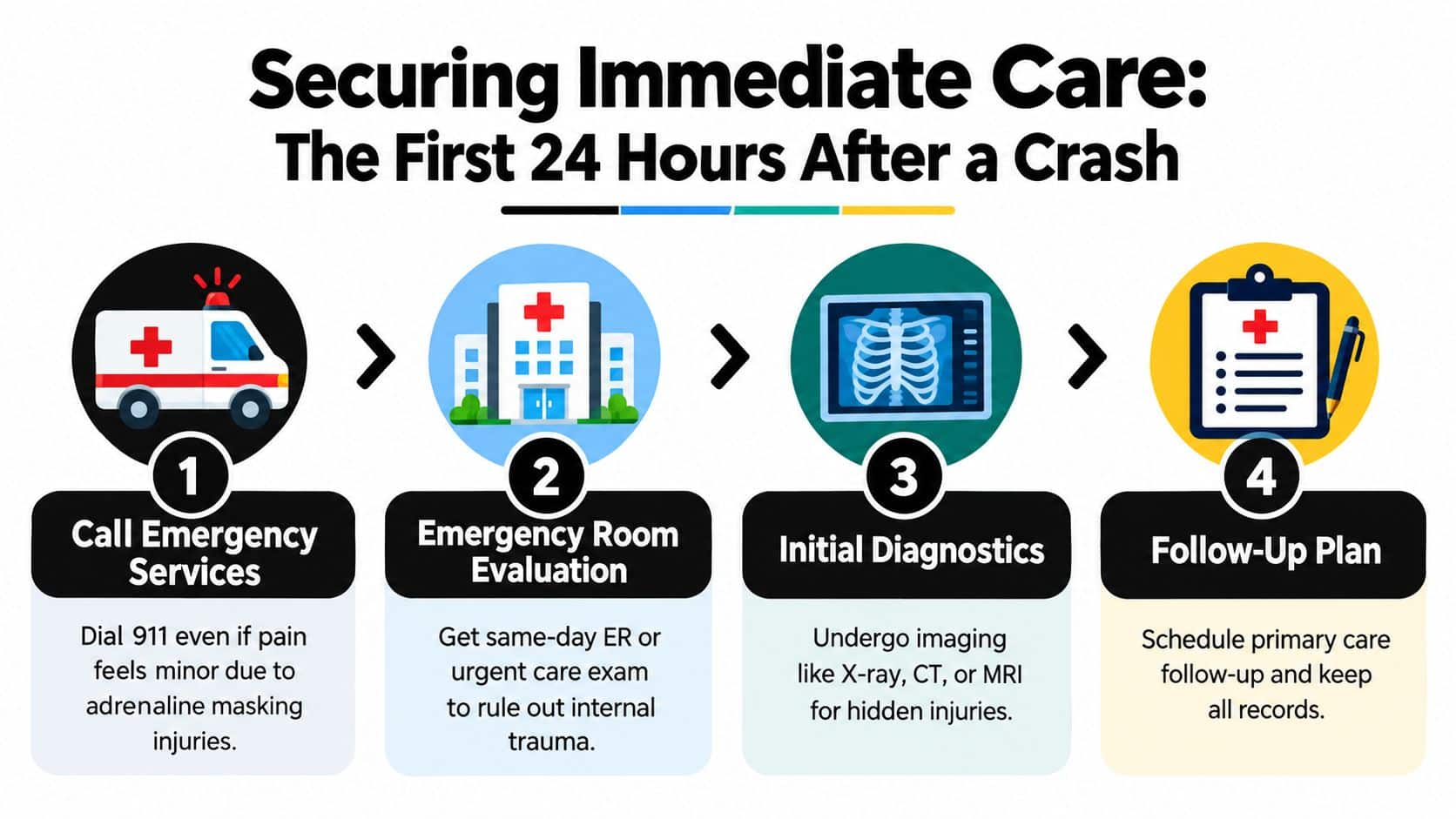
The first hours after a collision are chaotic. Adrenaline can make pain feel distant while you deal with emergency responders, vehicle damage, police, and family notifications. Don't use that temporary feeling of control as a medical test. A person can walk away from a wreck and still have an evolving brain, spinal, chest, or abdominal injury.
Call emergency services when anyone has severe pain, confusion, trouble breathing, significant bleeding, weakness, loss of consciousness, or difficulty moving. Even when symptoms appear minor, same-day medical evaluation creates an opportunity to identify injuries that aren't obvious and establishes a clear starting point for treatment.
What the trauma team checks first
Emergency teams use a standardized ABCDE primary survey. The sequence is airway with cervical spine protection, breathing, circulation and hemorrhage control, disability or neurologic status, and exposure with environmental control. Clinicians correct each immediate threat before moving forward, then repeat the assessment if your condition changes. The methodology is described in this trauma primary survey reference.
That process goes beyond checking for visible cuts or broken bones. The team may protect the neck while assessing the airway, evaluate oxygenation and chest movement, control external bleeding, establish intravenous access, calculate a Glasgow Coma Scale score, and look for signs of shock or neurological decline. Exposure matters because providers need to examine the whole body, while also preventing dangerous heat loss.
You should answer questions directly and report symptoms even if they seem unrelated. Mention headache, dizziness, nausea, memory problems, neck stiffness, abdominal tenderness, tingling, weakness, or pain that spreads into an arm or leg. If you aren't sure what to tell the EMT, this guide about what an EMT does upon arrival at a motor vehicle crash can help you understand why those initial observations matter.
Imaging and discharge instructions
Imaging depends on the mechanism of the collision, physical findings, neurological examination, and clinical judgment. X-rays can help identify fractures, while CT or MRI may be appropriate when clinicians suspect more complex injury. Don't demand a particular scan just to create paperwork, but do ask what injuries were considered, what the examination showed, and why a test was or wasn't recommended.
A normal initial scan doesn't mean your symptoms are imaginary or that follow-up is unnecessary. Soft tissue injuries, concussion symptoms, and some nerve-related conditions may require observation, repeat examination, or outpatient referral. Before leaving, obtain discharge instructions, medication information, warning signs, and a specific follow-up plan.
Practical rule: Never leave an emergency visit without knowing which symptoms require a return visit and who is responsible for your next evaluation.
Recognizing Delayed Symptoms and Hidden Brain Injuries
A person can leave a crash believing they are fine, then develop headache, dizziness, fatigue, concentration problems, or neck stiffness once the immediate shock fades. Treating those symptoms as unrelated to the collision creates a medical risk and gives an insurer an argument it should not receive. Record the onset, report it promptly, and keep follow-up coordinated.

Motor vehicle crashes are a major source of traumatic brain injury. The CDC reported 223,050 nonfatal TBI-related hospitalizations in the United States in 2018, with 23.8% caused by motor vehicle crashes. For people ages 15 to 24, the reported rate was 24.6 per 100,000 population, according to the CDC traumatic brain injury surveillance report.
Red flags require escalation
A mild concussion may cause headache, dizziness, nausea, fatigue, sensitivity to light or sound, slowed thinking, memory trouble, or difficulty concentrating. Report these symptoms, especially when they interfere with work, driving, school, sleep, or ordinary conversation. For more detail on delayed brain injury symptoms, review how symptoms can emerge after the first examination.
Seek urgent evaluation for a worsening headache, repeated vomiting, increasing confusion, unusual agitation, seizure, fainting, new weakness, numbness, slurred speech, vision changes, difficulty staying awake, or reduced ability to walk safely. Do not wait for a therapy appointment while neurological symptoms worsen. Call emergency services if the condition appears unstable.
TBI prognosis is affected by early physiological problems and initial neurological severity. A post-resuscitation Glasgow Coma Scale score below 8 is associated with substantially higher mortality risk, while systolic blood pressure below 90 mmHg is a documented negative predictor in severe TBI outcomes after road traffic crashes. The clinical review in Traumatic Brain Injury explains why providers must correct hypoxia and hypotension quickly and reassess neurological status rather than rely on one examination.
The same warning applies to neck and back complaints. Increasing radiating pain, numbness, weakness, balance problems, abdominal tenderness, tingling, or loss of function requires a new clinical assessment. Use guidance on when to seek care for late pain to recognize symptom progression, then contact a clinician instead of assuming the problem is ordinary soreness.
Rest is not the entire treatment plan
Strict inactivity can prolong stiffness, fear of movement, and loss of conditioning. The NHS advises people with whiplash to continue ordinary activities as tolerated, avoid neck collars unless directed by a clinician, and seek medical review when symptoms do not improve after one week. Its whiplash treatment guidance also identifies physiotherapy, pain care, and psychological support as possible needs in persistent cases.
Recent concussion guidance advises against driving or operating heavy machinery during the first 24 hours and states that strict rest until every symptom disappears is not beneficial. Use symptom-guided activity, with medical supervision when symptoms persist, intensify, or affect balance, vision, cognition, or neurological function.
Do not minimize a delayed complaint because you initially felt fine. Tell the provider when it began, what worsens it, and how it affects work or daily function. That timeline directs the next medical referral and protects an accurate record of recovery when emergency care ends but coordinated follow-up is still needed.
Building Your Specialist Care and Rehabilitation Team
Emergency care answers one question: Are you in immediate danger? It doesn't always answer what happens when headaches continue, the neck won't rotate, the back pain spreads, or sleep and concentration deteriorate. Recovery coordination begins when the first provider identifies unresolved problems and assigns responsibility for the next one.
Start with a written problem list
Create a short list before your primary care or follow-up appointment. Separate symptoms by body system and function:
- Neurological: headaches, dizziness, memory problems, concentration changes, nausea, balance issues.
- Spine and musculoskeletal: neck or back pain, restricted movement, spasms, numbness, tingling, weakness.
- Daily function: missed work, difficulty driving, interrupted sleep, reduced household activity, inability to exercise.
- Emotional and behavioral: fear of driving, nightmares, anxiety, irritability, low mood, or avoidance.
This structure helps the next clinician see the complete injury pattern instead of treating whichever symptom is mentioned first. Ask for referrals based on the problem, not on a generic label. A neurologist may be appropriate for persistent or complicated brain symptoms. An orthopedic or spine specialist may be needed for structural concerns. A physical therapist with experience in cervical, spinal, vestibular, or concussion rehabilitation can translate the diagnosis into safe activity.
Make providers communicate
Fragmented care is a practical risk. Keep a current list of every provider, appointment date, diagnosis, medication, imaging study, and recommendation. At each visit, ask whether the provider has reviewed relevant records and whether the next clinician will receive the imaging report, examination findings, and treatment plan.
Recent adult mild TBI guidance emphasizes social determinants of health, return-to-activity planning, patient and family education, mental health screening, and decisions about specialty referral. Those issues belong in the care plan because transportation, work demands, cost, language access, family responsibilities, and emotional health can determine whether treatment happens. Review the CDC guidance and data resources for adult mild traumatic brain injury with your provider when follow-up feels incomplete.
Treat rehabilitation as active care
Physical therapy isn't merely a final step after medical treatment. It can address restricted motion, strength loss, guarded movement, balance problems, and gradual return to work or driving. If you want background for a conversation with your clinician about therapy for neck and back pain, focus on whether the proposed plan addresses your actual functional limitations.
A referral is only useful if someone tracks whether the appointment occurred, the findings were shared, and the treatment plan changed when symptoms failed to improve.
Call the specialist's office promptly after a referral. Ask about cancellations, required records, insurance authorization, and whether the office can place you on a waiting list. If an appointment is delayed, tell the referring provider instead of waiting without a word. A persistent symptom with no follow-up is a care-coordination problem that needs active escalation.
Documenting Your Medical Journey for Insurance Claims
You leave the emergency department with basic instructions, then symptoms continue while referrals, therapy, and insurance paperwork move through separate offices. That gap can harm recovery and weaken your claim. Insurers examine timing, consistency, treatment compliance, and alternative explanations. Missing symptoms, unexplained gaps, vague descriptions, or conflicting accounts give an adjuster reasons to question the seriousness of your injuries.
Be precise at every visit. Tell the clinician what hurts, where the pain travels, what you could not do after the collision, what improved, and what remains difficult. “I don't feel right” is honest but incomplete. “I develop a headache after screen use, cannot turn my head far enough to check a blind spot, and wake repeatedly because of neck pain” gives the provider information that can guide treatment and support the record.
Build a parallel file
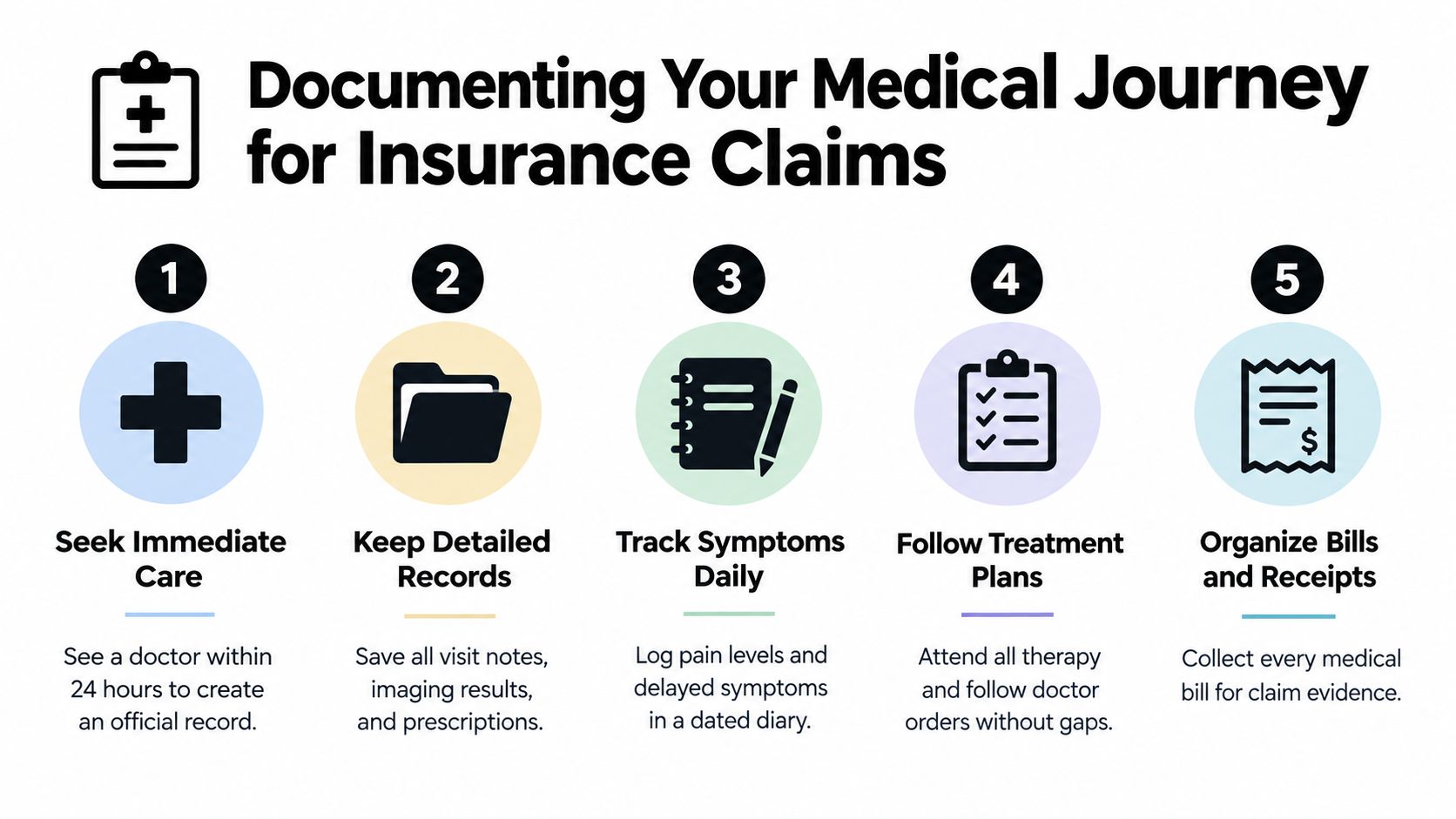
Your providers control the official chart. Keep an organized copy of your records so you can identify missing information, prepare for appointments, and answer questions consistently.
- Create a treatment timeline. Record the collision, first evaluation, later symptoms, referrals, imaging, therapy visits, medication changes, and work restrictions.
- Save clinical documents. Keep discharge papers, imaging reports, prescriptions, specialist notes, therapy plans, and written instructions together.
- Track symptoms by date. Note pain location, intensity in ordinary terms, duration, triggers, sleep disruption, neurological symptoms, and functional limits.
- Record treatment effects. Write whether medication, exercise, an injection, or therapy helped, worsened symptoms, or made no difference.
- Collect financial records. Preserve bills, receipts, mileage information, wage-loss documentation, and coverage correspondence.
This file should preserve facts, not turn every symptom into an argument. A dated history can show why you missed work, why a referral became necessary, or why an early scan did not end treatment. Use this guide to organize medical records and keep the same dates and descriptions across your notes, provider visits, and claim communications.
Document neurological status carefully
For a possible traumatic brain injury, detailed neurological documentation matters to both treatment and the claim. Initial severity and early clinical findings can affect prognosis, so repeated assessments provide a clearer record than one reassuring note. Ask providers to record changes rather than relying only on a diagnosis or scan.
Report trouble reading, concentrating, remembering instructions, tolerating noise, driving, or completing familiar tasks. Ask the clinician to document those functional limits, recommended restrictions, and the reason for any specialist referral. If follow-up is delayed, record the appointment date, the reason for the delay, and the office contacted.
Follow the prescribed plan unless a clinician changes it. If you miss an appointment, write down why and reschedule promptly. Transportation, cost, authorization problems, and limited appointment availability can interrupt care without proving recovery. Preserve evidence of the problem and notify the relevant provider, so a fragmented treatment timeline does not appear to be voluntary abandonment of care.
Coordinating Treatment with Legal Representation
Medical recovery and an injury claim often fail for the same reason, nobody owns the whole timeline. The emergency department treats the immediate problem. The primary care office manages referrals. The therapist records functional limitations. The insurer processes bills. Without coordination, important information can sit in separate systems while your symptoms continue.
A personal injury attorney can help connect those pieces. The attorney doesn't replace your doctors and shouldn't direct medical decisions. The role is to protect the claim while making it easier for you to obtain consistent care, understand billing pressure, and preserve evidence.
What coordinated legal support looks like
A responsive legal team can help identify missing records, request billing documents, track treatment dates, and communicate with insurers about the claim. It can also help address medical liens or payment arrangements when bills arrive before liability and coverage issues are resolved. The exact options depend on the facts, insurance policies, providers, and applicable law.
Financial stress can push people into bad decisions. You may feel pressured to stop care because bills are accumulating, use a settlement offer to pay an unresolved balance, or accept an early release before doctors understand whether symptoms will persist. Your lawyer should explain the consequences of those choices before you sign anything.
Don't settle before the medical picture is clear
An adjuster may ask for a recorded statement, request broad medical authorizations, or present a quick settlement while treatment is ongoing. Be careful. A settlement typically resolves the claim, and the amount may not account for future therapy, specialist care, lost income, or lasting limitations if the medical record is still developing.
Your attorney can assess liability evidence, crash reports, witness information, insurance coverage, medical causation, and the effect of the injury on your life. That assessment should remain grounded in provider opinions and documented functional losses, not assumptions about how quickly someone “should” recover.
Keep medical decisions with medical professionals
Legal coordination works best when the boundaries are clear. Tell clinicians the truth, follow their instructions, and ask questions about tests and treatment. Tell your attorney about changes in symptoms, missed work, bills, referrals, and insurer communications. Neither side can protect you from information it never receives.
A coordinated approach may include:
- Record collection: obtaining emergency, primary care, specialist, imaging, therapy, pharmacy, and billing records.
- Care tracking: maintaining a current treatment chronology and identifying stalled referrals.
- Coverage review: examining available auto, health, and liability coverage with qualified legal guidance.
- Communication control: directing insurer questions through counsel when appropriate and avoiding casual statements that mischaracterize recovery.
- Future planning: asking treating professionals what care may be needed if symptoms continue.
Nares Law Group LLC handles motor vehicle injury matters and describes coordinating medical providers while tracking treatment records and bills as part of the case process. If you retain counsel, ask exactly who will manage records, communicate with providers, monitor bills, and update you about settlement decisions.
Decision point: If an insurer wants a release before your treating team can explain your prognosis, pause and obtain legal advice.
The objective isn't to create conflict with the healthcare system. It's to keep treatment accessible, records accurate, and financial decisions aligned with the full injury picture.
Monitoring Long-Term Recovery and Future Care Needs
Finishing physical therapy doesn't automatically mean your crash-related care has ended. It may mean you've reached a treatment milestone, regained enough function for discharge, or moved into a home program. Those are different from knowing that no future care will be necessary.
The World Health Organization reports about 1.16 million deaths each year from road traffic crashes and 20 to 50 million non-fatal injuries, many causing disability. For patients and families, that scale explains why recovery can extend beyond emergency treatment and why some people need longer rehabilitation pathways. Review the WHO fact sheet on road traffic injuries for the global treatment context.
Define recovery by function
Pain intensity matters, but it isn't the only measure. Compare your current ability with your pre-crash baseline:
- Can you work your ordinary schedule without worsening symptoms?
- Can you drive, turn your head, use stairs, lift, sleep, and exercise safely?
- Do headaches, dizziness, memory problems, or fatigue still limit concentration?
- Do you avoid activities because of pain, fear, or loss of confidence?
- Do you need continuing medication, therapy, specialist review, or workplace adjustments?
Ask your providers to document both improvement and remaining limitations. A person may report less pain while still being unable to perform essential job duties or household responsibilities. That distinction can affect medical planning and the evaluation of legal damages.
Plan for possible future care
Before closing an injury claim, ask the treating team whether the condition is resolved, stable, or still under observation. Find out whether a home exercise program is sufficient, whether periodic follow-up is recommended, and what symptoms should trigger re-evaluation. For complex injuries, future needs may include additional therapy, medication management, specialist care, or surgery. Don't assume any of those needs exist, but don't ignore them because an early settlement makes the question inconvenient.
Your attorney should understand the medical basis for future-care concerns. That may require records, treatment recommendations, a prognosis, or a structured estimate from an appropriate professional. The final legal strategy should account for continuing expenses, lost earning capacity, and quality-of-life effects where the evidence supports them.
Know when to reopen the medical conversation
New or worsening symptoms deserve attention even after a period of improvement. Contact a clinician when headaches return, weakness develops, pain begins radiating, balance changes, sleep deteriorates, or ordinary activities become harder. Explain the original crash, the prior treatment, the period of improvement, and the new change so the provider can evaluate the complete timeline.
A legal claim and a medical plan should not be closed just because the emergency phase is over. Review your records, confirm that outstanding bills and referrals are addressed, and speak with counsel before signing a final release. That discipline protects your health and prevents an avoidable gap between what you need and what the claim recognizes.
Nares Law Group LLC helps motor vehicle accident victims coordinate medical treatment, organize records and bills, and pursue claims involving crashes, traumatic brain injuries, and lasting harm. Visit Nares Law Group LLC to learn about available guidance and request a consultation about protecting your recovery and legal rights.